Showing posts with label Harry Potter. Show all posts

06 February 2017

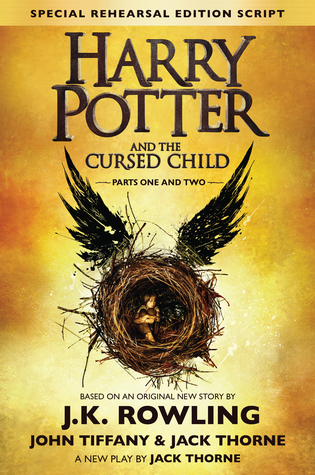
Harry Potter and the Cursed Child by J.K. Rowling, John Tiffany and Jack Thorne, 2016

Click to view
on Goodreads 
The Eighth Story. Nineteen Years Later.
Based on an original new story by J.K. Rowling, Jack Thorne and John Tiffany, a new play by Jack Thorne, Harry Potter and the Cursed Child is the eighth story in the Harry Potter series and the first official Harry Potter story to be presented on stage. The play will receive its world premiere in London’s West End on July 30, 2016.
It was always difficult being Harry Potter and it isn’t much easier now that he is an overworked employee of the Ministry of Magic, a husband and father of three school-age children.
While Harry grapples with a past that refuses to stay where it belongs, his youngest son Albus must struggle with the weight of a family legacy he never wanted. As past and present fuse ominously, both father and son learn the uncomfortable truth: sometimes, darkness comes from unexpected places.
(328 pages)


I was going to be so cool about this book.

I wasn't going to plunk down twenty dollars to buy it on release day.

I was completely prepared to wait three months for the library's single copy of the play to make its way down the list to me.

But then we went to Barnes & Noble, and I made the mistake of picking up the pretty gold-toned book and reading the first few pages. And my mom, a closet Potterhead herself, did what any amazing mother would do: she ran back into the store at the last possible minute, came back out with The Cursed Child, and then immediately handed it over to me.

Like I said. Amazing.

I wish that word could be applied to the play itself, though. I tried, I really tried, but I simply couldn't find the magic in The Cursed Child; it just wasn't there. The entire thing reads like clever fanfiction - it's not it's own story, not really. It's just a piece of sentimental junk designed to spend as much time as possible making clunky throwbacks to the original series. I lost all respect for the play right around the time Harry started having a big emotional conversation with Dumbledore's painting–about stuff that had happened about twenty years ago at this point. And don't even get me started on the relationships. Harry and Albus' strained one is absolutely cringe-worthy, and the whole "resolving issues between Harry and Draco" rang really false after the twenty years (!!) they'd spent not getting along (despite the fact that I'd gotten the impression they had reached a sort of respectful but still-not-amiable understanding at the end of the original series).

Basically, it's really, really obvious that JK Rowling didn't write this herself. And it may be considered official canon now, up there with the original books, but I am never going to be able to see this as a legitimate installment into the Harry Potter franchise. One possible interpretation of the future? Yes. A piece of rather strange fan-fiction? Yes. But not canon, never canon. Please. I can't stand to think of the characters being officially reduced to such clumsy caricatures of themselves.

Also, can we talk about the nonexistance of Lily and Rose? I spent literally years of my childhood playing Rose to one of my best friend's Lily. We created a whole elaborate future around those two characters, spinning our tale from one year to the next–until I had to move away sometime in the middle of the Triwizard Tournament. We declared I'd gone off to boarding school in Beauxbatons with my cousin Victoire (Bill and Fleur's daughter), and kept the story going over the phone and email for a few more years.

I know, it was so much fun. But anyway, my point is that I was really sad to see those two characters relegated to such small roles. Albus had siblings. Where were they when things got hard for him? And Rose, the only one of the Potter-Weasley cousins I can remember having any lines besides Albus, only talks like twice in the entire play (and is only mentioned a few other times because Scorpius has a crush on her). I mean, seriously. Why are they relegated to such a small spot in the tale? I'm not usually one of those feminists who reads too far into everything, but this time I'm a little upset that all of the main characters but one are male–and the only female character is a new one, whose backstory is so laughable I thought for sure it was going to turn out as a red herring in the end. My beloved version of Rose, with whip-sharp brains and a kind heart (pulled straight from her mother, of course), simply doesn't exist in the narrative of The Cursed Child. Instead we get a girl whose sole role in the play is to make a few random remarks and act as a romantic object for one of the male characters. As for Lily, well, she might as well not even exist. I doubt either Hermione or Ginny–both strong, kick-butt witches in their own rights–would be very happy with their daughters being delegated to the sidelines like this.
10 March 2015

My Top Eight Recommendations For People Who Like Harry Potter

This week's Top Ten Tuesday is rather open-ended. The prompt is literally "Ten Books For Readers Who Like _________." It doesn't get much more easy-going than that! I'm filling in Harry Potter because that's basically a catch-all for books with magic, adventure, and character-driven plots. However, in an effort to limit my reccomendations to books that are actually similar to the Harry Potter books in some aspect or another, I'm only listing eight instead of the usual ten.

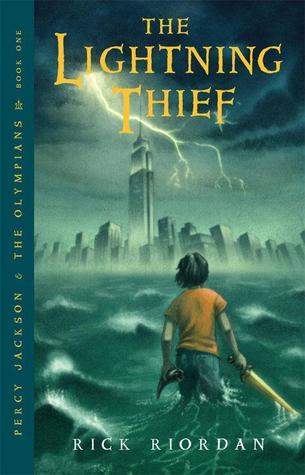
In the description for each individual series I will explain how exactly it is related to the Harry Potter books. I'm also putting the synopsis and cover of the first book in the description, so you can get a sense for the series' flavor.

1. Percy Jackson and the Olympians by Rick Riordan
Synopsis of The Lightning Thief:
Percy Jackson is a good kid, but he can't seem to focus on his schoolwork or control his temper. And lately, being away at boarding school is only getting worse-Percy could have sworn his pre-algebra teacher turned into a monster and tried to kill him. When Percy's mom finds out, she knows it's time that he knew the truth about where he came from, and that he go to the one place he'll be safe. She sends Percy to Camp Half Blood, a summer camp for demigods (on Long Island), where he learns that the father he never knew is Poseidon, God of the Sea. Soon a mystery unfolds and together with his friends -- one a satyr and the other the demigod daughter of Athena -- Percy sets out on a quest across the United States to reach the gates of the Underworld (located in a recording studio in Hollywood) and prevent a catastrophic war between the gods.

I know, I know. You've already heard of these, touted as the "next Harry Potters." Well you know what? They are not the next Harry Potters. Nothing, ever, can replace Harry's position in the book world and in our hearts. However, the books are still good in their own right, apart from Harry's shadow. If you love Harry Potter for its magic, adventure, world-building and humor, then this is the series for you. Be warned, though, it's geared for a younger audience than the later Potter books are. You may not find it as funny as all the tweens do.

2. Septimus Heap by Angie Sage
Synopsis of Magyk:
The seventh son of the seventh son, aptly named Septimus Heap, is stolen the night he is born by a midwife who pronounces him dead. That same night, the baby's father, Silas Heap, comes across a bundle in the snow containing a new born girl with violet eyes. The Heaps take this helpless newborn into their home, name her Jenna, and raise her as their own. But who is this mysterious baby girl, and what really happened to their beloved son Septimus?
The first book in this enthralling new series by Angie Sage leads readers on a fantastic journey filled with quirky characters and magykal charms, potions, and spells. Magyk is an original story of lost and rediscovered identities, rich with humor and heart.


This is one of my personal favorites as a Harry Potter substitute. Why, you ask? Because it wasn't geared to fill the demand raised by the Harry Potter books! It is set in a completely different universe from ours (or a thousand years in the future - same difference, right?), in a world with royalty and occupational wizards. I can't praise this humorous, exciting and heart-warming series enough, and I highly reccomend it to anyone who loved the relationships in the Harry Potter books - and maybe secretly wished there was a whole series written just about the Weasleys.

3. Knightley Academy by Violet Haberdasher
Synopsis of Knightley Academy:
Henry Grim is a servant boy at the Midsummer School—until he passes the elite Knightley Academy exam and suddenly finds himself one of the first commoners at the Academy, studying alongside the cleverest and bravest—and most arrogant—young aristocrats in the country. They thwart Henry’s efforts to become a full-fledged Knight of the Realm, but he and two commoner classmates are determined to succeed. In the process, the boys uncover a conspiracy that violates the Hundred Years’ Peace treaty—and could lead to war! Can Henry manage to save his school and country from their enemies—and continue to study at the Academy?

This is a two-book series that has basically fallen to the way-side. I have my serious doubts whether the author will ever finish the series, but if she did I'd be first in line to buy the third book! This is a work of love toward the Harry Potter books, full of sly references to the Potter universe even as it tells its own absorbing tale of the penniless orphan Henry who gains admittance into the posh private boarding school Knightley Academy. There's no magic but lots of fun in this awesome series that I always recommend to people who are interested in reading the Harry Potter books, but don't like the magic in the originals.

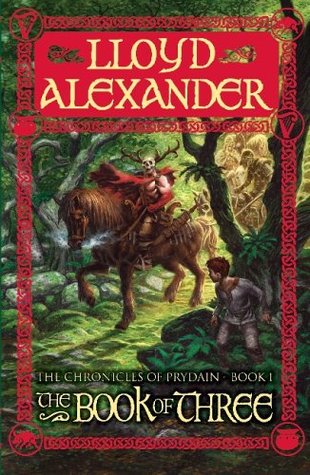
4. The Prydain Chronicles Alexander Lloyd
Synopsis of The Book of Three:
Taran wanted to be a hero, and looking after a pig wasn't exactly heroic, even though Hen Wen was an oracular pig. But the day that Hen Wen vanished, Taran was led into an enchanting and perilous world. With his band of followers, he confronted the Horned King and his terrible Cauldron-Born. These were the forces of evil, and only Hen Wen knew the secret of keeping the kingdom of Prydain safe from them. But who would find her first?

These are classics, so I'm not going to say too much about them. Let's just say that they're full of enough humor, friendship, and love that fans of these aspects in Harry Potter are going to love these books.
Bonus: if you like the Lord of the Rings books, you'll probably like these. The authors were friends in real life, and there are a lot of similarities between the two series.

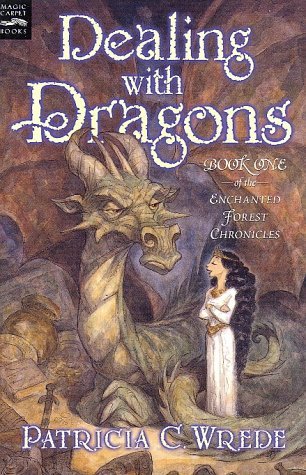
5. The Enchanted Forest Chronicles by Patricia C. Wrede
Synopsis of Dealing With Dragons:
Cimorene is everything a princess is not supposed to be: headstrong, tomboyish, smart - and bored. So bored that she runs away to live with a dragon - and finds the family and excitement she's been looking for.

These are some really fun books that play on a lot of fairy tale tropes. They're similar to Harry Potter in that they take traditional rules of magic and stand them on their head. Also, they're really funny but still heartwarming at the same time. I read them for the first time as little girl, probably before I even read Harry Potter, and loved them so much. Then, being a little girl, I completely forgot the title and couldn't find them again for like five years. When I re-read the books for the first time two years ago, I still loved them just as much as I did as a little girl. They've got that same ageless appeal that the Potter books do.

6. The Dragon Slippers trilogy by Jessica Day George
Synopsis of Dragon Slippers:
Many stories tell of damsels in distress, who are rescued from the clutches of fire-breathing dragons by knights in shining armor, and swept off to live happily ever after.
Unfortunately, this is not one of those stories.
True, when Creel's aunt suggests sacrificing her to the local dragon, it is with the hope that the knight will marry Creel and that everyone (aunt and family included) will benefit handsomely. Yet it's Creel who talks her way out of the dragon's clutches. And it's Creel who walks for days on end to seek her fortune in the king's city with only a bit of embroidery thread and a strange pair of slippers in her possession.
But even Creel could not have guessed the outcome of this tale. For in a country on the verge of war, Creel unknowingly possesses not just any pair of shoes, but a tool that could be used to save her kingdom… or destroy it.


So, these are on my list of all-time favorite books. On the surface they don't seem to have much in common with Harry Potter besides the presence of dragons - and where Harry Potter's dragons are basically just really scary wild beasts that breathe fire, these dragons are thinking, speaking creatures who actually make friends with the main character Creel. But this is a great trilogy full of humor and heart where the basic glue that holds everything together is friendship. Friendship and love - sound familiar?

7. Story Thieves by James Riley
Synopsis of Story Thieves:
Life is boring when you live in the real world, instead of starring in your own book series. Owen knows that better than anyone, what with the real world’s homework and chores.
But everything changes the day Owen sees the impossible happen—his classmate Bethany climb out of a book in the library. It turns out Bethany’s half-fictional and has been searching every book she can find for her missing father, a fictional character.
Bethany can’t let anyone else learn her secret, so Owen makes her a deal: All she has to do is take him into a book in Owen’s favorite Kiel Gnomenfoot series, and he’ll never say a word. Besides, visiting the book might help Bethany find her father…

…Or it might just destroy the Kiel Gnomenfoot series, reveal Bethany’s secret to the entire world, and force Owen to live out Kiel Gnomenfoot’s final (very final) adventure.

So this is a very new series, with only one book out. My review will be posted on Friday, but here's the short version: I basically decided the jury's still out until the later books come out and I see how the series progresses. However, the reason I would reccomend this just-started series to fans of Harry Potter is that it incorporates quite a bit of the plot of the high-fantasy series Kiel Gnomenfoot. Kiel himself is actually sucked into the "real world" (their world), and we learn most of the story of the seven-series fake story. While the basic facts aren't really that similar, a lot of the themes of the Kiel books are so similar to the Harry Potter books that it's just all-around awesome to read about them.

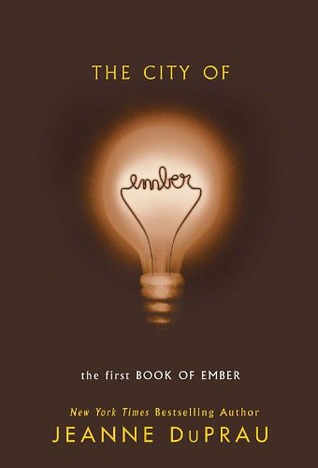
8. The Ember books by Jeanne DuPrau
Synopsis of The City of Ember:
Many hundreds of years ago, the city of Ember was created by the Builders to contain everything needed for human survival. It worked…but now the storerooms are almost out of food, crops are blighted, corruption is spreading through the city and worst of all—the lights are failing. Soon Ember could be engulfed by darkness….
But when two children, Lina and Doon, discover fragments of an ancient parchment, they begin to wonder if there could be a way out of Ember. Can they decipher the words from long ago and find a new future for everyone? Will the people of Ember listen to them?


These are for a younger age group, but I love them a lot. I think they're a great read for people who love Harry Potter for the way it changed the way they look at the world. In Harry Potter it's Mr. Weasley who best shows the shift in outlook the books provide: as a wizard, he sees the Muggle world from an entirely different light. And those of us who read the books also begin to see our world in a different light, at least while we're hanging out in the wizarding world. How on Earth can those poor Muggles cope with wearing tight clothing that actually goes between their legs?! In the same way, the books of Ember give us a different perspective on today's world. Because the people of Ember have never been above ground they are completely ignorant about so many things that we just take for granted. So one series looks at our world from the point of view of an outside culture, and the other looks at it by looking at the ruins we left behind.

Okay, there we go. Have you read any of these, and do you agree with my reccomendation? Are there any books you would add to my list?

16 December 2013

Knightley Academy by Violet Haberdasher, 2011

Synopsis (from Amazon):
Henry Grim is a servant boy at the Midsummer School until he passes the elite Knightley Academy exam, a test that every Midsummer boy has mysteriously failed the past five years. Henry suddenly finds himself one of the first commoners studying at the Academy, alongside the cleverest and bravest--and most arrogant--young aristocrats in the country. But someone isn't too happy about Henry, and two other commoners, who have been let into the prestigious school. And that someone is out to sabtoge the three from becoming full-fledged Knights of the Realm--the goal of every student at the Academy. As Henry and the two other boys try to ward off their classmates' attempts to thwart their paths, they soon uncover a conspiracy that violates the Hundred Years' Peace treaty--and could lead to war! Can Henry manage to save his school and country from their enemies--and continue to study at the Academy?

Delving into this book for the first time years ago, I had no idea what I was reading - a boarding school was involved, I knew that. A smart commoner who rubs shoulders with the elite. Danger, excitement, and intrigue. And really, I was hooked before I even knew anything else.

Henry is an orphaned servant at the posh Midsummer Academy. On the outside he is indistinguishable from any other servant, with a rough childhood and no foreseeable prospects. Dishes and dirty chalkboards are the only things in his future – or so it seems. You see, a professor at the academy, Professor Stratford, has been teaching Henry things far above his class. Henry can speak at least five languages, knows how to do math, and science, and all those other fancy rich-people subjects. But it’s not until he gets a chance, that these skills will ever do him any good. You see, the most elite school of all is Knightley Academy, a school that draws the best students from each of the best schools. Henry takes the entrance exam through a loop-hole (they never said entrants had to attend the school, just that they had to live there!), and lo and behold, he gets accepted! In fact, they even let in two more students from a pool of commoners, just because of him. And so the adventures begin. 

Knightley Academy follows Henry and his fellow misfit friends Adam and Rohan as they navigate their classes in fencing, etiquette, and medicine and train to be knights. Oh, I forgot to tell you, didn’t I? Yeah, it’s a school to train to be knights. But knights don’t actually fight, or kill, or go to war. A treaty was signed decades ago between the three countries of Britain (each independent), promising they would never train for battle or go to war against each other. Instead, Knightley Academy trains students to be knight protectors, knight police, knight medics, etc. All is right and peachy, until Henry, Adam, and Rohan realize that someone is out to get them expelled. And then Henry discovers something that shows their peaceable neighboring country (which happens to be communistic) might not be as peaceful as they thought, and things take a spiral toward excitement.

Before I get any farther, I have to talk about the fact that this book is a sort of tribute to Harry Potter, a parody, as it were. Except maybe I shouldn’t use the “p” word in connection with this book, because then people might not read it. Before you either quietly slip away rolling your eyes in distaste, or you run out and buy a copy just because I said the magic words (no pun intended!), no, this is not a laughably bad parody about a kid with parent in a coma who didn’t know he had the ability to tap dance while standing on his head. And it’s not a commentary about the good/bad things in the Harry Potter books. Pure and simple, it’s a work of love by an author who enjoyed Harry Potter so much she took the basic outline, twisted it, and then put it back together a bit skewed. There is no magic, Henry’s far from being a famous celebrity (try infamous, by dint of being the poorest), and his sporting abilities are pretty appalling.

It’s a lot of fun to catch all the parallels to Harry Potter in this book, but even if I’d never read Harry Potter in my life I’m convinced I still would have heartily enjoyed Knightley Academy and its sequel (still waiting for the third book, Ms. Haberdasher!).

Anyway, back on topic. I get the feeling my first book review might wind up a little long. Bear with me here.

The characterization in this book is not the best I’ve ever seen, and sometimes I felt like Henry was just a little too perfect. You know, good grades, speaks about five languages, always ahead on homework (speaking of Harry Potter, I’d actually put him closer to Hermione – without the know-it-all-ness), and still humble, kind, and a great friend. Really, I just want to wrap him up and make him my best friend/homework helper. You’d think that you would come to not like Henry, but I think because of all the odds stacked against him (and his great sense of humor) you really just commiserate with him and cheer when he gets any form of acceptance or praise from the snobby students around him (who aren’t really all that bad – most of them, anyway).

As for setting, well, the book is set somewhere around the Industrial Revolution. I think. Sorry, I’m taking so much AP European History right now, it’s all slushed around in my head. But they have primitive automobiles, and watches (signs of the Industrial Revolution), but it’s set in an alternative Britain where each of the three countries (Ireland, Scotland, and England) have completely different names and histories, and each is independent.

I have to say that I fell in love with Knightley Academy from the first description of its rambling grounds and mismatched buildings. Whether it’s overused or not, there’s something about a rather eccentric boarding school (and the rather eccentric new headmaster who let Henry attend) that just makes me curl my toes, snuggle up in my blankets, and wish for some hot chocolate to sip while I read. Not that I ever have any, however, because making the hot chocolate would entail getting out of bed.
So do I recommend this book? Yes. In fact, both Knightley Academy and its sequel, The Secret Prince, made it onto my Christmas wish list this year. It’s the perfect book for people who don’t want to/aren’t allowed to read Harry Potter, but who don’t want to miss out on all the good parts. It’s also a book for people who have read Harry Potter, because if you like Harry Potter, odds are you’ll love this book . . . well, not just as much, because really. That’s just not possible. But maybe, I don’t know. Three-fourths as much as Harry Potter.

Which really, in my book, is pretty much true love.