Showing posts with label Puffin Books. Show all posts

15 July 2016

The Total Tragedy of a Girl Named Hamlet by Erin Dionne, 2010

Click to view
on Goodreads 
Hamlet Kennedy just wants to be your average, happy, vanilla eighth grader. But with Shakespearean scholar parents who dress in Elizabethan regalia and generally go about in public as if it were the sixteenth century, that’s not terribly easy. It gets worse when they decide that Hamlet’s genius seven year-old sister will attend middle school with her— and even worse when the Shakespeare project is announced and her sister is named the new math tutor. By the time an in-class recitation reveals that our heroine is an extraordinary Shakespearean actress, Hamlet can no longer hide from the fact that she—like her family—is anything but average. In a novel every bit as funny as her debut, Erin Dionne has created another eighth grader whose situation is utterly unique—but whose foibles and farces will resound with every girl currently suffering through middle school.
(304 pages)

I've loved this book for years, since I myself was actually Hamlet's age. I always thought it was so amazingly funny, so clever and sweet and perfect.

Now that I'm older (and have actually read Hamlet), I find it a lot less amazing.

For one thing, a lot of the Shakespeare quotes seem to be taken entirely out of context. Her literary parents of all people should know better than to take random quotes from the plays and use them in everyday life; if they've read the plays, they know that the popular quotes people use from the plays aren't always used in ways that make any sense if you know the scenes they're pulled from. Another problem I have also connected to believability (not even bringing her genius little sister into the conversation) is this idea that Hamlet's family can really revolve so entirely around Shakespeare, and yet she's still kind of shaky on some of the plays. Also, there's no such thing as being a "natural Shakespearean actress." The book treats it like Hamlet was born with this magical ability, but I'd say her ability to read Shakespearean rhyme in rhythm probably has a lot more to do with her parents reading the plays to her when she was little and constantly speaking like they live during the Elizabethan era than it does with her own special little genius.

Anyway, I don't mean to be so negative. This is still a very cute book, the sort of novel that you read when you're twelve and think is just perfect. I shouldn't knock it too much now that I'm out of the target audience, because I truly did adore it once upon a time. I even recommend it to you, if you like a good MG school-drama and are willing to step into the ever-imaginative brain of a twelve-year-old girl.

01 February 2016

The Root Cellar by Janet Lunn, 1996

Click to view
on Goodreads 
It looked like an ordinary root cellar. And if twelve-year-old Rose hadn't been so unhappy in her new home, where she'd been sent to live with unknown relatives, she probably would never have fled down the stairs to the root cellar in the first place. And if she hadn't, she never would have climbed up into another century, the world of the 1860s, and the chaos of Civil War.
(256 pages)

I feel like I would have liked this one a lot better if I'd read it for the first time when I was younger.

It's not so much that it's geared for younger kids (in fact, it's kind of too gruesome for little children), but that the plot feels sort of . . . wobbly. On one hand it's a really cool concept, and it imparts a lot of history without being too painful, but on the other it relies on unrealistic characters and events to carry it on its way.

Rose is the worst offender when it comes to being an unrealistic character. She is, to put it in a single word, unpredictable. And not in the cool, the-author-did-this-on-purpose sort of way. No, she just up and completely changes halfway through the book for no reason other than "she went back in time, so she suddenly went from being an inhibited, emotionally-constrained doll-like girl to a headstrong, determined firecracker with a strong mind of her own." It's not that I dislike either side of her character, but I just don't like the way she so radically changes with no real impetus.

The other main thing I found confusing about the book was that it was set in Canada . . . but was about the American Civil War. And by the end, when I'd figured everything out, it was a really cool angle - I'd never known that Canadians came to fight in the war! - but it took me way too long to figure out the basic facts: that Rose is American, and that she's living with her relatives in Canada near the American-Canadian border. For a while, I honestly thought that Rose was Canadian and her relatives were the Americans. I think part of that confusion comes from the fact that Lunn grew up in America, but moved to Canada at eighteen and lived the rest of her life there: there's no real sense of an American identity for Rose to contrast against that of her relatives from Canada, because the author was a member of both countries and didn't herself differentiate between the two. That must be it, because that's the only reason I can think of for the rather muddled distinction between the two nationalities.

I did enjoy the book, though - it was a good feel-good read (except for the gruesome battle descriptions, of course). I can't see myself going out of my way to recommend it in the future, but I'm sure there are some readers out there who would be perfect for this odd little time-travel novel. When I meet one I will happily hand over my copy of the book, and probably forget entirely about it the next day.

14 August 2015

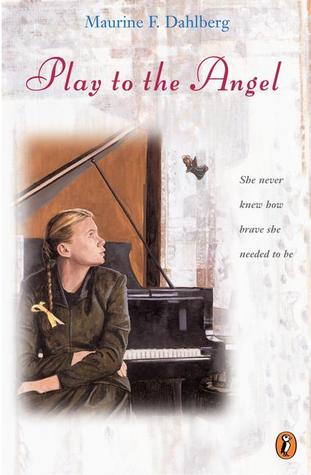
Play to the Angel by Maurine F. Dahlberg, 2000

Click to view
on Goodreads 
Austria in 1938 is under the shadow of the Nazis, but twelve-year-old Greta doesn't notice-she cares only for her piano lessons with their new neighbor, a teacher with a mysterious past. Herr Hummel believes in Greta, and she begins to prepare for a recital. Then the Nazis invade, and Greta discovers her teacher's secret. His life is in danger, and she may be the only one who can help him.
(192 pages)

This is a beautiful book that I'd read a long time ago, but almost completely forgotten. Seeing it in a bin at a book swap, I snatched it and brought it home so I could re-read it (and also, figure out which book it was - I had it muddled up with another WWII book that I still haven't been able to track down).

It really is a great story, and even though I can never entirely relate to piano-prodigy main characters (because who'm I kidding? I am so not a piano prodigy - I quit as soon as my parents let me!), I still love reading about people like Greta who are so dedicated to their art. I also like looking at the Holocaust from different angles, and the Viennese view of events has always particularly fascinated me. I can't imagine how terrible it must have been to be one minute a safe, independent country and the next minute - to not be.

I also have a penchant for characters with Hemophilia. I know that Kurt isn't actually in the book itself (he died before the book began), but his shadow hangs over the entire story, and I appreciated getting a look at the aftermath of the tragic disease. Kurt isn't just defined by his hemophilia, though, and I thought he was pretty well-fleshed out for not even being in the book at all. Greta is very obviously heartbroken about his death, and struggles with the conflict between trying to get out from under his legacy and forge her own name, and not wanting to give him up entirely.

I can't say I'm a big fan of Greta's mother, though. Actually, I really didn't like her. I don't care if she was so broken up about Kurt's death; she shouldn't have written Greta off like that! She's so wrapped up in mourning him, and trying to get herself together enough to move past his death, that she's completely blind to all that she's missing with her daughter. I know things were hard for her, but still. Also, she thought Hitler was a good guy for most of the book! I know she didn't really understand the horrors of what he was doing, but still. Not a big draw for me.

I did love Herr Kimmel, though, and I liked how his backstory tied Greta's piano-playing together with the events that were unfolding at the beginning of WWII. I really liked the ending, when everything came together, and I closed the book with a nice satisfied feeling.

I highly recommend Play to the Angel to anyone who thinks it looks interesting, and will definitely keep it in mind going forward, as a go-to WWII book for anyone who wants a good WWII book (including younger kids not yet ready for the more gruesome books about concentration camps, Nazi cruelty, etc).