11 May 2015

Faith, Hope, and Ivy June by Phyllis Reynolds Naylor, 2009

Note: This will be my last new review until May 22nd (next Friday). I thought I could make it through AP season without neglecting my blog, but I just don't have the time or energy to write reviews. As soon as this one goes live, am completely out of fresh content. I can post over some old reviews from Goodreads if you want me to - I'm not so short on time I can't copy and paste! - but I'm not sure if that isn't cheating. If you want me to do that, post in the comments and I'll pick out my best reviews to transfer over.
Click to view
on Goodreads
Ivy June Mosely and Catherine Combs, two girls from different parts of Kentucky, are participating in the first seventh-grade student exchange program between their schools. The girls will stay at each other’s homes, attend school together, and record their experience in their journals. Catherine and her family have a beautiful home with plenty of space. Since Ivy June’s house is crowded, she lives with her grandparents. Her Pappaw works in the coal mines supporting four generations of kinfolk. Ivy June can’t wait until he leaves that mine forever and retires. As the girls get closer, they discover they’re more alike than different, especially when they face the terror of not knowing what’s happening to those they love most.

Hmm. I'm wondering if part of my apathy toward the book comes from reading it at the wrong time or something. It has all the pieces that I normally love in a story, but this time around it just felt a little tired. Then again, I'm tired, so who knows whether the book is to fault?

The characterization is pretty well done. Ivy June and Catherine are very typical twelve-year-olds, and they are painted with the right mixture of faults and merits to be neither saccarine angels or cliche cheeky devils. The characterization (now that I think about it a little more) might err slightly on the side of the generic, but it serves its purpose and is done very well.

The depiction of city life seemed really straight-on to me, warts and all. The attitude the "city folk" have toward their destitute neighbors is a very realistic cocktail of curiosity, snobbishness, pity, and (in some people) spite. I enjoyed watching Ivy June interact with the city for the first time, seeing my culture through the eyes of a newbie.

As for Ivy June's culture . . . I don't know. I was definitely stressing right alongside her when things got scary in the second half of the book, but when it comes to the town as a whole I had a hard time connecting. Do people really live like that, in America, in the 21st century? Are outhouses really still a thing out in rural areas? I have a hard time suspending my inside realist and accepting the fact that Ivy June lives such a ninteenth-century life. I couuld be completely wrong, though - I don't really know much about rural Kentuky. If anyone knows, I would love to learn whether this aspect of the story was realistic or not.

At the end of the day, I liked Faith, Hope, and Ivy June, but I wasn't swept away. I almost wanted more. The similarities and contrasts between Ivy June and Catherine was interesting, especially once things started going wrong in the second half of the book, but when I put the book down I felt almost apathetic toward it. Somehow I didn't really connect at all with the characters - I felt like I'd seen everything before. Perhaps you might be able to get more out of it than I did; I think it is a good book, it just didn't really do for me.
08 May 2015

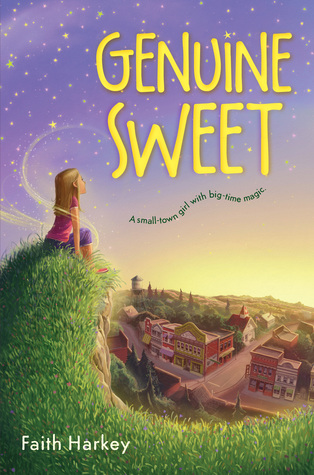
Genuine Sweet by Faith Harkey, 2015

Click to view
on Goodreads 
Twelve-year-old Genuine Sweet, of tiny Sass, Georgia, can grant any wish . . . except her own. It's a peculiar predicament, considering how much she could use a few wishes. New friends help Genuine give her family a boost--and then she takes her gift global! Life finally seems to be on the mend. But when she's faced with unexpected trouble that no amount of wishing can fix, Genuine must puzzle out the difference between wishing for a better life and building one.
Told in the engaging, irresistible voice of Genuine Sweet herself, Faith Harkey's debut novel spins a remarkable tale of a small-town girl with big-time magic and an even bigger heart.

(288 pages)

I needed this book. Neck-deep in studying for my AP exams, my brain was fried and my patience thin. I had the sinking sensation that only comes when my stock of reviews has bled dry and I've got a week of reviews in my backlog before I'm plumb out of content. I had a couple of books on my review pile, but none that really caught my eye and made me pour out a heartfelt review for. The TBR pile at the foot of my bed was full of appealing titles, but they had been sitting there waiting for so long that they already felt cliche and already done.

And that's where Genuine Sweet came in. I'd seen a review of it somewhere and requested it on a whim, and the day I hit my all-time low this new, shiny book popped into my hands screaming "I'm fun! I'm unique! I'll make you smile!" And it sure was. And did. Out of all the small-town-quirky-magic books I've read in my life, this one has carved its own spot. Where many "uniquely quirky" books fail in their use of the same old outside-the-box tropes, Genuine Sweet manages to take a lonely girl with negligent/dead parents, a loving/wise grandmother, and a new best friend, and actually make something new out of it.

The idea of wish-fetching is a very neat one, and I love that Harkey uses it to dig deep into the selfishness of human nature, through the people who harass Genuine for wishes, and the true potential of wish fetching - saving people in third-world countries. The fact that Geniune and Jura are so concerned about making the world a better place was just awesome.

However, I would be leery of recommending Genuine Sweet as a Middle Grade book. Harkey crafts a great story, but she includes enough mature themes that i know I for one won't be handing this off to my middle-school aged brother. For example, Genuine has an extremely sweet and touching slow-bloom relationship with a boy (whom I won't name for fear of spoilers) that I absolutely adored for as long as I could forget the fact that they were in middle school. Then I remembered, and I liked it a whole lot less. It's just weird when they're that age!

Actually, that's probably the biggest issue with this book: Genuine's age. If only she were seventeen, and then I could adore the book to pieces without feeling uncomfortable! As it is, I can still adore it, but I can't figure out who to recommend it to. I guess I'd offer it to fans of books like SavvyScumble, Drizzle, and Remarkable. It ranks right up there by the best of this sub-genre of quirky small-town magic, and would be absolutely perfect if Genuine were just five years older.

06 May 2015

A Day in the Life of a Homeschooler

I'm sorry I didn't post my regular Teaser Tuesday or Top Ten Tuesday posts yesterday! I had my first AP exam of the year on Monday (Environmental Science - fingers crossed until I get my score in July!), and my brain was such mush that I couldn't string more than a few words together at a time. If I'd posted anything, it would have been rubbish. As an apology for breaking routine, I decided to break routine further and post on a Wednesday with something that's been in draft form for almost a month now. I hope you like it!

You may or may not know this, but I'm homeschooled. That's right, I do school at home. On the couch. In my pajamas. Most people have a hard time grasping how this could possibly count as work, and I guess I can't blame them if all they see of homeschooling comes from popular culture and the Duggars.

I thought I'd post a rough sketch of my daily routine, including a to-do list from a month ago, so you can see what a homeschool life is really like.

~~~~~~~~~~~~~~~~~~~~~~~~~~~~~~~~~~~~~~~~~~~~~~~~~~~~~~~~~~~~~~~~~~~~~~~~

8:30 - Wake up
Yes, I wake up at 8:30. I know, I'm jealous of me too.

8:30-9:00 - Eat breakfast
Sometimes I work on reviewing some vocab while I eat. I use Memrise for vocab review, partly because they have an app I can use around the house.

9:00-12:00 - School
See list below

12:00-1:30 - Break
I'm crocheting a car-seat afghan for my cousin's unborn baby! It's my first real crocheting project, and is extremely addicting. I only wish I could crochet and type at the same time - that would really help me get things done faster!

1:30-6:30ish - More school
See list below for the specifics. I'm a bit iffy on when exactly I finish my school day - for example, on the day I'm writing this I didn't finish until 7:15. It varies a lot from day to day, depending on what I have to do.

6:30-9:30 - Relax/Eat Supper
This is when I get the bulk of my free time. I do my chores, read a book, and (of course!) work on my blog. But then sometimes I'm tired, so I just watch TV instead.

9:30 - 10:00 - Get ready for bed, talk to parents, wind down

10:00-10:30 - Read and/or blog in bed
I often work on my blog right before bed, because I can do that on my iPad. My sister won't let me leave my bedside light on because it keeps her up, so I can't really read a book in bed.

10:30 (ish) - Lights out

~~~~~~~~~~~~~~~~~~~~~~~~~~~~~~~~~~~~~~~~~~~~~~~~~~~~~~~~~~~~~~~~~~~~~~~

My school work isn't really parceled into specific time slots like it used to be, and every day is different. Here's my to-do from last Tuesday. I was prepping for my macroeconomics final and an environmental science unit test, and beginning my capstone speech project in English:

AP Macroeconomics (online):
~Read through Chapter 12 of my 5 Steps to a 5 review book for AP Macroeconomics
~Put the end-of-chapter vocabulary into Memrise

AP Environmental Science (online):
~Read back through the chapter in the textbook
~Water (i.e. review) my vocab on Memrise
~Take the lesson quiz, which covers all of the material on the upcoming test

AP English (online):
~Write at least one double-spaced page

Spanish (tutor):
~Spend at least 20 minutes working with the textbook and online component

SAT (online/study book):
~Take a Critical Reading practice quiz

Pre-Calculus:
~45 minutes of math (I was doing combinations, permutations, probabilities, and odds)

Art:
Finish painting my paper mache fish

Bible:
~About 20 minutes of reading. I'm planning to get through it in two years, and am really behind right now.

~~~~~~~~~~~~~~~~~~~~~~~~~~~~~~~~~~~~~~~~~~~~~~~~~~~~~~~~~~~~~~~~~~~~

When I was writing this post I was wiped out from an exhausting week of finishing the English project, taking my Macroeconomics final, and studying for my science test. I went for a quick walk with my sister to clear my head before taking the second half of the test, and we stopped to talk briefly with a man who lives in our neighborhood. He asked us why we weren't in school, and I explained that we were homeschooled. He laughed as though we were sharing an inside joke and chortled "I can tell you're working really hard today!" I gritted my teeth and smiled along with him, and just kept walking.

Five minutes later I ran into him again, this time in front of my house along with two of my siblings (both of whom insisted that I go around the block again). There was a couple and their little girl who stopped to chat with the man, and he introduced us to them with the explanation that we were homeschooled and obviously (chuckle) working really hard.

Yeah. I took a fifteen minute break from studying for my AP science test, and the minute I stepped foot outside my front door I got slack for being a slacker. It annoyed me just a little.

But I'm not afraid to laugh at myself. Most homeschoolers have a pretty good sense of humor. The comedian Tim Hawkins is a homeschool father, and he made a hilarious parody of the Addams Family theme song called "The Homeschool Family." It plays on all the common homeschool tropes (some of which are actually true!) and I have yet to meet a homeschool parent or student who didn't find it hilarious. Here it is if you want to watch it:


Do you have any burning questions about homeschooling? Put them in the comments section, and I'll be sure to answer all of them. Also, let me know if you want me to expand this into a series of posts. I was thinking I might do that, but I only will if you guys are interested in reading it.

04 May 2015

The Gollywhopper Games: Friend or Foe by Jody Feldman, 2015

Click to view
on Goodreads 
Chock-full of puzzles, riddles, and challenges for the reader to solve along with the main characters, this companion to the first two Gollywhopper Games books offers readers plenty of action and fun. The perfect choice for fans of Escape from Mr. Lemoncello's Library, Charlie and the Chocolate Factory, and Chasing Vermeer.
Zane is not that interested in the Gollywhopper Games. He'd rather play football and is sure that he's headed straight for the NFL. But when he gets his second concussion, his parents tell him, "No football for a year." Instead, to his surprise, he gets a chance to compete in the Gollywhopper Games. Zane's sense of strategy, his physical strength, and his competitive edge are all assets, and so is his ability to motivate his teammates and get them to work together. Zane becomes particularly close to Elijah, a young and scrawny genius who is friendly, awkward, and funny—Zane's polar opposite. These two unlikely friends end up head-to-head in the final challenge, where Elijah's quick thinking and Zane's physical strength make it a tough fight. This is a fun and fast-paced and interactive read for fans of The Mysterious Benedict Society.
(432 pages)

It's rather ironic that this third book is called "Friend or Foe," because the first two Gollywhopper books are much more cutthroat than this installment. Friend or Foe actually focuses more on the teamwork aspect of the Games than the sabotage, and while there is still a side plot of subterfuge, this time it's centered squarely on the administrative side and doesn't really involve the contestants.

The first book was awesome, full of adventures and puzzles in a Neverland-like atmosphere. What really made it great, though, was that there was an actual story underpinning the entire narrative; we don't just read it to find out who wins, we read it because we wanted Gil to get some justice from the company that wrongfully accused his father of thievery. The second book, The New Champion (click to read my review), continued this thread of fighting for something with the story of the under-valued Cameron competing against his superstar older brother. Friend or Foe follows this pattern as well, but this time Zane isn't facing any direct motivation from his family.

Well, he sort of is, but not really. His parents fight a lot and he thinks the money will make them reconcile. Deep down, I don't think he really believes this though. He just throws it in front of himself as a way to get himself absorbed in the Game. You see, he largely sees the Games as a distraction from the fact that he's not playing football that summer. Why is he not playing football, you ask? Well, because he had two concussions and his brain needs a break. He's terrified that his parents won't let him ever play again, and equally terrified that he'll get another concussion and his brain will turn to mush. He sees the Games as a way to avoid thinking about everything, and to just lose himself for a few days.

The irony I mentioned at the beginning of this review, about how the title belongs more to the other Gollywhopper Games books, actually runs deeper than the fact that sabotage doesn't take a front seat this time. You see, Zane quickly becomes best friends with fellow contestant and kid genius Elijah. As the Games continue Zane and Elijah stay realistic about the fact that they are competing against each other, but they never become nasty or overly competitive - in fact, they spend quite a bit of time commiserating over hard puzzles and complimenting each other when one of them did a great job. A lot of this comes from the fact that they both want to win, but aren't completely obsessed with the Games; they know how to step back, take a deep breath, and give each other a thumbs up. It was awesome, and their friendly dynamics were one of my favorite things about the book.

The biggest problem with this book is a lack of novelty, and that's really not its falt. Feldman has used the same basic premise three times now, and while she does a stellar job shaking things up as much as she can each time, it's just not possible to capture the same sort of excitement every single time. However, it's still a great book and a fun read, and I highly recommend it to fans of the first two books - or just puzzle books in general!

01 May 2015

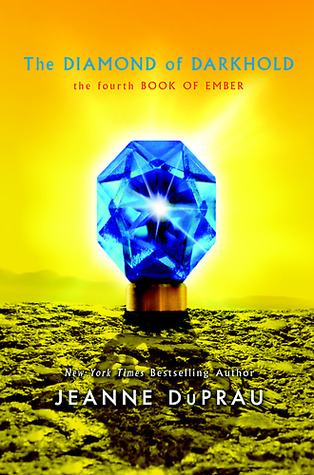
The Diamond of Darkhold by Jeanne DuPrau, 2008

It’s been several months since Lina and Doon escaped the dying city of Ember and, along with the rest of their people, joined the town of Sparks. Now, struggling through the harsh winter aboveground, they find an unusual book. Torn up and missing most of its pages, it alludes to a mysterious device from before the Disaster, which they believe is still in Ember. Together, Lina and Doon must go back underground to retrieve what was lost and bring light to a dark world.
In the fourth Book of Ember, bestselling author Jeanne DuPrau juxtaposes yet another action-packed adventure with powerful themes about hope, learning, and the search for truth.

(293 pages)

Was Diamond of Darkhold as good as the first two books (here and here)? No. But I was surprised how much better Diamond was than that dreadful prequel, Prophet of Yonwood (my review here) - in fact, it was only slightly less compelling than The People of Sparks was. And when you're writing the third book set around the same post-apocalyptic community, things are bound to get a little redundant. DuPrau does her best to combat this, taking old settings and recasting them in a whole new light.

The personification is wonderful: everyone, even minor characters, have their own personalities that are unique enough that you can differentiate between them, but they don't fall into stereotypes. Besides the main characters Lina and Doon there are many minor characters both old and new who play important roles in the story, all of whom have various backstories that meld into the larger story. Sometimes those backstories are short, but then again sometimes real-life backstories are short, too.

I love Lina and Doon, and I really enjoyed seeing them again. Their character development hasn't come very far from the first book, but it's definitely noticeable that they are both braver, stronger, and confident than they were in Ember. Their friendship has grown so that they are not just allies, but best friends as well. I appreciated that DuPrau didn't take their relationship to the next level during the bulk of the book, and left information about their future for the last chapter. The romantic in me hates that we didn't get to see Lina and Doon as a couple, but the realist in me appreciates that. For one thing, they're only like fourteen in this book. For another, they were busy! It's so annoying in most dystopian books how the main characters focus more on their love interests than they do on their missions. In the Ember books, romance is the last thing from everyone's mind and that makes my realist side extremely happy.

If you loved the first two Ember books, and then I highly recommend you read this as well. It brings the story full circle, tying everything off with a great mixture of realism and optimism throughout. Please don;t begin the series here, though - the first two books are both outsanding, and set the stage for this final book in the series.