Showing posts with label small town. Show all posts

17 September 2018

The Dollar Kids by Jennifer Richard Jacobson, 2018

Click to view
on Goodreads 
When a family buys a house in a struggling town for just one dollar, they’re hoping to start over — but have they traded one set of problems for another?

Twelve-year-old Lowen Grover, a budding comic-book artist, is still reeling from the shooting death of his friend Abe when he stumbles across an article about a former mill town giving away homes for just one dollar. It not only seems like the perfect escape from Flintlock and all of the awful memories associated with the city, but an opportunity for his mum to run her very own business. Fortunately, his family is willing to give it a try. But is the Dollar Program too good to be true? The homes are in horrible shape, and the locals are less than welcoming. Will Millville and the dollar house be the answer to the Grovers’ troubles? Or will they find they’ve traded one set of problems for another? From the author of
Small as an Elephant and Paper Things comes a heart-tugging novel about guilt and grief, family and friendship, and, above all, community.
(416 pages)

This is the second book by Jacobson that I've read; the first was Small As An Elephant, which I found to be sad and meaningful but in a way that was pretty generic and forgettable. I saw some promise in it, though, so when I was offered the chance to read The Dollar Kids I decided to give it a go.

And I'm very glad I did, because it hits all the right notes this time. There's sadness as Lowen struggles to cope with Abe's violent death, abandoning his artwork in mourning, but that sorrowful plotline is woven gently into a broader story about moving, small-town life, and struggling to fit in. I thought it was all very well done.

I suppose I'm biased to like this book from the start simply because it provides a relatively realistic depiction of what it's like to be the new kid. The Grovers and the other Dollar families are initially viewed with curiosity, and then suspicion. Some of the kids are incorporated into the town life, if they find an in with the established friend groups; the rest are consigned to outsider status forever. Lowen's mother's Cornish Eatery is a delightful place, which customers quickly grow to love, but the business struggles because the locals feel social pressure to frequent the restaurant run by a woman who has lived in the town for ages.

I've never experienced this same level of outcast status, but I moved across state lines six times before my eighteenth birthday, so I certainly know what it's like to be the new kid–and I can say that the feeling of being a "new" person is awful, and it takes forever to go away (and sometimes never does).

Many other reviewers will probably dedicate more space to the gun violence aspect of the book, so I won't discuss it too much other than to say that I thought some potentially controversial material was handled very smoothly. It's a tragic story, and we see the emotional impact of the loss firsthand through Lowen. I think the family's revulsion toward guns is presented logically and with no real chest-thumping rhetoric so it hopefully shouldn't offend gun rights supporters too much. Also, one of the Dollar families is a lesbian couple with children, but that isn't really a big focus of the story, either.

All in all, The Dollar Kids is a really great book. It's the kind of book you read and get thoroughly absorbed into, without worrying too much about the mechanics of it. Read it and enjoy it. That's really all I can say.

Disclaimer: I received a complimentary copy of this novel from the publisher in exchange for an honest review.

09 June 2017

The Runaway by Claire Wong, 2017

Click to view
on Goodreads 
Shortly before her eighteenth birthday, Rhiannon Morgan runs away from the remote Welsh village of Llandymna. Camping out in Dyrys Woods, she starts to make a new life for herself. In the woods she finds space for her active imagination--weaving together the stories she loves and memories of her past, including the mother she lost thirteen years ago.

Back in the village, Rhiannon's disappearance triggers a series of events that uncover the cracks in Llandymna's quiet surface. Relationships become frayed as a young police officer is forced to investigate his neighbors, and the village's elderly storyteller hints at a secret that the older generation has kept for decades. But as painful as the village's past may be, it may hold the key for hope in the present...

Claire Wong's strong debut explores how human relationships develop, how we change as we interact with one another, and the role of folktales and mythology in small communities.

(302 pages)

When I agreed to participate in the blog tour for The Runaway, I didn't really know that much about it. I thought it would be kind of interesting, with its story of a girl who ran away from home and of secrets in the village, and that the "surviving in the woods" storyline would be Hatchet-style thrilling while the village stuff would be kind of contrived and ridiculously dramatic.

It turned out completely different from how I was envisioning it. For one thing, the story is way more complex and intriguing than I expected it to be. Rhiannon turns out to not have as big a part to play in the story as we're drawn to believe, as most of the action during the middle of the book takes place in the village rather than in the forest, but it was still interesting to see the way she grows up over the course of the book. She's pretty much a self-centered jerk at the beginning of the book, believing herself to be so much better than everyone else in the village because she's "not a hypocrite" and is good in school, but as time goes on she begins to gain perspective on everything as she carves a life for herself in Dyrys Woods. Switching away from Rhiannon, though, I liked learning more about the motivations of her perfectionistic aunt/guardian who copes with tragedy by micro-managing everyone in the village. There's much more beneath Diana's surface than what first meets the eye. I also liked reading about Tom the policeman and Nia the rather oppressed farm-wife and Maebh the old woman who knows everything that has ever happened in the town. My favorite characters were probably Maebh and the sibling pair who came into the village a little ways into the book.

The book is called The Runaway for a reason, and it goes much deeper than just Rhiannon's last-minute decision to leave her aunt's home for the woods. Over the course of the book, we read about two more people who run away to Dyrys, each for their own unhappy reasons. The focus of the book is truly the village, not the woods, because we begin to discover the rotten reasons villagers are driven to run away from their homes and into the woods. You know how some books aren't necessarily super violent, but they still manage to drive home the complexities and occasional horrors of human nature? The Runaway is most definitely one of those books. I can't dive too much into that because of spoilers, but it is in every sense of the word a people-driven novel.

The Runaway was not quite the fluffy quick read I went in expecting, but I loved it even more for that. It's a fascinating exploration of human nature and the community in a small town, and I really, really liked it. I don't usually keep ahold of books I get for review, but I'll definitely hold off on passing this one along because I know I'll want to revisit it sometime down the line. And since this was just Wong's debut (and one of the most impressive debuts I've read in a long time), I'll be keeping a hopeful eye out for many more books by her in the future!


Disclaimer: I received a complimentary copy of this novel from the publisher in exchange for an honest review.
11 May 2015

Faith, Hope, and Ivy June by Phyllis Reynolds Naylor, 2009

Note: This will be my last new review until May 22nd (next Friday). I thought I could make it through AP season without neglecting my blog, but I just don't have the time or energy to write reviews. As soon as this one goes live, am completely out of fresh content. I can post over some old reviews from Goodreads if you want me to - I'm not so short on time I can't copy and paste! - but I'm not sure if that isn't cheating. If you want me to do that, post in the comments and I'll pick out my best reviews to transfer over.
Click to view
on Goodreads
Ivy June Mosely and Catherine Combs, two girls from different parts of Kentucky, are participating in the first seventh-grade student exchange program between their schools. The girls will stay at each other’s homes, attend school together, and record their experience in their journals. Catherine and her family have a beautiful home with plenty of space. Since Ivy June’s house is crowded, she lives with her grandparents. Her Pappaw works in the coal mines supporting four generations of kinfolk. Ivy June can’t wait until he leaves that mine forever and retires. As the girls get closer, they discover they’re more alike than different, especially when they face the terror of not knowing what’s happening to those they love most.

Hmm. I'm wondering if part of my apathy toward the book comes from reading it at the wrong time or something. It has all the pieces that I normally love in a story, but this time around it just felt a little tired. Then again, I'm tired, so who knows whether the book is to fault?

The characterization is pretty well done. Ivy June and Catherine are very typical twelve-year-olds, and they are painted with the right mixture of faults and merits to be neither saccarine angels or cliche cheeky devils. The characterization (now that I think about it a little more) might err slightly on the side of the generic, but it serves its purpose and is done very well.

The depiction of city life seemed really straight-on to me, warts and all. The attitude the "city folk" have toward their destitute neighbors is a very realistic cocktail of curiosity, snobbishness, pity, and (in some people) spite. I enjoyed watching Ivy June interact with the city for the first time, seeing my culture through the eyes of a newbie.

As for Ivy June's culture . . . I don't know. I was definitely stressing right alongside her when things got scary in the second half of the book, but when it comes to the town as a whole I had a hard time connecting. Do people really live like that, in America, in the 21st century? Are outhouses really still a thing out in rural areas? I have a hard time suspending my inside realist and accepting the fact that Ivy June lives such a ninteenth-century life. I couuld be completely wrong, though - I don't really know much about rural Kentuky. If anyone knows, I would love to learn whether this aspect of the story was realistic or not.

At the end of the day, I liked Faith, Hope, and Ivy June, but I wasn't swept away. I almost wanted more. The similarities and contrasts between Ivy June and Catherine was interesting, especially once things started going wrong in the second half of the book, but when I put the book down I felt almost apathetic toward it. Somehow I didn't really connect at all with the characters - I felt like I'd seen everything before. Perhaps you might be able to get more out of it than I did; I think it is a good book, it just didn't really do for me.

08 May 2015

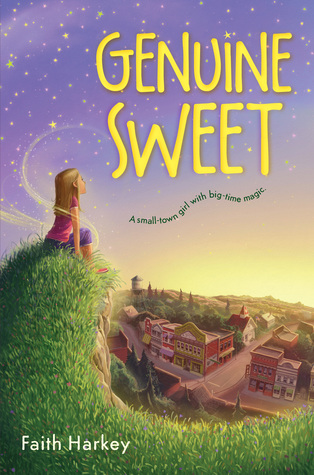
Genuine Sweet by Faith Harkey, 2015

Click to view
on Goodreads 
Twelve-year-old Genuine Sweet, of tiny Sass, Georgia, can grant any wish . . . except her own. It's a peculiar predicament, considering how much she could use a few wishes. New friends help Genuine give her family a boost--and then she takes her gift global! Life finally seems to be on the mend. But when she's faced with unexpected trouble that no amount of wishing can fix, Genuine must puzzle out the difference between wishing for a better life and building one.
Told in the engaging, irresistible voice of Genuine Sweet herself, Faith Harkey's debut novel spins a remarkable tale of a small-town girl with big-time magic and an even bigger heart.

(288 pages)

I needed this book. Neck-deep in studying for my AP exams, my brain was fried and my patience thin. I had the sinking sensation that only comes when my stock of reviews has bled dry and I've got a week of reviews in my backlog before I'm plumb out of content. I had a couple of books on my review pile, but none that really caught my eye and made me pour out a heartfelt review for. The TBR pile at the foot of my bed was full of appealing titles, but they had been sitting there waiting for so long that they already felt cliche and already done.

And that's where Genuine Sweet came in. I'd seen a review of it somewhere and requested it on a whim, and the day I hit my all-time low this new, shiny book popped into my hands screaming "I'm fun! I'm unique! I'll make you smile!" And it sure was. And did. Out of all the small-town-quirky-magic books I've read in my life, this one has carved its own spot. Where many "uniquely quirky" books fail in their use of the same old outside-the-box tropes, Genuine Sweet manages to take a lonely girl with negligent/dead parents, a loving/wise grandmother, and a new best friend, and actually make something new out of it.

The idea of wish-fetching is a very neat one, and I love that Harkey uses it to dig deep into the selfishness of human nature, through the people who harass Genuine for wishes, and the true potential of wish fetching - saving people in third-world countries. The fact that Geniune and Jura are so concerned about making the world a better place was just awesome.

However, I would be leery of recommending Genuine Sweet as a Middle Grade book. Harkey crafts a great story, but she includes enough mature themes that i know I for one won't be handing this off to my middle-school aged brother. For example, Genuine has an extremely sweet and touching slow-bloom relationship with a boy (whom I won't name for fear of spoilers) that I absolutely adored for as long as I could forget the fact that they were in middle school. Then I remembered, and I liked it a whole lot less. It's just weird when they're that age!

Actually, that's probably the biggest issue with this book: Genuine's age. If only she were seventeen, and then I could adore the book to pieces without feeling uncomfortable! As it is, I can still adore it, but I can't figure out who to recommend it to. I guess I'd offer it to fans of books like Savvy, Scumble, Drizzle, and Remarkable. It ranks right up there by the best of this sub-genre of quirky small-town magic, and would be absolutely perfect if Genuine were just five years older.

24 April 2015

Graceful by Wendy Mass, 2015

Stop right there! Don't go any further unless you've read the other four books in the Willow Falls series. I've done my best to avoid spoilers, but when you're reviewing the fifth book in a series you're bound to ruin something from the earlier books. Click the links to go to my reviews of the first, second, third, and fourth books in the series. And if you read on and spoil the entire series for yourself? Well, don't say I didn't warn you.

Click to view
on Goodreads
An exciting new story in the bestselling Willow Falls series from Wendy Mass!
Angelina D'Angelo has left town to see the world. It's now Grace's turn to use her magic to protect the people of Willow Falls, and she is up to the challenge. This is her destiny, after all. But destiny is a funny thing-it doesn't always behave the way you'd expect it to.
Mysterious postcards from Angelina begin showing up in the mail, Grace's parents are freaking out with worry, and something BIG is coming to town that will affect everybody who lives there. But all Grace is powerful enough to do is turn leftover meatloaf into pizza.

Fortunately, she's not alone. She has Team Grace on her side! Amanda, Leo, Rory, Tara, David, and Connor know a thing or two about magic and how it works. But none of them are prepared for what's coming, and none of them know how to stop it. Life in Willow Falls is about to change forever.
(272 pages)

Every Willow Falls book is told in first person present tense from the main character's POV, and Graceful is no exception. This time around it's Grace, learning to deal with her new magical abilities, who takes center stage. However, in this book Mass also adds snippets of narration from the other characters: there are diary entries by Amanda, letters from Tara to her pen pal/friend Julie, texts to and from Rory (who finally got a real phone!), poems written by Leo, inventor's notes from Connor, and more. I really like how Mass did that because it keeps the narration focused equally on all of the many characters. Otherwise she would've had to include long pages of second-hand descriptions as characters waited in line to tell Grace everything important that happened to them since the last time they talked to her. And that would not be fun.

The things that I expected to feel fake/annoying (like the middle school couples popping up every time I turn around) turned out to be perfectly fine, and actually pretty enjoyable. I think a large part of this success is the more disjointed technique of using all the different mediums to tell the story, because it dilutes the effect of having so many people running around with different things on their mind. Learning about the magic of Willow Falls was also really interesting - Mass does a good job of explaining it without sucking out all of the mystery and wonder.

Despite how much I did enjoy it, Graceful is not a perfect book. For one thing, I disagree with Grace's decision in regards to her parents. Just because they're stressed about your magical powers, does not mean you should use said abilities to make your parents forget about them! I'm not saying whether Grace succeeds in inflicting amnesia on her parents; it's the fact that this is treated like such a great idea by everyone involved that slightly annoys me. Surely someone would have pointed out that it wasn't really the ten-year-old's place to wipe her parents' memories? Another quibble is that the book can feel a bit disjointed. This wasn't a big deal for me, because I don't know of any other way for a story with that many characters to be told, but I know some might find it annoying. Also, did I mention there are three middle school couples? Yes, that's three. As in 3. As in two more than one.

To be fair, though, they're not just a bunch of random couples off the street; they're our couples, the ones we've watched from the very beginning, the ones we've rooted for and laughed at with and cried over. So I can't really fret too much about how many of them there are, because just in this one series, it doesn't really matter. I love them all with a passion that makes chapter fifteen particularly amazing for me - oh, you want to know what happens in chapter fifteen? I'm sorry, but you'll have to read Graceful and find out for yourself because I just can't bring myself to spoil it for you.

Bottom line: I love this book. A lot. It's the perfect ending to the series, and now that I've read it I can't imagine the series being complete without it. Is Graceful a standalone? Never! Is it the perfect close to an amazing series? Absolutely! So please take the time to read just one more Willow Falls book. But definitely make sure to re-read the other books before you delve into this one: trust me, Graceful is that much better if you understand all the references to the earlier books. And by "better," I mean "funnier." This book is hilarious!


Disclaimer: This is an Amazon affiliate link, and I received a free ARC from Scholastic Press in exchange for an honest review.

23 February 2015

The Prophet of Yonwood by Jeanne DuPrau, 2006

Click to view on Goodreads
It's 50 years before the settlement of the city of Ember, and the world is in crisis. War looms on the horizon as 11-year-old Nickie and her aunt travel to the small town of Yonwood, North Carolina. There, one of the town's respected citizens has had a terrible vision of fire and destruction. Her garbled words are taken as prophetic instruction on how to avoid the coming disaster. If only they can be interpreted correctly. . . . 
As the people of Yonwood scramble to make sense of the woman's mysterious utterances, Nickie explores the oddities she finds around town--her great-grandfather's peculiar journals and papers, a reclusive neighbor who studies the heavens, a strange boy who is fascinated with snakes--all while keeping an eye out for ways to help the world. Is this vision her chance? Or is it already too late to avoid a devastating war? 

Each book of Ember has a very specific role in the series. The first one, The City of Ember, was an adventure, suspense novel with the threat of the dying generator looming over Lina and Doone at every turn. The second one, The People of Sparks, was a look at conflict, war, and the slippery slope of giving "an eye for an eye." Both yielded even more on rereading than they did the first time, so I had high hopes when I started reading what was, for me, a boring and pointless addition to the series the first time around.

Unfortunately, my opinion hasn't risen too much the second time through. It's true that I see now the purpose of putting this book in the series: it shows the beginning of Ember, life on Earth during the conflicts that would ultimately tear apart all of human civilization. It explains in a way that the Emberites, clueless to their past, never could, what life was like in the lead-up to the events that destroyed almost all of humanity.

At least, I think that's what she was going for. In reality, it wanders all over the place and never really delivers on any of its promise. Parts of it remind me a little bit about Leaving Fishers by Margaret Peterson Haddix, because of the cult-like behavior of the superstitious village-members. Then there's Nickie's plans for the summer (she wants to fall in love, move to Yonwood for good, and help make the world a better place), which you'd think would help give the story a bit of backbone as she works toward those goals. Nope. For me, what kills any enjoyment I might have had is the fact that not only does DuPrau wander all over the place with her plot (religious fanaticism! Impeding war! Nickie wants a dog!), but she takes the time to set up for a great story . . . and then lets the reader down in practically every respect. Nothing happens the way you would expect it to, and I don't mean that in a good way. I mean it in a "wow, what a letdown" kind of way.

Nickie just never really clicked with me as a character, partly because she wasn't very bright (she spends half of the book spying on people to find sinners because she believes this is how she can help the world) and partly because she wasn't very, well, original. She just kind of was, and there was nothing special or unique about her. Grover had a lot of potential, and I was actually more excited about him than I was about Nickie. But while he wasn't as great a letdown as Nickie was, I still felt like DuPrau missed the mark so many ways with what could have been a great character.

All in all, this was a book with a great set-up and a very poor execution. Because it's a prequel, I would almost advise skipping over it as you read through the Ember books, unless you want to see if you can get more out of it than I can. I most definitely do not advise starting with this book before reading the rest of the series because a) it's really not necessary and b) it might turn you off from trying the rest of the wonderful series.

Have you read this book in the Ember series? Do you agree with me about The Prophet of Yonwood?

29 December 2014

11 Birthdays by Wendy Mass, 2009


Synopsis (from Goodreads):It's Amanda's 11th birthday and she is super excited -- after all, 11 is so different from 10. But from the start, everything goes wrong. The worst part of it all is that she and her best friend, Leo, with whom she's shared every birthday, are on the outs and this will be the first birthday they haven't shared together. When Amanda turns in for the night, glad to have her birthday behind her, she wakes up happy for a new day. Or is it? Her birthday seems to be repeating iself. What is going on?! And how can she fix it? Only time, friendship, and a little luck will tell. . . 


I read this book for the first time several years ago. In many ways it helped me start a new era of flexibility in my reading patterns: up until this point I refused to read any book not written in third person past tense. For those of you who have not read this book, it is written in first person present tense. I basically read it because my mother told me to and because I had nothing else to read and once started, could not put it down. It made me realize that sometimes you have to be flexible in your reading habits, because sometimes you can find the most wonderful books written in ways that you are not accustomed to.

Now, I'm sure you can tell from my opening paragraph that I really liked this book. That is true. I really, really like this book. In fact, I like the whole series. No, I love the whole series. Frankly, I love almost every book Wendy Mass has ever written. And it all started with this book, five years ago. Over the next few weeks, I plan to post my reviews of all of the books in this four – book series. As some of you may know, I recently had surgery on my dominant wrist and have spent a lot of time lately with nothing to do but read a book. Unfortunately, that time has now ended and I am scrambling to catch up all of the schoolwork that I got behind on while recovering from the surgery. But while I was still incapacitated, I started rereading the Willow Falls series as a sort of comfort read. Now I plan to review them so that others can see why I love these books so much.

The story itself in this book is a fun if slightly cliché set up: Amanda is stuck in a Groundhog Day-esque scenario where every morning when she wakes up she has to repeat the same birthday over and over again. It was miserable the first time; by the third time, it's practically unbearable. She has no idea what is going on, or how to fix it. It's like her worst nightmare: she has spent a year feeling very alone without her ex-best friend Leo, but now she is truly alone with no one to confide in as she has to repeat the same day over and over again. I love the set-up of the story (part of which I can't mention for spoiler reasons), and while the book literally takes place over the course of one day repeated over and over aagin, it's really cool seeing how the choices Amanda makes affects the world around her. It's like one of those models I'm learning about in AP Macroeconomics: how does a change in one factor change the entire economy? How does a change in the behavior of one(ish - sh, spoilers!) person?

I love the two main characters. Amanda is, obviously, the main focus of the book. The story is told from her point of view so you get a firsthand view of the worst day of her life. While I personally have never gotten in a huge fight with my best friend, stressed about getting onto the chearleading squad (while really wanting to join the much nerdier marching band as a drummer), or gotten stuck in a time loop where I have to repeat a terrible day over and over again, I was still right there with Amanda every step of the way. She was not like me in any way, but she was someone I'd like to be friends with. The other MC, Leo, doesn't really get involved directly in the story until about halfway through the book. I can't really go into much detail with Leo because of the risk of spoilers, but suffice to say I wouldn't mind having him as a friend, either!

I love this book. I just want to end on that point. Because of reading this one book several years ago, I have now read (and loved!) over ten other books by Mass. And the wonderful thing about this series is that it builds in the most delicious way. Each book focuses on a different person and a different storyline (except the fourth book, which focuses on Amanda once more), and each book is just as good if not better than the one before it. Stay posted for my reviews of the other books in the wonderful Willow Falls series!