Showing posts with label future. Show all posts

13 February 2017

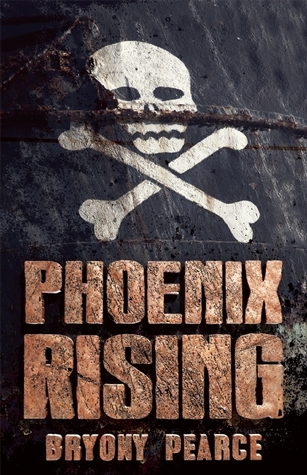
Pheonix Rising by Bryony Pearce, 2017

Click to view
on Goodreads 
Sail. Salvage. Repeat.
For as long as Toby can remember, he and his father have sailed on the Phoenix, salvaging from the junk-filled seas to stay afloat, while keeping under the radar of the authorities. His father is, after all, a wanted man.
And now the
Phoenix is on the trail of the ultimate prize, a salvage of solar panels that could mean they’ll never need to hunt for fuel again.
Ayla is second-in-command on the rival
Banshee, where she’s trained her whole life to fight—just as her mother, Captain Nell, demands. Since childhood, Ayla’s been taught the Phoenix must be destroyed. And now they have the ship in their sights. And they’re desperate to have their precious intel, too.
Toby’s sick of a life at sea, and Ayla may be his only hope. Can he turn an old feud into a new alliance that will save both their skins?
Award-winning Bryony Pearce brings the high seas to life with her rousing steampunk pirate adventure that will have you craving more.

(368 pages)

This actually has an even cooler premise than I thought it would going in. I guess I didn't read the description very carefully, because I saw "pirates" and thought "historical fiction." You know, like Blackbeard and shanghaied pirates and the Jolly Roger and all that stuff? Well, it turns out that Phoenix Rising is definitely nothing like that. It has the Jolly Roger, sure, but that's where any similarities to historical pirate stories ends. This book actually tells a story set in a bleak future where fossil fuel supplies have dried up, the sun was entirely blocked by atmospheric gases for several decades, and the oceans have become cluttered full of garbage from ancient garbage dumps that broke apart during land shifts. Toby lives on a pirate ship full of pirates wanted for various (non-violent) crimes, and they move through the water by burning wood and using whatever scraps of natural gas they can find in the junk that fills the ocean.

It's actually an amazing premise, isn't it? I love the way it blends historical pirate culture, modern environmental crises, and predictions of how things could devolve once nations start fighting over resources.

All that to say . . . I didn't like the book quite as much as I'd hoped I would. It's got gobs of semi-minor characters everywhere, and I had a terrible time trying to keep them all straight. Several of those characters die throughout the book, and more random people we don't even know die as well. Even the two main characters, both of whom are about fourteen, kill multiple people throughout the book. I can be okay with death, when it's realistic and contributes to a story, but I just didn't like the way people skated past all the deaths. Toby never struggles with what he's done, not really, and I just needed to see him do that in order to believe in him as a character.

As for Ayla, she's not in the book as much as you'd think from the description. She shows up about a third of the way through, actually. I think she's supposed to be a tough but lovable character, one of those "enemies with a heart of gold." Unfortunately, I never really bought that conception of her character. Ayla seems like a troubled soul, and I do wish her greater happiness in the future, but I don't really see her as an innocent in this story.
I assume there will be a sequel, since the story has a pretty open ending. If one does come out in the future, despite not falling completely in love with Phoenix Rising, I would definitely still be interested in reading it and discovering what happens next. I'd also like to see the conflicting politics of the land countries explained in more detail, because we only get a quick sketch of them in Phoenix Rising but it sounds like they could be really fascinating. Until then, though, I'm content to pass my copy of Phoenix Rising along to my local book swap.

Disclaimer: I received a complimentary copy of this book from the publisher in exchange for an honest review.
03 February 2017

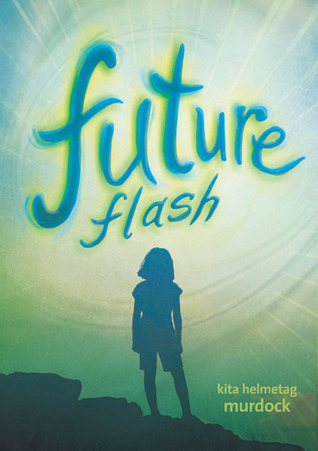
Future Flash by Kita Helmetag Murdock, 2014

Click to view
on Goodreads 
For as long as she can remember, Laney has been having “future flashes”—visions of the future that she sees when she makes physical contact with another person. Left on a doorstep as a baby, Laney’s past has always been cloudy to her, despite the clarity with which she can see the future. Her caretaker, Walt, claims to be her father, but Laney has a nagging suspicion that he isn’t quite telling her the entire truth. And when a new kid, Lyle, moves to her small town, Laney is dreading meeting him—she almost always gets a future flash when first meeting someone new, and the flashes aren’t always good. Unfortunately, her meeting with Lyle isn’t just bad; it’s painful. Engulfed in flames, Lyle’s future flash is the worst Laney’s ever experienced. But what does it mean? Is there anything Laney can do to change the future? And will she be able to save Lyle not only from a fiery death but also from the merciless class bully without becoming a victim of his antics herself?

In this thrilling and imaginative middle grade novel from author Kita Helmetag Murdock, follow Laney as she works against the clock to understand her past and prevent the disaster looming in the future.

(208 pages)

Such an interesting premise, isn't this? I'll own that I was originally drawn to the book because it had the word "Flash" in the cover–I've been a bit of a flash addict ever since I started watching The Flash last year! The "flashes" that happen here aren't anything like Barry Allen's bursts of speed, though. Instead, the awesome premise of the story is that Laney gets "future flashes" of things that will happen at some point. I'm not sure whether it's ESP or actual magic, but it's fun to imagine what it would be like to grow up with a power like that.

Unfortunately, I didn't feel like the book quite lived up to its potential. It needed to be longer, I think. I wanted more time to get to know Laney's caretaker, Walt. We get no idea of who he is, what his past was or what sort of personality he has, outside of a few stray snatches. Laney seems to be angry at him for not telling her the truth of how she came to live with him, but she also loves him. Why? What makes their relationship tick? And, for that matter, how did she go through her entire childhood without ever letting slip that she remembered the day he found her on the doorstep? I don't think any real child could manage to hold something that big in for so long.

Also, I wish there had been more of an explanation for Laney's powers. Because basically, we don't get  an explanation. There's no hint of a mythology behind it, or a culture, or even an explanation of why certain people got it but most didn't. I was also frustrated by descriptions of Laney's mother, who sounds like such a flake–because seriously, who just ups and abandons their kid like that? I don't care how good she thought her reasons were, she just shouldn't have done that.

There were a few other areas that weren't as well-developed as I'd have liked, but I'm not going to drag this review down by listing them all out. Instead, let's look at the positives: I still really like the idea of getting selective flashes of someone's future. I liked reading about Walt's sort-of girlfriend and Laney's mother figure, Carmen. She's a baker who seems like an amazing person, and I honestly wish she'd come bake and talk with me once in a while. I liked Lyle, though I really would have liked more insight into his character by learning more about his past. I really liked observing the rather complex relationship between Laney and the school bully, Axel. Most of the time he's an absolute jerk, but through Laney's memories of when they were both much younger we get a more nuanced and sympathetic look at why he acts so horribly now. The past doesn't excuse the way he treats people now, of course, but it does make for some interesting complexity in the character.

All in all, Future Flash is an interesting book but it could have been better. I would have been much more invested in the characters if I'd gotten more information about them, if I felt like I really knew them. Since that wasn't the case, I only recommend Future Flash to you if you like sci-fi-ish thriller-ish books with cool premises that they don't quite fill in completely.

Disclaimer: I received a complimentary copy of this novel from the publisher in exchange for an honest review.
17 October 2016

Sherlock Mars by Jackie Kingon, 2016

Click to view
on Goodreads 
A riotous concoction: fine dining, virtual reality, and murder.
Molly Marbles runs a successful bistro on terraformed Mars. But a virtual restaurant opens near her place, offering the experience of delicacies from across the Solar System with none of the calories. What will this do to her business?
Then its owner is murdered in her kitchen. Molly, an amateur detective, springs into action to help the police solve the mystery, while also planning her pop-star daughter's wedding, keeping her kitchen staff from feuding, and protecting her cyborg friend from the humans-only mob. Meanwhile, the infamous Cereal Serial Killer has escaped prison on Pluto and has everyone worried. Things are getting hectic, but Molly is a resilient and resourceful woman. And her knack for mysteries sees her nick-named 'Sherlock Mars'.
A rollicking science fiction, mystery, comedy.

(266 pages)

Sherlock Mars is a really hard book to describe because it's so many things at once. Sure, it's a "science fiction, mystery, comedy" as the synopsis describes it. But there's much more to it than that. It's a futuristic envisionment of what will happen to the universe when human technology catches up with our addiction to colonization; it's also a philosophical take on the extent to which technology will replace lost body parts, and about the hateful prejudice/political turmoil that always springs up when the majority party feels threatened by the growth of a powerful minority–in this case, the development of androids who not only have electronic bodies but have also been given some huge functionality enhancements from their "natural" states. It's a really interesting scenario, watching the horrible hate that springs up between androids and the anti-enhancements groups. I can see both sides of the debate: androids are still human beings, and they shouldn't be discriminated against, but all the upgrades they get aren't exactly fair. It's one thing to save someone's life by giving them a new body, but it's another to give them software that provides them with unfair physical and mental advantages over non-enhanced humans, you know? That's just my take on things, though–and, taking a step back from things, I do feel slightly ridiculous getting into a political argument about androids of all things. It's a fascinating topic, though, and I honestly would have loved if the whole book had revolved around it.

Actually, the biggest trouble I had with Sherlock Mars was that there were just too many interesting storylines floating around. There are way too many characters, most of whom walk onto the page just a handful of times but who the reader is expected to recognize after the first time they show up. There were several times throughout the book when Molly would start talking to someone, and I would have to sit back and wrack my brains for a minute to figure out who they were. This also made it harder for me to recognize the important people (like suspects for the murder), because I'm too busy trying to keep straight all the myriad of people who work at Molly's bistro. Honestly, I suspect that Kingon was more fascinated by the futuristic world and culture that she had created than with the storyline herself; a few times, it definitely felt like she was just using the plot as an excuse for having Molly explore different parts of this world. Not that I'm complaining, though, because it was really fascinating to read about it (and Nirgal Palace, the resort where Molly's daughter is getting married, is absolutely amazing!).

Before I end, I should probably throw in a few negatives. First, I didn't like Molly's family–like, at all. Her daughters were prejudiced prima donas who only showed up to demand help for Becky's wedding or to groan and make rude faces whenever Molly mentioned her friend Trenton–just, as far as I can tell, because they didn't like associating with androids. Plus, Becky's future in-laws run with an extremely anti-android crowd (we're talking anti-android-rights protests). The other main negative is more of a content warning than anything: this is an adult book, not MG or YA, and it shows. Most of the content is fine, but once in a while the characters (who are all married) bring up questions/comments (never detailed) about having sex. Also, though it's never addressed in too much detail, one character is trans. These things barely hurt my enjoyment of the book, but I wanted to bring them up in case they'd affect your decision to read it.

This is getting incredibly long, so I'm going to stop. If you're interested in Sherlock Mars, then give it a try. I'm not going to scream "read it!" from the rooftops–I liked it, but the characters/pacing were a little strange, and as a rule of thumb I don't recommend adult books with racy comments/content–but I did enjoy Sherlock Mars. It made for a nice, silly (but still thought-provoking) break from my normal MG historical fiction and fantasy fare.

Disclaimer: I received a complimentary copy of this novel from the publisher in exchange for an honest review. My mom's also old school friends with the company's founder (which is how he knew me to send it in the first place), but I tried not to let that influence my review too much.

16 October 2015

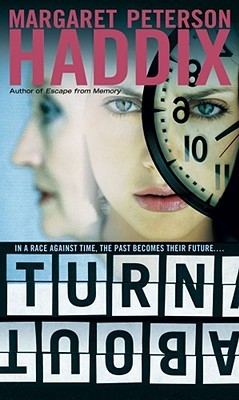
Turnabout by Margaret Peterson Haddix, 2002

Click to view
on Goodreads 
In the year 2000 Melly and Anny Beth had reached the peak of old age and were ready to die. But when offered the chance to be young again by participating in a top-secret experiment called Project Turnabout, they agreed. Miraculously, the experiment worked -- Melly and Anny Beth were actually growing younger every year. But when they learned that the final treatment would be deadly, they ran for their lives.
Now it is 2085. Melly and Anny Beth are teenagers. They have no idea what will happen when they hit age zero, but they do know they will soon be too young to take care of themselves. They need to find someone to help them before time runs out, once and for all....

(240 pages)

I'm named after my great-grandmother, who was born in 1900. I'm actually named after two of my great-grandmothers (Marie, my middle name, was my dad's grandmother's name), but it's the woman whose first name I share that really captures my fascination. She grew up in a completely different time, on a farm in rural Missouri. She lived a fascinating life full of ups and downs, and died an old woman living on the same farm she'd spent her entire adult life working.

In some ways, Melly is just like my great-grandmother: she grew up in a rural village in the twentieth century, and she was one hundred and one in 2000 so she must have born around the same time as my great-grandmother. The big different between the two women, however, is that my great-grandmother died long before 2015; Melly, on the other hand,  made it much farther than that. She made it much farther than even my grandparents are going to get: to the year 2085. Rereading Turnabout for the first time in a few years, just as I'm becoming interested in researching my family history, I can't help but obsess over how awesome it would be if I could meet my great-grandmother. Meeting her when she'd unaged so far that she was biologically my own age? Even cooler. Just think of all the stories she could tell, all of the precious anecdotes and family stories. She could help me decipher my sometimes-confusing family tree, putting stories to all of the different faces. She could humanize the past with her own personal experience.

Sitting here typing this, I'm thinking that would be pretty cool for me. But would my great-grandmother have wanted to participate in Project Turnabout? I have no way of knowing - it wouldn't be as simple a choice as you'd think. Getting to live for twice your allotted time is great, but what sort of life would you have? You'd either be an anomaly to the world, living your life under a scientific microscope, or you'd spend your whole life running away from anyone and anything that could make you lose your secret. This second choice is the one that Melly and her friend Anny Beth make: to run, to hide, and to lie. They've spent the last eighty-five years completely on their own, with only the agency that initiated Project Turnabout to help them, and they haven't seen hide nor hair of their descendants in all that time because they're afraid it would be too hard to resist telling them who they really were.

I am a huge fan of Haddix's, and it's books like Turnabout that are perfect examples of why I love her writing so much. She takes an amazing story idea ( here it's an unaging scenario with so much potential), adds compelling characters with complex backstories and convincing motives, and sprinkles in some profound thoughts for the reader to chew on (in this case it's aging and death, and what exactly the consequence of avoiding them would be). She often also includes a really interesting setting (here it's her early-2000s view of what the world will be like in the future - including a scary-good prediction of voice recognition software), as the icing in the proverbial cake. So do I recommend Turnabout? That's a silly question, of course I do. The only real question is one that's been haunting me since I first read it years ago: could Project Turnabout ever happen in real life? And if it did, would I want to participate in it?