Showing posts with label dystopian. Show all posts

24 September 2018

Bash Bash Revolution by Douglas Lain, 2018

Click to view
on Goodreads 
Seventeen-year-old Matthew Munson is ranked thirteenth in the state in Bash Bash Revolution, an outdated Nintendo game from 2002 that, in 2016, is still getting tournament play. He's a high school dropout who still lives at home with his mom, doing little but gaming and moping. That is, until Matthew's dad turns up again. Jeffrey Munson is a computer geek who'd left home eight years earlier to work on a top secret military project. Jeff has been a sporadic presence in Matthew's life, and much to his son's displeasure insists on bonding over video games. The two start entering local tournaments together, where Jeff shows astonishing aptitude for Bash Bash Revolution in particular. 

Then, as abruptly as he appeared, Matthew's father disappears again, just as he was beginning to let Jeff back into his life. The betrayal is life-shattering, and Matthew decides to give chase, in the process discovering the true nature of the government-sponsored artificial intelligence program his father has been involved in. Told as a series of conversations between Matthew and his father's artificial intelligence program, Bash Bash Revolution is a wildly original novel of apocalypse and revolution, as well as a poignant story of broken family.
(293 pages)

I've always been interested in cutting-edge technology and the ways that technological advancements affect society, so I was naturally very excited to read Bash Bash Revolution.

Unfortunately, I didn't like it nearly as much as I'd thought I would. This is for a couple of reasons, so I'll just go through them.

First, the language. Pretty self-explanatory, I thought the profanities were entirely unecessary.

Second, I didn't really like Matthew. I don't care what his reasons were, I just couldn't get behind his whole "smart guy drops out of high school to play video games" story.

Third, I don't like how they represented religion. One of the characters comes from a super-conservative Christian background, but she doesn't act like any of the (many) people I know who actually come from conservative families. Instead, she's basically just a tool for Lain to show the way technology was breaking down old pillars. She is fine as a character, but as a representative of my faith (or, really, of any serious religion) I didn't really like her. Because seriously, people don't change that easily.

And that brings me to my fourth and largest gripe with Bash Bash Revolution: it's completely unrealistic. I doubt an AI would ever seriously come to those sorts of conclusions, or behave in the manner that it does, and it certainly could have been shut down. Plus, there's no way it could obtain enough data to so perfectly develop and present programs to enthrall each person. Not to mention the simple fact that there are many people who simply would not become enthralled forever. Surely I'm not the only one who gets sick when I play VR for more than half an hour without giving my eyes a break, right? And there are old people who would never put the headsets on in the first place. And mothers with young children would never just up and abandon their kids, no matter how good the game they were playing. And so on and so forth. Enough people would not play, or would quit playing after a while, that they would realize what was going on and put a stop to it.

Honestly, I liked the basic premise at the beginning of the book, but I quickly realized that my ability to suspend disbelief simply didn't reach far enough to get invested in Bash Bash Revolution. Plus, this is the sort of book that scares people about tech for no good reason, and as a computer science major I just can't get behind that.

Disclaimer: I received a complimentary copy of this book in exchange for an honest review.
24 November 2017

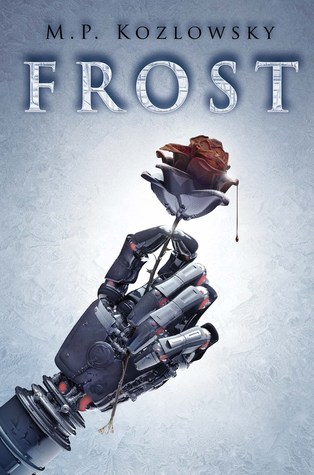
Frost by M.P. Kozlowsky, 2016

Click to view
on Goodreads 
Being human is her greatest strength.

Sixteen-year-old Frost understands why she’s spent her entire life in an abandoned apartment building. The ruined streets below are hunting grounds for rogue robots and Eaters.

She understands why she’s never met a human besides her father. She even understands why he forbids her to look for medicine for her dying pet. But the thing is, it’s not her real father giving the orders…

It’s his memories.

Before he died, Frost’s father uploaded his consciousness into their robot servant. But the technology malfunctioned, and now her father fades in and out. So when Frost learns that there might be medicine on the other side of the ravaged city, she embarks on a dangerous journey to save the one living creature she loves.

With only a robot as a companion, Frost must face terrors of all sorts, from outrunning the vicious Eaters…to talking to the first boy she’s ever set eyes on. But can a girl who’s only seen the world through books and dusty windows survive on her own? Or will her first journey from home be her last?
(352 pages)

When I was not far into Frost, I described it as a steampunk novel to my younger sister. When she asked me what steampunk was, I told her it's a genre of fiction that usually has a lot of advanced tech and clockwork motifs, a fair number of robots, a fantasy-esque scenario that's explained with sciency stuff rather than magic, lots of dystopian situations with oppressive bad guys, and stories that grapple with what it means to truly be human (and whether a robot "with a human-like consciousness" is still inferior to a living, breathing human being)

I legit started laughing halfway through Frost because it had every single one of those elements in it. I've only read about three steampunk novels counting Frost, but I must really have a deeper insight into the genre than I expected. Since it follows so many of my expectations, as you might guess, the book isn't exactly the most original book I've ever read; it sticks with the usual tale of robots gone bad, humanity oppressed, a quest to find the legendary human colony, etc. I'm a little sketchy on the details of why the humans all went nuts when Frost was a baby, because it seems like most of the dangers are human-inflicted rather than related to the robots, but it's definitely the humans' fault now that things aren't improving. Things get pretty gory at some points, with mentions of people eating their own bodies in order to stay alive (which is both really gross and highly unrealistic) and of the brutal treatment slaves receive under the dictator who offers asylum to the humans. They're not described in extreme detail, but Frost definitely is not for the faint of heart.

Honestly, though, I'm not sure I agree with Frost's decision to put herself and the people around her in danger over and over again in order to save the life of a pet that was already like eight years old. It's absolutely horrible when pets are dying, I should know that more than anyone right now, but I don't know that the solution is really to throw yourself and everyone you know into mortal peril in the slim hopes of finding something that would help it recover. It seems like throughout the book characters are unable and unwilling to deal with the finality of death; they're constantly either avoiding it, daring it, or cheating it (by way of uploading their brain to a robot). Death is awful and horrible, yes, but I don't think that trapping a soul inside a metal body is really a good long-term alternative. It cheapens the tragedy of a human body's death and decay when you can just install a copy of their brain in a robot and keep right on going. Their consciousness may still be alive in another form, but that original human being is still dead. And that is still a tragedy.

Anyway, that's my two cents on the whole issue. I liked Frost more than I thought I would, enjoyed foraying into a genre that I don't usually read, but I wasn't blown away by it. If you like steampunk, or you're interested in getting into it, then Frost might well be a good place to start–or at least I think so. Keep in mind that I've only ever read three steampunk's novels when you take my recommendation under consideration.

Disclaimer: I received a complimentary copy of this novel from the publisher in exchange for an honest review.

06 March 2017

A Single Stone by Meg McKinlay, 2017

Click to view
on Goodreads 
Every girl dreams of being part of the line—the chosen seven who tunnel deep into the mountain to find the harvest. No work is more important.

Jena is the leader of the line—strong, respected, reliable. And—as all girls must be—she is small; years of training have seen to that. It is not always easy but it is the way of things. And so a girl must wrap her limbs, lie still, deny herself a second bowl of stew. Or a first.


But what happens when one tiny discovery makes Jena question the world she knows? What happens when moving a single stone changes everything?
(272 pages)

Yikes. Just, yikes. This book has some serious grit in it. We're talking dystopian, cult-like, surgically-alter-your-daughters-to-make-them-thinner grit.

I know, when I say that your thoughts immediately leap to eating disorders and low self-esteem. But in Jena's world, the "Mothers" who run the village encourage girls to be as small as possible so they can crawl deep into the heart of the mountain that surrounds them and harvest the mica that provides them with fuel. It's a cruel world, this closed-off little village that has been completely isolated for generations because of a landslide that closed off the pass leading outside the mountain. This really weird semi-religious cult society has risen from the ashes of the villages that lived there before the landslide, and everyone is taught from birth to worship the mountain (which is seen as the giver of all life, since it holds the mica they need for survival). It's a dog-eat-dog world, one where life-giving mica is allocated to families in proportion to their usefulness, and where parents willingly bind their baby daughters from birth to force them to grow up small. It's like a more practical version of the Chinese foot-binding custom: they bind the whole body, to make suitable seekers of fuel, and then they actually use surgical procedures to alter girls whose bones are becoming too big. It's gruesome and horrible, but it also makes sense in a sick sort of way. After all, I suppose I'd rather be tiny than dead.

But the trouble is that all too often the girls become both. Because the mountain is treacherous, and maneuvering through its crevices a nightmare. I can't say much about specific instances of this, because I don't want to spoil the story, but some horrible things happen on and inside the mountain. It's painful and gruesome to read, but so fascinating at the same time that I devoured the entire book in one sitting.

Unfortunately, I can't talk much more about the plot, because even the most basic aspects of the story's set-up are teased out throughout the book. The story of Jena's past, for example, comes in bits and pieces: we learn that she's living with her best friend's family very early on, but the exact reason for this isn't fully revealed through flashbacks until over halfway through. I always love this sort of narrative technique, so I'm honestly not complaining, but that does make reviewing it a little trickier.

Actually, I think I'll just stop here. I really enjoyed reading A Single Stone and that others will, too. Have you read it? Tell us your thoughts in the comments section down below!

Disclaimer: I received a complimentary copy of this novel from the publisher in exchange for an honest review.

13 February 2017

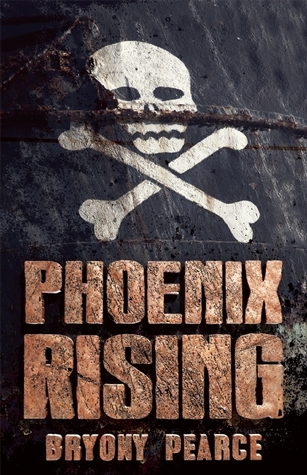
Pheonix Rising by Bryony Pearce, 2017

Click to view
on Goodreads 
Sail. Salvage. Repeat.
For as long as Toby can remember, he and his father have sailed on the Phoenix, salvaging from the junk-filled seas to stay afloat, while keeping under the radar of the authorities. His father is, after all, a wanted man.
And now the
Phoenix is on the trail of the ultimate prize, a salvage of solar panels that could mean they’ll never need to hunt for fuel again.
Ayla is second-in-command on the rival
Banshee, where she’s trained her whole life to fight—just as her mother, Captain Nell, demands. Since childhood, Ayla’s been taught the Phoenix must be destroyed. And now they have the ship in their sights. And they’re desperate to have their precious intel, too.
Toby’s sick of a life at sea, and Ayla may be his only hope. Can he turn an old feud into a new alliance that will save both their skins?
Award-winning Bryony Pearce brings the high seas to life with her rousing steampunk pirate adventure that will have you craving more.

(368 pages)

This actually has an even cooler premise than I thought it would going in. I guess I didn't read the description very carefully, because I saw "pirates" and thought "historical fiction." You know, like Blackbeard and shanghaied pirates and the Jolly Roger and all that stuff? Well, it turns out that Phoenix Rising is definitely nothing like that. It has the Jolly Roger, sure, but that's where any similarities to historical pirate stories ends. This book actually tells a story set in a bleak future where fossil fuel supplies have dried up, the sun was entirely blocked by atmospheric gases for several decades, and the oceans have become cluttered full of garbage from ancient garbage dumps that broke apart during land shifts. Toby lives on a pirate ship full of pirates wanted for various (non-violent) crimes, and they move through the water by burning wood and using whatever scraps of natural gas they can find in the junk that fills the ocean.

It's actually an amazing premise, isn't it? I love the way it blends historical pirate culture, modern environmental crises, and predictions of how things could devolve once nations start fighting over resources.

All that to say . . . I didn't like the book quite as much as I'd hoped I would. It's got gobs of semi-minor characters everywhere, and I had a terrible time trying to keep them all straight. Several of those characters die throughout the book, and more random people we don't even know die as well. Even the two main characters, both of whom are about fourteen, kill multiple people throughout the book. I can be okay with death, when it's realistic and contributes to a story, but I just didn't like the way people skated past all the deaths. Toby never struggles with what he's done, not really, and I just needed to see him do that in order to believe in him as a character.

As for Ayla, she's not in the book as much as you'd think from the description. She shows up about a third of the way through, actually. I think she's supposed to be a tough but lovable character, one of those "enemies with a heart of gold." Unfortunately, I never really bought that conception of her character. Ayla seems like a troubled soul, and I do wish her greater happiness in the future, but I don't really see her as an innocent in this story.
I assume there will be a sequel, since the story has a pretty open ending. If one does come out in the future, despite not falling completely in love with Phoenix Rising, I would definitely still be interested in reading it and discovering what happens next. I'd also like to see the conflicting politics of the land countries explained in more detail, because we only get a quick sketch of them in Phoenix Rising but it sounds like they could be really fascinating. Until then, though, I'm content to pass my copy of Phoenix Rising along to my local book swap.

Disclaimer: I received a complimentary copy of this book from the publisher in exchange for an honest review.
09 September 2016

Children of Exile by Margaret Peterson Haddix, 2016

Click to view
on Goodreads 
For the past twelve years, adults called “Freds” have raised Rosi, her younger brother Bobo, and the other children of their town, saying it is too dangerous for them to stay with their parents, but now they are all being sent back. Since Rosi is the oldest, all the younger kids are looking to her with questions she doesn’t have the answers to. She’d always trusted the Freds completely, but now she’s not so sure.
And their home is nothing like she’d expected, like nothing the Freds had prepared them for. Will Rosi and the other kids be able to adjust to their new reality?

(304 pages)

I don't think this is my absolute favorite of Haddix's books, but I can't exactly put my finger on why that is. Perhaps it's a touch too on-the-nose in its social critique; perhaps the reveals at the end are too wild to be entirely believable; perhaps the adults just didn't ring true for me (or if they did, I simply didn't like them). Or perhaps the ending is so bizarre that I honestly can't figure out what to make of it.

I have a hunch, though, that the Children of Exile series as a whole will be great - this book is clearly laying the groundwork for either a breathtaking action series or a thought-provoking social commentary (or both!), and I'm really intrigued to see where on earth the story goes from here. I'm especially interested to see Haddix tackle the ethical dilemmas she presented in Children of Exile, because I honestly have no idea how I feel about everything Rosie finds out in the end.

Speaking of Rosi, I really loved the kids in Children of Exile. I haven't read a character like Rosi in a long time: she's not particularly brave, not particularly clever (at least not that we've seen so far), is a useless fighter but an amazing babysitter, and is altogether too naive to be a good judge of anything. But it's her innocence - and the innocence of the other children - that's so fascinating. They were raised to believe war was a historical trouble, left behind in the stone ages; they were taught to be kind, and good, and to never hit back at anyone but instead to talk out their feelings until things were settled. Their upbringing was like some sort of politically-correct extreme, focused on respecting everyone. And in part, it truly is perfect; if everyone got along the way these children did, then war really wouldn't exist anymore. But after a while, it started to hit me: what sort of world is it, where there's no war or hitting or swearing, or even fighting? Where every conflict between your parents is magically solved in a single private conversation? It's a wonderful world, but it's not a real world. It never can be. That's partly why the children's return to their birth families is so terrible for them - they've lived in a bubble their whole lives, so they can't cope with the real world that is their home.

And that, right there, is why I always love reading Margaret Peterson Haddix novels: because they make me think. They make me look at some dilemma and try to figure out my own views. So just because Children of Exile wasn't a clear favorite of mine right from the get-go doesn't mean it's a bad book by any means - in fact, the more I sit here and chew over it the better I think Children of Exile actually is. I still hold points against it for keeping me at arms length for so long, though. Haddix has written many thought-provoking novels with major plot twists/withheld information, books I absolutely adored from page one. Somehow that didn't happen with Children of Exile, and I'm still a little bit sad about that. I guess every book can't be as perfect as Under Their Skin or Double Identity, right?

The truth is that Children of Exile is one of those books that you read, you analyze, you chew over . . . but you don't really love. I can recommend it as a thought-provoking dystopian novel, but I can't say you'll fall head over heels for it - because I didn't. I still hold out hope for the sequel, where I have complete faith that Haddix will pull all the strings together into a cohesive and fascinating whole; until then, though, my recommendation of Children of Exile as a standalone will have to be slightly tepid. If you do get a chance to read it, definitely comment below and let us know what you think!

Disclaimer: I received a complimentary ARC of this novel from the author in exchange for my honest review.

03 June 2016

The Always War by Margaret Peterson Haddix, 2011

Click to view
on Goodreads 
In a war-torn future United States, fifteen-year-old Tessa, her childhood friend Gideon, now a traumatized military hero, and Dek, a streetwise orphan, enter enemy territory and discover the shocking truth about a war that began more than seventy-five years earlier.
(256 pages)

The first time I read this book, I was absolutely floored by the plot twist. Margaret Peterson Haddix is a genius when it comes to inventing mind-bending scenarios, and The Always War is one of her very bendiest books. Unfortunately, it's also one of her shortest.

And that's what always frustrates me when I re-read it. Just when things are really getting hot, just when the plot twists are falling hard and fast and the world is about to change forever, the book ends. I know there's something to be said for letting the reader fill in their own ending (which I did, vividly, as a twelve-year-old girl after reading it for the first time), but I'd much rather have just read her description.

Besides its shortness, though, I love everything about this book. The worldbuilding is intriguing, the characters are realistically flawed and yet still lovable, and the plot - oh, gosh, that plot. I just can't get over it. I wish I could talk about it more, but I can't spoil the twists for you!

Anyway, this is a good book but doesn't make my list of favorite Margaret Peterson Haddix books because of its short length and rather abrupt ending. If you've never read one of her books, don't start with this one - maybe try Double Identity or Turnabout first; if you've read several of her other novels, then definitely give The Always War a go!


28 March 2016

Curio by Evangeline Denmark, 2016

Click to view
on Goodreads 
Grey Haward has always detested the Chemists, the magicians-come-scientists who rule her small western town. But she has always followed the rules, taking the potion the Chemists ration out that helps the town’s people survive. A potion that Grey suspects she—like her grandfather and father—may not actually need.
By working at her grandfather’s repair shop, sorting the small gears and dusting the curio cabinet inside, Grey has tried to stay unnoticed—or as unnoticed as a tall, strong girl can in a town of diminutive, underdeveloped citizens. Then her best friend, Whit, is caught by the Chemists’ enforcers after trying to protect Grey one night, and after seeing the extent of his punishment, suddenly taking risks seems the only decision she can make.
But with the risk comes the reality that the Chemists know her family’s secret, and the Chemists soon decide to use her for their own purposes. Panicked, Grey retreats to the only safe place she knows—her grandfather’s shop. There, however, a larger secret confronts her when her touch unlocks the old curio cabinet in the corner and reveals a world where porcelain and clockwork people are real. There, she could find the key that may save Whit’s life and also end the Chemists’ dark rule forever.

(432 pages)

I'm a long-time fan of the author Donita K. Paul. Her DragonKeeper Chronicles are amazing - literally the best Christian fantasy I have ever read - and I've gobbled up tons of her books over the years. When I got a newsletter telling me that her daughter Evangeline had a book coming out, and that it was steampunk dystopian, I was excited. Then I saw the gorgeous cover and I was completely hooked.

It was available on BookLook Bloggers, a review program I'm a part of, but the copies were snapped up so fast that when I went to request it the day it became available, they were already out of hard copies. I hate reading ebooks unless I absolutely have to, so I sent a semi-begging email to Blink. I got a lovely email back letting me know that I would be getting a copy in the mail, asking whether I would like to interview the author, and just all-around being so nice and welcoming to me that it made me feel even more warm and fuzzy about the book than I already did. That was literally the most pleasant interaction I've ever had with a publishing company! Plus, they sent me a gorgeous hard-back copy instead of an ARC or even just a regular paperback. When I pulled that beauty out of the package my heart just about stopped.

The trouble started once I actually cracked open the cover. And I'm absolutely heartbroken to say it, but . . . Curio was really bad. And the terrible thing is that I actually really love the premise - even now, having read the book and kind of hated it, I'm still excited about the premise because I feel like Denmark really had some really awesome material to go on. She came up with a fascinating scenario, with the tocks and the porcies and the entire world full of fully-animated, living dolls. The entire dystopian backstory to everything sounded really cool too, and the writing was quite good - though I kind of lost track of all the myriad side-characters running around - and, with a few rounds of judicious edits, the book could have come out really well.

I'm not talking about editing for grammar or anything like that - Denmark is a competent writer, there's really nothing lacking there, though I wouldn't have minded a few more paragraphs explaining the dystopian setting before diving into the story. But no, what I would really focus on removing are all the lust scenes. Like, seriously. In Grey's community there's some rule (that really doesn't make any sense, to be perfectly honest) that forbids males and females from standing within a few feet of each other. Literally from the first chapter - when a childhood friend picks her up to protect her from a pack of wolves - every single time she touches a man Grey starts obsessing about it. Every. Single. Time. Her heart starts racing, she starts focusing on the touch of his skin, she forgets whatever super-important thing she's in the middle of and just starts thinking about that person's eyes. And I'll be straight with you: it's not just Grey who gets carried away with her lustful instincts. Whit does too, and so does a character who comes into the story later (whom I don't want to name for fear of spoilers). People who barely know each other randomly start passionately kissing, but it's supposed to be okay because we know that the kissing obviously means that they are meant to be a good match for each other - they're soul mates or something, never mind the fact that they have no idea whether they even have anything in common other than some hormonal urges.

But honestly. I don't really like reading a book where I get the feeling that if you left the two main characters alone together in a room for more than ten minutes you'd come back to find them, ahem, getting it on. I legitimately think that the self-control in all of these characters is so low that they could not deny the urge to take it all the way and sleep together if other pressing matters didn't keep them preoccupied most of the time. And that is really not a pleasant impression to have of the protagonists of a story.

Plus, I'll just add, there's some really creepy goings-on amongst the porcies, including a lord who we're told cycles through mistresses and who actually tries to rape Grey at one point. I wasn't such a huge fan of that, either, for obvious reasons.

Basically, if all those pages of racing heartbeats and trembling kisses and creepy hands-on-skirts had been deleted from the book, it would have been a very entertaining read; as it is, though, I struggled to get past all of the troubling parts and through to the meat of the story. I almost DNF'd about halfway through, actually, but I decided I was still interested enough in the core story to see it through to the end. I can't say I'd highly recommend this book to anyone, but I am interested to see what Denmark comes out with in the future; she's definitely inherited that knack for creating fascinating worlds from her mother, and if she would just stop giving her characters so many hormones she could easily write some quality fiction.

Disclaimer: I received a complimentary copy of this novel from the publisher in exchange for an honest review.

09 February 2015

The People of Sparks by Jeanne DuPrau, 2004

Click to view
on Goodreads
"it is green here and very big. Light comes from the sky...."
When Lina and Doon lead their people up from the underground city of Ember, they discover a surface world of color and life. The people of a small village called Sparks agree to help the Emberites, but the villagers have never had to share their world before. Soon differences between the two groups escalate, and it's up to Lina and Doon to find a way to avoid war!

In the riveting sequel to the highly acclaimed The City of Ember, Jeanne DuPrau explores the nature of conflict and the strength and courage necessary to overcome it. 
(338 pages)

This is the sequel to the New York Times bestselling dystopian The City of Ember, which I reviewed here. There are some inevitable spoilers from the first book, so read ahead at your own risk!

Where Ember was a story of setting and plot, this was a story of characters and relationships. The people of Sparks are reluctant to care for four hundred extra people out of their own reserves, and the people of Ember quickly become embittered about the "stinginess" of their unwilling hosts. The book is one long look at conflict: the small things that can spark big wars, and the devastating effects of human anger.

A few times in the book characters talk about the idea that the only way to stop bad events from escalating, is to return good for bad and convince your opponent to stop the cycle of retaliation. This was the idea that stuck with me most strongly when I first read the book many years ago, and it's the idea that once again hits me with the most force. It's a very important message, and one that everyone could take a moment to consider.

Lina and Doon play prominent roles in this book, which makes me happy because I love them. What I particularly love about them is that they don't let their relationship drama consume the story: in fact, I wouldn't even call it "drama." They go through a small rough patch in their friendship, but it doesn't consume the story. They've each got much bigger issues to deal with as Doon struggles to decide what to do/where his loyalties lie during the revolution, and Lina worries about her sick sister and finding a place to live away from Sparks. They spend most of the book apart from each other, both physically and emotionally, but there's none of that "oh no, we'll never be friends again" garbage that authors often throw in to add some tension.

On another note, it's fascinating to see the world a couple centuries after the cataclysmic events ended. People survive by scavenging goods from old deserted cities, the science of electricity long forgotten. It's like a primitive time period from our own past in many respects (the water pumps, the farming for survival, etc.), but it's also futuristic in the most fascinating and kind of depressing way. Roamers, who pick through ruins to find goods to trade for, drive trucks - that's right, trucks - pulled by horses or mules. One woman buys (via trading) an old sink top with hot and cold faucets, because she likes the looks of it and wants to use it as a candleholder. 

It's hard to put this book into words, but it really is a gripping, fascinating, throught-provoking read about the future, the past, the nature of conflict, and the road to peace. If this sounds interesting to you, read The People of Sparks - I promise you won't be disappointed!

Note: click here to read my review of the third book in the series, The Prophet of Yonwood.

23 January 2015

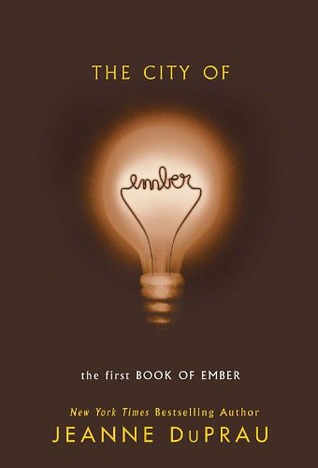
The City of Ember by Jeanne DuPrau, 2003


Many hundreds of years ago, the city of Ember was created by the Builders to contain everything needed for human survival. It worked…but now the storerooms are almost out of food, crops are blighted, corruption is spreading through the city and worst of all—the lights are failing. Soon Ember could be engulfed by darkness….
But when two children, Lina and Doon, discover fragments of an ancient parchment, they begin to wonder if there could be a way out of Ember. Can they decipher the words from long ago and find a new future for everyone? Will the people of Ember listen to them?

(270 pages)

Forget The Hunger Games or Divergent, The City of Ember is my favorite dystopian!

I'm not joking. I don't even like either of those series, but I love The City of Ember. It's a unique story set in a city underground - a city running out of power as the generator that runs everything is slowly breaking down. Lina discovers a piece of paper left by the Builders (the mysterious people who built Ember) to be handed down through the years. It has been forgotten in a messy closet in Lina's house, and Lina's sister Poppy chews the paper up before Lina gets a chance to look at it. Lina enlists the help of her friend Doon to help her decipher what she believes is their key to saving the city - and before they know it, they're in far over their heads.

I normally talk about characters before I mention setting (if I even have room for it at all), but this time I have to focus on the setting first: it is phenomenal. The grungy streets, the way Lina cherishes a couple of colored pencils and a can of pineapples, the shortage of light bulbs, the total fear when the city lights flicker and the city plunges into blackness . . . all blend together perfectly to create this atmosphere of decrepitude. The city is failing. The people of Ember are running out of everything. People know that someday the generator might stop and never turn back on again, leaving the city in complete darkness forever.

Lina is an imaginative, good-natured girl who doesn't even like thinking about the blackouts. Her parents are dead and she lives with her increasingly dotty grandmother and her sweet but troublesome baby sister Poppy whose major contribution to the story is her almost complete destruction of the valuable paper via chewing. Lina is essentially the adult figure in her home, which makes her quite independent.

Where Lina is sweet and has her head in the clouds (well, in what would have been the clouds if she actually lived above the earth), Doon is a realist. He knows something is wrong with the city, and from the first he is determined to do something about it. Throughout the book he struggles to master both his temper and his pride, making him a realistic and relatable character.

If this interests you at all, then read it! I guarantee your library will have it. If you know any kids who are desperate to jump on the dystopian bandwagon but aren't allowed to read the popular dystopians, then send this their way. There's even a movie adaptation to go with it!

Note: If you've already ready The City of Ember, click here to check out my review of the second book in the series, The People of Sparks.