Showing posts with label Blogging for Books. Show all posts

06 January 2017

The Secret Language of Dogs by Victoria Stilwell, 2016

Click to view
on Goodreads 
World-renowned trainer and star of Animal Planet's It's Me or the Dog Victoria Stilwell reveals the secret language of dogs, allowing owners to recognize what their dogs are trying to say, then effectively communicate and change their dogs' behavior for a better-behaved and happier pooch.

Victoria Stilwell is a well-loved and trusted name in America's pet media, winning over audiences with her SuperNanny-like British mannerisms on her Animal Planet show, It's Me or the Dog. In this book, Stilwell uses the latest research on canine language and behavior to reveal what your dog is really thinking--and saying--through its body language, expressions, and actions. Unlike other guides to understanding how dogs think, Stilwell takes it a step further, providing training tips for changing your dog's behavior--as well as tips on communicating back to your dog. Filled with adorable full-color photographs and instructive line drawings, this insightful guide will make you a bona fide "dog whisperer."

(151 pages)

Okay, just for starters: before I requested my copy of The Secret Language of Dogs, I'd never heard of its author Victoria Stilwell. Apparently she's some sort of animal trainer/dog whisperer, but I don't watch much TV in general (and definitely no reality TV) so I've never seen It's Me or the Dog. My dog-training days are pretty much over, at least for now, since the only dog we have is a beautifully-behaved Boxer. She's never growled in her entire life, she doesn't bite even when I shove a pill down her throat, and she's an angel with children. In short, she's perfect! Also, she's crazy-intelligent: it's like she can read minds, that's how well she can know when we're talking about her or follow random commands that I give her but never taught her.

Sorry, I think I got off on a tangent talking about my dog. Focus, Jaina! Let's talk about the book. It's divided up into two parts, "The Secret Inner Experience of Dogs" and "The Secret Meaning of Body and Vocal Languages," both of which are subdivided up into smaller chapters. Nearly every page includes at least one gorgeous full-color picture of a dog (all of whom are at least as cute as that fluffy creature on the cover!) or a pretty pencil drawing of dogs in different positions that illustrate whatever description the text provides. It's a very attractive book, with thick pages and photos that make you want to ignore the text altogether.

As for the content of that text, I thought it was pretty good. I read a ton of dog behavior/training books back when my dog Daisy was a puppy, so I don't think any of the information really blew my mind, but it was presented in a very pleasant and accessible format. The author is very opinionated about the way we should treat dogs (i.e. extremely respectfully), and while I completely agree with her that we need to respect our animal best friends I do think she went a little overboard on that a few times. I got the vibe that she's one of those people who kind of think that dogs are more important than humans.

I do like the emphasis she put on bonding with your dog in order to train it, though, and that she pointed out the way you can use body language to punish your dog more effectively than you ever could by yelling at them. The few times Daisy has gotten in trouble (usually for eating something expensive off the table when we weren't looking), the fastest way I knew to make her feel punished was to put her outside and make a show of glaring at her disappointedly and then turning my back to her. She hated it!

All in all, this is a pretty good book. I'm docking one point from four to three, though, just because of this paragraph:
Interestingly, hand preference could also be linked to learning and emotional issues in people. Approximately 85 percent of people are right-handed, and a preference for using one hand over the other is noticeable in children by about eighteen months of age. Right-handed bias could have evolved because natural selection produced a majority of people with speech and language control in the left brain hemisphere. Because the left hemisphere also controls the movements of the right hand, evolutionary development produced a majority of individuals with a left hemisphere speech/language bias and a right-handed preference to produce written language.
As a third-generation lefty, I can't help but point out how not cool it is to imply that left-handed people are sociologically inferior and probably the left-overs from a natural selection process that weeded the rest of us out. I think it's pretty safe to say that Ms. Stilwell is not left-handed.

Disclaimer: I received a complimentary copy of this book from the publisher through the Blogging for Books program.
19 May 2016

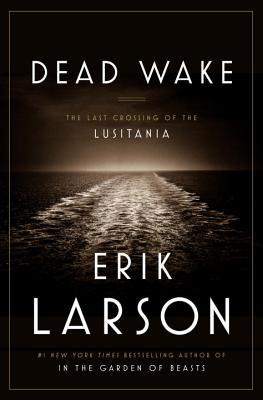
Dead Wake by Erik Larson, 2016

Click to view
on Goodreads 
On May 1, 1915, with WWI entering its tenth month, a luxury ocean liner as richly appointed as an English country house sailed out of New York, bound for Liverpool, carrying a record number of children and infants. The passengers were surprisingly at ease, even though Germany had declared the seas around Britain to be a war zone. For months, German U-boats had brought terror to the North Atlantic. But the Lusitania was one of the era’s great transatlantic “Greyhounds”—the fastest liner then in service—and her captain, William Thomas Turner, placed tremendous faith in the gentlemanly strictures of warfare that for a century had kept civilian ships safe from attack.
Germany, however, was determined to change the rules of the game, and Walther Schwieger, the captain of Unterseeboot-20, was happy to oblige. Meanwhile, an ultra-secret British intelligence unit tracked Schwieger’s U-boat, but told no one. As U-20 and the Lusitania made their way toward Liverpool, an array of forces both grand and achingly small—hubris, a chance fog, a closely guarded secret, and more—all converged to produce one of the great disasters of history.
It is a story that many of us think we know but don’t, and Erik Larson tells it thrillingly, switching between hunter and hunted while painting a larger portrait of America at the height of the Progressive Era. Full of glamour and suspense, Dead Wake brings to life a cast of evocative characters, from famed Boston bookseller Charles Lauriat to pioneering female architect Theodate Pope to President Woodrow Wilson, a man lost to grief, dreading the widening war but also captivated by the prospect of new love.
Gripping and important, Dead Wake captures the sheer drama and emotional power of a disaster whose intimate details and true meaning have long been obscured by history. 

(430 pages)

I've just read three disturbing historical novels in the past three days, and I am most definitely reeling right now. It started with Laurie Halse Anderson's Fever, a historical fiction novel about a plague of yellow fever in Philadelphia; then I re-read Margaret Peterson Haddix's devastating Uprising, which is all about three fictional girls (two of whom die gruesome deaths by the end) and the Triangle Shirtwaist Factory fire. And now there's Dead Wake, which is the most devastating of all because it both focuses on such a huge calamity (two thousand dead!) and describes in painfully exquisite detail the deaths of actual people.

I just . . . ugh. I can't believe I went through a Titanic obsession a few years ago. How could I derive any sort of enjoyment from analyzing the horrible, traumatic deaths of so many people? Somehow with this book - which I thought I'd enjoy because I used to like studying the Titanic - I see now the true horror of these maritime disasters in a way that I never did with the Titanic. The macabre picture Larson paints is just too sick for words, and I really don't even want to think about it.

This is a review, though, so I can't just stop there. I'm going to move away from the actual disaster, which takes place in just the final third of the work, and talk about the book as a whole.

Before now, I would have said that only two nonfiction books stuck completely with the facts and still read like fictional novels. One of these is Candace Fleming's The Family Romanov, a vivid depiction of the last Romanovs drawn from a variety of firsthand accounts and intimate photos; the other is Walter Lord's classic account of the sinking of the Titanic, titled A Night to Remember. Both of these books are amazing, and are the first titles I suggest whenever people ask me for titles on either of those topics. Now I must add Dead Wake to this list, because it is the most stunningly intimate and up-front look you're ever going to get at the Lusitania disaster. You read about the passengers themselves, of course, but you also get to read a little bit about the politics at play behind the scenes; about the British government decoders who knew the general whereabouts of German submarines near the Lusitania but mysteriously neglected to warn anyone; about the rules Germans had for their submarine captains (basically "shoot whatever ships you want, and we'll track your success by measuring how many tons you sink); about Schwieger, the "kind-hearted" submarine captain who once rescued a dog from a ship's wreckage but saved none of the Lusitania passengers.

I can't speak for Larson's historical accuracy, because this is the first book I've ever read about the sinking of the Lusitania. I usually don't read about man-made disasters, because it upsets me so much to see the pain we inflict on each other. Having read many historical nonfiction books in the past, though, this certainly reads like an excellently-researched book - it seems that Larson has done a lot of legwork, and it's obvious from the four-page bibliography (and 25-page Notes section!) that he did a very thorough job with his sources; it didn't all just come straight off of Wikipedia. In the author's note in the back, Larson even talks about how he was very careful to trace every historical claim back to its origins to make sure he used only facts in his account and not just commonly-repeated lies. I for one am more than satisfied, and only the true history buffs are possibly going to be able to poke holes in Larson's interpretation of the event.

At the end of the day, though, forget the squabbles over minor historical details - I'm just left gaping in shock at how terribly cruel humans can be to each other. I shudder at the descriptions that aren't leaving my head any time soon, at the pictures of small children's corpses that I saw when I idiotically typed "Lusitania victims" into Google Images (hint: don't do that). Dead Wake is a stunningly evocative book, and I'm warning you now: only read it if you have the stomach for a front-row look at such a terrible tragedy.

Disclaimer: I received a complimentary copy of this book through the Blogging for Books program in exchange for an honest review.

01 May 2016

How to Have a Good Day by Caroline Webb, 2016

Click to view
on Goodreads 
In How to Have a Good Day, Caroline Webb—economist and former partner at consulting powerhouse McKinsey—shows us how to use recent findings from behavioral economics, psychology and neuroscience to transform our approach to everyday working life. Her science-based techniques have boosted workplace performance and enjoyment for people in hundreds of organizations. Here, Webb shows us how to build these powerful tools into our own daily routines, to give us more control over the quality of our days.
The book is arranged around seven practices that are central to having a good day: setting the right priorities, making productive use of our time, having effective conversations, doing our very best work, achieving great personal impact, being resilient to setbacks, and sustaining our energy. Throughout, Webb teaches us how to be at our best even under pressure, and equips us to handle common challenges such as co-worker conflicts and difficult deadlines.
Filled with real stories of people who have used the Webb’s insights to improve their working lives, and drawing on cutting-edge ideas from the latest research in behavioral science, How to Have a Good Day is the book people wanted to read when they finished Blink and Thinking Fast and Slow, and were looking for practical ways to apply what they had learned to their own lives and careers.

(368 pages)

I'm not exactly sure how I thought I'd be a good person to read this book.

I mean, it's geared toward adults struggling as they face the daily grind of their office jobs. I'm a seventeen-year-old homeschooled high school student who sees an average of three people (excluding my family) a weekday - none of whom are actually my age. I'm not exactly drowning in office politics! But I liked the description of "science-based techniques" that could "transform our approach to everyday working life," and there weren't any other books in the program that I desperately wanted, so I requested How to Have a Good Day.

And it took me almost two full months to get through. For a girl who can read a 350-page novel in two and a half hours, this is really pathetic. What happened? Well . . . I got bored. Like, really bored. Her advice is actually really insightful, and there were parts that I could apply to myself, but so much of the content didn't apply to me that I had a hard time getting through it. I wound up leaving it by my bed and reading a chapter right before I went to sleep, when I was ready to start slowing myself down. Then today I finished the last third of the book all in one sitting, because I wanted to just get it done once and for all.

But honestly, it's not even that bad of a book. It's good, it really is! Webb's advice is thought-provoking, and I loved how she backed up all of her points with solid scientific evidence from legitimate studies. It was also cool to see how she combined studies and phenomena I've encountered over the years to explain human behavior. My favorites were when she explained how we make choices at the margin (an AP Micro topic), and when she talked about how the REM phase of sleep is the most restful and helpful phase for rebooting our brains. It was really cool to read a book that was so clearly not one of those quack science advice books. As the daughter of a real scientist, I can't stand those! This one, though, is full of hard data that really makes her points extremely valid and believable (though of course I can't totally vouch for them since I can't put them to the test).

Anyway, I'm sorry if I'm not much help in deciding whether to get this book. It made for an interesting and engagingly-written book, and I really will try to work on knowing myself and following her advice for moderating my interactions with others, but I'm not really the best judge of her techniques. As soon as I'm done writing this review, though, I'm planning on handing the book off to my father - he only recently began working in industry and is still adjusting to life in a bureaucracy, so he's pretty much the ideal target for this book. If I can actually get him to read it, I'll be sure to let you know whether he thinks it helps him! In the meantime, let me know in the comments below what your go-to tactic is for getting through a hard day.

Disclaimer: I received a complimentary copy of this novel from the publisher through the Blogging for Books program.

15 February 2015

Knitting Block by Block by Nicky Epstein, 2010

No one forgets the sweet victory of completing their first knitted block, but most of us quickly move on to more complex constructions, only making swatches for guage. In this comprehensive volume, celebrated designer and innovator Nicky Epstein reimagines the humble block with 150 new patterns and masterfully demonstrates how to mix, match, and easily combine them into stunning one-of-a-kind garments and accessories. Inside you will find: 150 original block patterns, from simple textures to embossed pictorials, intricate lace to cables, colorwork, double knit, and more, all with Nicky’s signature wit, verve, and style. More than ten exclusive project designs that will make you say “I can’t believe that is made out of blocks!”Detailed guidance for creating exciting pieces out of block knitting, without using increases or decreases. Exclusive cut-and-paste project design pages. Simply cut out the printed blocks and arrange them to help create your own masterpieces.
Blocks are quick to knit, portable pieces perfect for group and charity projects, and now not limited to just afghans! Knitting Block by Block gives you the tools to unlock a world of creative possibilities and confidently build your own design “blockbusters,” one block at a time.  

My knitting project (the blobs are
supposed to be cabling)
Yes, I really did request a knitting book for my next read-to-review. I clicked before I finished thinking it through, okay? My inner voice was going "you know, you've always wanted to learn how to knit" and I had requested the book before my brain remembered that this isn't actually a book that's made to teach people how to knit. It arrived two weeks ago, and it's been interesting. I really have learned how to knit! I've had a blast learning the ins and outs of knitting, purling, and even cabling (though I have a sinking feeling I'm doing it wrong), and after half a dozen bad starts I even got a project well under way. I decided to make the "Reversible Cables" block (in retrospect maybe I should have started with something toward the beginning, instead of the back, of the book), and I'm about halfway through. It's taken me a really long time, though, because my hand is still weak from the surgery I had in December (though on the whole it's doing much better), and so it gets sore if I knit for more than half an hour at a stretch. Also, I had an English assignment and two science tests in the last two weeks, and not a lot of down time. I decided I wouldn't wait until I finished the entire square to write the review, because I'm not exactly gathering any new knowledge about the book itself while I knit - I know how it works, what the projects are, and (bonus!) even how to knit now, so I've got everything I need to review the book - following the same instructions for another two weeks won't give me any deeper understanding into the books as a whole.

I'm not exactly a knitting patterns connoisseur, but I really love Knitting Block by Block. It has patterns ranging from simple beginners' blocks to the intricate ones I can't even begin to decipher at first glance (how the heck do you put a decorative zipper on a block of knitting?!), with detailed pictures of every project so you can see exactly what it should look like when you're done. The instructions are laid out neatly and concisely, listing exactly what you should do in simple enough terms that I caught on with only one Google search necessary - and that was just for the cable. There are also box chart  thingies that show you what to do using dots and slashes and things, but I'm afraid I still can't make heads or tails of those. It's fun, it's detailed, and there are some really cute projects that I can't wait to try out. There's also a chapter with some ideas for ways to sew blocks together into bigger projects, like scarves and afghans and a (rather ugly) shrug/shawl thingy. I obviously am not far enough to attempt any of these, because I don't have the blocks to do them, but I'm excited to make some of the projects - I think I'll start with one of the one-block projects, which are these cute little stuffed animals, and then try either the tote (which is a two-block!) or the "cool ruffle pod bag," which is a weird name for a cute purse.

All in all, the only complaint I have is that there aren't more projects for using the blocks. There are tons and tons of awesome block designs, but only like ten ideas for putting them together in larger pieces. For someone who knits more than me, this might be a problem if they wind up with more blocks to try out than they have projects to put them in. As for me, though, I think this book will provide fodder for my knitting projects for a very, very long time. If you are at all interested in knitting blocks, then this is most definitely the book for you!

Disclaimer: I received a free copy of this book from the Blogging for Books program in exchange for an honest review