Showing posts with label LibraryThing. Show all posts

12 February 2018

Just Friends by Dyan Sheldon, 2015

Click to view
on Goodreads 
From the writer of Confessions of A Teenage Drama Queen and My Worst Best Friend comes this hugely entertaining teen read about falling for the wrong person. The first time Josh sets eyes on Jena he's hooked. He can't stop thinking about her; looking for her wherever he is; hoping to turn a corner and find her there. The problem is she's completely out of his league as his friends never tire of telling him, so Josh decides he will settle on simply being Jena's friend. But the more time he spends with her the more infatuated he becomes, despite the fact Jena only turns to him when she's had a fight with her on-again off-again boyfriend. Finally realizing he can't go on pretending he only wants to be her friend, Josh vows to tell Jena how he feels on Valentine's Day.
(288 pages)

Meh. Too many love triangles/squares for my taste. Sometimes I really love unrequited love stories, when they're well done, but here they're just cringeworthy and pretty dumb. I wanted to reach into the book and smack Josh for being such an idiot: he let Jena constantly take advantage of him, and treated his own friends like dirt in order to be a "good friend" too her (with secret aspirations for more). I don't really like the idea of becoming a girl's best friend to try to become her boyfriend, while letting her think you aren't romantically interested in her, because it just seems emotionally manipulative and dishonest.

I mean, it's one thing to be good friends while keeping the possibility of becoming more someday in the back of your brain; but Josh very explicitly decides that he wants to be romantically tied to Jena, but repeatedly lets her believe otherwise when she brings that very topic up. That's when I think it crosses the line and becomes stupid and unfair.

The characters were fairly well-written, though rather one-dimensional at times (each person basically had one or two traits/interests that defined who they were in the story), and there were a few too many of them–I wound up getting some of the more minor friends confused.

The language is also not ideal; I can't remember specifically what words were used (since I don't have my copy of the book here with me at uni), but I do know that I noticed it was bad in parts. That's not a huge deal for older readers, and it's realistic because the characters are in high school, but that's something to keep in mind for younger readers.

All in all, I was kept entertained by Just Friends but I wasn't wowed by it–rather, I was very frustrated/embarrassed for the characters in parts. I don't really recommend it highly, but I won't actively warn you off it either if you still think it sounds interesting. If you do decide to read it, let us know in the comments what you think of it!

Disclaimer: I received a complimentary copy of this novel from the publisher through a LibraryThing giveaway.

17 November 2017

The Hand Book by Miryam Z. Wahrman, 2016

Click to view
on Goodreads 
Handwashing, as part of basic hygiene, is a no-brainer. Whenever there's an outbreak of a contagious disease, we are advised that the first line of defense is proper handwashing. Nonetheless, many people, including healthcare workers, ignore this advice and routinely fail to wash their hands. Those who neglect to follow proper handwashing protocols put us at risk for serious disease--and even death.

In this well-researched book, Wahrman discusses the microbes that live among us, both benign and malevolent. She looks at how ancient cultures dealt with disease and hygiene and how scientific developments led to the germ theory, which laid the foundation for modern hygiene. She investigates hand hygiene in clinical settings, where lapses by medical professionals can lead to serious, even deadly, complications. She explains how microbes found on environmental surfaces can transmit disease and offers strategies to decrease transmission from person to person. The book's final chapter explores initiatives for grappling with ever more complex microbial issues, such as drug resistance and the dangers of residing in an interconnected world, and presents practical advice for hand hygiene and reducing infection. 

With chapters that conclude with handy reference lists, The Hand Book serves as a road map to safer hands and better hygiene and health. It is essential reading for the general public, healthcare professionals, educators, parents, community leaders, and politicians.
(248 pages)

This was one of the first books I ever won through the LibraryThing Early Reviewer program. I was new to LibraryThing at the time, and slightly too trigger-happy about clicking "request" for books that I'd normally never pick up. When I got the email saying I'd actually won a copy of The Hand Book, I was shocked–what was I going to do with a book about hand sanitization?! I thought it was going to be one of those pseudo-science books, full of "solutions" to germs that involved, I don't know, drinking special tea or something. I wound up just shoving the book on my shelf and planning to get to it "someday." Since I'm trying to review all the books I've gotten for review this summer before heading off to college, that day has finally come.

And honestly,  The Hand Book is way more legit than I was expecting. Wahrman is actually a real scientist who has done detailed experiments into the spread and dangers of germs. Her advice is thorough and practical, designed to make you think about the disgusting germs you come into contact with on a regular basis and to help you make some small changes to decrease the chances of contracting  an illness. That's interesting enough, but what I really liked were Wahrman's discussions of hand hygiene in hospitals, restaurants, and third-world countries. It's really disgusting to read about all the mistakes and deaths that occur every year because of carelessness in the first two institutions, but also quite interesting to learn about all the creative (and surprisingly effective) ways people in poor countries have developed to cleanse themselves without water.

I'll be honest, I didn't carefully read every page of The Hand Book; I was in a skimming sort of mood when I sat myself down to finally read it. But I enjoyed it way more than I'd ever thought I would–it was far more interesting, engaging, relevant, and well-researched than I'd expected. I can't say it was a page-turner, because this sort of material simply can't be, but it was as close to that as a book about hand hygiene can get. It also temporarily turned me into a germaphobe, so that's new.

Disclaimer: I received a complimentary copy of this book through the LibraryThing Early Reviewer program.

27 January 2017

Hundred Percent by Karen Romano Young, 2016

Click to view
on Goodreads 
The last year of elementary school is big for every kid. Christine Gouda faces change at every turn, starting with her own nickname—Tink—which just doesn't fit anymore. Christine navigates a year's cringingly painful trials in normalcy—uncomfortable Halloween costumes, premature sleepover parties, crushed crushes, and changing friendships. Throughout all this, Tink learns, what you call yourself, and how you do it, has a lot to do with who you are.
(256 pages)

I don't read a lot of these "middle school drama" type books because, to be perfectly honest, I often find them to be annoying and unrealistic. What real thirteen-year-olds spend their entire lives revolving around puberty, boys, and changing friendships? Neither I nor my friends were ever like that, but we did run into those sorts of kids once in a while. I didn't really get them then, and I still don't completely get that mindset.

Anyway, though Hundred Percent was actually a pretty good book, my biggest issue with it was that the kids were way too "mature" (as the adults at school put it) for their age. They throw around words like "slutty" and "sexy," make jokes about "balls," and are always listening to "Rolling Stones" songs with very suggestive lyrics. And they're not even in middle school–they're in sixth grade! Eleven-year-olds are way too young to be thinking about any of those things.

If you forget the fact that Tink and her friends are so young, though, the story itself is a good one. I enjoyed watching her grow over the course of the novel as she struggled to define who she was. I can't say I'm a huge fan of her on-again-off-again childhood best friend Tracie, who tries way too hard to fit in with the cool kids (the "circle"), but one of the great things about the way the book is written is that by the end of the story I do understand and empathize with her decisions. There are several other side characters in Tink's class who are interesting, though probably more than were absolutely necessary–I started getting them muddled after a while. My favorite of these other characters was probably Bushwack, the nice, funny, and very uncool boy Tink likes a little more than Tracie thinks she should.

Some of the topics that come up are pretty serious ones. Tracie's mom has always been single, and there are whispers that Tink doesn't really understand calling her "a slut." The man she's dating is a twice-married guy with two kids, and Tracie spends quite a bit of the book romantically pursuing his son who's two years older than she is. There's a new boy at school who holds Tink's hand and tells her that he thinks she'd look attractive without any clothes on. Ick. The way all of these issues are handled is very tasteful, but I definitely wouldn't hand Hundred Percent over to an actual sixth-grader.

Honestly, I'm not really sure who the target audience for this book is. If you think it looks interesting, then you should check it out. Let me know if you do!

Disclaimer: I received a complimentary copy of this novel through the LibraryThing Early Reviewers program.

08 May 2016

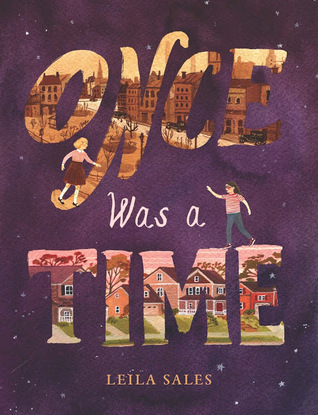
Once Was a Time by Leila Sales, 2016

Click to view
on Goodreads 
In the war-ravaged England of 1940, Charlotte Bromley is sure of only one thing: Kitty McLaughlin is her best friend in the whole world. But when Charlotte's scientist father makes an astonishing discovery that the Germans will covet for themselves, Charlotte is faced with an impossible choice between danger and safety. Should she remain with her friend or journey to another time and place? Her split-second decision has huge consequences, and when she finds herself alone in the world, unsure of Kitty's fate, she knows that somehow, some way, she must find her way back to her friend. Written in the spirit of classic time-travel tales, this book is an imaginative and heartfelt tribute to the unbreakable ties of friendship.
(272 pages)

I'm still reeling, taking in all of the thoughts and experiences I had while reading Once Was a Time. 

I initially wanted to read it because it has time travel in it, but I soon realized that this is far more than just your average "time travel book." Lottie isn't an adventurer; she's just a ten-year-old girl from WWII-era England who ran through a portal to escape danger and suddenly found herself in Wisconsin in 2013. Watching her find her way through our world, watching her discover everything that's been invented in the last seventy years, was fascinating. At times, I even forgot that she had come to my own time; everything was so foreign and frightening to her that I found myself just as scared as Lottie, just as disconcerted by the cavalier 21st-century attitudes that I'm normally used to.

I love watching Lottie struggle to adapt to her new persona of "Charlotte the foster kid," and to bluff her way through life as a completely normal 21st-century kid. You can see how she almost loses control of herself, how she throws away everything that made her her in her attempt to fit in and be welcomed by those around her. She compromises so much to fit in (both when it comes to keeping her life a secret, and to being popular at school), and I really loved watching her come to the realization that she is still in control of her own life even though she's not living the life she'd expected when she was little.

I can't say too much more without spoiling the book, but before I end the review I will say that this book is not completely perfect. I appreciated how well Sales drove home the reality of what it would be like to be forced into such a situation, but I would have preferred to spend even more time watching Lottie go through the transition. As it is, we watch her for a little while and then speed forward to a few years later. Then, near the end, there's another "days turned to months, months to years" segue and we skip forward again in time. I would have liked a longer book that really delved into describing those periods of times, instead of just skipping over them.

All in all, though, I'm so glad I got the chance to read this engaging and thought-provoking book about what it would really be like to travel forward in time. I'm definitely adding it to my favorites list! What are your favorite time travel books? Let me know in the comments below!

Disclaimer: I received a complimentary ARC of this novel from the publisher through a LibraryThing giveaway.