Showing posts with label bullying. Show all posts

05 May 2017

Restart by Gordon Korman, 2017

Click to view
on Goodreads 
Chase's memory just went out the window.

Chase doesn't remember falling off the roof. He doesn't remember hitting his head. He doesn't, in fact, remember anything. He wakes up in a hospital room and suddenly has to learn his whole life all over again . . . starting with his own name.

He knows he's Chase. But who is Chase? When he gets back to school, he sees that different kids have very different reactions to his return.

Some kids treat him like a hero. Some kids are clearly afraid of him.

One girl in particular is so angry with him that she pours her frozen yogurt on his head the first chance she gets.

Pretty soon, it's not only a question of who Chase is--it's a question of who he was . . . and who he's going to be.

From the #1 bestselling author of Swindle and Slacker, Restart is the spectacular story of a kid with a messy past who has to figure out what it means to get a clean start.

(256 pages)

Do you know, I was supposed to be studying for my AP exams all day today. That was the goal, at least, until that little yellow package from Scholastic showed up on my doorstep. Once I pulled out my brand new ARC of Restart, the newest Korman novel, then my day was doomed. I dropped everything and devoured the entire thing in about two sittings (the one break consisted of my trying to get back to work, failing, and then shrugging and picking the book up again).

I don't know what it is about Gordon Korman, but his books always suck me in. Perhaps it's because I've been reading them for so long now, his distinctively funny yet deep writing style makes me nostalgic and lets me pretend that I'm a little kid again and not a high school senior preparing to head off to college. Perhaps its simply because of the intriguing storylines or because he always takes the story the way I'm hoping. Maybe it's a combination of all of those things.

Because on the surface, Restart is not the most amazing book I've ever read. I mean, its premise is awesome–a bully who's lost his memory and is nice now? Sweet!–but it's also incredibly unrealistic. Take it from the girl who was supposed to be studying AP Psychology all afternoon. And a lot of the elements that make up Restart have shown up in previous Korman novels. I was especially reminded of No More Dead Dogs and The Chicken Doesn't Skate, because all three books have elements of social blending, with kids from wildly different clubs and interests coming together in a combination of sports and theater/filmmaking/science (respectively). I also noticed a few character archetypes, like the filmmaker addict and the main girl who starts out hating the protagonist, and the slightly spacey fangirl chasing after the protagonist. All of these characters show up in at least two of the three books I mentioned, and some of them in others besides.

But you know what? I just don't care. Gordon Korman does middle schools books well. And I love the elements he pulls together, and Restart is actually a really good book. Because you see, I adored No More Dead Dogs and The Chicken Doesn't Skate. To this day, they still rank on my list of favorite books ever. If Korman wants to revisit some of his greatest successes and borrow a few devices, then I am totally okay with that.

And besides, how could I not love the "bully with amnesia" angle? Realistic or not, it's played amazingly here. My main critique, honestly, is that we don't get enough details about Chase's ordeal. I would have loved much more time spent just on watching him adjust to life without any of his memories, and I wouldn't have even minded getting more medical mumbo-jumbo to explain why his whole personality suddenly shifted with the bump on the head!

Anyway, I'll stop the review here because I don't actually have my copy of the book anymore: my elementary-school-aged brother came into my room tonight, asked for Restart, and disappeared with it. And honestly, if that doesn't tell you something about the universal appeal of Korman's books, then I don't know what would.

[Update: Just thought you'd like to know that within the first two days of Restart being in the house, three of us read it: I finished it the first day, my brother borrowed it that night and finished it by lunch the next day, and my mom borrowed it that night and stayed up past midnight reading it (on the landing, because my dad kicked her out so he could go to sleep). Like I said, my family love Gordon Korman books.]


Disclaimer: I received an unsolicited copy of this novel from the publisher in exchange for an honest review.

27 January 2017

Hundred Percent by Karen Romano Young, 2016

Click to view
on Goodreads 
The last year of elementary school is big for every kid. Christine Gouda faces change at every turn, starting with her own nickname—Tink—which just doesn't fit anymore. Christine navigates a year's cringingly painful trials in normalcy—uncomfortable Halloween costumes, premature sleepover parties, crushed crushes, and changing friendships. Throughout all this, Tink learns, what you call yourself, and how you do it, has a lot to do with who you are.
(256 pages)

I don't read a lot of these "middle school drama" type books because, to be perfectly honest, I often find them to be annoying and unrealistic. What real thirteen-year-olds spend their entire lives revolving around puberty, boys, and changing friendships? Neither I nor my friends were ever like that, but we did run into those sorts of kids once in a while. I didn't really get them then, and I still don't completely get that mindset.

Anyway, though Hundred Percent was actually a pretty good book, my biggest issue with it was that the kids were way too "mature" (as the adults at school put it) for their age. They throw around words like "slutty" and "sexy," make jokes about "balls," and are always listening to "Rolling Stones" songs with very suggestive lyrics. And they're not even in middle school–they're in sixth grade! Eleven-year-olds are way too young to be thinking about any of those things.

If you forget the fact that Tink and her friends are so young, though, the story itself is a good one. I enjoyed watching her grow over the course of the novel as she struggled to define who she was. I can't say I'm a huge fan of her on-again-off-again childhood best friend Tracie, who tries way too hard to fit in with the cool kids (the "circle"), but one of the great things about the way the book is written is that by the end of the story I do understand and empathize with her decisions. There are several other side characters in Tink's class who are interesting, though probably more than were absolutely necessary–I started getting them muddled after a while. My favorite of these other characters was probably Bushwack, the nice, funny, and very uncool boy Tink likes a little more than Tracie thinks she should.

Some of the topics that come up are pretty serious ones. Tracie's mom has always been single, and there are whispers that Tink doesn't really understand calling her "a slut." The man she's dating is a twice-married guy with two kids, and Tracie spends quite a bit of the book romantically pursuing his son who's two years older than she is. There's a new boy at school who holds Tink's hand and tells her that he thinks she'd look attractive without any clothes on. Ick. The way all of these issues are handled is very tasteful, but I definitely wouldn't hand Hundred Percent over to an actual sixth-grader.

Honestly, I'm not really sure who the target audience for this book is. If you think it looks interesting, then you should check it out. Let me know if you do!

Disclaimer: I received a complimentary copy of this novel through the LibraryThing Early Reviewers program.

05 December 2016

Larger-Than-Life Lara by Dandi Daley Mackall, 2016

Click to view
on Goodreads

This isn't about me. This story, I mean. So already you got a reason to hang it up. At least that's what Mrs. Smith, our English teacher, says.
But the story 
is about ten-year-old Laney Grafton and the new girl in her class--Lara Phelps, whom everyone bullies from the minute she shows up. Laney is just relieved to have someone else as a target of bullying. But instead of acting the way a bullied kid normally acts, this new girl returns kindness for a meanness that intensifies . . . until nobody remains unchanged, not even the reader.

In a unique and multi-layered story, with equal parts humor and angst, Laney communicates the art of storytelling as it happens, with chapter headings, such as: 
Character, Setting, Conflict, Rising Action, Climax. And she weaves an unforgettable tale of a new girl who transforms an entire class and, in the process, reveals the best and worst in all of us.
(176 pages)

I've been a long-time casual fan of Dandi Daley Mackall's books ever since I picked up a copy of her the first Winnie the Horse-Gentler book at a yard sale a few years ago. I was getting rather sick of horse books at the time because I was realizing they all had the same rather vapid and predictable plot lines, but the book reinvigorated my passion for horse novels. I also later loved Mackall's Starlight Animal Rescue series, which is connected to the Winnie books, and loved them even more. Mackall has a gift for blending realistic characters, hard facts about life, and inspirational messages all together and offering them to her readers in slim, engaging novels. That's why I leaped at the opportunity to review Larger-Than-Life Lara: it looked like a very different book than the other ones I'd read by Mackall, but I was pretty sure she'd still be able to pull off a great story.

And she did. I really enjoyed reading Lara, it felt kind of like a grittier version of The Hundred Dresses. Actually, now that I think about it, I would be surprised if Mackall got the inspiration to write Lara from Dresses. Since I always loved Dresses growing up, that is a very good impression for me to come away with.

The narration in Lara comes from Laney, who has to be on of the best narrators I've read in a while. She's writing the "true" story down the way her teacher taught her to, using all the tricks they learned in school. Every chapter is titled with exactly what it introduces (Villain, Setting, Dialogue, etc.), and Laney prefaces her plot devices or narration decisions with funny, candid explanations like this one:
Mrs. Smith says stories have a beginning, middle, and end. They should get told in a chronological order, which is a fancy way of saying making stuff happen like it did in real life, without jumping back and forth in time like some kind of time traveler. I tried to do that, which is why you can find words like first and next and then, if you go back looking for them in this story.
But I can't figure out how else to tell this one conflict without time traveling backwards. So Mrs. Smith, if you're reading this, I just apologize for this.
Isn't that just so cute? I don't know what it is, but I just really love this sort of fourth-wall-breaking narration style.

Anyway, moving on. Laney is a really great character, not just a fun narrator, and I definitely felt for her. The situation at her home is not so great (think three older brothers, no mother, and an alcoholic/likely abusive father), and she is constantly covering for her family at school and hiding her school life from her family. It's not good, at all, and I felt terrible watching her hold everything in. The focus in the end of the book, though, isn't really on her home life; it's on Lara and the way she was being treated at school. Now I haven't had much experience with bullying, but I thought it was absolutely horrible the way everyone treated Lara from day one. The minute she walked in the classroom door, people were calling her ugly names and making fun of her. That's despicable! If she's really that overweight, that's her parents' fault–or the fault of some disorder, maybe, I don't know–but it's definitely not her fault. She's ten years old, people! I don't know, fifth graders are just so barbaric sometimes.

As for Lara as a character, I never really felt like I got to know her that well. She seems sweet, and extraordinarily brave, but almost rather one-dimensional: we never really see Laney have a heart-to-heart with Lara and find out what makes her tick. There were honestly a lot of characters and plotlines whose stories I would have loved to see expanded, which is why I wish the book were a little longer. Barring an updated and heftier re-release of the novel, I'm hoping for a sequel sometime down the road. I think there's a lot of material in Larger-Than-Life Lara that Mackall could use to develop a whole series, actually. It could be, I don't know, "The Paris, Missouri series." Or something catchier. I'm not really a title developer. But anyway, I definitely enjoyed Larger-Than-Life Lara and I'm glad I had the chance to read it. If you've read it, comment below and let me know what you thought!

Disclaimer: I received a complimentary copy of this novel from the publisher in exchange for an honest review.

23 October 2015

Frosted Kisses by Heather Hepler, 2015

Click to view
on Goodreads 
A delicious follow-up to Heather Hepler's smash hit The Cupcake Queen!
Former Manhattan girl Penny has quickly discovered that life in a small town is never dull. Not when there's a festival for every occasion, a Queen Bee to deal with, an animal shelter to save, and a cute boy to crush on.
There's a new girl in town: Esmeralda. She's beautiful, French, and just happens to be Queen Bee Charity's best friend. Penny hopes the arrival of Esmeralda means Charity might be too busy to keep making her life miserable.
But Penny doesn't have a lot of time to worry about Charity. Her best friend, Tally, has recruited her to help raise money to save the local animal shelter. Then there's Marcus, the adorable and mysterious boy who Penny thinks maybe likes her as much as she likes him. Plus, this is Penny's first holiday season as a "divorced" kid--although she has no idea what this means.
Can Penny help her friends save the shelter, navigate her new family dynamics, and get the boy, or will Charity and Esmeralda find a way to ruin everything?

(272 pages)

I'll be honest: this is the second book in a series, and I haven't read the first book. I don't really know what's spoilers and what isn't for the first book, so check The Cupcake Queen out on Goodreads here if you want to read it before my review. I don't make a habit of starting series halfway through, but I got an ARC of Frosted Kisses in August, and I just couldn't resist diving into what looked like the perfect end-of-summer read.

The MC Penny is fine, a bit of a vanilla character really, and I honestly felt like the other characters were the ones who stole the show. I appreciated the depth of Penny's worries, though, because mixed right in there with the petty school-girl pranks and fretting about her budding relationship with Marcus are some serious scenes about her absentee father, and about her realization that she can't keep excusing his behavior away. I don't know what happened between Penny's parents in the first book, and I'm not really a fan of divorce in general, but it's compelling to watch Penny struggle to come to terms with her father's parenting fails.

Trouble with bad parents brings me to Penny's best friend Tally, who may or may not have been a little over-the-top (okay, yeah, she was), but was still likable enough. I feel like Hepler probably wanted me to love her even more, but I just didn't really click with her. I didn't dislike her, though, and I enjoyed reading about some of the scrapes she pulled Penny into. I also appreciate that she was dealing with some truly terrible issues, bringing further depth to the story. What I didn't enjoy as much was the way she kept switching back and forth between being friendly and being mysteriously moody, for a reason that wasn't explained until Chapter 17. I think the decision to reveal it so far into the book was a bad one, because it made the entire novel feel more contrived and little bit like a soap opera. If she had just told Penny sooner, or been a little subtler about the whole thing until later, the entire book would have been much stronger.

As for Penny's love interest, Marcus has it all: he's sweet, he's kind, he's loyal, and he's motherless. Marcus isn't really "mysterious," though. I'm really not sure where the synopsis comes off saying that. He's not (unlike most of the other characters) hiding any big secrets, he's not brooding, he's not erratic. All in all he's a nice, normal, sweet boy and the only mystery to be found in connection with him is wondering why Penny could ever doubt his affection for her. He and Penny have a very sweet relationship, and I loved the way they weren't just "Boyfriend and Girlfriend!" with no room for thinking about anything other than impressing each other, and trying to find the privacy to have their first kiss. They were also just friends, and very good ones at that.

All in all, Frosted Kisses is a lot deeper than I was expecting. At the same time, it's still just as shallow. For the first 150 pages I had hope that it would, despite its flaws, end up a meaningful, original, stereotype-bending novel. It didn't - I mean, it had its meaningful parts and its fairly original components, but it also featured a few too many cliches. The mean girl is so shallow and petty I couldn't help finding her funny, and once or twice the action felt forced (like when Blake knew the answer to a question Penny had, and was sitting right there when she asked it, but didn't tell her because he "wasn't going to get involved." I mean, seriously?).

So yeah. I'm not sure whether I'll be going out of my way to recommend Frosted Kisses, but I won't be warning people off of it either. And if you think it looks good, then you should definitely give it a try! Just, um, maybe start with the first book. I can see Frosted Kisses being even sweeter to read if you actually know everyone's backstories.

Disclaimer: I received an ARC of this book from the publisher in exchange for my honest review.

09 October 2015

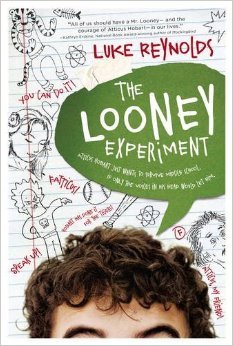
The Looney Experiment by Luke Reynolds, 2015

Click to view
on Goodreads 
Atticus Hobart couldn't feel lower. He s in love with a girl who doesn't know he exists, he is the class bully's personal punching bag, and to top it all off, his dad has just left the family. Into this drama steps Mr. Looney, a 77-year-old substitute English teacher with uncanny insight and a most unconventional approach to teaching. But Atticus soon discovers there's more to Mr. Looney's methods than he'd first thought. And as Atticus begins to unlock the truths within his own name, he finds that his hyper-imagination can help him forge his own voice, and maybe just maybe discover that the power to face his problems was inside him all along.
(208 pages)

Hmm. This one looked a lot better in the description.

I mean, it looks good, doesn't it? The synopsis makes it look like a sort of mix between Dork Diaries (or whatever it's called - Diary of a Teenaged something, maybe? I don't read them, in case you couldn't tell) and the Terupt books (which I have read - and loved!). I always like a good coming-of-age story, and books about kids with crazy-but-super-effective teachers are kind of my secret addiction. So I snapped The Looney Experiment up when I saw it available for review - and now I'm wishing I hadn't.

Because for one thing, they swear too much. And fart too much. I get that Atticus and his classmates aren't little kids, but it's still a little excessive that they have to be using the A word all the time. And I can forgive some of the farting because Atticus' little brother is pretty young, but I still don't really enjoy reading about it. There's only so much family bonding over flatulence that I can stomach, okay?

And in a way The Looney Experiment is meaningful - after all, Atticus learns some very valuable lessons from Mr. Looney! - but it also felt pretty fake. I mean, we're basically told (and not shown) that Mr. Looney is this awesome teacher, but all he really does is really nutty antics that shock his students into thinking he could be someone cool. To be perfectly honest, I would probably have behaved more like Danny than like Atticus when they all made a conga line and danced around the classroom.

As for the girl - yikes! I feel bad, because I know that kitschy middle-school romances are part and parcel with reading MG these days, but I just couldn't really handle it. They're, like, twelve. I don't care if she's nice, she's still six years from reaching majority! When I was that age, I wasn't even thinking about romance, let alone crushing on guys or wanting to go out with them. Reading about Atticus' clumsy attachment to Audrey is cute in a way, but the whole thing just isn't handled well enough to keep me invested. I know it's possible for me to enjoy MG romances (just look at the Willow Falls books by Wendy Mass, or The Wednesday Wars by Gary D. Schmidt - links go to my reviews), but there was nothing doing this time.

I just don't know. I don't know who I would give this to, or why, or when. It's got some great themes and messages, don't get me wrong, but there are so many other books out there that cover all of this same material in a more tasteful way (or at least in a way that's more to my taste). If it looks good to you, go for it - maybe it's more your cup of tea than it is mine. But I won't be recommending The Looney Project in the future, and I'm donating my copy to the local book swap.

Disclaimer: I received a free copy of this book through the BookLook Bloggers program in exchange for an honest review.

15 June 2015

Sorry I'm Not Sorry by Nancy Rue, 2015

Click to view
on Goodreads
According to the Ambassadors 4 Kids Club, one out of every four students is bullied--and 85% of these situations never receive intervention. Parents, students, and teachers have amped up solving the bullying problem for a networked generation of kids.
Written by bestselling author Nancy Rue, each book in the Mean Girl Makeover trilogy focuses on a different character's point of view: the bully, the victim, and the bystander. The books show solid biblical solutions to the bullying problem set in a story for tween girls.
"Sorry I'm Not Sorry" tells the story of Kylie Steppe, former queen bee of Gold Country Middle School. After bullying a fellow GCMS student, Kylie has been expelled--"and "she" "has to attend mandatory counseling. Without her posse to aid her and other peers to torment, Kylie focuses on the person who stole her GVMS popularity crown: Tori Taylor. As Kylie plots revenge on Tori, she attends therapy sessions, where she reveals a few details that might explain why she finds power in preying on her middle school peers. After a rough year with bullying backfire, will Kylie decide to become more empathetic with her peers?
It's hard for tweens to imagine why a bully acts the way she does. "Sorry I'm Not Sorry" shows girls that they hold the power to stop bullying through mutual understanding and acts of love.
(288 pages)


This is the third book in the "Mean Girl Makeover" series. I've never read the first one, but I got a copy of the second book (You Can't Sit With Us - click to check out my review) in January. I didn't particularly love You Can't Sit With Us for its plot or characters, but it still held a special place in my heart because it was the first book I ever got for free as a read-to-review. That's why I still chose to review Sorry I'm Not Sorry, when I probably wouldn't have otherwise. I'm actually glad that I did, because it's much better than its prequel.

It's still got some issues, I'm not going to sugarcoat that. Kylie has such a complete turn-around that it's just a little too good to be true. The anti-bullying Code the "nice" kids go by still is kind of over-the-top touchy-feely. Lydia, the bullying counselor, is a little too perfect. Everyone thinks it's perfectly normal for a public school counselor to talk about faith and the Bible when she's working with students. Kylie's ex-friends go way overboard when they turn on her and give her a chance to understand what it's like to be the one who's bullied.

But somehow all of these things, which bugged me like crazy in YCSWU, aren't nearly as glaring in this book. I think a large part of this is that I actually liked Kylie a lot better than Ginger. Ginger was like this quivering, emotional mess who thought that if her father heard the mean rumors about her mother he would have such a mental collapse she would be taken out of his custody. This when her mother had been dead for several years, and the authorities had never even hinted that her father was a negligent parent. And she was supposed to be smart! Kylie, on the other hand, was much more believable - and, frankly, likeable. Her reasoning for keeping the bullying a secret was "I don't want to deal with this. I'm grounded off of going online anyway, so I'll just not think about it." You can almost understand how Kylie, a kind-hearted girl deep down, could do such horrible things to her classmates: it's obvious that she's emotionally stunted, and that her parents don't know squat about raising children. They always come to her defense, are constantly on her side . . . and consider their duties fulfilled if they give her a credit card and send her off to the mall.

I can almost buy that Kylie was a genuinely nice person who did some terrible things without thinking through the consequences. But, as much as I found myself loving her as a character, how can I accept that she never second-guessed what she'd been doing? How can I believe that she was so steeped in the bullying game, and yet can do a complete one-eighty over the course of a few months? Shouldn't she have had a stronger conscience during her time as a bully? Shouldn't she have had a few relapses into bullying people? Why does she go from being completely horrible, to being so nice? I can understand that being taken away from the social pressures of middle school would play a role in that, and certainly getting a taste of her own medicine in the form of her ex-friends' treatment helps Kylie understand her own shortcomings. But at the same time, it's just a little too rose-tinted to survive any careful scrutiny.

But maybe that's why I enjoyed it.

Disclaimer: I received a copy of this book through the BookLook Bloggers program in exchange for an honest review.

10 January 2015

You Can't Sit With Us by Nancy Rue, 2014


Synopsis (from Goodreads):
According to the Ambassadors 4 Kids Club, one out of every four students is bullied-and 85% of these situations never receive intervention. Parents, students, and teachers alike have amped up discussions on how to solve the bullying problem for a networked generation of kids.
Written by bestselling author, Nancy Rue, each book in the Mean Girl Makeover trilogy focuses on a different character's point of view: the bully, the victim, and the bystander. The books, based on Scripture, show solid biblical solutions to the bullying problem set in a story for tween girls.
You Can't Sit With Us tells the story of Ginger Hollingberry, a new sixth grader at Gold Country Middle School. Ginger has been the brunt of teasing and taunting from the queen bee of GCMS. Kylie Steppe, and her so-called Wolf Pack. Kylie and the Pack favor a new and especially hurtful medium of taunting: social networking. What follows is a candid look into the growing world of cruel cyberbullying, showing kids that bullying doesn't always end at school-it can now follow you even into your home and torture 24 hours a day.
(224 pages)

I'm still buzzing from this. I joined the BookLook Bloggers program over the winter holiday, and requested this from the available titles. They sent it in the mail and it came the other day. I can't describe the feelings rushing through my mind as I pulled my new book out of its box. I got a real, actual book (for free!) in real life, just because of my blog. It was like a reward for all the work I've put into this blog, and that was amazing.

Okay, now for the book itself. Apart from being a symbol of my moving up in the blogging world, what did I think of You Can't Sit Here? Well, it was okay. The options were kind of mediocre when I picked it, so I just went with this one on the basis of its pretty cover (blue is my favorite color!) and its message about bullying. I figured that even if it was really bad, at least it was aiming to be good! 

The thing about this book is that it is, above all else, an anti-bullying book. The plot, the characters, the dialogue - everything revolves around bullying. Learning to cope when you're being bullied, self-esteem exercises to do when the bully puts you down, ways to discourage the bully from focusing on you. If I were being bullied at school, I would love this book with all its messages about self-worth and practical tips for coping and turning to adult help. As it is, I'm the biggest bully on the playground - otherwise known as the oldest kid in a homeschool family.

Apart from its important message, the book is pretty mediocre. The characters are practically caricatures (the shy, insecure girl being bullied by the pure evil bully and her personality-less wannabes, the clueless parent, the empathetic anti-bullying counselor, etc.), and the basic plot concepts pretty unrealistic. Ginger is terrified that the rumors about her mother's fatal car accident will reach home, where her father will then curl into a miserable ball at the thought of her mother's death and forget to take care of her, and her grandmother will take custody of Ginger and her brother. There is also a school Code that was established in the first book of the series (It's called So Not Okay, and I haven't read it). The teachers are so incredibly sensitive to bullying that if someone even snaps at a classmate, they have to go to anti-bullying counseling during lunch. I get the idea of this, and it's really nice to see teachers so worried about stopping bullying. But seriously? There's such a thing as too sensitive!

Ginger alternates between being "smarter than people think" and make really stupid assumptions, like her belief that her grandmother will take custody away from her father if he so much as hears the nasty rumors going around about her mother's death. I alternately loved her (especially when she was working on her Lord of the Rings project with her new friend Colin), and hated her (mainly when she was acting so idiotically). She's an okay character for this sort of message-driven book, but if she were in a character-driven novel I'd be pretty unimpressed.

I don't think I'd ever have picked this up unless it was in the BookLook program. I enjoyed reading it, and I definitely enjoyed receiving it, but I don't think it's anything special. If you're hunting for a good, biblically-based book about dealing with bullies, then this should be right up your alley. Otherwise, you're probably fine skipping this one.

Disclaimer: I received a copy of this book from the publisher in exchange for an honest review.
07 November 2014

A Faraway Island by Annika Thor, 2009

Synopsis (from Amazon)

It's the summer of 1939. Two Jewish sisters from Vienna—12-year-old Stephie Steiner and seven-year-old Nellie—are sent to Sweden to escape the Nazis. They expect to stay there six months, until their parents can flee to Amsterdam; then all four will go to America. But as the world war intensifies, the girls remain, each with her own host family, on a rugged island off the western coast of Sweden.
Nellie quickly settles in to her new surroundings. Not so for Stephie, who finds it hard to adapt; she feels stranded at the end of the world, with a foster mother who's as unforgiving as the island itself. It's no wonder Stephie doesn't let on that the most popular girl at school becomes her bitter enemy, or that she endures the wounding slights of certain villagers. Her main worry, though, is her parents—and whether she will ever see them again.

11/1/14
I just finished A Faraway Island, and I really liked it. It's not going on my top ten list of 
favorites, but it was really good. I've already begun the sequel, but I'll review A Faraway Island once I've finished that.

A few days later:
Okay, I have now finished the sequel (The Lily Pond) and am bemoaning the fact that the third and fourth books of the series have not been translated into English yet. You see, they were originally written in Swedish!

The book is written in third person present tense, from the point of view of the fictional twelve-year-old Stephie. Stephie and her sister Nellie are two of only five hundred Austrian children who were offered asylum by the Swedish, and I frankly hadn't known anything about the Swedish point of view of World War II. It was very interesting for me to read about the lives of the Swedish during WWII, in part because I am actually half Swedish.

The characterization in the book was good, but not to the point of drawing attention away from the story. Stephie is essentially supposed to be a stand-in for the reader - or at least, that's what she was for me. When I was reading this book I forgot that I was reading about someone else, and became Stephie. I felt perfect empathy with her, despite the fact that I've never been to Austria, World War II has been over for decades, and my real parents were literally in the same house as me for most of the duration of my reading. That didn't matter, because I was sucked in and I felt Stephie's pain. And that's why I enjoyed this book so much.

The secondary characters are still good, but not perfect. My favorite is probably Auntie Marta (with a mark over the "a"), because she's so much deeper than she seems at first (and because I have a thing for tough-love characters). Nellie was shallow and callous, and didn't care at all that she was losing her very heritage as she dropped her native German tongue for the more popular Swedish language. Then again, she was seven years old so what can you expect? She acted her age, even though I might not like it. There's some pretty interesting side threads with two of Stephie's school friends, neither of which I really loved. One of the girls she makes friends with is the illegitimate daughter of a man who died at sea before he married his fiance. She and her mother are sort of the scum of the town, but Stephie doesn't care. It's a nice story line, it just felt kind of dry and cliche.

The other friend Stephie makes at school is more on the in crowd. She's a bit of a goody-goody, and there's a scene later in the book she says that Stephie needs to do something or otherwise Jesus will be mad at her. Forget the fact that I don't agree with the Pentecostal religion that the people on the island follow (seriously, who is this girl to say whether Jesus will be mad at Stephie?!), I just think that's so obnoxious. Stephie. a Jew who was baptized before she even spoke English, gets very mad at her friend and tells her that Jesus doesn't exist. Of course she regrets that later, and I do believe that Jesus exists, but I'm still on her side in that scene.

As a whole, this is a great WWII book. You get to see a lot of the struggles that children who were separated from their families went through, and I never felt like it was fake. The sequel is also well-written, but I didn't find the subject matter as a whole (Stephie delves a bit more into the tween crush phase than I really enjoy reading about) as compelling as this book.

Are you interested in WWII books? Post your favorites in the comments, or ask for recommendations!

29 October 2014

Found Things by Marilyn Hilton, 2014

Synopsis (from Goodreads):
Experience the wonder of the river in this haunting debut novel, where family is lost, friends are found, and hope runs in the current.One morning, River Rose Byrne wakes up talking like nobody else, and she doesn't know why. Maybe it's because her beloved older brother, Theron, has abruptly vanished. Maybe it's because that bully Daniel Bunch won't leave her alone. Or maybe it has everything to do with the eerily familiar house that her mind explores when she's asleep, and the mysterious woman who lives there. River has to puzzle through these mysteries on her own until she makes a strange new friend named Meadow Lark. But when she brings Meadow Lark home and her mother reacts in a way that takes River by surprise, River is more lost than before. Now all that's left for her to do is make wish after wish;and keep her eyes open for a miracle. Marilyn Hilton's haunting debut dives down deep into murky waters brimming with secrets, sorrow, and hope, giving us faith in the things that we seek, but haven't yet found. 


I really, really liked this book while I was reading it. I decided right off the bat that it would be a snap to review, partly because the whole thing was like one long poetic quote. The main character, River, has a speech defect that makes everything she says take on a rhythmic, pretty feel. For example, here's the first paragraph from the book:

"The morning after Theron leave us, I start talking this way - like no one else I'd ever known in Quincely, New Hampshire. Whenever Mama heard me, she look like she just ate a purple plum and didn't know what to do with the memory of it, all sweet and sour mixed together in her mouth. But the only thing she saw was that miracles are what's left after everything else is used up, and one morning I'd wake up and talk just like her River again."

Of course, the flavor in the rest of the book isn't quite as strong as in the first few pages, but I really like the effect it creates: you can hear River's unique voice, but the writing style doesn't hamper comprehension. Plus (and this is purely the writer in me) Hilton found a really clever way to avoid worrying about verb tense in her writing! I'll bet her editor loved that.

Now, like I said I really loved this book while I was reading it. It kind of reminded me of True (Sort of . . .) by Katherine Hannigan, which is a truly wonderful book (that someday I will get around to reviewing). The big difference was that I didn't finish the book with the knowledge that I would never ever forget the story, as I had when I put down True (Sort of . . . ). It was a nice ending, it really was, but it left me feeling empty. Maybe everything ended too quickly, or maybe I guessed too much of the ending ahead of time: most of what I wanted to happen/be explained did, and I was disappointed in what didn't happen. I mean, I thought there was going to be more about Meadow Lark in the end, a la True (Sort of . . . ), but there wasn't.

Speaking of Meadow Lark, let's talk about her as a character. It really seemed like Hilton was taking her somewhere, but then somewhere down the line couldn't decide what to do with her. Who exactly is Meadow Lark? Why does she move so much? What happened to her mother? You know what? I'll bet there's a sequal in the works. Besides all the questions about her past, though, she seems very insensitive to me. She is constantly pushing River to do things she doesn't want to, and going into Theron's room even though River says they're not allowed. I understand that she thinks they have too many rules, and I know she's good for River because she encourages her to be brave, but I still felt like she went too far every now and then - and then didn't really apologize.

River was a much more complex character, and I really liked her. She is still reeling from her brother's departure (he was basically kicked out of their house by her father, after driving a car into the river when he was, by all accounts, drunk), and has developed a strange way of speaking that springs from her conflicted emotions. She gets made fun of for her accent at school, and is becoming increasingly reticent and insecure. More and more she finds her mind "wandering" during her free moments, exploring a big house that she can see with perfect clarity in her mind. The minute I read that she was adopted I went "ah-ha!" But I have to say that I envy River for this house in her mind. How amazing it would be to be able to effortlessly enter a world in your head and literally hear, smell, and taste your surroundings!

The supporting characters are very strong as well, and some frankly have a better ending than the main characters. The resident bully is anything but one-dimensional, and provides a very interesting thread to the story web. Frankly, some of the later scenes with him are among my favorites from the entire book.

All in all, a deep book with more threads than you would expect, and extremely gripping. I would call it satisfying, but like I said before there's just something that doesn't resonate with me about the ending. Who knows, maybe I'm just weird and you'll love it. I'd definitely reccomend checking it out for yourself! If you do, let me know what you think.