Showing posts with label science. Show all posts

17 November 2017

The Hand Book by Miryam Z. Wahrman, 2016

Click to view
on Goodreads 
Handwashing, as part of basic hygiene, is a no-brainer. Whenever there's an outbreak of a contagious disease, we are advised that the first line of defense is proper handwashing. Nonetheless, many people, including healthcare workers, ignore this advice and routinely fail to wash their hands. Those who neglect to follow proper handwashing protocols put us at risk for serious disease--and even death.

In this well-researched book, Wahrman discusses the microbes that live among us, both benign and malevolent. She looks at how ancient cultures dealt with disease and hygiene and how scientific developments led to the germ theory, which laid the foundation for modern hygiene. She investigates hand hygiene in clinical settings, where lapses by medical professionals can lead to serious, even deadly, complications. She explains how microbes found on environmental surfaces can transmit disease and offers strategies to decrease transmission from person to person. The book's final chapter explores initiatives for grappling with ever more complex microbial issues, such as drug resistance and the dangers of residing in an interconnected world, and presents practical advice for hand hygiene and reducing infection. 

With chapters that conclude with handy reference lists, The Hand Book serves as a road map to safer hands and better hygiene and health. It is essential reading for the general public, healthcare professionals, educators, parents, community leaders, and politicians.
(248 pages)

This was one of the first books I ever won through the LibraryThing Early Reviewer program. I was new to LibraryThing at the time, and slightly too trigger-happy about clicking "request" for books that I'd normally never pick up. When I got the email saying I'd actually won a copy of The Hand Book, I was shocked–what was I going to do with a book about hand sanitization?! I thought it was going to be one of those pseudo-science books, full of "solutions" to germs that involved, I don't know, drinking special tea or something. I wound up just shoving the book on my shelf and planning to get to it "someday." Since I'm trying to review all the books I've gotten for review this summer before heading off to college, that day has finally come.

And honestly,  The Hand Book is way more legit than I was expecting. Wahrman is actually a real scientist who has done detailed experiments into the spread and dangers of germs. Her advice is thorough and practical, designed to make you think about the disgusting germs you come into contact with on a regular basis and to help you make some small changes to decrease the chances of contracting  an illness. That's interesting enough, but what I really liked were Wahrman's discussions of hand hygiene in hospitals, restaurants, and third-world countries. It's really disgusting to read about all the mistakes and deaths that occur every year because of carelessness in the first two institutions, but also quite interesting to learn about all the creative (and surprisingly effective) ways people in poor countries have developed to cleanse themselves without water.

I'll be honest, I didn't carefully read every page of The Hand Book; I was in a skimming sort of mood when I sat myself down to finally read it. But I enjoyed it way more than I'd ever thought I would–it was far more interesting, engaging, relevant, and well-researched than I'd expected. I can't say it was a page-turner, because this sort of material simply can't be, but it was as close to that as a book about hand hygiene can get. It also temporarily turned me into a germaphobe, so that's new.

Disclaimer: I received a complimentary copy of this book through the LibraryThing Early Reviewer program.
10 February 2017

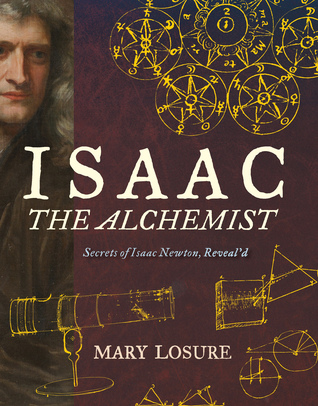
Isaac the Alchemist by Mary Losure, 2017

Click to view
on Goodreads 
A surprising true story of Isaac Newton's boyhood suggests an intellectual development owing as much to magic as science. 

Before Isaac Newton became the father of physics, an accomplished mathematician, or a leader of the scientific revolution, he was a boy living in an apothecary's house, observing and experimenting, recording his observations of the world in a tiny notebook. As a young genius living in a time before science as we know it existed, Isaac studied the few books he could get his hands on, built handmade machines, and experimented with alchemy--a process of chemical reactions that seemed, at the time, to be magical. Mary Losure's riveting narrative nonfiction account of Isaac's early life traces his development as a thinker from his childhood, in friendly prose that will capture the attention of today's budding scientists--as if by magic. Back matter includes an afterword, an author's note, source notes, a bibliography, and an index.
(176 pages)

Wow. I thought I knew a good amount about Isaac Newton (father of modern physics, first person to discover gravity, the whole "apple fell out of a tree" story, etc.). It turns out I knew very, very little, though–and most of what I thought I knew was actually completely wrong. The story about the apple falling out of a tree and inspiring Newton's conception of gravity, for example, simply didn't happen. Also, it turns out that he was absolutely obsessed with alchemy. He spent most of his life, from the sounds of it, inside a cramped furnace-room trying desperately to figure out how to transmute metals! It's fascinating to read about his determination and very active imagination in this arena, but still sad to see how much of his life he wasted chasing after something that he never could have achieved. Also, who knows what else he could have discovered if he'd been focusing on more fruitful pursuits?

Ah, well, I suppose being the father of modern science, the inventor of calculus, and the discoverer of gravity is more than enough for one human being. As someone who's taking AP Physics with Calculus right now, though, I'm not sure I'm entirely happy about the role Newton had in providing for this experience. I can be blown away by his genius and impact on science while still hating physics, right? Totally.

Anyway, I really liked the format of the book. It's pretty short, and the pages are filled with not just text describing his story but also pictures of Newton's actual books and journals. It's fascinating to see his ancient scrawled notes about things like perpetual motion and philosophers' stones! The information is presented in a way that's pretty accessible to kids, focusing heavily on Newton's formative childhood years and then skipping through his adult life to main describe his pursuit of alchemy and then his greatest scientific achievements. I never thought the writing was simplistic, even if it was geared toward kids, and the extra quotes and information in the back of the book really helped enhance my understanding of Newton's world.

Also, this book totally makes me sad that I didn't know Isaac Newton spent most of his life at Cambridge two months ago. If I'd known while I was there for my interview, I totally would have tried to nose around his home base in Trinity College!

Anyway, bottom line, this is a really engaging and fascinating book about Isaac Newton. Is it the most thorough book about him on the market? I very much doubt it. But it's a great book for kids who aren't ready for the bigger biographies, and it's perfect for older people like me who aren't really feeling up for the bigger biographies either. I learned everything I ever could have wanted to about Newton from Isaac the Alchemist, so I for one really love it. If you're looking to dip your toes into learning about the amazing scientist, mathematician and alchemist that was Newton, then this is definitely the book for you!

Disclaimer: I received a complimentary copy of this book from the publisher in exchange for an honest review.

06 July 2015

Headstrong by Rachel Swaby, 2015

Click to view
on Goodreads 
In 2013, the New York Times published an obituary for Yvonne Brill. It began: “She made a mean beef stroganoff, followed her husband from job to job, and took eight years off from work to raise three children.” It wasn’t until the second paragraph that readers discovered why the Times had devoted several hundred words to her life: Brill was a brilliant rocket scientist who invented a propulsion system to keep communications satellites in orbit, and had recently been awarded the National Medal of Technology and Innovation. Among the questions the obituary—and consequent outcry—prompted were, Who are the role models for today’s female scientists, and where can we find the stories that cast them in their true light?
Headstrong delivers a powerful, global, and engaging response. Covering Nobel Prize winners and major innovators, as well as lesser-known but hugely significant scientists who influence our every day, Rachel Swaby’s vibrant profiles span centuries of courageous thinkers and illustrate how each one’s ideas developed, from their first moment of scientific engagement through the research and discovery for which they’re best known. This fascinating tour reveals these 52 women at their best—while encouraging and inspiring a new generation of girls to put on their lab coats.

(288 pages)

I'm not the biggest fan of science as a subject. The only science class I ever truly enjoyed was last year's AP Environmental Science, in large part just because I had a great teacher.To put it another way: in a hundred years, no one is going to put me in a list of women who contributed to science. Thus I requested Headstrong with a few reservations about my suitability for the book.

I needn't have worried. Because this isn't a chemistry textbook; it's a photo album; A photo album in words of women who did their part to change the world of science forever. Full of anecdotes, quotes, and career sketches, Headstrong contains written snapshots of different people who accomplished amazing things, often despite seemingly impossible odds.

And my disinterest in science is more than made up for by my love for people. I love to study individuals: their emotions and their surroundings and how they handled the challenges that faced them. All of history (my favorite subject in school!) is a tale of individuals doing amazing things, both good and bad, in ways that ripple through time. Headstrong is like a mini-history book, a snapshot of 52 different women whose accomplishments rippled through all of pop culture as well as the world of science.

By the end of the book the snippets begin to feel a bit repetitive, mainly because they're all so short they only focus on a few key features of each scientist's life. I think Headstrong would have been an even more fascinating read if it had gone into less scientists in more depth, instead of more scientists in less depth. But then, Headstrong is supposed to be a collection of snapshots, a sampling of sorts to introduce people to a wide variety of women scientists who made huge contributions to science. They're not supposed to be comprehensive portraits, they're just supposed to provide starting points for people to discover scientists they can read more about on their own. And as a sampler, a photo album, a compilation of sketches, and every other metaphor I've thrown around in this review, Headstrong is perfect for learning about some of the biggest players in modern science.

Even though I still don't like studying science. Oh, well.

Disclaimer: I received a free copy of this book through the Blogging For Books program in exchange for an honest review.