Showing posts with label disappointment. Show all posts

14 September 2018

Flood by Melissa Scholes Young, 2018

Click to view
on Goodreads 
A sparkling debut set in Mark Twain's boyhood town, FLOOD is a story of what it means to be lost…and found.

Laura Brooks fled her hometown of Hannibal, Missouri, ten years ago after a historic flood and personal heartbreak. Now she’s returned unannounced, and her family and friends don't know what to make of it. She says she's just home for a brief visit and her high-school reunion, but she's carrying too much luggage for that: literal and metaphorical. Soon Laura is embroiled in small-town affairs—the contentious divorce of her rowdy best friend, Rose; the campaign of her twelve-year-old godson, Bobby, to become the town's official Tom Sawyer; and the renewed interest of the man Laura once thought she'd marry, Sammy McGuire.

Leaving town when she was eighteen had been Laura’s only option. She feared a stifling existence in a town ruled by its past, its mythological devotion to Mark Twain, and the economic and racial divide that runs as deep as the Mississippi River. She can’t forget that fateful Fourth of July when the levees broke or the decisions that still haunt her. Now as the Mississippi rises again, a deep wound threatens to reopen, and Laura must decide if running away once more might be the best way to save herself.

(323 pages)

Yeah, no.

This book is just depressing. Its characters are all, with the sole exception of twelve-year-old Bobby, unpleasant and immoral people who have gotten themselves into crummy situations. Laura's best friend Rose is the most grating, but Rose's ex is pure awful (read: he tries to sleep with Laura!), Laura's mother is unhelpful and emotionally distant, her brother is a druggy, her "dream man" and ex Sammy is divorcing his wife because she doesn't want kids (or, possibly, she's divorcing him because she caught him messing with her birth control!), and the list goes on and on.

Laura herself is just as bad as anyone. She likes to pity herself a lot, but she's made her fair share of bad choices. She's slept around a lot, and she's still coping with a miscarriage she had after a series of flings. She is a big-time enabler, helping Rose even when she is going nuts and assuaging her guilt by taking Bobby away on outings whenever she can. She also lends her brother money to buy land for a house, and we all knew how that was going to turn out.

I liked the idea of a book set on the island where Mark Twain grew up, and the attempts at examining racism were well-meant, but I just found Flood so frustrating and depressing (and expletive-filled) that I couldn't find much more to enjoy. I don't recommend it to anyone.

Disclaimer: I received a complimentary copy of this book from the publisher in exchange for an honest review.
04 December 2015

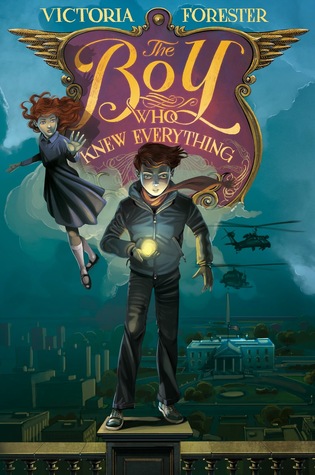
The Boy Who Knew Everything by Victoria Forester, 2015

Click to view
on Goodreads 
Here is the long-awaited companion to The Girl Who Could Fly.
There is a prophecy.
It speaks of a girl who can fly and a boy who knows everything. The prophecy says that they have the power to bring about great change...
The boy is Conrad Harrington III. The girl is Piper McCloud. They need their talents now, more than ever, if they are to save the world—and themselves.

(416 pages)

I really, really, really loved The Boy Who Knew Everything's prequel, The Girl Who Could Fly (my review here). I spent years desperately waiting for a sequel, and when I discovered a few months ago that it was finally happening, I literally started jumping around squealing. I was so excited.

Coming out of The Boy Who Knew Everything, I'm a lot less elated.

I mean, what I loved so much about The Girl Who Could Fly was that it had so many amazing messages mixed in with the really cool sci-fi scenario and the touching inter-personal interactions. It was a story about friendship and bravery and loyalty and staying true to yourself, and it was amazing. The Boy Who Knew Everything, on the other hand, is trying so hard to be some sort of breathtaking, mind-bending story that it forgets its own roots. Its sci-fi storylines stray almost into fantasy, and there's this weird prophecy thing that really doesn't mesh well with the tone of the first book. And then there's the whole plot with Conrad's father, which some will probably like but which I thought was a) weird and b) a dreadful reopening of a wound that I thought beautifully closed at the end of the first book. Piper also didn't seem to have as much spirit in her as she did in the first book. I mean, there was definitely a semblance of trying to represent her as having that spirit, sure, but she just felt pretty forced. And I'm forced to admit that The Girl Who Could Fly should probably have remained a standalone forever, despite how desperate I was all those years for it to have a sequel.

Actually, I think The Boy Who Knew Everything would have done better as a standalone almost as much as its prequel would. Placed next to The Girl Who Could Fly, it simply has lost too much for me to consider it any good; all of my favorite storylines seem to have been polluted and twisted, and new ones introduced that throw off the entire balance of the stories. I can't say that I know for sure that I would adore The Boy Who Knew Everything if it were a standalone - I'm too prejudiced by its prequel to be able to judge - but I do know that a lot of the things I hated about it (the storyline with Conrad's father, for example) I would have actually enjoyed in other circumstances, with different characters. It's just when they are changing the tone and ending of one of my all-time favorite books that I get mad.

Let's be honest, I'm pretty much going to pretend that The Boy Who Knew Everything didn't happen. I mean, I might think of it from time to time as a book completely on its own, but when I think about The Girl Who Could Fly I will not draw any connection between the two books. My Piper and Conrad and Violet and Kimberly and Jasper and all the rest did not travel down the path laid out in The Boy Who Knew Everything; they are still safely where my nine-year-old self left them, their futures completely disconnected to anything that happened to the kids in Forester's second book.


Disclaimer: This is an Amazon affiliate link.

11 September 2015

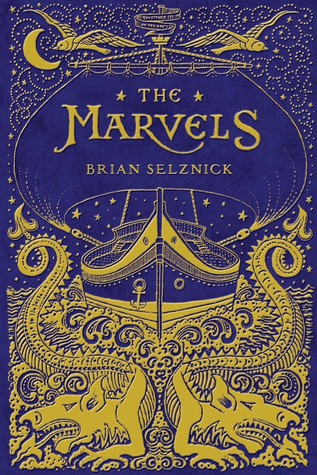
The Marvels by Brian Selznick, 2015

Click to view
on Goodreads 
Caldecott Award winner and bookmaking trailblazer Brian Selznick once again plays with the form he invented and takes readers on a voyage!Two seemingly unrelated stories--one in words, the other in pictures--come together. The illustrated story begins in 1766 with Billy Marvel, the lone survivor of a shipwreck, and charts the adventures of his family of actors over five generations. The prose story opens in 1990 and follows Joseph, who has run away from school to an estranged uncle's puzzling house in London, where he, along with the reader, must piece together many mysteries.
(672 pages; Release date September 15))

 I absolutely adored Selznick's The Invention of Hugo Cabret. The way he combined text with gorgeous pictures awed me to no end, and I loved the (also gorgeous) movie Hugo, starring Asa Butterfield. I also read Wonderstruck, Selznick's second book using this combined medium, and really loved the story, the pictures, the way I got to see the world through the eyes of deaf kids . . . and pretty much everything else about the story as well!

The first half of The Marvels was everything I had hoped for and more in a new book from Brian Selznick: stunning pictures, a beautiful storyline, compelling characters, and the pure joy that comes from devouring a gorgeous story. My favorite sequences were the ones that showed time passing, like the four pictures showing Billy growing up. Selznick's drew Billy as a little kid learning how to work the curtains, then a few years later working them under supervision, then as an adolescent working them by himself, and then working them as an adult. It's really beautiful.

But then there was the text, and it wasn't so amazing. In the past I don't remember ever being very enamored with Selznick's prose, but it was intermingled with the pictures and didn't really stick out enough for me to really analyze it. Here in The Marvels it's forced to stand by itself, though, telling its own tale without the crutch of Selznick's beautiful pictures, and it really isn't up to the task. Even before the big reveals came, I was just kind of bored by the story. I never had any reason to like Joseph, and his uncle was kind of over-the-top strange about the house. I love a good mystery as well as the next person, but what on Earth am I supposed to make of the way Uncle Albert kept all of the rooms looking as though people from the 1700s had just stepped out, but were actively living in them? I was thinking along the lines of ghosts, time travel, and just plain insanity (on Albert's part), and the real explanation was pretty original but also pretty disappointing.

Partly because of homosexuality. And that's really all I'm going to say about that, because I don't want to spoil anything for people who are going to read the book. It's one thing to put that sort of material in a book for adults, but The Marvels is (according to my ARC, anyway) geared for ages 10 and up, and grades 5 and up. That makes it MG. This is not MG material. And I didn't like being blindsided by it so far into the book, without any previous warning. To be perfectly honest, though, I probably wouldn't have liked the ending anyway - it feels like there's a lot of build-up, between the mysterious story told in the first half and the pressing questions Joseph encounters in the second half, and then the explanation at the end is pretty . . . anticlimactic. I would have much preferred a more poetic, romantic ending to the - well, the explosion we wind up getting.

So yeah. I highly recommend the first half of this book, and I very much don't recommend the second half to anyone. So unless you're going to get the book and only read the first half (which is, actually, completely reasonable - that's what I would have chosen to do, if I'd known what I do now in advance), I say just don't read it. And I'm sad to discourage people from reading a book with Selznick's amazing pictures, but I just can't encourage anyone to read the second half of The Marvels.

Disclaimer: I received a free ARC of this book from the publisher in exchange for an honest review.
31 July 2015

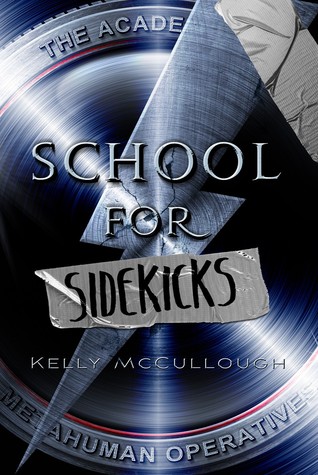
School For Sidekicks by Kelly McCullough, 2015

Click to view
on Goodreads 
Evan Quick is a GIANT superhero geek who dreams of one day becoming a superhero himself. Every morning he checks to see if he's developed his powers overnight, and every day there's nothing. No flying, no super strength, no invulnerability—that always hurts to check—no telepathy, no magic. Not even the ability to turn off the alarm clock without smacking the switch.
But then Evan somehow manages to survive a supervillian's death ray, and is sent to the Academy for Metahuman Operatives. Unfortunately, his new school is not what he expected, and instead of fighting bad guys, Evan finds himself blacklisted, and on the wrong side of the school's director. If Evan ever wants to realize his dream, he must convince his "mentor" Foxman, a semi-retired has-been, to become a real hero once again.
(336 pages; Release date August 4, 2015)

All right, I'm starting on the deep end with this one: School for Sidekicks was just a little too, well, politically correct for my tastes. Evan's father had two mothers, one of the students at the school is a gender-neutral shapeshifter, a girl tries to kiss another girl - each of these were completely unnecessary to the plot, and really only served to send the not-so-subtle message of "Look at me, I'm a liberal author!" I can understand having things like that in a book when they're central to the plot or are in a book directed at the gay community, but in this case McCullough went out of his way to add them to a kid's book that totally didn't need them at all. And I'm really sad that he did that, because it totally hurt my enjoyment of the book.

Political correctness (which, I am perfectly aware, won't even bother a lot of readers) aside, School for Sidekicks is still just a little too . . . much. This is apparently McCullough's first children's book, and it's pretty obvious that he's not used to toning his material down the way you have to for MG. Besides Foxman (who, as I said, is a recovering drunkard), there are a few points where the violence becomes a bit too graphic for me. At one point, somebody literally dies a few times but is basically rebooted each time. The deaths aren't described extremely vividly, but they're still deaths and they're not exactly peaceful deaths. At another point, a professor teaches his students a class on killing bad guys with common objects they might have at hand. He goes in-depth into describing what organs you can hit when you stab which spots at which angles, and I honestly had to skip over a paragraph or two because it was getting a little too much for me. Sure, I'm a wimp, but that's not exactly the sort of thing middle-school kids should be reading about, either. There's also some pretty bad language scattered throughout, including the "D" word and the "B" word (the one for "illegitimate child").

Now let's talk about the good aspects to the book. McCullough did a good job inserting as many twists as he possibly could into the dry formula, and I really enjoyed a lot of the aspects of his take on the superhero universe. Foxman, Evan's superhero mentor and a recovering alcoholic, was my personal favorite character because he was so different from all of the other usual superhero tropes. Plus, he was hilarious! I wish I could have someone like him to talk to when I'm down. The big reveal at the end was pretty mind-blowing, too, and really makes you rethink everything. It also sets up for some very interesting sequels. I really loved Evan as well, because I could see myself in him. As a massive Harry Potter/Doctor Who fangirl, I can totally relate with his obsession with superheroes - I just wish I was lucky enough to attend Hogwarts and meet all the characters in Harry Potter, the way he attended the "School for Sidekicks" and met all his favorite heroes. Even if some of them did turn out to be total losers!

Honestly, though, I feel like the bad-to-good ratio on this one is just too high. I won't be recommending it to anyone, and I doubt I'll be reading the sequel. If the bad points I've mentioned don't turn you off, though, then you could still give it a try. I know that without them, I would definitely have really enjoyed School for Sidekicks.

Disclaimer: I received an ARC of this book from the publisher in exchange for an honest review.