Showing posts with label Center Street. Show all posts

08 October 2018

Make It Rain! by Areva Martin, 2018

Click to view
on Goodreads 
What if you could get in front of millions of prospects with the avid endorsement of famous influencers--without spending a dime?

It's happening right in front of you every day. Guest experts on TV, radio, podcasts, blogs, and live streaming are getting local and national exposure for their business and brand that they could never have afforded to reach with ads.

For a decade, Areva Martin has used the media to build a huge platform that expanded the influence and power of her brand exponentially. Media appearances on Dr. Phil, Anderson Cooper 360, The Doctors, CNN, MSNBC, FOX, and more have virtually eliminated the need of a marketing budget for her thriving law firm and non-profit organization, while securing her place as one of America's most sought after thought leaders.

In 
Make It Rain! Areva breaks the silence to reveal what insiders know about the power of media appearances to revolutionize a business and brand and get your core message out to the people who need it most. You'll learn how to:

Match your brand to the right audience and media venues
Craft pitches producers can't resist
Jump on breaking news shows
Pivot and speak in soundbites like the pros
Amplify every interview with social media
Turn appearances into platform and become a rainmaker


Never before have there been more ways to build a presence that matters. Whether you are the executive of a corporation, the author of an upcoming book, the owner of a rapidly growing small business, or the public face of a local nonprofit or association, if you have a business to build or people you want to help, nothing beats using the media to create the visibility, influence, and power you need. Are you ready to
Make It Rain!?
(272 pages)

Since I've been blogging for years now, I figured it was time to read a book about how to market yourself effectively.

So far, my approach has been to post two reviews a week, copy-and-paste them into Goodreads, set up Bloglovin to automatically post links to my reviews on Twitter, and occasionally post pictures of books and/or my Scottish university on Instagram. According to Areva, I'm doing everything wrong.

I don't have a cohesive brand, because I'm split between talking about books and my international university. I don't interact with people much on social media (in fact, I usually forget to even check in on my accounts). I don't plug myself nearly enough, and I'm not marketing myself nearly so aggressively enough.

After reading Make It Rain!, I can say with some definity that I have no interest in changing my habits to conform to Areva's advice. But that doesn't mean it's not good advice–in fact, for people who really want to establish themselves as experts in a field and bring themselves into the public eye, I think this book is an absolute goldmine! Areva doesn't tell any warm, fuzzy stories about wandering into fame. This book is full of tips for projecting an aura of professionalism, convincing tv producers to invite you onboard, keeping on top of pop culture to see if you can find an in, etc. She talks about following hashtags on Twitter, tweeting about relevant topics early in the morning so producers will see you. She talks about watching hours of different talk shows, seeing how they interact with their interviewees and what tone they keep. Her road to fame is not an easy one; it involves hours of daily grunt work to keep on top of things, to stay relevant, and to get your name out there.

Honestly, I think I would hate trying to become a "tv professional" the way Areva is. I don't want to whittle my personal brand down into a few bullet points, or constantly try to insert myself into every national dialogue that comes across the front page. But for people who might be interested in such a pursuit, this book seems like a wonderful starting point. Areva is a goldmine of resources as well as tips, and I think anyone starting out in the self-publicity arena will gain quite a bit from reading Make It Rain!.

Disclaimer: I received a complimentary copy of this book from the publisher in exchange for an honest review.

14 September 2018

Flood by Melissa Scholes Young, 2018

Click to view
on Goodreads 
A sparkling debut set in Mark Twain's boyhood town, FLOOD is a story of what it means to be lost…and found.

Laura Brooks fled her hometown of Hannibal, Missouri, ten years ago after a historic flood and personal heartbreak. Now she’s returned unannounced, and her family and friends don't know what to make of it. She says she's just home for a brief visit and her high-school reunion, but she's carrying too much luggage for that: literal and metaphorical. Soon Laura is embroiled in small-town affairs—the contentious divorce of her rowdy best friend, Rose; the campaign of her twelve-year-old godson, Bobby, to become the town's official Tom Sawyer; and the renewed interest of the man Laura once thought she'd marry, Sammy McGuire.

Leaving town when she was eighteen had been Laura’s only option. She feared a stifling existence in a town ruled by its past, its mythological devotion to Mark Twain, and the economic and racial divide that runs as deep as the Mississippi River. She can’t forget that fateful Fourth of July when the levees broke or the decisions that still haunt her. Now as the Mississippi rises again, a deep wound threatens to reopen, and Laura must decide if running away once more might be the best way to save herself.

(323 pages)

Yeah, no.

This book is just depressing. Its characters are all, with the sole exception of twelve-year-old Bobby, unpleasant and immoral people who have gotten themselves into crummy situations. Laura's best friend Rose is the most grating, but Rose's ex is pure awful (read: he tries to sleep with Laura!), Laura's mother is unhelpful and emotionally distant, her brother is a druggy, her "dream man" and ex Sammy is divorcing his wife because she doesn't want kids (or, possibly, she's divorcing him because she caught him messing with her birth control!), and the list goes on and on.

Laura herself is just as bad as anyone. She likes to pity herself a lot, but she's made her fair share of bad choices. She's slept around a lot, and she's still coping with a miscarriage she had after a series of flings. She is a big-time enabler, helping Rose even when she is going nuts and assuaging her guilt by taking Bobby away on outings whenever she can. She also lends her brother money to buy land for a house, and we all knew how that was going to turn out.

I liked the idea of a book set on the island where Mark Twain grew up, and the attempts at examining racism were well-meant, but I just found Flood so frustrating and depressing (and expletive-filled) that I couldn't find much more to enjoy. I don't recommend it to anyone.

Disclaimer: I received a complimentary copy of this book from the publisher in exchange for an honest review.

29 June 2018

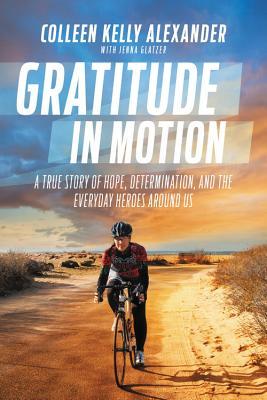
Gratitude in Motion by Colleen Kelly Alexander, 2018

Click to view
on Goodreads 
It was a beautiful fall day in Connecticut when Colleen Kelly Alexander, a lifelong athlete, rode her bike home from work. She had survived both a diagnosis of lupus and brain surgery, had a fulfilling career, and was married at last to the love of her life. Everything was good as she coasted along, meeting the eyes of a truck driver as he approached the stop sign beside her.

He didn't stop. The truck hit Colleen, running over her lower body with front and back tires and dragging her across the pavement. As she bled out in the street, nearby strangers surrounded her and the driver attempted to get away. An EMT herself, Colleen knew she had to stay awake. "I've just been reconnected with my soulmate," she told the medic. "We want to have a baby. I can't die now. Please don't let me die."

Five weeks in a coma and twenty-nine surgeries later, Colleen survived. Rather than let the trauma and PTSD control her life, she became determined to find a way to make something positive from her pain. She decided she'd run again and dedicate her race medals to the everyday heroes around us, including the medical staff and blood donors who saved her life. Since then Colleen has run fifty races and completed forty triathlons, including four half-Ironman events. Now a spokesperson for the Red Cross, Colleen shares her incredible inspirational story to encourage others to take that first step forward.

(296 pages)

What an inspiration. Truly, Colleen survived the unthinkable and managed not only to regain her will to live despite horrific injuries but to find inspiration and strength in overcoming it.

First, a word to the more squeamish readers: she spares no punches. Her descriptions of her injuries and treatments are brutally specific. Much of her body was completely ripped to shreds, and she underwent lots of excruciating and humiliating treatments. She was also in a very dark place emotionally for a while after the accident. As the daughter of two doctors I didn't mind hearing the gory details, but some might not take it so well.

I thought it was amazing that Colleen was strong enough to not only survive such a horrible situation but also to find grace and gratitude through the ordeal, to continue marathoning, and to turn herself into an advocate for blood donation and being grateful for the people around you.

But really, if anyone was going to overcome this accident so gracefully, it would have to be Colleen. The first few chapters of the book are about her childhood, (three) marriages, and early career. She'd literally built a career around working at community centers, helping and advocating for disadvantaged youths. She was on the way home from a meeting with her boss at the center when she was run over. Colleen's clearly always had a loving and open heart.

It's hard to say much more in my review, because I'm honestly just inspired by Colleen's story and her gracious attitude about it. I've had several joint injuries over the past few years which have made me stop doing some activities because of the pain/risk of reinjury. Reading about Colleen's drive to go back to marathons, even when she was literally bleeding by the end of the races, was so inspiring. As soon as I know that I can't do any more damage by stressing my ankles, I'm going to go out and be active again because there's no way my small amount of pain is anything approaching what she has to go through. If she could overcome it, I definitely can.

The word I keep coming back to when reading Colleen's story is inspiring. I don't often wind up loving the memoirs I read, but this one is definitely the best one I've read by far–it's really touched me on a more personal level. I highly recommend it to any and all, as long as you have the stomach for the gorier details.

Disclaimer: I received a complimentary copy of this book from the publisher in exchange for an honest review.

02 October 2017

Remember the Ladies by Angela P. Dodson, 2017

Click to view
on Goodreads 
2017 begins the centennial celebrations of women first winning the right to vote, culminating in national suffrage three years later. This book documents the milestones in that hard won struggle and reflects on women's impact on politics since.

From the birth of our nation to the recent crushing defeat of the first female presidential candidate, this book highlights women's impact on United States politics and government. It documents the fight for women's right to vote, drawing on historic research, biographies of leaders, and such original sources as photos, line art, charts, graphs, documents, posters, ads, and buttons. It presents this often-forgotten struggle in an accessible, conversational, relevant manner for a wide audience. Here are the groundbreaking convention records, speeches, newspaper accounts, letters, photos, and drawings of those who fought for women's right to vote, all in their own words, arranged to convey the inherent historical drama. The accessible almanac style allows this entertaining history speak for itself. It is full of little-known facts. For instance: When the Constitutional Convention of the thirteen colonies convened to draft the Constitution, Abigail Adams admonished her husband John Adams to "remember the ladies" (write rights for women into the Constitution!). Important for today's discussions, REMEMBER THE LADIES does not extract women's suffrage from the inseparable concurrent historic endeavors for emancipation, immigration, and temperance. Its robust research documents the intersectionality of women's struggle for the vote in its true context with other progressive efforts.
(448 pages)


As a young American woman in the 21st century, I take my right to vote for granted. My ability to participate in politics, whether through voting or campaigning or running for office, is such an obvious right that I struggle to imagine a time when I wouldn't have been able to even speak in public before men.

I suppose that's a sign of how far we've come, right? I don't usually like to think about that, though, because it makes me strangely uncomfortable to think that I would have been considered a second-class citizen even a hundred years ago. My great-grandmother was twenty years old when the Nineteenth Amendment was passed giving her the right to vote. Twenty! That's just inconceivable to me.

The entire focus of Remember the Ladies is on detailing the fight for woman's rights. It includes descriptions of the small attempts made in the country's early years, focuses mainly on the 70+ year battle for enfranchisement/legal rights, and then discusses the roles modern women play in politics. It's the historical details that I find so fascinating, and which are so crucial for me to learn about. I don't really agree with Dodson that Hillary Clinton lost the 2016 presidential election because she's a woman–I'd guess it has more to do with how wildly unlikeable she is and how strictly conservative a lot of Americans are–but that is literally my only complaint about Dodson's viewpoint. In the rest of the book, she does a very good job describing all the different suffragists and their organizations, conflicts, splits, allies, and conflicting causes (as issues like temperance and abolitionism alternately aided and undermined the fight for suffrage).

I mean, the suffrage movement lasted over seventy years. As Dodson herself points out, that is a very long time for a single movement. It progressed in clunky fits and starts at first, but it made it to victory despite the chaotic (and pressing!) distractors of the Civil War, Reconstruction, anti-immigration sentiment, and World War I. It's amazing to read about all the strands of activism that wove themselves through the background of U.S. history until the suffragist movement finally achieved its main goal. And I think it's important for me to read a book like Remember the Ladies once in a while so I can appreciate all the people in the past who fought for rights that I take for granted today.

Actually, I think everyone should read a book like Remember the Ladies once in a while, be they male or female. It's good for all of us to get a reality check now and again, to gain an appreciation for how far gender equality has progressed in just the last 100 years.

Disclaimer: I received a complimentary copy of this book from the publisher in exchange for an honest review.

14 July 2017

Dog Company by Lynn Vincent and Roger Hill, 2017

Click to view
on Goodreads 
Two decorated American war heroes survive combat in Afghanistan only to find themselves on an unfamiliar battlefield - the courtroom - in this true story by the commander of Delta Company, 1/506th a.k.a. Dog Company.

The deaths of two of his men is agony for Captain Roger Hill and the agony is intensified when he realizes those responsible - 12 Taliban spies- have been working right under his nose on the American base.

When unreasonable military regulations demand that he free the spies within 96 hours, and Hill can't get his superior officer to respond to the deadline, he takes action to intimidate the prisoners to confess - and to protect his company from another attack.

Instead of being thanked, Hill's superior brings him up on charges making this decorated officer's next battle a personal one - for his honor and for that of 1st Sergeant Tommy Scott, his second in command.

Combining the camaraderie and battle action of
Band of Brothers with the military courtroom drama of A Few Good Men, Roger Hill's story will leave you impassioned, inspired and forever changed.
(448 pages)

I'm not sure what was going through my mind when I asked to review Dog Company. It's not exactly my typical read, you know? I've been trying to become a little more informed about modern international relations, though, so I guess I thought a true story about soldiers deployed in Afghanistan could be a beneficial read.

I guess I forgot that I really don't like war. I mean sure, I've read lots of stories set during wars–about Jews fleeing the Holocaust, for example, or the brother-against-brother quandaries confronting soldiers during the Civil War–but the main characters in my books almost uniformly are either civilians or green soldiers. Captian Hill is just that: a captain. At the time of the events in the book, he'd served for eight years, and most of his men for far longer. They're all just such complete . . . well, soldiers. And I'm really not one. And I never really want to be. Lots of respect to the men and women who risk their lives to keep the nation safe, of course, but I could never stand the idea of shooting anyone; if I felt the call to join the service, I'd do it as a medic of some sort rather than as a soldier. The other reason I'd never want to be a soldier–and this is a huge one for me–is that I'd dread the day my higher-ups ordered me to do something that went against my moral code.

And really, that's what happened to Captain Hill. He was under orders to release the twelve men who were unequivocally spies for the Taliban, men whose intel had directly led to the deaths of two of his men, back into their freedom because his higher-ups wouldn't accept custody of them. Before they went, he wanted to get some good information out of them that would help them take down the Taliban and, presumably, prevent the loss of more men. To do so, one or two of the soldiers first slapped around a few of the prisoners (something that, in and of itself, was definitely illegal). When that didn't work, Hill grabbed one of them and pulled him outside, dumped him on the ground and shot at nothing so the other prisoners thought he'd killed their comrade. When they still didn't talk, he pretended to shoot two more men and then one of the remaining men cracked, spilling valuable information.

That's . . . pretty awful. I mean, I know the prisoners were probably all horrible people who would have done even worse to the soldiers if the roles had been reversed, but that still doesn't excuse that sort of behavior. We're supposed to be better than the Taliban; that moral high ground is our only real excuse for being in Afghanistan in the first place. So while I can understand the emotional reasons why Captain Hill decided to break the law and use such violent scare tactics on his prisoners, I actually agree with the decision to punish him. Was completely kicking him out of the army necessary? Definitely not, that seems rather disproportionate to his crimes. He should have just been demoted a rank or two (or however they call it) and posted somewhere where he could be monitored a little more closely.

Anyway, while the core moral dilemma is an interesting one, I didn't really enjoy reading Dog Company. It's broken up into units that jumble the chronology just enough to be rather confusing, and just kind of randomly jumps into the backstory of soldiers that were interesting but not exactly relevant. It also covers more than I really needed to know of the months leading up to the prisoner situation, which shifted from intriguing and educational to just straight-up boring by some point. I wound up skimming through a lot of the second half of the book. People more interested in military stuff might find those parts more entertaining than I did, though. Also, the language in the book is atrocious–gobs of f-words are littered in all over the place along with a whole alphabet of other (mildly less offensive) swear words. I pushed past them to read the book, but it wasn't pleasant.

If you've reading this review to the end, then you probably have a pretty good idea of whether Dog Company is for you. I can't say that I really recommend it personally, but it might do something for you that it didn't for me.


Disclaimer: I received a complimentary copy of this book from the publisher in exchange for an honest review.

10 July 2017

My Brother's Keeper by Rod Gragg, 2016

Click to view
on Goodreads 
Thirty captivating profiles of Christians who risked everything to rescue their Jewish neighbors from Nazi terror during the Holocaust. 

MY BROTHER'S KEEPER unfolds powerful stories of Christians from across denominations who gave everything they had to save the Jewish people from the evils of the Holocaust. This unlikely group of believers, later honored by the nation of Israel as "The Righteous Among the Nations," includes ordinary teenage girls, pastors, priests, a German army officer, a former Italian fascist, an international spy, and even a princess.
In one gripping profile after another, these extraordinary historical accounts offer stories of steadfast believers who together helped thousands of Jewish individuals and families to safety. Many of these everyday heroes perished alongside the very people they were trying to protect. There is no doubt that all of their stories showcase the best of humanity--even in the face of unthinkable evil.
(352 pages)

I asked to review My Brother's Keeper because it looked like a really great compilation of nonfictional stories from WWII, but once it actually showed up on my doorstep I continually put off cracking it open because I thought it would be too depressing (and also because it looked kind of boring).

It wasn't boring, though. Come to think of it, I've never read a book about the treatment of Jews during WWII that was boring–everything was just so horrific back then that even the most snooze-inducing historian couldn't dull the horrifying tales. As for my other concern, yes, My Brother's Keeper was definitely depressing. Its description of the systematic hunting down and wiping out of an entire race is horrifyingly detailed, and primary source quotes and images are used hauntingly throughout the book. Every chapter opens with a black and white image, occasionally of the featured person/family but often of German soldiers or real children who were murdered in concentration camps. In the beginning of the chapter there's a little bit of background on the featured figures, a detailed description of the historical context and the evils that they faced (including some truly horrific descriptions of German murder techniques), and then a detailed account of how they risked their lives to help the Jews and what happened to them afterward. I'd say that most of the featured people wound up surviving the war, though a large amount of them spent at least some time in a concentration camp. In one or two instances, the heroes–and their entire families–were murdered outright for their "crimes" under German law.

Honestly, it's pretty amazing to read about the people who risked everything to help save hundreds (sometimes thousands) of Jews from the Germans. Many heroes found it incomprehensible that the Jewish children were also being targeted, so they set up elaborate systems that rescued thousands of young innocents right out from under the Germans' grasp. It's amazing. But at the same time, I can't believe the depths of inhumanity that went on during the war. It's great that there were some heroes who rescued children, sure, but it's also horrifying to learn that 1.5 million kids died during the Holocaust. That's obscene. That's . . . I can't even find words for it. Monstrous fits, but it's not even enough. The actions of the people described in the book were amazing, incredibly brave, but they didn't even begin to conquer out the terrible evil of all the people who perpetrated the murder of innocents–or all of those who sat by and watched them do it. Gragg discusses the fact that many Christians throughout Europe allowed themselves to get swept up by the Germans, swearing their loyalty to the Third Reich and turning their backs on their Jewish neighbors, but he says that all of the people in My Brother's Keeper channeled their belief in God toward a conviction that they had to help the Jews in whatever way they could. I think that's amazing, but again–I only wish that more people, Christian or atheist or whatever, had stood up to the monstrosity of the Nazis.

But then I stop and wonder what I would have done in their shoes, and I'm afraid that I would have shut up and put my head down in order to save myself. And even if I worked up the courage to sacrifice myself, it's hard to decide whether it's worth saving others at the risk of having all of my loved ones murdered. It was an impossible time, an impossible situation. The Nazis were truly monsters in every sense of the word, and the noble secret actions of these thirty heroes (and of many more, I'm sure!) are even more incredible in contrast to the inhumanity surrounding them. I weep for all those they couldn't save, but I still celebrate every life they managed to save.


Disclaimer: I received a complimentary copy of this book from the publisher in exchange for an honest review.

22 May 2017

Just Life: A Novel by Neil Abramson, 2016

Click to view
on the publisher's site
From Neil Abramson, the acclaimed author of Unsaid, comes a riveting novel that explores the complex connection between humans and animals.

Veterinarian Samantha Lewis and her team are dedicated to providing a sanctuary for unwanted, abused, and abandoned dogs in New York City. But every day it gets harder to operate her no-kill shelter. Sam is already at her breaking point when she learns of an unidentified, dangerous virus spreading through their neighborhood. The medical community can only determine that animals are the carriers. Amid growing panic and a demand for immediate answers, suspicion abruptly falls on dogs as the source. Soon the governor is calling in the National Guard to enforce a quarantine -- no dog may leave the area.

Samantha knows from her own painful history that, despite the lack of real evidence against the dogs, a quarantine may only be the beginning. As questions about the source of the virus mount and clash with the pressure for a politically expedient resolution, Sam is forced to make life-altering choices. She finds allies in a motley crew of New Yorkers -- a local priest, a troubled teen, a smart-mouthed former psychologist, and a cop desperate to do the right thing -- all looking for sanctuary from their own personal demons. But the person Sam needs the most to unravel the mystery of the virus and save the dogs is the last one she'd ever want to call on -- because contacting him will mean confronting the traumatic past she has fought so hard to escape.

(386 pages)

Whew, this book is heavy.

I mean, it's got the whole animal euthanasia plotline about Sam's attempts to protect New York's dog population during the outbreak, but it also has a lot of poignant discussions about animal abuse, the use of animals in medical testing, human abuse (including one memory of a sexual assault and another of the discovery of a gruesome murder), substance abuse, and more. The main characters each carry their own heavy, terrible baggage and they must learn to cope with it throughout the course of the book in order to do their best for the dogs who are being pinned (with little to no evidence) for the spread of a dangerous new virus that is affecting and killing children.

Honestly, I didn't really like the book that much. It was a little too gritty, too painful, and too explicit. The language was really bad and the description of violence was too extreme for my tastes. Also, the descriptions of animal cruelty and of the euthanasia process were way too much for this animal lover. It's absolutely heartbreaking to read about how the innocent, loving creatures who are put down because no one will love them back!

Setting aside the strong language and my emotional reaction to the violence, Just Life is definitely a very thought-provoking read that makes a good jumping-off point for interesting debates. The characters are diverse and pretty well-rounded, and Sam is even pretty likeable (though her sort-of romance plotline feels really forced). If you're a little less sensitive than I am, you might like this book much more than I did.

As it is, I'm handing off my copy to the Little Free Library by my house and making sure to give my dog lots of extra pats. It's been a roller-coaster month as my sweet old boxer has been slowly losing control over her hind legs, and I really don't need any sad books about dying dogs lying around while watching her deteriorate. Come to think of it, my dog's health problems may also have affected my reaction to the book; if so, I'm sorry I can't give a more unbiased review. If anyone else has read Just Life, please let me know in the comments what you thought of it!


Disclaimer: I received a complimentary copy of this book to participate in a TLC book tour.

12 May 2017

Pinot, Pasta, and Parties by Dee Dee and Paul Sorvino, 2017

Click to view
on Goodreads 
Goodfellas star Paul Sorvino and Emmy-award winner Dee Dee Sorvino create delicious, authentic Italian recipes in this entertaining cookbook.

Dee Dee and Paul Sorvino do their best to make everyday a party. They celebrate life and being with each other in big and small ways as often as they can. They believe that the best way to celebrate or to solve the problems of the world is with a nice glass of wine and bountiful meal. No subject is taboo at their lively dinner table-especially when cocktails are served!

Providing a glimpse into their bi-coastal life and tales of Paul's acting career, this authentic Italian cookbook offers 80 recipes with menus for relaxed entertaining. From a Goodfellas' feast to a picnic with an Italian accent, from an abundant buffet to elevated Italian street fair food, the Sorvinos know how to turn out meals that are as delicious as they are fun. Their easy-to-prepare, mouthwatering recipes range from regional Italian classics to new takes on traditional food. Stuffed clams oreganata, unique bruschetta combinations, pasta e faigioli, pizza salumeria, farfalle with asparagus and pancetta, Pauls' famous meatballs and spaghetti sauce, chicken scarpiello, panzanella, grilled figs with honey and walnuts are just a few of the outstanding recipes found in Pinot, Pasta, and Parties. The food is so good at the Sorvinos' that theirs is the place of choice for casual get-togethers wherever they are.
(264 pages)

I basically only like to eat meat and carbs.

At least, that's what my parents say. Whether that's true or not may be up for debate, but it's a definite fact that all of my favorite foods consist of pastries, pastas, and meats. This means that Italian is favorite style of cooking (followed closely by mediterranean, of course!), and that Pinot, Pasta, and Parties is perfect for me.

I mean, come on. It's a cookbook full of recipes for foods like "Chicken Parmigiana Sticks with Marinara Sauce," "Calzones with Spinach-Ricotta filling," "Lentil Soup," and "Bruschetta with Caramelized Onions, Mushrooms, and Roasted Garlic." Just flipping through the cookbook's pages made me starving. I put scraps of paper between the pages to mark my favorite recipes, and wound up marking about twenty of them. Then I showed some of them to my mom and she thought they looked amazing too. She usually finds it slightly annoying when I get cookbooks for review, because she never uses them and they take up space in her kitchen, but not this one–her eyes lit up as soon as I said the words "Italian cookbook!"

There are full-color pictures of almost all the foods, though a few don't have pictures (or feature pictures of the authors instead of the food, which is a little odd). A handful of recipes, though, get two-page spreads to show how tasty they look. It seems a little random in which foods get no pictures and which ones get big spreads. The recipes are not sorted by type, but rather they're organized into ten multi-course meals (which are essentially chapters). Each meal is supposed to have some sort of theme, related to either a location or to patriotism, and some of the connections made sense. Others just seemed like they were filler to complete the full meal. But anyway, I thought it was an interesting way of organizing things. Each meal chapter starts with an intro from the authors, talking about their lives and inspiration for the food, and then more or less features foods for the following traditional Italian courses: Aperitivo (small bites served with drinks), Antipasto (appetizer), Primi (pasta course), Secondi (main course), Contorni (side dishes), Insalata (salad), and Dolce (dessert).

Whew, I'm stuffed just thinking about all that food! Anyway, mixed into each chapter are also tips about some of the techniques needed to make the recipes featured in them. It's a good thing everything's listed in the table of contents, because otherwise it would be basically impossible to ever find anything in the cookbook.

Anyway, the recipes are amazing. You can probably skip the intro texts for each chapter, in which the authors alternately talk about how much in love they are (he at 75, on his third wife, and she at 50 years old) and humble-brag about all of their accomplishments, but the recipes look so amazing. I can't wait to try them out!


Disclaimer: I received a complimentary copy of this book from the publisher in exchange for an honest review.

01 May 2017

Claiming Noah by Amanda Ortlepp, 2017

Click to view
on Goodreads 
This riveting debut novel of psychological suspense explores the dilemmas that arise when motherhood and science collide.

Catriona Sinclair has always had a well-developed sense of independence--in fact the one sore point in her otherwise happy marriage is her husband James's desire to take care of her. As she's often tried to explain to him, she took care of herself before she met him, and did a good job of it. But James has been especially attentive lately as they struggle to have a baby. They succeed at last through in vitro fertilization, but unwilling to risk the heartbreak of another miscarriage, they decide to make their "spare" frozen embryo available to another family.

Diana and Liam Simmons are desperate for a child. Unable to conceive, they are overjoyed to learn that as the closest genetic match to the Sinclairs they are the recipients of the embryo donation. Diana's only concern is her mother's disapproval of IVF, but any doubts raised are quickly eclipsed by Diana's joy of being pregnant.

As Diana is finding delight in every aspect of motherhood, Catriona keeps waiting for the rush of adoration she knows she is supposed to feel, but instead slips into a deep depression. Just as Catriona begins to find her way back to normalcy, one of the babies is kidnapped. Suddenly, all of their lives begin to unravel and intertwine, and none of them will ever be the same.

(384 pages)

This is a very interesting premise, isn't it? The moral issues and shades of gray introduced through in vitro fertilization make for bizarre sci-fi issues that seem a little too plausible to be comfortable.

To be perfectly honest, I never really saw the fight over Noah as a shades of gray case. He clearly belonged, both morally and legally, to his adoptive parents. The entire scenario of the custody battle that is the focus of the second half of the book rang false to me because I just couldn't believe it was a seriously-contested issue. I could be wrong, though–if anyone has any links to similar real-life cases, please do share them with me so I can read up on the issue!

Anyway, the actual fight over "Claiming Noah" doesn't really start until about halfway through the book. The focus is instead on the four parents, beginning with the two couples' complex journey to getting pregnant and then through the first few months of parenthood before things really got intense as one of the babies disappeared. These early stages were pretty interesting, though the description of Catriona's IVF procedures were a little more detailed than they probably needed to be. I immediately took the greatest liking to Diana, the adoptive mom who becomes pregnant with Catriona and James's extra embryo. She was just such a nice, warm, loving person who was desperate to be a mom! Her husband was a total domineering jerk from day one, though. I never liked him.

As for Catriona, she has a very . . . interesting path. I really blame her husband for a lot of the stress and bad reactions that she had, because he clearly wanted to have a baby way more than she did. He essentially pushed her into continuing the IVF treatment, even when she felt miserable after a failed attempt, by making puppy dog eyes at her and guilt-tripping her with descriptions of how desperately he's always wanted to have a child of his own.

I can't go too much into the story details without spoiling things, so I suppose I'll stop there. Suffice it to say that I was absolutely horrified by something Catriona did not too far into the book, which I felt like everyone skated past a little too quickly, and she makes some moral (sexual) choices later in the book that are described in way too much detail for my liking.

Anyway, before I end this review I have to touch on the issue of IVF. I'm one of those people who doesn't love the idea of creating a viable embryo and then destroying it, so I liked that Catriona and James decided to donate theirs and that Diana and Liam took it. But at the same time, as a foster sister who's heard way too many horror stories over the years, I'm rather horrified that people with fertility problems can be so selfish in their pursuit of the "experience" of being pregnant and having their "own" baby that they completely ignore all of the helpless children of the world who have already been born and desperately need homes. I understand the emotions involved in making these sorts of decisions, and I know it's not my place to tell either of them that I have a personal issue with their choice, but part of me says both couples should have just adopted babies and donated the IVF money to charity. In this case at least, it certainly would have saved a lot of trauma in the long run.

Anyway, I can't really recommend this book because of one or too scenes that are a little too sexually explicit. There's also one (fairly justifiable, at least in my opinion) use of the F-word. It's an interesting story, though, and there's a lot going on in both couples' lives. If you don't mind the issues I've described and you're interested to learn more about the book, you can check it out here or via the widget below.


Disclaimer: I received a complimentary copy of this novel from the publisher in exchange for an honest review.

20 January 2017

Crossing the Thinnest Line by Lauren Leader-Chivée, 2016

Click to view
on Goodreads 
FROM THE VERY FOUNDING OF OUR NATION, diversity has been one of our greatest strengths but also the greatest source of conflict. In less than a generation, America will become "minority-majority," and the world economy, already interconnected, will be even more globalized. The stakes for how we handle this evolution couldn't be higher. Will diversity be a source of growth, prosperity, and progress-or perpetual division and strife?

America has the potential to realize huge gains economically and socially by more fully capitalizing on diversity, but significant challenges remain and it's a problem that all Americans should be focused on solving. Despite tremendous progress, women and minorities still face barriers to accessing the full promise of the American dream. It doesn't have to be this way. Many of the solutions are right in front of us, and many exceptional, committed Americans are doing their part to make a difference.

In the twenty-first century, nations will prosper only insofar as they embrace and celebrate the individuals, organizations, and collective efforts to advance every kind of diversity. Lauren Leader-Chivée believes America must lead the way. In CROSSING THE THINNEST LINE, she explores the state of our diverse union and shares important stories of progress and potential, highlighting those who are crossing dividing lines of race, gender, culture, and political party to build a more united and prosperous nation. Her revelations will transform the discussion and set the agenda for America's progress on these critical issues. A work of originality and ambition, CROSSING THE THINNEST LINE changes our understanding of diversity and offers lessons to change our lives and our country.

(336 pages)

Okay, first, I have to admit that I didn't read this whole thing. About halfway through I got so sick of it that I started skimming. The author claims to be striving for adversity, and she does concede that Republicans are probably people too right near the very end of the book, but most of the 300+ pages consist of her presenting one passionate argument after another for why America should follow every single left-leaning Democrat policy ever.

From the bitter way I say that, you might think that I'm a Republican. I'm not. I think of myself as being in the middle of the road, conservative about some things but liberal about others. I am not inherently opposed to diversity in any way, and in fact I do think we need more diversity in this nation. That's why I chose to review Crossing the Thinnest Line in the first place! I just got annoyed by the author's tone: she spends the entire time talking about how awesome and amazing her beliefs are, and uses the words "Republican" and "conservative" like they're slightly insulting. She interprets every single possible thing that happens to a person of color as being about race (even when they don't seem remotely related to me), and refuses to consider the fact that people who disagree with her are just as entitled to their opinions as she is to hers.

Anyway, I jotted down a few quotes that particularly struck me. Here are the ones that stuck out the most, in no particular order:
  • This might be controversial because of the media, but I had to include it: Freddie Gray. The author says that his death was purely because of race, despite the fact that Baltimore is extremely diverse and several of the policemen charged with his murder were black. As someone who lived in Baltimore for five years (including when all of that happened), I am so sick of the way people turn Freddie Gray's death into something it isn't. Police brutality is an issue here, yes. Racism? I seriously doubt it.
  • She writes "In 2013, when Republicans forced a shutdown of the US government in a standoff over the budget . . . " Right. Because a standoff between two political parties is totally only one of those parties' fault. I don't even remember the details of their conflicts, but I doubt the Democrats were innocent victims.
  • This is probably my favorite: "By some estimates, given the changing demographics of the nation, even a candidate who won 60 percent of the white male vote could not win the presidency without meaningful support from women and minorities. It's a reality that may ensure a democratic president for a generation–unless the Republican Party changes course and returns to the politically sound and morally decent tradition of inclusion that George W. Bush exemplified." Whew! First, it's kind of hilarious to think about how wrong Leader-Chivée is right here (even though Donald Trump becoming president isn't something I normally find very funny). Second, "returns to the . . . morally decent tradition of inclusion" sounds a lot to me like Leader-Chivée is calling current Republicans immoral and indecent. Yeah, very open-minded of her.
Well, great, there goes my resolve to never discuss politics on here. Blast this book for being way more political than I thought it would be! Anyway, I suppose what really grated on my nerves was that in a book all about encouraging diversity, the author constantly just focused on using her platform to push her own political agenda at the expense of all others. We need ethnic and religious diversity, sure. But we also need ideological diversity, we need people who think about the world in different ways. We need to be able to recognize that some people have morals that are different from our own, and to respect that. I don't think Leader-Chivée has much respect for anyone who isn't a flaming Democrat, which is a pity. I hope that her experience near the end of the book meeting George W. Bush (and realizing he isn't as horrible a human being as she'd thought) might help her reach across the aisle and find respect for conservative Americans.

Disclaimer: I received a complimentary copy of this book from the publisher in exchange for an honest review.