Showing posts with label fairy tales. Show all posts

02 February 2021

The Wolf Gate by Hanna Sandvig, 2021

Click to view 
on Goodreads 
My...what big teeth you have…
Have you ever wondered if something was up with your boyfriend? Distant. Moody. Never texts you back. Turns into a wolf at nightfall?
No, just me?
When a wolf chased me through a faerie portal in the forest, the last person I expected to see on the other side was my ex-boyfriend Gavin. Turns out, he’s a fae, and everything I thought I knew about him was a lie. Now we’re on the run from his Alpha, the minion of the Unseelie Queen, through the mountains and forests of Faerie.
But our deadly pursuers may be the least of my worries.
Because the longer I stay in Faerie with Gavin, the harder it is to remember why I’m so mad. I can feel my defenses crumbling, but how can I give him another chance when he’s proven he can break my heart? Am I strong enough to discover if this is true love? And will I survive long enough to find out?
(125 pages)

I read the first book in this series, The Rose Gate, during a reading phase where I was reading nothing but fairytale retellings. I had gotten pretty sick of Beauty & the Beast retellings by that point, but I was glad I tried The Rose Gate because it was a lot of fun and an interesting new take on the story.

That's why I was recently excited to learn that there were a couple other books in the series. My excitement dimmed a bit when I learned they were novellas, but I decided to give them a go anyway. I started with The Wolf Gate because it's the most recent release, and I just finished it. And I have to say that it stays pretty true to form: just like The Rose Gate it's a fun, unique take on a traditional fairytale. I love how modern and independent the protagonist is without being obnoxiously so. She's a teenager who knows her own worth, respects herself and her emotions, and refuses to let anyone treat her poorly. I love how snarky she is throughout the book, too. I also love that she's so assertive about the fact that she won't sleep with anyone before she's married, which is a decision that you don't often see treated so respectfully in novels, though I should put in a content warning that there are a couple conversations about sex and whether or not people had/will have it. So parents might want to keep that in mind if considering this for younger kids.

Obviously things aren't as fleshed out as they would be in a full-length novel. Things move a bit quickly toward the second half of the story, and honestly feel a bit rushed in places. But that's to be expected. I liked seeing the lore of the series being built out, and I was able to follow along with all of the fantasy elements reasonably well despite having forgotten most of it from The Rose Gate. I was disappointed not to catch more glimpses at how the characters from The Rose Gate were doing after that book's events, but since this story is basically taking place at the same time as that one I guess that's kind of inevitable. I did have some issues with the ending (for a pretty sensible girl, Audrey's decision seem very much not thought through). And some unexplained magic convenience. But to be honest I didn't let it get me too frustrated.

All in all this was a fun couple of hours and a great addition to the series. I'll definitely be checking out The Lily Gate very soon, and keeping my eye out for another full-length novel in the future.
04 June 2018

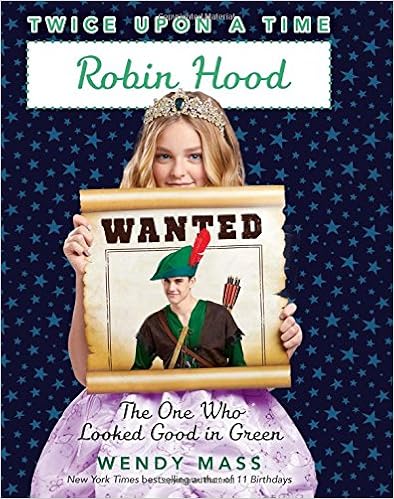
Robin Hood, The One Who Looked Good in Green by Wendy Mass, 2018

Click to view
on Goodreads 
Robin has a bad habit of getting into trouble–and a better habit of getting out of it (barely). He lives on an isolated outpost in the middle of nowhere and has no idea why his parents disappeared years ago. Then a strange delivery arrives at his doorstep, and the past is suddenly very present.

Marian was raised to be a very powerless girl in a very powerful family. But that hasn't stopped her from making her own adventures–and trespassing in some places her parents definitely don't want her to see. She has no idea what life would be like outside of her home–until a mysterious invitation forces her to leave everything behind.

Robin and Marian have lived very different lives in every different places. Their paths should never, ever cross–but before they know it, they are thrown together on a quest that requires legendary bravery, quick-witted escapes, and the ability to . . . get along with each other.

The sky's no longer the limit on what Robin and Marian can do–as long as they manage to do it together.
(224 pages)

This is actually the fourth Twice Upon a Time book, but they're all standalones so they can be read in any order. I was a huge fan of the first three books in the series, but it had been several years since Beauty and the Beast: The Only One Who Didn't Run Away came out so I was extra excited when I learned this one was coming out. 

I have to say that I was surprised with how different Robin Hood is from the previous entries in the series. They usually stuck pretty close to the original tales, just embellishing and reinterpreting the stories from fun new angles. I suppose Robin Hood continues this pattern, but it does it to such an extreme that the story is set in a dystopian inter-planetary future with impressive healthcare tech but also an oppressive, omnipresent government (headed by Prince John, filling in for his brother King Richard, as per the original tale). There are spaceships and futuristic technologies, meshed with this very old-timey legend. It's an interesting mix, and I found it very intriguing to see how Mass did it.

Honestly, though, I felt like there was something . . . missing. Maybe it was that Robin and Marian spent very little time actually together, so their romance felt like it came almost entirely out of nowhere. Or maybe it's that neither of them or their backstories felt quite fleshed out enough. It seemed like we could have gone deeper into their lives before they met to understand their personalities and motivations, so their actions later in the story seemed less disjointed. I think this was more of an issue with Robin: Marian's backstory and personality were pretty well-sketched, though I would have liked a little more details, but Robin just seemed like too much of an archetype for my taste. The backstory of his family is interesting but still kind of hazy, even by the end of the book.

Also, this is a small point, but a character passes some time with Friar Tuck at what can only be assumed to be some sort of Catholic-esque school, but the setting is basically scrubbed of all religious messages and replaced with basically meditation techniques. I didn't like this at first, but I can understand why Mass chose to keep those spiritual-ish scenes without weighting them with the trappings of a particular religion.

At the end of the day, though, the truth is that I really enjoyed reading Robin Hood. Basically, I just wanted it to be longer. At only 224 pages, there wasn't enough space to explore all the characters, scenarios, and issues that Mass introduced with her worldbuilding. It's still a fun read, though, and I hope Mass decides to add even more books to the series in the future. I would love for her to continue fleshing out this universe, adding more depth to it by creating new interpretations of more fairytales.

What about you, what do you think of fairytale retellings? Should they stick close to the base material, or do you like it when the author completely picks them apart to make something new? 

Disclaimer: I received a complimentary copy of this novel from the publisher in exchange for an honest review.

18 September 2017

Brave Red, Smart Frog by Emily Jenkins, 2017

Click to view
on Goodreads 
Step into a wintry forest where seven iconic fairy tales unfold, retold with keen insight and touches of humor.
There once was a frozen forest so cold, you could feel it through the soles of your boots. It was a strange place where some kisses broke enchantments and others began them. Many said witches lived there -- some with cold hearts, others with hot ovens and ugly appetites -- and also dwarves in tiny houses made of stones. In this icy wood, a stepmother might eat a girl's heart to restore her own beauty, while a woodcutter might become stupid with grief at the death of his donkey. Here a princess with too many dresses grows spiteful out of loneliness, while a mistreated girl who is kind to a crone finds pearls dropping from her mouth whenever she speaks. With empathy and an ear for emotion, Emily Jenkins retells seven fairy tales in contemporary language that reveals both the pathos and humor of some of our most beloved stories. Charming illustrations by Rohan Daniel Eason add whimsical details that enhance every new reading.

(104 pages)

Like most people, I've always loved fairy tales. There's something really magical about reading the stories that have been honed through generations of telling and retelling, where magic exists and it usually teaches a lesson and bad people/decisions wind up in terrible trouble. I haven't read all the original tales, but I had a storybook when I was little that told the "true" stories in a pretty way without putting too much emphasis on the gore. I always liked those versions more than the Disney ones.

That's why I chose to review Brave Red, Smart Frog. I did indeed know six of them in some form or another (though my version of the woodcutter who gets three wishes involved a river spirit throwing increasingly-ornate axes onto the bank); the only one that was completely unfamiliar was "The Three Great Noodles," which was actually a really cool story. It may well have been my favorite from the collection, and not just because it was the only new one for me!

I do like these retellings; they stick with the original material but cut out the worst parts and very cleverly fill in some of the logic gaps left by the originals. They also feature familial relationships that are much more realistic than the ones usually described in the fairy tales (full of dysfunction, yes, but also love). However, I wish the stories were longer–they each take up about 13 pages or so, a shortness that I'm just not used to anymore. I suppose this is good for kids listening to the stories at bedtime, but it leaves me wishing for more!

If you like fairy tale retellings, then Brave Red, Smart Frog might be what you're looking for. I can't say that it stands head and shoulders above all the other fairy tale retellings out there, because it doesn't really, but I can say that I enjoyed it and I'm sure others will as well. It doesn't have many illustrations, which is a pity, but the stories are told very well. Jenkins put together a very nice collection!


Disclaimer: I received a complimentary copy of this book from the publisher in exchange for my honest review.