Showing posts with label romance. Show all posts

16 January 2022

Cotillion by Georgette Heyer, 1953

Click to view 
on Goodreads 
"One of you shall have her, and my fortune into the bargain"
Such was the whimsical, some would say outrageous, statement of the ageing Mr Penicuik, to the three of his great-nephews gathered around him.
The future of his vivacious step-daughter, Miss Kitty Charing, was thus assured, provided she married one of the handsome beaux now seeking her hand. But Kitty was in no hurry to conclude such a contract. By hook or by crook she meant to go to London, where anything might happen and very often did...
(355 pages)

My first introduction to Georgette Heyer’s works sounds almost like a story from a movie. My friend took me into her favorite used bookstore, a tiny but extremely cozy and welcoming shop down a small cobblestone alley in the oldest part of our ancient Scottish university town. I started pulling old books off the shelves at random, and grabbed an unassuming old book entitled “Friday’s Child”. I flipped to the first page and from the opening lines – a woman asks the young man kneeling at her feet not to propose, and he protests "Damn it - I mean, dash it, Isabella! . . . I haven't started!" – I was entranced. I bought the book, and once I was home I quickly devoured the novel. And then, whenever I was stressed, I’d look up another book or two by Heyer and read the ebook from my library. By this point, I’ve read almost all of her 40+ books.

I’ll be honest, a lot of them aren’t actually that good. And of the best – of which both Friday’s Child and Cotillion definitely classify – there are still iffy elements. All of her Regency books are focused on members of English high society, and there’s a strong layer of classism sprinkled over every tale. However poor a heroine might be, we’re still reassured that she’s of good birth. Men might be philanderers, but as long as they’re only chasing after lower-class, supposedly easy women – referred to most commonly in the books as “bits of muslin” – then it’s not a big deal as long as they stop when they fall in love with a “quality” woman.  There’s arguably some misogyny as well, though to be honest I think Heyer does a fabulous job of crafting strong, independent heroines within the context of the time period her books are set.

All those issues aside, I’ll be honest: Cotillion is one of my favorite comfort books. I’ve reread it at least three times since I discovered it two years ago, and I always come away from it with a smile on my face. I love both Kitty and Freddy, and their arranged betrothal may be cliché but it’s such a fun premise. Freddy is such a refreshing male lead, so different from most Regency heroes. He’s a dandy, obsessed with fashion and clothes, and not particularly quick-witted or athletic. But he’s an extremely kind-hearted, practical man who is too decent to ever cause a scandal. He basically agrees to the fake betrothal because Kitty starts crying and he doesn’t know what else to do to make her stop. It’s so cute watching him grow more attached to her as they spend time together throughout the book. As for Kitty, while I don’t love her quite as much – she’s more of a stock Heyer heroine – I do still enjoy watching her fumble her way through high society. One of my favorite scenes in the book is watching her drag Freddy around London to look at all the historic buildings and museums. I laugh every time I read the bit where they go to an exhibit of Ancient Greek statues which are missing their heads and he's disgusted to have been ripped off, because he had to pay full price even though the statues are defective.

As for the other characters, cousin Jack (the one Kitty originally hoped would propose) is one of those people it’s fun to hate. Freddy’s sister Meg, whom Kitty lives with in London, is a pretty good character. I’m not a huge fan of the subplot where she’s flirting with Jack while her husband is traveling, though. Freddy’s parents are delightful, and don’t get enough screentime. His other cousins are a hilarious study in character work. And the remaining characters are honestly very annoying. There’s an entire subplot that becomes very dominant in the later part of the book that I barely liked the first time, and that I now skip over entirely when I reread the book, which entirely revolves around the boring characters. It’s a shame, because if it were better then this book would be even more perfect. 

What can I say? Warts and all, I love this book. I’m sure I’ll revisit it many times again in the future, and I’m so glad I discovered Heyer’s books by chance that rainy day in early 2020. And now I’m feeling the itch to reread Friday’s Child again!


02 February 2021

The Wolf Gate by Hanna Sandvig, 2021

Click to view 
on Goodreads 
My...what big teeth you have…
Have you ever wondered if something was up with your boyfriend? Distant. Moody. Never texts you back. Turns into a wolf at nightfall?
No, just me?
When a wolf chased me through a faerie portal in the forest, the last person I expected to see on the other side was my ex-boyfriend Gavin. Turns out, he’s a fae, and everything I thought I knew about him was a lie. Now we’re on the run from his Alpha, the minion of the Unseelie Queen, through the mountains and forests of Faerie.
But our deadly pursuers may be the least of my worries.
Because the longer I stay in Faerie with Gavin, the harder it is to remember why I’m so mad. I can feel my defenses crumbling, but how can I give him another chance when he’s proven he can break my heart? Am I strong enough to discover if this is true love? And will I survive long enough to find out?
(125 pages)

I read the first book in this series, The Rose Gate, during a reading phase where I was reading nothing but fairytale retellings. I had gotten pretty sick of Beauty & the Beast retellings by that point, but I was glad I tried The Rose Gate because it was a lot of fun and an interesting new take on the story.

That's why I was recently excited to learn that there were a couple other books in the series. My excitement dimmed a bit when I learned they were novellas, but I decided to give them a go anyway. I started with The Wolf Gate because it's the most recent release, and I just finished it. And I have to say that it stays pretty true to form: just like The Rose Gate it's a fun, unique take on a traditional fairytale. I love how modern and independent the protagonist is without being obnoxiously so. She's a teenager who knows her own worth, respects herself and her emotions, and refuses to let anyone treat her poorly. I love how snarky she is throughout the book, too. I also love that she's so assertive about the fact that she won't sleep with anyone before she's married, which is a decision that you don't often see treated so respectfully in novels, though I should put in a content warning that there are a couple conversations about sex and whether or not people had/will have it. So parents might want to keep that in mind if considering this for younger kids.

Obviously things aren't as fleshed out as they would be in a full-length novel. Things move a bit quickly toward the second half of the story, and honestly feel a bit rushed in places. But that's to be expected. I liked seeing the lore of the series being built out, and I was able to follow along with all of the fantasy elements reasonably well despite having forgotten most of it from The Rose Gate. I was disappointed not to catch more glimpses at how the characters from The Rose Gate were doing after that book's events, but since this story is basically taking place at the same time as that one I guess that's kind of inevitable. I did have some issues with the ending (for a pretty sensible girl, Audrey's decision seem very much not thought through). And some unexplained magic convenience. But to be honest I didn't let it get me too frustrated.

All in all this was a fun couple of hours and a great addition to the series. I'll definitely be checking out The Lily Gate very soon, and keeping my eye out for another full-length novel in the future.

27 January 2021

Fierce Heart by Tara Grayce, 2019

Click to view 
on Goodreads 
Essie would do anything for her kingdom…even marry an elf prince she just met that morning.
When a diplomatic meeting goes horribly wrong, Essie, a human princess, finds herself married to the elf prince and warrior Laesornysh. Fitting in to the serene, quiet elf culture might be a little difficult for this talkative princess, but she’s determined to make it work.
With impending war and tenuous alliances, it will be up to Essie to unite her two peoples. And maybe get her hands on elven conditioner while she’s at it.
(219 pages)

I won't beat around the bush here. This book is good. Really good. Probably my favourite book discovery of 2020. The entire series is such a gem, and I have revisited all three of the published books many times since I first read them in September. Sometimes I reread the entire books; other times, I redownload them just to skim through a couple favourite scenes.

The first reason I fell in love with this book (and series!) was because of Essie. She feels like a genuinely real person from the very beginning, someone I could meet in real life and with whom I definitely would have become great friends. She honestly reminds me of myself in many ways, from her large family to her red hair and talkative nature to her sometimes clumsy desire to do the right thing in any given situation. I love that she is given layers and agency. She isn't forced into this marriage by some archaic patriarchal ruling; she offers herself up for a royal alliance in order to save lives by staving off war, and while she's often nervous about her new situation she never stops fighting to carve out a place for herself in her new home. Much of this involves reaching out to her emotionally distant new husband.

And that brings me to my second favourite thing about this series: Farrendel! I've read (and DNF'ed) way too many fantasy novels with elves in them, where the main elven lead is a charismatic, confident warrior with incredible combat skills and lots of attitude. I can't put into words how refreshing it was to be introduced to Farrendel and to learn more about him alongside Essie throughout the book. He is a fierce warrior, yes, but he is also painfully shy and suffers from severe PTSD. He struggles to open up with Essie and is basically clueless about what he's supposed to do with this human suddenly constantly in his space. Watching him get to know Essie, and watching her come to understand him and his past, is a truly lovely experience and my one main complaint about this book is that we don't get more of those scenes (there's an unfortunate time jump of about two months which I'd have loved to explore in more detail!).

I also love the worldbuilding Grayce has done. The culture of the elves is fairly classical, with long-lived and pointy-eared elves living in cities built in massive trees. The details she adds are a lot of fun, though, like the obsession with propriety. Elven couples don't even clasp palms in public: they intertwine their first two fingers so that the backs of their hands are touching. They portray their emotions with subtle twitches of their faces, so humans struggle to pick up on what they're feeling - and the elves are slightly appalled at the amount of emotion humans are constantly displaying. The way elven aging works, they mature very slowly so that their childhoods last around a hundred years. This is a neat way of keeping the difference in elven and human lifespans without making Farrendel's and Essie's marriage kind of gross.

Basically, this book is amazing and the entire series is awesome. This is the perfect clean, enthralling romantic story to read in lockdown, and I highly recommend it. I read it with my Kindle Unlimited subscription, and it's just a couple pounds on Amazon (not affiliated, just eager to share!). If you do read it, I want to know! Tell me what you think, and what your favorite part is.

15 January 2018

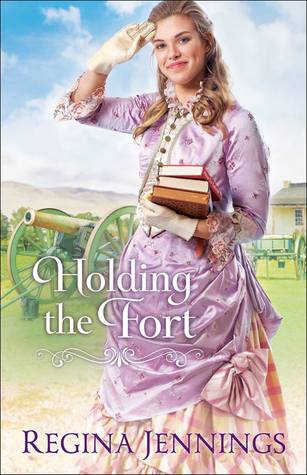
Holding the Fort by Regina Jennings, 2017

Click to view
on Goodreads 
Louisa Bell never wanted to be a dance-hall singer, but dire circumstances force her hand. With a little help from her brother in the cavalry, she's able to make ends meet, but lately he's run afoul of his commanding officer, so she undertakes a visit to straighten him out.

Major Daniel Adams has his hands full at Fort Reno. He can barely control his rowdy troops, much less his two adolescent daughters. If Daniel doesn't find someone respectable to guide his children, his mother-in-law insists she'll take them.

When Louisa arrives with some reading materials, she's mistaken for the governess who never appeared. Major Adams is skeptical. She bears little resemblance to his idea of a governess--they're not supposed to be so blamed pretty--but he's left without recourse. His mother-in-law must be satisfied, which leaves him turning a blind eye to his unconventional governess's methods. Louisa's never faced so important a performance. Can she keep her act together long enough?

(345 pages)

Sometimes I'm just in the mood for a fluffy book, you know? And it doesn't get much fluffier than a historical fiction novel about a dance hall singer mistaken for a governess at a fort in the American West.

A small part of my brain hates the entire premise of the book, since basically the entire point of Fort Reno appears to be to dole out food rations to the American Indians of the West and generally just "keep them in line." I also dislike a man, Frisco Smith, who showed up a couple of times in the story and may be setting up to be the hero of a future book: he's fighting to open the latest land aquisition up to homesteading. The exact quote:

"All I'm asking is that the government do the same thing for them [white settlers] that they did for the Indians. Give them a chance at a homestead, too.

 This is completely unfair, of course, since the land was the Native Americans' to begin with–not the white settlers'–and their culture was not really compatible with the euro-centric model of small, individual homesteads.

But honestly, sometimes I just need to read a fluffy historical fiction without thinking about all the horrible parts of American history. The story in Holding the Fort is held together by the romance, which is likely the driving factor for most people reading the book and basically also is the plot. I think my favorite parts were honestly when Louisa was spending time with the girls and studying her way into an education of her own along the way. I sympathized with her struggles and rooted for her to find a happy ending, since life had dealt her nothing but bad cards and she had always done the best she could with them. I cared for Daniel's daughters more than I cared for him himself, but I was happy enough to see them both finding their way to happiness together.

Honestly, though, I think I'm much too cynical for this book, because I kind of agreed with the grandmother that the girls needed to get out of that fort full of men and get a real education. Fort Reno doesn't seem like a very nice place to raise children, and the "mean old grandmother" trying to "steal the children" presented in the story really just seems like a loving and concerned grandmother who wants the best for her daughter's children more than anything else.

But gah, that's me thinking about things too much again. Anyway, Holding the Fort is a fun escapist read for a few hours–if you can manage to turn off the questioning part of your brain long enough to enjoy it.

Disclaimer: I received a complimentary copy of this novel from the publisher in exchange for an honest review.

30 October 2017

The Shadow of Your Smile by Susan May Warren, 2011

Click to view
on Goodreads 
A beautiful blanket of snow may cover the quaint town of Deep Haven each winter, but it can't quite hide the wreckage of Noelle and Eli Hueston's marriage. After twenty-five years, they're contemplating divorce . . . just as soon as their youngest son graduates from high school. But then an accident erases part of Noelle's memory. Though her other injuries are minor, she doesn't remember Eli, their children, or the tragedy that has ripped their family apart. What's more, Noelle is shocked that her life has turned out nothing like she dreamed it would. As she tries to regain her memory and slowly steps into her role as a wife and mother, Eli helps her readjust to daily life with sometimes-hilarious, sometimes-heartwarming results. But can she fall in love again with a man she can't remember? Will their secrets destroy them . . . or has erasing the past given them a chance for a future?
(344 pages)


The Shadow of Your Smile has a nice premise (very similar to a movie that came out a few years ago, right?), and I thought it was pretty well done. I liked the idea of a ruined marriage being "restarted" with the wife's sudden amnesia, even if the possibility of such amnesia is scientifically iffy. It's rather sad to watch Noelle realize that she gave up all of her dreams of pursuing her art and establishing a career, and that she's just an average housewife now. The cynical part of me wonders whether there's some sort of sexist reason she's not working, because it's not like she's staying home to homeschool her kids or something that would actually prevent her from working during the day, but I don't think that's where my mind is supposed to go with this scenario. I can't say I really agree that her husband is such a catch, because he does a lot of things I'm not really a fan of, but I suppose she's looking for something different from what I would want in her shoes.

There are several side plots that I liked better than the main one, including Noelle's grown son's growing romance with a childhood acquaintance and the family's attempts to move past the brutal death of Noelle and Eli's daughter, Kelsey. The storyline about Kelsey is actually my favorite, just because it's so brutal and honest and real. Reading about the parts where the family is remember (or, in Noelle's case, forgetting) Kelsey is heartbreaking. The rest of the book is kind of soft and cheesy in comparison.

And also really cheesy. Keep in mind that the cheese levels in The Shadow of Your Smile are practically out of the roof. It was an entertaining read that passed a few nice hours, though, and I'm glad I took the time to give it a try. Sometimes a fluffy, clean, slightly cheesy romance novel is just what the doctor ordered.

Disclaimer: I received a copy of this book through the Tyndale Rewards program (click here to check it out–by using my link you'll get 25 credits, which is enough to get a book).

27 October 2017

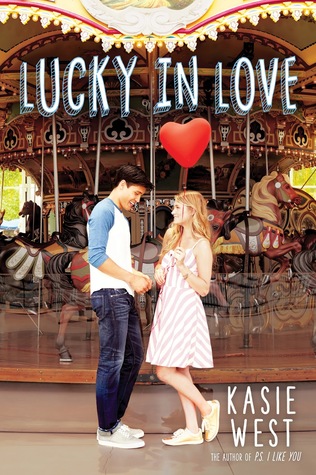
Lucky in Love by Kasie West, 2017

Click to view
on Goodreads 
In this new contemporary from YA star Kasie West, a girl who wins the lottery learns that money can cause more problems than it solves, especially when love comes into the picture.

Maddie doesn't believe in luck. She's all about hard work and planning ahead. But one night, on a whim, she buys a lottery ticket. And then, to her astonishment --

She wins!

In a flash, Maddie's life is unrecognizable. No more stressing about college scholarships. Suddenly, she's talking about renting a yacht. And being in the spotlight at school is fun... until rumors start flying, and random people ask her for loans. Now, Maddie isn't sure who she can trust.

Except for Seth Nguyen, her funny, charming coworker at the local zoo. Seth doesn't seem aware of Maddie's big news. And, for some reason, she doesn't want to tell him. But what will happen if he learns her secret?

With tons of humor and heart, Kasie West delivers a million-dollar tale of winning, losing, and falling in love.

(333 pages)

Wow. This book is just so darned cute! Why did no one tell me to read a Kasie West novel before now?! I'm so glad its cover and description caught my attention enough to make me send off a request for it to Scholastic, because Lucky in Love was exactly the fluffy and innocent, though still realistic and thought-provoking, book that I needed to read this summer.

Because seriously, how could I not pick up a book about a girl who wins the lottery and falls in love with the one guy who's oblivious to her windfall?! This book lives up to its promise, offering interesting and compatible main love interests and a lottery story that could honestly have filled a whole book by itself without the romance even showing up.

But who am I kidding? The romance is my favorite part! I love that Maddie and Seth are legitimate friends and coworkers long before they start to become anything else, and that their relationship develops very organically from that relationship. I couldn't care less about physical chemistry (i.e. lust between two characters), because that tells me nothing about their suitability for each other as life partners. But when they're bonding over their shared love for animals, then I definitely start shipping.

Lest you accuse me of giving a biased review, though, I should discuss the cons of the book. There are a few minor ones, but only one that truly bugged me: Maddie's academic life. As a recently-graduated senior who has just finished four extremely rigorous years of high school, including a year and a half of standardized testing/college applications, I could totally tell that West didn't do her homework on, well, anything when it came to Maddie's college application. Maddie and all of her friends take it as a given that of course she'll get into every good school in California (including Stanford and UCLA). Her best friend literally starts this big campaign to convince Maddie to come to Stanford with her in the fall . . . before either of them has gotten an admission letter. There's no one alive who can be that confident in their admission chances to Stanford unless Stanford is their last name or they literally cured cancer (preferably both). If Maddie were a real high school senior, she and her friends would know this. Also, if she were such a shoe-in for such high-ranking schools, she would totally have way more extracurriculars than just working at the zoo.

I'm sorry if it seems like I'm nitpicking, I just thought this was all kind of frustrating because I was in Maddie's shoes–and frankly, probably had an application stronger than hers would have been from what we read in the book–but I was far from a shoe-in at any of the schools she applied to. And also, no one–and I mean literally no one–cares if you get a B or two in the second semester of senior year. Once the decisions are out, they are out. Period. Unless you suddenly flunk out of high school or something equally dramatic. And throwing a wild party or two will not get you blacklisted by any university, either.

Okay, okay, now I'm done. The academic stuff bugs me more and more as I sit here thinking about it, but it's not really that big a deal in the context of the book. The focus is truly on Maddie's struggles to adjust to her fame/fortune and to tangle out her feelings toward Seth. It's such an adorable story, and I really loved it. If you're in the mood for a fun romance, then I definitely recommend it.

Also, I recently picked up another one of West's books, P.S. I Like You, practically by accident. I can't go into it much here, but needless to say that it was also adorable and I actually liked it even more than Lucky in Love!

Disclaimer: I received a complimentary copy of this novel from the publisher in exchange for an honest review.

25 August 2017

The Next Together by Lauren James, 2017

Click to view
on Goodreads 
Katherine and Matthew are destined to be born again and again, century after century. Each time, their presence changes history for the better, and each time, they fall hopelessly in love, only to be tragically separated.

Spanning the Crimean War, the Siege of Carlisle and the near-future of 2019 and 2039 they find themselves sacrificing their lives to save the world. But why do they keep coming back? What else must they achieve before they can be left to live and love in peace?

Maybe the next together will be different...

(356 pages)

I'd definitely heard of this basic scenario (two souls in love reborn again and again throughout time), but I love it so much I just had to request The Next Together. I was so excited when it came that I cracked it open that same day and read the whole thing by bedtime.

The sad thing is that it wasn't as good as I'd hoped it would be. And it's strange, because in some ways it lived up to my expectations: it features true love, multiple fascinating and under-represented periods in European history, drama and sacrifices galore.

But it was also a disappointment. Because I never really felt the connection between Katherine and Matthew, I was just told that there was this big special tie between them. And there was so much skipping around between time periods that I never really got invested in any of them. And the side characters were basically footnotes in the stories. And in at least one storyline, Katherine and Matthew are both a little too . . . promiscuous for my tastes.

Instead of being a beautiful epic love story about two intricate people throughout time, and the mystery of why they kept being separated from each other, The Next Together basically turned out to be four rather shallow romance novelettes about unremarkable people who are tied together by some funky time travel shtuff. And the time travel shtuff wasn't even explained in the end. I was prepared to be really mad about that in this review, but then I looked on Goodreads and found out that there's actually a sequel coming that will probably explain everything (though I don't think I'll read it). As an aside, the main character of this sequel is lesbian. I think that gives you a good idea of the author's outlook on certain things.

I did enjoy the storyline that was told entirely through notes between the two characters, though. They may have been rather naughty from time to time, but they were also so sweet and hilarious that I couldn't help but love them. I kind of want a whole book now just made up of the sticky-notes they sent each other via the fridge.

Disclaimer: I received a complimentary copy of this novel from the publisher in exchange for an honest review.

04 August 2017

The Captivating Lady Charlotte by Carolyn Miller, 2017

Click to view
on Goodreads 
Lady Charlotte Featherington is destined for great things on the marriage market. After all, as the beautiful daughter of a marquess, she should have her pick of the eligible nobility hen she debuts. She, however, has love at the top of her list of marriageable attributes. And her romantic heart falls hard for one particularly dashing, attentive suitor. Sadly for Charlotte, her noble father intends her betrothed to be someone far more dull.

William Hartwell may be a duke, but he knows he was Charlotte's father's pick, not the young lady's own choice. And the captivating Lady Charlotte does not strike him as a woman who will be wooed by his wealth or title. While she has captured his heart, he has no idea how to win hers in return--and the betrayal and scandal his first wife put him through makes it difficult for him to believe that love can ever be trusted. His only hope is that Charlotte's sense of responsibility will win out over her romantic notions.

Can a widowed duke and a romantically inclined lady negotiate a future and discover love beyond duty? Will they be able to find healing and hope from the legacy of grace? Poignant and charming, this is another beautifully written, clean and wholesome Regency romance from Carolyn Miller.

(310 pages)

First, a word of warning: The Captivating Lady Charlotte is the second book in the Regency Brides: A Legacy of Grace series so there may be some accidental spoilers for its prequel, The Elusive Miss Ellison (my review). There's a fairly strong connection between the two, since Charlotte is the younger cousin of Lavinia Ellison from the first book. Lavinia and her–ahem–personal life actually wind up taking a pretty big role in the story, but I'll try to steer around the biggest spoilers.

I went back to read my review of Miss Ellison after reading Lady Charlotte, and I was reminded of the strengths and weaknesses of the former. It's funny, because I think this second book is directly opposite its prequel–better where Miss Ellison was weak, and weak in areas it was strong. What do I mean? Well, the religion in Miss Ellison was so cheesy and pushy (perhaps because Lavinia's father was a pastor) that I found it almost hard to read; discussions of faith and religious duty in Lady Charlotte, on the other hand, are sparse and focused mainly on a duty to help those who fall through society's cracks (as well as a few mentions among fellow believers of the importance of prayer during hard times). On the other hand, I actually really loved the romance in Miss Ellison–it was entertaining and realistic, if unrealistically enabled by the plot at times, and everything was just really sweet. In Charlotte's case, however, I never really get the vibe that she and William had enough of a connection or a shared passion for anything that would tie them together. William basically decides he needs a new wife and that Charlotte is pretty enough (and, you know, probably has enough substance) to take on the role. She never shows any interest in him until very late in the book, and I honestly feel like she just managed to convince herself that she was in love with the older man so she could comfortably resign herself to the situation dictated by her parents and society.

I know. That's not exactly the most romantic storyline, is it? The whole premise of the book (basically, "Charlotte is eighteen now so she must be married off to the highest bidder!") becomes more sexist the longer I think about it. I don't entirely hold that against Miller, since I'm pretty sure that's just how things were back then and she does try to create realistic loving relationships amidst the arranged marriages, but it still just rubs me the wrong way. As an eighteen-year-old young woman myself, I can't really stomach the way Charlotte's entire life revolves around getting married, loving her future husband, and bearing an heir and a spare for his family. Ick.

I really did enjoy reading The Captivating Lady Charlotte, even if it sounds like I didn't. While I didn't love the main characters quite so much this time, and the plot was a little more murky/rambling than that of Miss Ellison, I actually enjoyed it just as much. I look forward to also enjoying the third book in the series, The Dishonorable Miss DeLancey, when it comes out in a few months.


Disclaimer: I received a complimentary copy of this book in order to participate in a Kregel blog tour.

31 July 2017

A Name Unknown by Roseanna M. White, 2017

Click to view
on Goodreads 
Edwardian Romance and History Gains a Twist of Suspense

Rosemary Gresham has no family beyond the band of former urchins that helped her survive as a girl in the mean streets of London. Grown now, they concentrate on stealing high-value items and have learned how to blend into upper-class society. But when Rosemary must determine whether a certain wealthy gentleman is loyal to Britain or to Germany, she is in for the challenge of a lifetime. How does one steal a family's history, their very name?

Peter Holstein, given his family's German blood, writes his popular series of adventure novels under a pen name. With European politics boiling and his own neighbors suspicious of him, Peter debates whether it might be best to change his name for good. When Rosemary shows up at his door pretending to be a historian and offering to help him trace his family history, his question might be answered.

But as the two work together and Rosemary sees his gracious reaction to his neighbors' scornful attacks, she wonders if her assignment is going down the wrong path. Is it too late to help him prove that he's more than his name?

(432 pages)

I was a little wary of reading A Name Unknown because I get rather frustrated with the cheesy, unrealistic nature of a lot of historical fiction novels (and most especially Christian historical fiction novels). I really liked the premise, though, so I decided to take the plunge and review it.

And I'm very glad I did. While the writing was indeed slightly cheesy in parts (mainly in the few–rather skippable–scenes where the characters were talking/writing about religion), I was impressed by how normal A Name Unknown really was. I didn't read it thinking "ick, this is cringe-worthy but it's fluffy enough that I'm enjoying it;" rather, I was so engaged by the story and its characters that I wasn't really thinking anything to myself at all. I believe I can unequivocally say that A Name Unknown is not only the best Christian fiction novel I've read in a very long time, but it's also straight-up one of the best romances I've read in a while.

I think a huge reason for this is the male lead. Most books feature male protagonists who are handsome and brooding, rich and intelligent, well-spoken and clever. Peter Holstein is many of these things–he's middlingly handsome, quite wealthy, very smart, and extremely clever–but all of this is hidden from the world by his terrible stutter. That's right, Peter has a stutter. Like, a really bad one. And I love that, because it makes him so much more real and vulnerable. I mean, the man communicates important things to people by letters because he can't make his tongue trip out all the right words! Peter is also definitely not some high-society golden boy: he's basically scorned by everyone but a close few, because his family and last name tie him too closely to the hated Germans (the book's set during the lead-up to WWI, a fascinating time I know far too little about).

I also love that we get to watch Peter and Rosemary develop a very natural relationship over the course of over 400 pages–there's zero insta-love involved. They don't look at each other for the first time and get a strange spike in their heartbeat, they don't find themselves yearning to be close to each other, they don't rush to fall in love with someone they just met because they're physically attracted to them. During the first half of the book their relationship grows carefully, slowly, respectably, and genuinely. It's a beautiful thing to watch.

Now for a few negatives. I have to say, A Name Unknown does fall for the usual trap of having the characters start saying stupid, unrealistic things after things have developed a bit: Rosemary and Peter express their high opinions of each other in terms that are way too frank, for example. The only other bad dialogue comes in once or twice when Rosemary is supposed to be showing off her street smarts and cleverness–her dialogue in those scenes reads more like something from a movie than anything from real life. Come to think of it, Peter was a little too perfect as well.

But I'm really not complaining too loudly. He's a sweet, humble bookworm, for crying out loud. A bookworm and an author. And they grow to know each other by reading books and talking about them, which is like my ideal romance. So I'm just going to make a passing reference to the political stuff that I've completely ignored (and which was actually quite fascinating, by the way!) and end the review here.

Disclaimer: I received a complimentary copy of this book from the publisher in exchange for an honest review.

24 July 2017

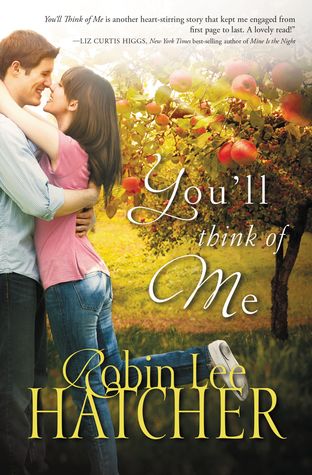
You'll Think of Me by Robin Lee Hatcher, 2017

Click to view
on Goodreads 
In a small town in Idaho’s idyllic wine country where the past looms large, can two people realize their individual dreams for the future … together?

Abandoned once too often, Brooklyn Myers never intended to return to Thunder Creek, Idaho. Her hometown holds too many memories of heartache and rejection. But when her estranged husband Chad Hallston dies and leaves his family home and acreage to her and their ten-year-old daughter Alycia, it's an opportunity to change their lives for the better—a chance Brooklyn can't pass up, for Alycia's sake if not her own.

Derek Johnson, Chad's best friend since boyhood, isn't keen on the return of Brooklyn Myers to Thunder Creek. He still blames her for leading his friend astray. And now she has ruined his chance to buy the neighboring ten acres which would have allowed him to expand his organic farm. To add insult to injury, Chad's dying request was that Derek become the father to Alycia that Chad never was. How can he keep that promise without also spending time with the girl’s mother?

Brought together by unexpected circumstances, Derek and Brooklyn must both confront challenges to their dreams and expectations. He must overcome long held misconceptions about Brooklyn while she must learn to trust someone other than herself. And if they can do it, they just might discover that God has something better in mind than either of them ever imagined.

(320 pages)

First, let's just acknowledge that the premise of You'll Think of Me is slightly creepy. Brooklyn's husband dumped her penniless ten years ago when he found out she was pregnant, but he decided to track her down and leave her his family land to raise their daughter Alycia. He then proceeds to write to his childhood best friend Derek, whom he'd been promising to sell that same house and land to for years, and told him "yeah, I changed my mind. Also, I want you to be the father I never was to Alycia."

I'm sorry, but . . . what? It doesn't sound like Chad ever paid a penny of child support to Brooklyn in all this time–he owes her big-time! But instead of bequeathing her the money she really needs, he leaves her a dusty old fixer-upper and a bunch of land in a town she hates. Then he asks a friend of his to be Alycia's father, as though he has any parental claim to the girl (or any right to ask a stranger, without Brooklyn's consent, to take on such an intimate role with her daughter!). I feel like Derek never completely acknowledged how messed-up his old best friend's actions really were. Brooklyn does, which is good, but he just skirts around it and talks about "honoring Chad's last wishes" with Alycia.

Setting that aside, though, I did enjoy reading You'll Think of Me. Once in a while, it's nice to just read a fluffy romance book. This one reminded me of that old Sandra Bullock movie, Hope Floats, just with less questionable behavior and more religious lines. This is one of the first Christian romance books I read where I didn't feel like the portrayal of faith was so cheesy it was ridiculous, though, so that's good.

Basically, if you're looking for a fun, fluffy romance read then this fits the bill. It's nothing extraordinarily memorable, but it's entertaining and even meaningful and better than most of the books out there. Once you get past Chad's questionable role in Brooklyn's life, there's a lot of good to be discovered here–the characters are realistic and flawed, the situations are plausible enough, and the relationship that grows up between Derek and Brooklyn is sweet (though I never felt as emotionally invested in it as I'd have liked).

Have you read You'll Think of Me? If so, let us know what you thought of it in the comments section below!


Disclaimer: I received a complimentary copy of this novel from the publisher in exchange for an honest review.

03 July 2017

Cold Summer by Gwen Cole, 2017

Click to view
on Goodreads 
Today, he’s a high school dropout with no future.
Tomorrow, he’s a soldier in World War II.

Kale Jackson has spent years trying to control his time-traveling ability but hasn’t had much luck. One day he lives in 1945, fighting in the war as a sharpshooter and helplessly watching soldiers—friends—die. Then the next day, he’s back in the present, where WWII has bled into his modern life in the form of PTSD, straining his relationship with his father and the few friends he has left. Every day it becomes harder to hide his battle wounds, both physical and mental, from the past.

When the ex-girl-next-door, Harper, moves back to town, thoughts of what could be if only he had a normal life begin to haunt him. Harper reminds him of the person he was before the PTSD, which helps anchor him to the present. With practice, maybe Kale could remain in the present permanently and never step foot on a battlefield again. Maybe he can have the normal life he craves.

But then Harper finds Kale’s name in a historical article—and he’s listed as a casualty of the war. Kale knows now that he must learn to control his time-traveling ability to save himself and his chance at a life with Harper. Otherwise, he’ll be killed in a time where he doesn’t belong by a bullet that was never meant for him.

(322 pages)

Some of my favorite story tropes include childhood friends falling in love, time travel, and kids healing and growing after parental abandonment. Cold Summer has all three of those, so it seems like it should be perfect for me.

And in some way, it is. I really, really enjoyed reading it. Kale and Harper's relationship is so beautiful, built on the shared experiences of their childhoods. They trust each other completely and it's beautiful to watch. Kale's struggles with his uncontrollable time travel and the PTSD from living as a soldier during WWII are tragic, though also preventable (he's literally offered an out at one point!) and occasionally skated past (we spend a lot more time in the drama of the present than in the life-or-death horror of the past). The storylines about Harper's neglectful-to-the-point-of-abandonment mother and Kale's tense-and-angry father are very delicately and honestly done.

But at the same time, the book isn't perfect. Like I said, I liked the romance between Kale and Harper–but I also didn't like how physical things got between them. At one point, they nearly even had sex! Also, the language was less than ideal: swears are littered here and there, and the f-word is even used maybe once a chapter. It's used during times of great stress usually, sure, but that's still not great especially for younger readers. I thought Harper's abandonment issues were dealt with way too quickly at the end, and the time travel mechanism still seems kind of hazy to me. I like the "purpose" they realize Kale's experiences served, but it seems really random that he was chosen for that one thing out of everything he could have done throughout history.

All that aside, I still spent a couple of hours reading and enjoying Cold Summer. It's a good summer read, full of plot and grit while somehow managing to simultaneously be rather fluffy. If you're curious, and you don't mind the medium to high-level racy material and swearing, then you might like it. Let us know in the comments section what you think if you do decide to read it!


Disclaimer: I received a complimentary copy of this novel from the publisher in exchange for an honest review.

12 June 2017

Promise Me This by Cathy Gohlke, 2012

Click to view
on Goodreads 
Michael Dunnagan was never supposed to sail on the "Titanic," nor would he have survived if not for the courage of Owen Allen. Determined to carry out his promise to care for Owen's relatives in America and his younger sister, Annie, in England, Michael works hard to strengthen the family's New Jersey garden and landscaping business. Annie Allen doesn't care what Michael promised Owen. She only knows that her brother is gone--like their mother and father--and the grief is enough to swallow her whole. As Annie struggles to navigate life without Owen, Michael reaches out to her through letters. In time, as Annie begins to lay aside her anger that Michael lived when Owen did not, a tentative friendship takes root and blossoms into something neither expected. Just as Michael saves enough money to bring Annie to America, WWI erupts in Europe. When Annie's letters mysteriously stop, Michael risks everything to fulfill his promise--and find the woman he's grown to love--before she's lost forever.
(416 pages)

I am a total sucker for anything connected to the Titanic. I went through a massive Titanic obsession phase in middle school, reading everything from eyewitness accounts to fictionalized retellings, and to this day I will still snap up any book that promises to tell a story about the doomed ship. That's why I leaped at the chance to receive a copy of Promise Me This, which is marketed with a literal Titanic on its cover.

Unfortunately (or fortunately, for those of you who don't like maritime disasters), the time on the ship actually only takes up about two chapters and it's not really dwelt on too much by Michael afterward. The rest of the book is either establishing backstory in Ireland/England or detailing the progression of events in the lives of Michael and Annie through the start and end of WWI. I actually really liked that Gohlke recognized and drew a connection between the ship and the massive war that came after it, because I always felt like books were either about the Titanic or WWI or the Russian Revolution, but never all of them. This one at least was about two of them. And it approached the war from a fairly novel angle, to boot.

To be perfectly honest, though, I didn't actually like the relationship between Michael and Annie that much. I felt like they just sort of started having feelings for each other over time, without much interaction or even letters exchanged, and that even when they did start writing letters to each other regularly we never saw much of a spark between them. I think the main problem was that we didn't really get to read many of those letters: we are told about them, but we don't get to watch Michael and Annie grow to know each other organically. Their relationship moves forward rather erratically because we don't really see it advancing until all of the sudden it has.

Also, the plotline about why Annie is suddenly cut off from contact with anyone else felt really contrived and unrealistic. I can't talk much about it, but there's no way I can see it working like that in real life. Besides that, though, I actually did enjoy the book. It's full of many different storylines that weave themselves around each other very well, and the historical research that went into it was clearly extensive–even this Titanic trivia nut had zero complaints about her description of the ship (except for the fact that I still think the band ended with "Autumn," not "Nearer My God to Thee," but this is quite definitely up for debate!). Anyway, Promise Me This is a good book for when you're looking to read a rather fluffy book that still has some real drama in it. If you do read it, be sure to let me know what you think in the comments section down below! And do tell me your favorite Titanic reads so I can check them out!


Disclaimer: I received a copy of this book through the Tyndale Rewards program (click here to check it out–by using my link you'll get 25 credits, which is enough to get a book).

24 March 2017

The Elusive Miss Ellison by Carolyn Miller, 2017

Click to view
on Goodreads 
Pride, prejudice and forgiveness...
Hampton Hall's new owner has the villagers of St. Hampton Heath all aflutter--all except Lavinia Ellison. The reverend's daughter cares for those who are poor and sick, and the seventh Earl of Hawkesbury definitely does not meet that criteria. His refusal to take his responsibilities seriously, or even darken the door of the church, leave her convinced he is as arrogant and reckless as his brother--his brother who stole the most important person in Lavinia's world.

Nicholas Stamford is shadowed by guilt: his own, his brother's, the legacy of war. A perfunctory visit to this dreary part of Gloucestershire wasn't supposed to engage his heart, or his mind. Challenged by Miss Ellison's fascinating blend of Bluestocking opinions, hoydenish behavior, and angelic voice, he finds the impossible becoming possible--he begins to care. But Lavinia's aloof manner, society's opposition and his ancestral obligations prove most frustrating, until scandal forces them to get along.

Can Lavinia and Nicholas look beyond painful pasts and present prejudice to see their future? And what will happen when Lavinia learns a family secret that alters everything she's ever known?

(304 pages)

Meh. This is a very forgettable Christian romance book that tries not very successfully to be a Jane Austen novel with "Christian morals" (i.e. lots of moralizing) squished in around the edges. It certainly got in the Christian parts, but got nowhere near the wittiness of Jane Austen.

I'm sorry, is that too harsh? To be honest, I didn't hate the book–I enjoyed reading such a complete escapist story set in Regency-era England. Some of the back-and-forth between Lavinia and Nicholas really is quite clever, and once I stop implicitly comparing the book to Pride & Prejudice I can enjoy it for what it is. The story had a lot of elements I like in old-timey stories–wealthy settings, hatred turn to romance, outspoken females–and I enjoyed reading them.

The book's two main errors, though, are taking things too far and being too obvious about it. Lavinia isn't just outspoken: she's a downright feminist, and she spends her days devoted to caring for the poor. These are both excellent traits, but they are also slightly annoying (she is way too perfect!) and are very unrealistic for her time. There's a constant tension between Lavinia and the very backward way everyone else approaches wealth, class structure, etc. I would have liked to see some evidence that Lavinia was a product of her own time, that her egalitarian tendencies weren't just some convenient flash of inspiration from God, and that she had given a little more thought to why her beliefs about social decorum were so different from everyone else's. I liked Nicholas more than I did Lavinia, though, and seeing him gradually move to her way of thinking (after originally being very prim and proper about what women could and couldn't do!) felt more realistic.

Everything is very melodramatic in The Elusive Miss Elison. Lavinia and Nicholas are constantly accidentally hurting each other's feelings, and their "hearts start pining for each other" from the first time they're separated–despite the fact that at that point they've only ever snapped meanly at each other, and Nicholas's brother literally killed Lavinia's mother when she was a little girl. Lavinia gets past that way too easily, in my opinion. You can forgive someone without falling in love with them, you know? And the plot twists themselves are straight out of a soap opera: Lavinia falls hopelessly ill with the influenza and winds up spending months being taken care of in Nicholas's elaborate house. She moves to London to visit some conveniently-discovered estranged family members, learns all sorts of juicy secrets about her past (that her aunt decided to wait twenty-three years to tell her about, because reasons), and so on and so forth. It's fun to read, sure, but it's also cringe-worthy in how cliche everything is. And don't even get me started on the fakey-happy way everyone's always talking about religion; I may be a Christian, but I don't start randomly talking about the Bible with casual acquaintances like that–and I certainly don't start giving religious advice when they may or may not be Christians themselves. Telling someone to pray about their worries, or to ask God for help, is not always a socially appropriate thing to do.

All in all, I spent a few pleasurable hours with Miss Ellison but I've certainly read better books in its genre. In fact, excuse me, I feel the urge to re-read Pride & Prejudice coming over me . . .


Disclaimer: This is an Amazon affiliate link, and I received a complimentary copy of this novel from the publisher in exchange for an honest review.

27 February 2017

Unbound by Steph Jagger, 2017

Click to view
on the publisher's
website 
A young woman follows winter across five continents on a physical and spiritual journey that tests her body and soul, in this transformative memoir, full of heart and courage, that speaks to the adventurousness in all of us.

Steph Jagger had always been a force of nature. Dissatisfied with the passive, limited roles she saw for women growing up, she emulated the men in her life—chasing success, climbing the corporate ladder, ticking the boxes, playing by the rules of a masculine ideal. She was accomplished. She was living "The Dream." But it wasn't her dream.

Then the universe caught her attention with a sign: Raise Restraining Device. Steph had seen this ski lift sign on countless occasions in the past, but the familiar words suddenly became a personal call to shake off the life she had built in a search for something different, something more.

Steph soon decided to walk away from the success and security she had worked long and hard to obtain. She quit her job, took a second mortgage on her house, sold everything except her ski equipment and her laptop, and bought a bundle of plane tickets. For the next year, she followed winter across North and South America, Asia, Europe, and New Zealand—and up and down the mountains of nine countries—on a mission to ski four million vertical feet in a year.

What hiking was for Cheryl Strayed, skiing became for Steph: a crucible in which to crack open her life and get to the very center of herself. But she would have to break herself down—first physically, then emotionally—before she could start to rebuild. And it was through this journey that she came to understand how to be a woman, how to love, and how to live authentically.

(304 pages)

Hmm. This was not exactly what I was expecting. I thought it was going to be a book about traveling around the world, about experiencing new cultures and broadening your horizons and gaining new perspectives on yourself through those multicultural experiences. That's the sort of tale I'm looking for right now, as I try to decide whether or not to attend college in Scotland.

Instead, though, Unbound is a book about a deeply confused young woman who spent the first few decades of her life trying to emulate her father's masculine example before realizing that it wasn't for her. She spends a lot of time realizing that she doesn't actually want to be that masculine, that she's suppressed her femeninity for far too long with the urge to be an independent woman of the world. I'm glad she found a way to balance her competitiveness, her "masculine" traits and her womanhood, though I'm not sure I completely agree that, say, to be competitive or to live independently are necessarily "manly" things. I'm a young woman who's going to major in computer science, and likely spend at least some time living independently, and I certainly don't consider myself to be stifling my womanhood by going into such a lucrative and male-dominated field. If that's the way Steph felt about things, though, then it's good that she dug down and realized the things she needed to change.

That being said, I didn't really enjoy reading this memoir at all. For one thing, she swears in it–constantly. We're talking the f-word on almost every single page, often more than once, along with the s-word and the h-word and a whole alphabet of other words besides. It was very unpleasant and distracting. Also, she has a lot of sex throughout the book with two different guys. The scenes aren't described in too much detail at first, but as the book goes on they become more explicit. There are some things that are intimint, that should stay between two people, you know? Plus, I was just very uncomfortable with how willing Steph was to sleep with people at the drop of a hat. I know not everyone wants to wait until marriage, which is what I believe is best, but she seemed very . . . well, easy. And I really didn't enjoy reading about that.

Honestly, there's no way I'm ever recommending this book to anyone–it's just too explicit. If the content I described doesn't bother you, though, and you think the concept is interesting, then by all means do give it a try. Maybe you'll get something from it that I wasn't able to.

Disclaimer: I received a complimentary copy of this novel for the purpose of participating in a TLC Book Tour.

24 February 2017

The Sisters of Sugarcreek by Cathy Liggett, 2017

Click to view
on Goodreads 
Many lives were changed the day a fire burned down Faith Community Church, devastating the small town of Sugarcreek, Ohio.Now a young Amish widow, Lydia Gruber faces an uncertain future. Her husband, a craftsman and volunteer firefighter, always took care of everything, keeping her isolated from others in their community. Without anyone or any skills, how will she survive?With the death of her beloved aunt Rose in the fire, single mom Jessica Holtz inherits Rose's Knit One Quilt Too cottage. Though determined to keep the shop open in her aunt's memory, she doesn't know the first thing about knitting and quilting and begins to see her aunt's dream slip through her fingers.When Liz Cannon lost her dear friend Rose, she also lost her partner in the Secret Stitches Society--the name they gave themselves while delivering gifts of hope to troubled folks in the dark of night. Liz convinces Jessica to keep the anonymous society going, despite the younger women's inadequacy with knitting and sewing needles. But soon Liz has problems of her own as the life she has rebuilt for herself begins to crumble again.When Liz and Jessica choose Lydia for their first mission, the three women cross paths and form an unlikely friendship in the aftermath of tragedy. As they walk together through triumph and heartbreak--through grief and new chances at love--they begin to discover that with friends by your side, a stitch of hope can be found anywhere.
(388 pages)


This was just the sort of book I needed: fluffy yet meaningful, silly yet sweet, and full of drama that took me away from the drama in my own life.

This is a very . . . busy book. There are three main characters, all of whom have their own lives to live and storylines unique from each other. They're all brought together, in a roundabout way, by a church fire from before the start of the book that stole huge chunks of each of their lives: Lydia's husband, Jess' aunt who raised her, and Liz's church community. It was very interesting to watch them all pick up the pieces, struggling in different ways as they each began to heal and move forward from the tragedy.

But to be honest, I wish the focus had stayed on grieving and moving on and all that sort of stuff. As it went along, other storylines began to be thrown in that I didn't find nearly as interesting. Each woman gets a love interest of sorts, and of varying seriousness. I thought Lydia's potential connection with her neighbor, a very nice single man, was nice. It's not given much attention, and for good reason–she's still processing through her husband's death from the fire. I appreciated that a door was opened for her in the future, but that things were pushed so quickly that Lydia would have seemed callous about her first husband. As for Jess, hers was definitely my second favorite of the three romantic storylines. I liked Derek, Jess's childhood best friend who moves back to Sugarcreek and wants to strike up the same easy friendship they used to have. The cynical side of me thinks that he's a little too perfect, and that Jess sure gets flushed and self-conscious an awful lot around him for an old childhood friendship, and that if they were really so perfect for each other they would have figured this out long before they got to their mid-thirties. But, hey, why be critical when you can enjoy yourself instead? If I let myself ignore those things, then I can see Jess and Derek's rekindled relationship for what it is: a sweet love story about childhood best friends who were always meant for each other.

As for the third romantic storyline, I have to say that I didn't much like Liz's. Her love interest, Daniel, is just as pseudo-perfect as Derek but doesn't have a sweet backstory to excuse away that fact. He's the repairman who agrees to fix Liz's kitchen ceiling (because apparently this woman is so helpless without a man in her life that she didn't notice the ceiling was literally about to collapse? Huh?). They strike up a friendship, pour their hearts out to each other over plaster of paris, and proceed to go through a dramatic series of "will they or won't they" that was too much for my stomach. I wound up flipping through a lot of their scenes, because they just felt forced and didn't interest me the way the rest of the book did.

Oh, and I can't discuss this much but the book also includes some interesting themes about both gender roles in marriage and childhood sexual assault. I'm not sure that I exactly agree with how the former was addressed, but I thought the latter was handled very delicately.

Anyway, this is getting rather long so I'll wrap it up. If you're interested, the publisher also sent me the link to some goodies related to the book that you can check out. Here they are:

· Random Acts of Kindness Cards
· Amish Friendship Bread Recipe
· Lemon Bars Recipe
· Shepherd’s Pie Recipe
· White Chocolate Chex Crunch Recipe
· Blank Recipe Card
· Blog Post

Disclaimer: I received a complimentary copy of this novel from the publisher in exchange for an honest review.

02 December 2016

A Blind Guide to Normal by Beth Vrabel, 2016

Click to view
on Goodreads 
Richie “Ryder” Raymond has a gift. He can find the punchline in any situation, even in his limited vision and prosthetic eye. During the past year at Addison School for the Blind, Ryder’s quick wit earned the respect and friendship of his classmates. Heading to mainstream, or “normal,” school for eighth grade is going to be awesome.

After all, what’s not to like? At Addison, Ryder was everyone’s favorite person. He could make anyone laugh, especially his best friend Alice. So long as he can be first to make all of the one-eyed jokes, Ryder is sure he’ll fit in just as quick at Papuaville Middle School, home of the Fighting Guinea Pigs. But Alice warns him fitting in might not be as easy as he thinks.

Turns out, Alice was right. In just the first hour of “normal” school, Ryder is attacked by General MacCathur II (aka, Gramps’s cat), causes his bio teacher to pass out cold, makes an enemy out town hero Max, and falls for Jocelyn, the fierce girl next door who happens to be Max’s girlfriend. On top of that, Ryder struggles to hold onto his dignity in the face of students’ pity and Gramps’s non-stop practical jokes.

Ryder quickly sees the only thing worse than explaining a joke is being the punchline. But with help from his stuck-in-the-70s Gramps and encouragement from Alice, Ryder finds the strength to not only fight back, but to make peace.

This exciting sequel to A Blind Guide to Stinkville weaves humor, recovery and second chances into an unforgettable story, with characters who will hook you from page one.

(272 pages)

I always meant to read A Blind Guide to Stinkville. I even went so far as to check it out from the library one time about a year ago, but then life happened and I had to turn it back in before I got around to reading it. When I got an email from Sky Pony Press asking whether I'd like to review its sequel/companion, A Blind Guide to Normal, I figured this was my chance to read a book at least connected to Stinkville. I went in with very high hopes.

Coming out of the book I'm a little less enthusiastic. I liked it, sure, but I just didn't really connect with the characters the way everyone else seemed to with Stinkville. I could see and understand the pain Ryder buried deep inside his chest, the way he shoved aside his fear and anger and insecurity and masked it with corny jokes. I saw that, but I still didn't really like him. Ryder treats his grandfather like a laughingstock throughout most of the book, even though the old man is still mourning the death of his wife; he makes new friends in school but treats them absolutely horribly; he does some very insensitive things, then never really apologizes for them. To be honest, I feel bad for Ryder–I really do. But I feel even worse for Jocelyn and Max and Gramps.

And really, Jocelyn and Max and Gramps are the main reason I liked Normal. Jocelyn was probably my favorite character, just because I loved the glimpses we got of her past and how she fought to move forward. Max is, basically, an ideal boyfriend. I loved him throughout the book, even when he was going head-to-head with Ryder. And Gramps? Gramps is just straight-up awesome. When he tells the story of his past, it's so touching to see how much in love he still is with his wife–even though she's been gone for around thirty years. Ryder was too busy being embarrased by his grandfather's old-fashioned sense of style to realize how sweet and cool the old man really was.

Do I recommend A Blind Guide to Normal? Meh. I suppose if you want to read it I'm not going to warn you off it, it really is funny in some parts and meaningful in others. Just go in knowing that Ryder isn't the nicest person in the world, and that there is way too much romantic angst in this book about a bunch of thirteen-year-olds. If you do/have read it, definitely let me know what you think! In the meantime, I think I'm going to send my copy off to my local Little Free Library.

Disclaimer: I received a complimentary copy of this novel from the publisher in exchange for an honest review.

23 October 2015

Frosted Kisses by Heather Hepler, 2015

Click to view
on Goodreads 
A delicious follow-up to Heather Hepler's smash hit The Cupcake Queen!
Former Manhattan girl Penny has quickly discovered that life in a small town is never dull. Not when there's a festival for every occasion, a Queen Bee to deal with, an animal shelter to save, and a cute boy to crush on.
There's a new girl in town: Esmeralda. She's beautiful, French, and just happens to be Queen Bee Charity's best friend. Penny hopes the arrival of Esmeralda means Charity might be too busy to keep making her life miserable.
But Penny doesn't have a lot of time to worry about Charity. Her best friend, Tally, has recruited her to help raise money to save the local animal shelter. Then there's Marcus, the adorable and mysterious boy who Penny thinks maybe likes her as much as she likes him. Plus, this is Penny's first holiday season as a "divorced" kid--although she has no idea what this means.
Can Penny help her friends save the shelter, navigate her new family dynamics, and get the boy, or will Charity and Esmeralda find a way to ruin everything?

(272 pages)

I'll be honest: this is the second book in a series, and I haven't read the first book. I don't really know what's spoilers and what isn't for the first book, so check The Cupcake Queen out on Goodreads here if you want to read it before my review. I don't make a habit of starting series halfway through, but I got an ARC of Frosted Kisses in August, and I just couldn't resist diving into what looked like the perfect end-of-summer read.

The MC Penny is fine, a bit of a vanilla character really, and I honestly felt like the other characters were the ones who stole the show. I appreciated the depth of Penny's worries, though, because mixed right in there with the petty school-girl pranks and fretting about her budding relationship with Marcus are some serious scenes about her absentee father, and about her realization that she can't keep excusing his behavior away. I don't know what happened between Penny's parents in the first book, and I'm not really a fan of divorce in general, but it's compelling to watch Penny struggle to come to terms with her father's parenting fails.

Trouble with bad parents brings me to Penny's best friend Tally, who may or may not have been a little over-the-top (okay, yeah, she was), but was still likable enough. I feel like Hepler probably wanted me to love her even more, but I just didn't really click with her. I didn't dislike her, though, and I enjoyed reading about some of the scrapes she pulled Penny into. I also appreciate that she was dealing with some truly terrible issues, bringing further depth to the story. What I didn't enjoy as much was the way she kept switching back and forth between being friendly and being mysteriously moody, for a reason that wasn't explained until Chapter 17. I think the decision to reveal it so far into the book was a bad one, because it made the entire novel feel more contrived and little bit like a soap opera. If she had just told Penny sooner, or been a little subtler about the whole thing until later, the entire book would have been much stronger.

As for Penny's love interest, Marcus has it all: he's sweet, he's kind, he's loyal, and he's motherless. Marcus isn't really "mysterious," though. I'm really not sure where the synopsis comes off saying that. He's not (unlike most of the other characters) hiding any big secrets, he's not brooding, he's not erratic. All in all he's a nice, normal, sweet boy and the only mystery to be found in connection with him is wondering why Penny could ever doubt his affection for her. He and Penny have a very sweet relationship, and I loved the way they weren't just "Boyfriend and Girlfriend!" with no room for thinking about anything other than impressing each other, and trying to find the privacy to have their first kiss. They were also just friends, and very good ones at that.

All in all, Frosted Kisses is a lot deeper than I was expecting. At the same time, it's still just as shallow. For the first 150 pages I had hope that it would, despite its flaws, end up a meaningful, original, stereotype-bending novel. It didn't - I mean, it had its meaningful parts and its fairly original components, but it also featured a few too many cliches. The mean girl is so shallow and petty I couldn't help finding her funny, and once or twice the action felt forced (like when Blake knew the answer to a question Penny had, and was sitting right there when she asked it, but didn't tell her because he "wasn't going to get involved." I mean, seriously?).

So yeah. I'm not sure whether I'll be going out of my way to recommend Frosted Kisses, but I won't be warning people off of it either. And if you think it looks good, then you should definitely give it a try! Just, um, maybe start with the first book. I can see Frosted Kisses being even sweeter to read if you actually know everyone's backstories.

Disclaimer: I received an ARC of this book from the publisher in exchange for my honest review.

27 March 2015

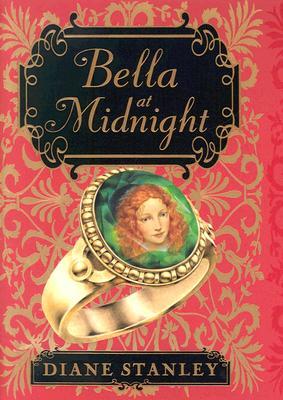
Bella At Midnight by Diane Stanley

Click to view
on Goodreads 
In the little village of Castle Down, in a kingdom plagued by war, lives a peasant girl called Bella. Blessed with a kind family and a loving friend, she manages to create her own small patch of sunlight in a dark and dangerous world. Bella is a blacksmith's daughter; her friend Julian is a prince -- yet neither seems to notice the great gulf that divides his world from hers.
Suddenly Bella's world collapses. First Julian betrays her. Then it is revealed that she is not the peasant she believed herself to be: She is Isabel, the daughter of a knight who abandoned her in infancy. Now he wants her back, so Bella is torn from her beloved foster family and sent to live with her deranged father and his resentful new wife. Soon Bella is caught up in a terrible plot that will change her life -- and the kingdom -- forever. With the help of her godmother and three enchanted gifts, she sets out on a journey in disguise that will lead her to a destiny far greater than any she could have imagined.
(278 pages)

So, I love The Silver Bowl books (link goes to my review of The Silver Bowl). I've had this earlier book by Stanley on my radar for a while, but it got buried under all the other books that were on my radar (i.e. it fell to somewhere in the middle of the infamous Goodreads "to read" pile). A month ago I made a Top Ten post listing ten books I can't believe I haven't read, and this was right near the top. I requested it right after posting the article, and read it in one day - as soon as I could wrestle it away from my mother, another Diane Stanley fan!

As an earlier work than the Silver Bowl series, you can see that Stanley's writing skills were still developing; the writing isn't quite a crisp as in her later series. However, considering how amazing those books are this really doesn't hurt Bella at Midnight very much. I initially thought the technique of telling the story from so many different POVs, switching every chapter between everyone from Bella to seemingly random people off the street, was clumsy and distracting. I soon realized, though, that the technique fit the story perfectly as all the threads began to weave together into one big, tightly knitted story.

Bella is a very interesting character, especially in comparison with the original Cinderella. Where Cinderella began life with a loving father but no real family outside of that, Bella grew up believing herself to be the peasant daughter of a loving couple. She has two siblings, village friends, and of course her best friend Prince Julian right by her side. When she is brought to her birth father's home to be lonely, abused, and neglected (not to a truly abusive state, but still pretty cruelly), she is homesick more than anything else. She doesn't dream of marrying a prince and riding off into the sunset; all she wants is to be back with the family who loves her. I love this, because at the end of the day it isn't wealth that matters to her: it's people. How can you not love a character with priorities like that? I won't pretend she's going on my list of "most memorable heroines" (if I were making that list, which I'm not), but she's definitely a engaging and sympathetic main character.

This is a fun, humorous twist of a classic fairy tale, one that I'm glad I read but I probably won't be in a huge hurry to reread. If you're looking for a well-written fairy-tale spinoff that messes everything up the time period and the happy ending, then this is most definitely the book for you!

10 February 2015

Top Ten Things I Like/Dislike in Romances

Here we go, my second Top Ten Tuesday! You can find my first one, a list of Fictional books I can't believe I haven't read yet, here. You can read more about Top Ten Tuesday here at The Broke and the Bookish.

This week's topic is "things you like/dislike in romance." I'm doing five I like, four I don't. Here they are:

Things I like:

1. Slow-burning  - Is there anything more romantic than a relationship that takes it time? Is there anything sweeter than watching the hero and heroine go from strangers, to friends, to a little bit more than friends, to a little bit more than that . . . all the way to true love?

2. Childhood friends - I don't know if everyone will agree with me on this one, I know it's become a bit cliche. But there's just something so wonderfully sweet about the relationship between two people who have known each other their whole lives. I love the idea that two people can know each other so incredibly well because they've shared secrets, memories, and friends since they were very young.

3. They both are loyal to the end - Yep, this one's definitely cliche. But if there's anything I can't stand, it's a character who's flaky about his priorities. If he or she is the one, then he or she is The One! Don't waffle about it, don't be a flake and lead on two different people at the same time. Just pick one, love them forever, and don't ever, ever, betray their trust or their love.

4. Characters have their priorities straight - Let's see, should I save the world from impending doom or dream about how hot my crush is? Um, duh! Save the world! I love a good romance that doesn't take center stage, and doesn't take over the main plot line. If two people are really in love, then great. I'd love to see some of that slow-burning romance I mentioned in my first point (in fact, it's books like these that often have the best slow-burn squee moments!). But if I'm going to like them as characters, they'd better spend more time worrying about Impending Doom than they do about whether or not their crush likes them back.

5. They are willing to do anything for each other, but don't spend a lot of time talking about it - Back to the slow-burn. I guess most of these points all go back to this, but I really really love subtle romance. I love it when it's light-handed and sweet, when characters spend most of the time poking fun at each other, insulting each other, or even pretend to hate each other, but at the end of the day they each know they would both go to the ends of the earth for the other person.


Things I don't like:

1. Insta-love - What's betting this is on almost every Top Ten list this week? Everybody hates insta-love! Well, probably not everybody. I suppose there must be a group out there who like it, otherwise they would stop publishing it. But I for one detest insta-love. So sure, he's cute and he has an accent. Maybe he's got magic powers, I don't care. He might be an awesome person (and the way these stories go, he probably is), but you don't know that, do you? You don't know that because you only met him last week! Any time a character falls for someone after knowing them less than, say, a couple of months, I lose any respect I had for their intelligence.

2. Love triangles - I kind of touched on this with #3 in the first list, but I had to reiterate this second pet peeve of mine. Love triangles are proof that the main character is not worth either of the people she's considering being with. If two people offer you their love, then you pick one and move on. You don't keep stringing them along because you're paralyzed with indecision. That's just plain mean, and shows that neither of them is really your "true love," because if he were you wouldn't spend the whole time vascilating between him and the other guy!

3. When the childhood best friend is really obviously the One, but the protagonists spends the entire book looking everywhere and anywhere else for true love - Yeah, I love stories where childhood friends fall in love. I know this looks like I'm rescinding that statement, but I'm not. I just don't like childhood friends stories where one of the main characters spends the whole time running in circles looking for love away from her best friend when I, the reader, am just holding my head and moaning "figure it out already!"

4. On-again-off-again - Be one or the other. Just pick and be done with it. If you're really waffling that much, then how on earth are you planning on spending the rest of your lives together?

And there you have it, some of my favorite and least favorite components of romance. What are yours? Let me know in the comments section below!

03 February 2014

Princess of the Midnight Ball by Jessica Day George, 2009

Galen is a young soldier returning from war; Rose is one of twelve princesses condemned to dance each night for the King Under Stone. Together Galen and Rose will search for a way to break the curse that forces the princesses to dance at the midnight balls. All they need is one invisibility cloak, a black wool chain knit with enchanted silver needles, and that most critical ingredient of all—true love—to conquer their foes in the dark halls below. But malevolent forces are working against them above ground as well, and as cruel as the King Under Stone has seemed, his wrath is mere irritation compared to the evil that awaits Galen and Rose in the brighter world above. 

Galen is a returning soldier without a true family to come home to. His mother, father, and sister all died during the endless war. He lives with the aunt, uncle and cousin he'd never known, working in the king's garden under his uncle (the head gardener)'s careful, grouchy eye.

Rose is a princess, the oldest of twelve girls (all named after flowers), and destined to rule the kingdom one day. She has sisters, and more sisters, and a few more over there in the corner. Sisters coming out her ears, and no mother to take care of them. That duty has fallen squarely on Rose's shoulders, and is a duty more difficult than anyone knows. Because every third night, when midnight strikes, the princesses must travel down into a land of darkness, and dance until dawn with the shadowy figures of dark princes. It is a curse, one handed down to them by the mother who made a foolish bargain with a man of evil.

Now the curse grows worse, because the princesses were deathly sick and missed a day. Every time they miss a night of dancing, they have to dance more often. Now they dance every night, and their father the king is frantic to find out what is happening to them. If he asks his daughters, all they can speak is gibberish. So he offers his crown and one of his princesses in marriage to any prince who can discover what ails the girls. The only problem? Every prince who tries and fails to learn their secret winds up dead from some accident within a month. Soon all the other kingdoms are mad, and they are on the brink of war once more.

But Galen, the clever soldier turned gardener, is smarter than he looks, and driven by something the princes never had: the unspoken love for a certain eldest princess. He is worried by how tired she looks, and wants nothing more than to bring her peace.

So, this is a retelling of the famous Twelve Dancing Princesses, which I obviously knew going into it. Fairy tale retellings are one of my favorite genres, and I just read Jessica Day George's Dragon series, so I had extremely high hopes going into the book. And it did not disappoint.

The characters weren't caricatures, but they weren't so finely developed it distracted from the story. Rose wasn't the only princess to get at turn in the spotlight, and each of the sisters had their own distinct personality. From Lily, Rose's right hand sister, to Hyacinth the devout, to Poppy the tomboy, and Pansy the darling youngest, each girl had a unique view of the curse that troubled them, and each dealt with the pressure in different ways (which was sometimes quite amusing). Galen's uncle was - argh, I have to either give a big plot summary, or a short (but rather big) spoiler to talk about the people on Galen's side of the book. Well, let's just say that the rarely seen weren't just given a stick-on that read "bland." Even the women who helped Galen find his aunt and uncle's house were unique.

Read it? Yes. Stay up till dawn with it? Um, *sheepish grin* I just reread it last week, for maybe the fourth time. And I still stayed up to finish it.

10/14 note: This is actually the first book in a trilogy, and I just wanted to stick on here that the other books are really good too.