Showing posts with label Kregel. Show all posts

01 September 2017

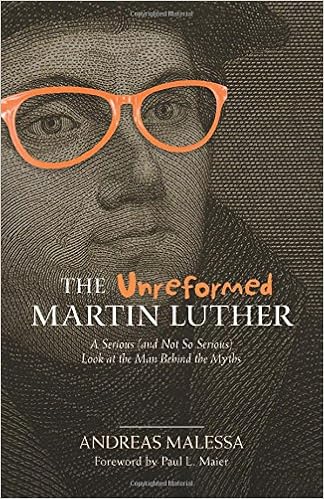
The Unreformed Martin Luther by Andreas Malessa, 2017

Click to view
on Goodreads 
Will the real Martin Luther please stand up? 

After five hundred years of examining the life of the "father of the Reformation," we must surely know all there is to know about Martin Luther. But is that true?
Did he really nail his Ninety-Five Theses to the church door?
Did he throw an inkpot at the devil?
Did he plant an apple tree?
Did his wife escape her convent in a herring barrel?
German radio and television journalist Andreas Malessa looks at the actual history of Luther and concludes that many of the tales we know best are nothing but nonsense.
Diving gleefully into the research, Malessa investigates many of the falsehoods and fallacies surrounding the reformer, rejecting them in favor of equally incredible facts. Full of humor and irony, this book educates and entertains while demonstrating a profound respect for Luther's life and mission.
If you're looking for the truth of the man behind the theses, come discover his faith and influence--with the myths stripped away.
(168 pages)


First, I want to describe my background going into The Unreformed Martin Luther: basically, I am not a Lutheran and I don't really worship the ground Luther once walked on. I do, however, think he was a very important historical figure and that his life warrants historical examination. I'd read a biography about him in the past and learned a little bit about him in AP European History, but I had never even heard most of the rumors being debunked in this book until, well, the book said them right before debunking them.

But you know what? The middle ages were a very interesting time period. And people back then were . . . well, not exactly living up to the Victorian standard. Even Martin Luther, this Catholic priest and religious leader, was bawdy at times. And he also, apparently, liked to write in detail to his friend(s) about his constipation. Because oversharing was definitely a thing back then.

Speaking over oversharing, did you know that newlyweds in the Middle Ages had to have witnesses on their wedding night to make sure they were really consummating the marriage? They would slip away once things really started to get going, but still. That is yet another reason I am glad I don't live in the Middle Ages (ranked fourth after 1. they didn't have glasses so I would have been blind as a bat and 2. women were stuck making bread and raising babies and 3. everybody died young).

But honestly, some of these chapters were really cool. My favorites were probably the one on constipation (because I just think it's hilarious we know so much about the bowel movements of some guy from 500 years ago!) and the one about the origin of the "Here I stand" quote. It turns out that when Luther said "Here I stand" he was actually saying "Look, I've already given my speech in two different languages today and it's really hot and I feel sick and I can't do it a third time. All I can do now is stand here." The actual end to his speech was good too, but I can't remember what it was. Obviously not as memorable as "here I stand," I guess.

Before I end I suppose I should also add that, in keeping with the slightly vulgar nature of discourse back then, a few of the Luther quotes are rather lewd. I pretty much just took that in stride, though, because the whole point of the book is to show us the "unedited" version of who Martin Luther really was.

Basically, The Unreformed Martin Luther is a really funny and infomative book about a major historical figure and his time period. Whether you agree with his beliefs or not, you can't help but get a hoot out of reading this unfiltered examination of the real man behind the myths.

Disclaimer: I received a complimentary copy of this book from the publisher in exchange for an honest review.

04 August 2017

The Captivating Lady Charlotte by Carolyn Miller, 2017

Click to view
on Goodreads 
Lady Charlotte Featherington is destined for great things on the marriage market. After all, as the beautiful daughter of a marquess, she should have her pick of the eligible nobility hen she debuts. She, however, has love at the top of her list of marriageable attributes. And her romantic heart falls hard for one particularly dashing, attentive suitor. Sadly for Charlotte, her noble father intends her betrothed to be someone far more dull.

William Hartwell may be a duke, but he knows he was Charlotte's father's pick, not the young lady's own choice. And the captivating Lady Charlotte does not strike him as a woman who will be wooed by his wealth or title. While she has captured his heart, he has no idea how to win hers in return--and the betrayal and scandal his first wife put him through makes it difficult for him to believe that love can ever be trusted. His only hope is that Charlotte's sense of responsibility will win out over her romantic notions.

Can a widowed duke and a romantically inclined lady negotiate a future and discover love beyond duty? Will they be able to find healing and hope from the legacy of grace? Poignant and charming, this is another beautifully written, clean and wholesome Regency romance from Carolyn Miller.

(310 pages)

First, a word of warning: The Captivating Lady Charlotte is the second book in the Regency Brides: A Legacy of Grace series so there may be some accidental spoilers for its prequel, The Elusive Miss Ellison (my review). There's a fairly strong connection between the two, since Charlotte is the younger cousin of Lavinia Ellison from the first book. Lavinia and her–ahem–personal life actually wind up taking a pretty big role in the story, but I'll try to steer around the biggest spoilers.

I went back to read my review of Miss Ellison after reading Lady Charlotte, and I was reminded of the strengths and weaknesses of the former. It's funny, because I think this second book is directly opposite its prequel–better where Miss Ellison was weak, and weak in areas it was strong. What do I mean? Well, the religion in Miss Ellison was so cheesy and pushy (perhaps because Lavinia's father was a pastor) that I found it almost hard to read; discussions of faith and religious duty in Lady Charlotte, on the other hand, are sparse and focused mainly on a duty to help those who fall through society's cracks (as well as a few mentions among fellow believers of the importance of prayer during hard times). On the other hand, I actually really loved the romance in Miss Ellison–it was entertaining and realistic, if unrealistically enabled by the plot at times, and everything was just really sweet. In Charlotte's case, however, I never really get the vibe that she and William had enough of a connection or a shared passion for anything that would tie them together. William basically decides he needs a new wife and that Charlotte is pretty enough (and, you know, probably has enough substance) to take on the role. She never shows any interest in him until very late in the book, and I honestly feel like she just managed to convince herself that she was in love with the older man so she could comfortably resign herself to the situation dictated by her parents and society.

I know. That's not exactly the most romantic storyline, is it? The whole premise of the book (basically, "Charlotte is eighteen now so she must be married off to the highest bidder!") becomes more sexist the longer I think about it. I don't entirely hold that against Miller, since I'm pretty sure that's just how things were back then and she does try to create realistic loving relationships amidst the arranged marriages, but it still just rubs me the wrong way. As an eighteen-year-old young woman myself, I can't really stomach the way Charlotte's entire life revolves around getting married, loving her future husband, and bearing an heir and a spare for his family. Ick.

I really did enjoy reading The Captivating Lady Charlotte, even if it sounds like I didn't. While I didn't love the main characters quite so much this time, and the plot was a little more murky/rambling than that of Miss Ellison, I actually enjoyed it just as much. I look forward to also enjoying the third book in the series, The Dishonorable Miss DeLancey, when it comes out in a few months.


Disclaimer: I received a complimentary copy of this book in order to participate in a Kregel blog tour.

09 June 2017

The Runaway by Claire Wong, 2017

Click to view
on Goodreads 
Shortly before her eighteenth birthday, Rhiannon Morgan runs away from the remote Welsh village of Llandymna. Camping out in Dyrys Woods, she starts to make a new life for herself. In the woods she finds space for her active imagination--weaving together the stories she loves and memories of her past, including the mother she lost thirteen years ago.

Back in the village, Rhiannon's disappearance triggers a series of events that uncover the cracks in Llandymna's quiet surface. Relationships become frayed as a young police officer is forced to investigate his neighbors, and the village's elderly storyteller hints at a secret that the older generation has kept for decades. But as painful as the village's past may be, it may hold the key for hope in the present...

Claire Wong's strong debut explores how human relationships develop, how we change as we interact with one another, and the role of folktales and mythology in small communities.

(302 pages)

When I agreed to participate in the blog tour for The RunawayI didn't really know that much about it. I thought it would be kind of interesting, with its story of a girl who ran away from home and of secrets in the village, and that the "surviving in the woods" storyline would be Hatchet-style thrilling while the village stuff would be kind of contrived and ridiculously dramatic.

It turned out completely different from how I was envisioning it. For one thing, the story is way more complex and intriguing than I expected it to be. Rhiannon turns out to not have as big a part to play in the story as we're drawn to believe, as most of the action during the middle of the book takes place in the village rather than in the forest, but it was still interesting to see the way she grows up over the course of the book. She's pretty much a self-centered jerk at the beginning of the book, believing herself to be so much better than everyone else in the village because she's "not a hypocrite" and is good in school, but as time goes on she begins to gain perspective on everything as she carves a life for herself in Dyrys Woods. Switching away from Rhiannon, though, I liked learning more about the motivations of her perfectionistic aunt/guardian who copes with tragedy by micro-managing everyone in the village. There's much more beneath Diana's surface than what first meets the eye. I also liked reading about Tom the policeman and Nia the rather oppressed farm-wife and Maebh the old woman who knows everything that has ever happened in the town. My favorite characters were probably Maebh and the sibling pair who came into the village a little ways into the book.

The book is called The Runaway for a reason, and it goes much deeper than just Rhiannon's last-minute decision to leave her aunt's home for the woods. Over the course of the book, we read about two more people who run away to Dyrys, each for their own unhappy reasons. The focus of the book is truly the village, not the woods, because we begin to discover the rotten reasons villagers are driven to run away from their homes and into the woods. You know how some books aren't necessarily super violent, but they still manage to drive home the complexities and occasional horrors of human nature? The Runaway is most definitely one of those books. I can't dive too much into that because of spoilers, but it is in every sense of the word a people-driven novel.

The Runaway was not quite the fluffy quick read I went in expecting, but I loved it even more for that. It's a fascinating exploration of human nature and the community in a small town, and I really, really liked it. I don't usually keep ahold of books I get for review, but I'll definitely hold off on passing this one along because I know I'll want to revisit it sometime down the line. And since this was just Wong's debut (and one of the most impressive debuts I've read in a long time), I'll be keeping a hopeful eye out for many more books by her in the future!


Disclaimer: I received a complimentary copy of this novel from the publisher in exchange for an honest review.

24 March 2017

The Elusive Miss Ellison by Carolyn Miller, 2017

Click to view
on Goodreads 
Pride, prejudice and forgiveness...
Hampton Hall's new owner has the villagers of St. Hampton Heath all aflutter--all except Lavinia Ellison. The reverend's daughter cares for those who are poor and sick, and the seventh Earl of Hawkesbury definitely does not meet that criteria. His refusal to take his responsibilities seriously, or even darken the door of the church, leave her convinced he is as arrogant and reckless as his brother--his brother who stole the most important person in Lavinia's world.

Nicholas Stamford is shadowed by guilt: his own, his brother's, the legacy of war. A perfunctory visit to this dreary part of Gloucestershire wasn't supposed to engage his heart, or his mind. Challenged by Miss Ellison's fascinating blend of Bluestocking opinions, hoydenish behavior, and angelic voice, he finds the impossible becoming possible--he begins to care. But Lavinia's aloof manner, society's opposition and his ancestral obligations prove most frustrating, until scandal forces them to get along.

Can Lavinia and Nicholas look beyond painful pasts and present prejudice to see their future? And what will happen when Lavinia learns a family secret that alters everything she's ever known?

(304 pages)

Meh. This is a very forgettable Christian romance book that tries not very successfully to be a Jane Austen novel with "Christian morals" (i.e. lots of moralizing) squished in around the edges. It certainly got in the Christian parts, but got nowhere near the wittiness of Jane Austen.

I'm sorry, is that too harsh? To be honest, I didn't hate the book–I enjoyed reading such a complete escapist story set in Regency-era England. Some of the back-and-forth between Lavinia and Nicholas really is quite clever, and once I stop implicitly comparing the book to Pride & Prejudice I can enjoy it for what it is. The story had a lot of elements I like in old-timey stories–wealthy settings, hatred turn to romance, outspoken females–and I enjoyed reading them.

The book's two main errors, though, are taking things too far and being too obvious about it. Lavinia isn't just outspoken: she's a downright feminist, and she spends her days devoted to caring for the poor. These are both excellent traits, but they are also slightly annoying (she is way too perfect!) and are very unrealistic for her time. There's a constant tension between Lavinia and the very backward way everyone else approaches wealth, class structure, etc. I would have liked to see some evidence that Lavinia was a product of her own time, that her egalitarian tendencies weren't just some convenient flash of inspiration from God, and that she had given a little more thought to why her beliefs about social decorum were so different from everyone else's. I liked Nicholas more than I did Lavinia, though, and seeing him gradually move to her way of thinking (after originally being very prim and proper about what women could and couldn't do!) felt more realistic.

Everything is very melodramatic in The Elusive Miss Elison. Lavinia and Nicholas are constantly accidentally hurting each other's feelings, and their "hearts start pining for each other" from the first time they're separated–despite the fact that at that point they've only ever snapped meanly at each other, and Nicholas's brother literally killed Lavinia's mother when she was a little girl. Lavinia gets past that way too easily, in my opinion. You can forgive someone without falling in love with them, you know? And the plot twists themselves are straight out of a soap opera: Lavinia falls hopelessly ill with the influenza and winds up spending months being taken care of in Nicholas's elaborate house. She moves to London to visit some conveniently-discovered estranged family members, learns all sorts of juicy secrets about her past (that her aunt decided to wait twenty-three years to tell her about, because reasons), and so on and so forth. It's fun to read, sure, but it's also cringe-worthy in how cliche everything is. And don't even get me started on the fakey-happy way everyone's always talking about religion; I may be a Christian, but I don't start randomly talking about the Bible with casual acquaintances like that–and I certainly don't start giving religious advice when they may or may not be Christians themselves. Telling someone to pray about their worries, or to ask God for help, is not always a socially appropriate thing to do.

All in all, I spent a few pleasurable hours with Miss Ellison but I've certainly read better books in its genre. In fact, excuse me, I feel the urge to re-read Pride & Prejudice coming over me . . .


Disclaimer: This is an Amazon affiliate link, and I received a complimentary copy of this novel from the publisher in exchange for an honest review.