Showing posts with label mourning. Show all posts

09 November 2018

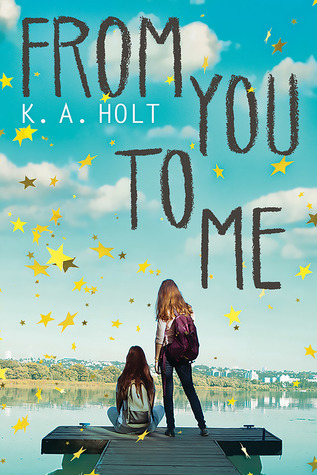
From You To Me by K.A. Holt, 2018

Click to view
on Goodreads 
Amelia Peabody lives in a small town where nothing changes. And that's just fine by her. After losing her big sister, Clara, a few years ago, Amelia can't handle any more change. But when she starts eighth grade, she accidentally receives a letter that Clara had written to herself. In it, there's a list of things she'd wanted to do before the end of middle school and never finished, like get on the softball team and throw an awesome birthday party on the lake.

Amelia wonders if it's a sign from Clara. Maybe if she completed the list, her heart would stop hurting so much, and she could go back to being her old self. But as she makes her way through, Amelia finds that there's no going back, only forward. And she realizes she'll have to put her own spin on Clara's list to grow and change in the ways she needs to.

K. A. Holt's beautiful new novel is about grieving and growing up, and the ripples loss creates for a girl, a family, and a community.
(208 pages)

I'm not exactly sure how it happened, but I read a lot of books about death and grief this summer. Whereas both Planet Grief and Speechless tackle the aftermath of death through a setting which forces the characters to deal with their feelings (a group counselling session and a wake, respectively), From You To Me shows Amelia's struggles to cope with her overwhelming grief long after the dust has settled and the rest of the world has moved on.

It's a sad angle, and I thought Holt's representation of Amelia's grief was well done (though I'm lucky enough not to have first-hand experience in this field). However, at times I got really frustrated with Amelia. Her best friend really is a wonderful friend, putting up with way more crap than I would probably have been able to handle in her shoes. Amelia's parents are less great, but that's to be expected since they're coping with their own grief. I did kind of hate how hard her father was pushing to get his wife and daughter to come back to the lake with him (in their shoes, I don't think I'd ever go near large bodies of water ever again!).

I liked the book, but somehow it didn't hit me quite as well as the other two grief books I've read this summer. I don't know why exactly that is, but I suspect part of it is because I got pretty frustrated with Amelia at times, and perhaps partly because as a Christian I was a little uncomfortable about Amelia's thoughts on the afterlife. On the whole, though, it's a pretty good book.

If you're on a kick looking for stories about girls coping with the death of their older sister, I recommend Riding the Flume by Patricia Curtis Pfitch. That's been one of my favorite books for over a decade!

Disclaimer: I received a complimentary copy of this book from the publisher in exchange for an honest review.

27 March 2017

Matylda, Bright and Tender by Holly M. McGhee, 2017

Click to view
on Goodreads 
In a courageous debut novel, Holly M. McGhee explores the loss that shakes one girl’s world — and the unexpected consequences of the things we do for love.
Sussy and Guy are best friends, fourth-graders who share their silliest thoughts and deepest hopes. One afternoon, the two of them decide they must have something of their very own to love. After a trip to the pet store, they bring home a spotted lizard, the one with the ancient face and starfish toes, and they name her Matylda (with a y so it’s all her own). With Guy leading the way, they feed her and give her an origin story fit for a warrior lizard. A few weeks later, on a simple bike ride, there is a terrible accident. As hard as it is, Sussy is sure she can hold on to Guy if she can find a way to love Matylda enough. But in a startling turn of events, Sussy reconsiders what it means to grieve and heal and hope and go on, for her own sake and Matylda’s. By turns both devastating and buoyant, this story is a brave one, showing how far we can justify going for a real and true friend.

(224 pages)

Oof, this is a sad one.

Honestly, I was not emotionally prepared to handle such a heartbreaking topic. That's why I kept pushing it down my TBR list. But now I'm to the end of March, and it came out in March, so I really have to review it. I downed it in a single sitting last night.

I just . . . I don't like books about death. No, scratch that. Sometimes I love books about people getting over the deaths of loved ones (case in point: Suzanne LaFleur's Love, Aubrey). I like reading about the turmoil, watching characters face the very worst-case scenarios and come out the other side still living. There's something very poetic and encouraging about seeing someone recover from the unthinkable. And we get some of that in Matylda, as Sussy takes baby steps to begin functioning again after Guy's death, but I would have liked to see even more.

Actually, my biggest struggle with the book is that it was so short. Cut out the lizard trivia (and let's be honest, I want to cut out the lizard trivia–I am so not an amphibian person!) and the book becomes even shorter. We get a few chapters of background that gets us to care about Guy (who, for the record, is way more well-spoken than any nine-year-old I've ever known), one chapter in which the accident actually occurs, and then about a hundred pages dealing with the aftermath.

For the book's short length, it packs in a lot of details about Sussy's grieving process. She has wonderful parents, who know just when to push and when to leave her be, and Matylda is a great focus for Sussy's evolving emotions about Guy's death. I thought everything was very well done, and what I would imagine the grieing processing could be like (though I've never gone through it on such a scale as Sussy does). I did wish we got a little more background with Guy, a few more scenes with his grieving parents, more details about Sussy's and Guy's school life, an explanation about why these little kids run around saying they love each other all the time (no nine-year-old I know would be caught dead saying the word "love!"), and a little background on why all these nine-year-olds are allowed to roam free on their bikes all the time (even after Guy's totally-preventable death) . . . but, you know, maybe all that would have detracted from the raw story.

Anyway, I do recommend Matylda. I think if you're in the right mood, and a little less squeamish than I, you'll enjoy it much more than I did. Every once in a while a person is just itching for a good sad book to wallow in for a while; this is just that sort of book.


Disclaimer: This is an Amazon affiliate link, and I received a complimentary copy of this novel from the publisher in exchange for an honest review.

02 December 2016

A Blind Guide to Normal by Beth Vrabel, 2016

Click to view
on Goodreads 
Richie “Ryder” Raymond has a gift. He can find the punchline in any situation, even in his limited vision and prosthetic eye. During the past year at Addison School for the Blind, Ryder’s quick wit earned the respect and friendship of his classmates. Heading to mainstream, or “normal,” school for eighth grade is going to be awesome.

After all, what’s not to like? At Addison, Ryder was everyone’s favorite person. He could make anyone laugh, especially his best friend Alice. So long as he can be first to make all of the one-eyed jokes, Ryder is sure he’ll fit in just as quick at Papuaville Middle School, home of the Fighting Guinea Pigs. But Alice warns him fitting in might not be as easy as he thinks.

Turns out, Alice was right. In just the first hour of “normal” school, Ryder is attacked by General MacCathur II (aka, Gramps’s cat), causes his bio teacher to pass out cold, makes an enemy out town hero Max, and falls for Jocelyn, the fierce girl next door who happens to be Max’s girlfriend. On top of that, Ryder struggles to hold onto his dignity in the face of students’ pity and Gramps’s non-stop practical jokes.

Ryder quickly sees the only thing worse than explaining a joke is being the punchline. But with help from his stuck-in-the-70s Gramps and encouragement from Alice, Ryder finds the strength to not only fight back, but to make peace.

This exciting sequel to A Blind Guide to Stinkville weaves humor, recovery and second chances into an unforgettable story, with characters who will hook you from page one.

(272 pages)

I always meant to read A Blind Guide to Stinkville. I even went so far as to check it out from the library one time about a year ago, but then life happened and I had to turn it back in before I got around to reading it. When I got an email from Sky Pony Press asking whether I'd like to review its sequel/companion, A Blind Guide to Normal, I figured this was my chance to read a book at least connected to Stinkville. I went in with very high hopes.

Coming out of the book I'm a little less enthusiastic. I liked it, sure, but I just didn't really connect with the characters the way everyone else seemed to with Stinkville. I could see and understand the pain Ryder buried deep inside his chest, the way he shoved aside his fear and anger and insecurity and masked it with corny jokes. I saw that, but I still didn't really like him. Ryder treats his grandfather like a laughingstock throughout most of the book, even though the old man is still mourning the death of his wife; he makes new friends in school but treats them absolutely horribly; he does some very insensitive things, then never really apologizes for them. To be honest, I feel bad for Ryder–I really do. But I feel even worse for Jocelyn and Max and Gramps.

And really, Jocelyn and Max and Gramps are the main reason I liked Normal. Jocelyn was probably my favorite character, just because I loved the glimpses we got of her past and how she fought to move forward. Max is, basically, an ideal boyfriend. I loved him throughout the book, even when he was going head-to-head with Ryder. And Gramps? Gramps is just straight-up awesome. When he tells the story of his past, it's so touching to see how much in love he still is with his wife–even though she's been gone for around thirty years. Ryder was too busy being embarrased by his grandfather's old-fashioned sense of style to realize how sweet and cool the old man really was.

Do I recommend A Blind Guide to Normal? Meh. I suppose if you want to read it I'm not going to warn you off it, it really is funny in some parts and meaningful in others. Just go in knowing that Ryder isn't the nicest person in the world, and that there is way too much romantic angst in this book about a bunch of thirteen-year-olds. If you do/have read it, definitely let me know what you think! In the meantime, I think I'm going to send my copy off to my local Little Free Library.

Disclaimer: I received a complimentary copy of this novel from the publisher in exchange for an honest review.

18 November 2016

Be Light Like a Bird by Monika Schröder, 2016

Click to view
on Goodreads 
After the death of her father, twelve-year-old Wren finds her life thrown into upheaval. And when her mother decides to pack up the car and forces Wren to leave the only home she's ever known, the family grows even more fractured. As she and her mother struggle to build a new life, Wren must confront issues with the environment, peer pressure, bullying, and most of all, the difficulty of forgiving those who don't deserve it. A quirky, emotional middle grade novel set in Michigans Upper Peninsula, Be Light Like a Bird features well-drawn, unconventional characters and explores what it means to be a family and the secrets and lies that can tear one apart.
(240 pages)


This is a fairly melancholy book, but not in an overpowering way. I was a little worried about reading Be Light Like a Bird right now, just because I'm already emotionally overextended from stressing out about college stuff, but it actually turned out to be an almost cathartic read for me. Nothing like reading about a girl with a dead dad to put things in perspective, you know?

I'm moved tons of times, so I know how hard it can be to let go of a past home and live somewhere new, but Wren's moves are like a thousand times worse than any I've ever done. She lived in one place–one house–her entire life, and suddenly she's forced to leave all of that behind and start completely from scratch! Add to that the reason for their sudden move (her father's plane crash, which didn't even leave behind a body to be buried), the fact that she didn't even have anything of her father's to remember him by, and things become extremely bleak.

Considering how horrible her experiences were, I can completely understand Wren's anger at her mother and her desperation to put down roots and be absorbed into a support system–any support system. That's why I really kind of despised her mom for most of the book. Even at the end, when we learn a little more about the reasons for her actions, I'm still not really okay with them. Wren shouldn't have had to befriend strangers just to talk about how much she missed her father.

Now that we're on the topic of Wren's new friends, though, I have to say that I really loved them for the most part. I didn't particularly like Carrie, the popular girl Wren decides to befriend as a way of fusing herself into the social hierarchy at school, but I thought the way Wren responded to Carrie's nastiness was much more mature and realistic than the ways characters in other books have handled similar situations. Theo was another slightly stereotypical character (the nerdy unpopular boy who's secretly an ideal best friend for the main character), but somehow I didn't really mind. He and Wren bond over interesting things like bird-watching and photography, and Theo–who's mother died a few years before–is as a compassionate friend who knows exactly what Wren is going through. I hope the two of them stay side-by-side for a very long time.

Honestly, though, I can't put my finger on it but I just wanted . . . more from Be Light Like a Bird. I don't mean more in the sense of having a heavier dosage of Wren's grief, because I think Schröder handled that aspect of the story beautifully, but I just mean more details. If Wren lived her entire life in that one town, why does she barely even think about it? You'd think she'd feel the loss of her old classmates, who were at least familiar even if they weren't her best friends, and that she'd spend more time comparing her old home with this new one. More than anything, though, I honestly felt like we don't get a very good description of her father. We get flashbacks and memories with him in them, but I never feel like I truly know him as a complex and nuanced human being.

To be fair, the focus of Be Light Like a Bird really isn't on Wren's father or her old town, or even on her mother. The focus is on Wren's struggle to move on from her father's death, and I think it does a great job of that. Be Light Like a Bird is a beautiful book in its own way, and I recommend it to anyone who thinks they'd like it.

Disclaimer: I received a complimentary copy of this novel from the author in exchange for an honest review.

14 November 2016

How to Avoid Extinction by Paul Acampora, 2016

Click to view
on Goodreads 
For fans of Gary Schmidt and Joan Bauer, a laugh-out-loud intergenerational road trip story from acclaimed author Paul Acampora!

Since the death of his grandfather, Leo's number one chore has been to chase after his grandmother who seems to wander away from home every few days. Now, Gram's decided to roam farther than ever. And despite his misgivings, Leo's going along for the ride. With his seventeen-year-old cousin, Abbey, and an old, gassy dog named Kermit, Leo joins Gram in a big, old Buick to leave their Pennsylvania home for a cross-country road trip filled with foldout maps, family secrets, new friends, and dinosaur bones.


How to Avoid Extinction is a middle-grade comedy about death and food and family and fossils. It's about running away from home and coming back again. For Leo, it's about asking hard questions and hopefully finding some sensible answers. As if good sense has anything to do with it. Against a backdrop of America's stunning size and beauty, it's also about growing up, getting old, dreaming about immortality, and figuring out all the things we can -- and can't -- leave behind.
(208 pages)

Honestly, my gut reaction when closing the book was "man, this needed to be longer!"At barely 200 pages, there didn't seem to be much room for the story to stretch as long as it needed to go. I did really like the characters and the path that they took, but I was also yearning for more.

If I'm being completely honest, actuall, I did have a little trouble with some of the characters: namely, Leo's mother and grandmother. Mainly his mother. She's not actually around for most of the book, so it's hard to get a pin on her personality, but from the little we do get she seems like a rather unpleasant mother. I get that there were reasons for her behavior, that her life hasn't been all roses and sunshine, but she's been very closed-off and hasn't mentioned any of the major parts of her life to Leo (even the parts that include his own birth father). Leo, for his part, seems remarkably nonchalant about all the information she's hidden from him–but grows increasingly curious to find out more as the book progresses. It's a bit peculiar, really, that he hadn't wondered much before about what his gone-away dad was like.

Anyway, I'm not always the biggest fan of quirky stories: sometimes they just feel forced, like someone is trying to hard to be "meaningful" by being bizarre. I think Acampora legitimately knows how to pull off a touching and off-beat story, as he did in his debut Defining Dulcie (my review) all the way back in '06. It definitely works in How to Avoid Extinction as well, though I have to admit Extinction didn't quite connect with me on the emotional level that Dulcie did.

This is a meaningful and interesting book, full of interesting and colorful characters facing up to some pretty tough truths about life. I will admit freely that there was one scene about three-fourths in that made me sob like a baby, and I definitely came out of the book wishing it hadn't ended. I get the general vibe from the book, though, that it could have gone a little deeper. The material felt a little rushed at times, because (as I said at the beginning of this review) it honestly just felt too short. Maybe it's just a shortcoming inherent in the middle-grade genre, but I can't help but bemoan all of the amazing things Acampora could have done with the plot if he'd only taken another hundred pages to write it.

Disclaimer: I received a complimentary ARC of this novel from the publisher in exchange for my honest review.