Showing posts with label grief. Show all posts

09 November 2018

From You To Me by K.A. Holt, 2018

Click to view
on Goodreads 
Amelia Peabody lives in a small town where nothing changes. And that's just fine by her. After losing her big sister, Clara, a few years ago, Amelia can't handle any more change. But when she starts eighth grade, she accidentally receives a letter that Clara had written to herself. In it, there's a list of things she'd wanted to do before the end of middle school and never finished, like get on the softball team and throw an awesome birthday party on the lake.

Amelia wonders if it's a sign from Clara. Maybe if she completed the list, her heart would stop hurting so much, and she could go back to being her old self. But as she makes her way through, Amelia finds that there's no going back, only forward. And she realizes she'll have to put her own spin on Clara's list to grow and change in the ways she needs to.

K. A. Holt's beautiful new novel is about grieving and growing up, and the ripples loss creates for a girl, a family, and a community.
(208 pages)

I'm not exactly sure how it happened, but I read a lot of books about death and grief this summer. Whereas both Planet Grief and Speechless tackle the aftermath of death through a setting which forces the characters to deal with their feelings (a group counselling session and a wake, respectively), From You To Me shows Amelia's struggles to cope with her overwhelming grief long after the dust has settled and the rest of the world has moved on.

It's a sad angle, and I thought Holt's representation of Amelia's grief was well done (though I'm lucky enough not to have first-hand experience in this field). However, at times I got really frustrated with Amelia. Her best friend really is a wonderful friend, putting up with way more crap than I would probably have been able to handle in her shoes. Amelia's parents are less great, but that's to be expected since they're coping with their own grief. I did kind of hate how hard her father was pushing to get his wife and daughter to come back to the lake with him (in their shoes, I don't think I'd ever go near large bodies of water ever again!).

I liked the book, but somehow it didn't hit me quite as well as the other two grief books I've read this summer. I don't know why exactly that is, but I suspect part of it is because I got pretty frustrated with Amelia at times, and perhaps partly because as a Christian I was a little uncomfortable about Amelia's thoughts on the afterlife. On the whole, though, it's a pretty good book.

If you're on a kick looking for stories about girls coping with the death of their older sister, I recommend Riding the Flume by Patricia Curtis Pfitch. That's been one of my favorite books for over a decade!

Disclaimer: I received a complimentary copy of this book from the publisher in exchange for an honest review.

05 November 2018

Speechless by Adam P. Schmitt, 2018

Click to view
on Goodreads 
How do you give a eulogy when you can't think of one good thing to say? A poignant, funny, and candid look at grief, family secrets, difficult people, and learning to look behind the facade.

As if being stuffed into last year's dress pants at his cousin's wake weren't uncomfortable enough, thirteen-year-old Jimmy has just learned from his mother that he has to say a few words at the funeral the next day. Why him? What could he possibly say about his cousin, who ruined everything they did? He can't recall one birthday party, family gathering, or school event with Patrick that didn't result in injury or destruction. As Jimmy attempts to navigate the odd social norms of the wake, he draws on humor, heartfelt concern, and a good deal of angst while racking his brain and his memory for a decent and meaningful memory to share. But it's not until faced with a microphone that the realization finally hits him: it's not the words that are spoken that matter the most, but those that are truly heard.

(304 pages)

You'd think a book set at a young boy's wake would be way too morbid to be entertaining.

Somehow, Speechless isn't. It's sad, of course, but Schmitt straddles that line between sorrowful and funny very carefully. Little details, like Jimmy's aunt who is an "expert wake-goer" and Jimmy's ongoing struggles with the dress pants he's outgrown, add a morbid sort of humor to the present-day scenes.

The flashbacks to memories with Patrick start out as comedic interludes as well, but they grow increasingly sadder as the book progresses, painting a picture of Patrick's struggles with what was probably undiagnosed ADHD, or something similar. I got so mad at his parents, because they did such an awful job helping him.

The narrative jumps around a lot, as Jimmy flashes back to all these different memories of Patrick, but since the flashbacks go roughly in order it never becomes too confusing. I thought it was very well done, and by the end of the book I felt like I knew all the members of both Jimmy's and Patrick's families quite well. I got very mad at some of the parents at times (especially Patrick's father and Jimmy's mother!), but it was clear that they were all doing the best that they could and I appreciated that level of realism–no one was ever turned into a stereotype, for good or bad.

Speechless takes material that would normally be overwhelmingly depressing and manages to make it entertaining. It's still sad, of course–Patrick's death was a colossal tragedy. But the tragedy is handled near perfectly, and it's wonderful. Don't read this book if you're dealing with death in your own life, of course, but I think most other readers could definitely get something out of Speechless.

Disclaimer: I received a complimentary copy of this book from the publisher in exchange for an honest review.
01 October 2018

Tiny Infinities by J.H. Diehl, 2018

Click to view
on Goodreads
When Alice's dad moves out, leaving her with her troubled mother, she does the only thing that feels right: she retreats to her family's old Renaissance tent in the backyard, determined to live there until her dad comes home. In an attempt to keep at least one part of her summer from changing, Alice focuses on her quest to swim freestyle fast enough to get on her swim team's record board. But summers contain multitudes, and soon Alice meets an odd new friend, Harriet, whose obsession with the school's science fair is equal only to her conviction that Alice's best stroke is backstroke, not freestyle. Most unexpected of all is an unusual babysitting charge, Piper, who is mute—until Alice hears her speak. A funny and honest middle-grade novel, this sharply observed depiction of family, friendship, and Alice's determination to prove herself—as a babysitter, as a friend, as a daughter, as a person—rings loud and true.
(352 pages)

My parents haven't gotten divorced, thank goodness, but I imagine that if they did I would probably behave a lot like Alice does.

I mean, running away to the backyard and swearing to live in a tent until your dad moves back in totally seems like a reasonable response to learning that your parents are separating. Is that just me? Maybe? Ok.

Anyway, I feel like Alice is a very normal girl in many ways. Besides her strong response to her parents' separation, she tries to keep the summer as normal as possible. She focuses on her passion for swimming, and her goal to get on the swim team record board, and on babysitting her young neighbor.

I think my favorite storyline was the one with her parents, just because it was so sad and frustrating and . . . real. Beyond that, I liked the babysitting storyline just because Piper is such a precious little girl and I was rooting for them to figure out how best to help her (though the way they did was so cheesy/unrealistic I had to swallow some serious disbelief). I wasn't a huge fan of her big brother Owen, the illegitimate pre-marriage son of her father who seemed nice enough but also like kind of a player (and seriously, does a MG book need a character with such a morally iffy backstory?).

As for Harriet, I didn't really like her at all. I'm kind of tired of the trope of "quirky best friends" who say whatever pops into their head and acts like kind of a jerk but gets away with it because they're so "smart." Harriet just really annoyed me, probably more than was entirely reasonable. But I really appreciated that she kind of annoyed Alice too, and that Harriet didn't entirely get away with everything she did and said.

All in all, I liked reading Tiny Infinities. At places, I was really swept away by it; at others, I was merely entertained (or vaguely annoyed with characters in it). But it's a good book, and if you're interested then I do recommend you pick it up.

Disclaimer: I received a complimentary copy of this book in exchange for an honest review.

24 August 2018

The Stars at Oktober Bend by Glenda Millard, 2018

Click to view
on Goodreads 
i am the girl manny loves. the girl who writes our story in the book of flying. i am alice.

Alice is fifteen, with hair as red as fire and skin as pale as bone. Something inside Alice is broken: she remembers words, but struggles to speak them. Still, Alice knows that words are for sharing, so she pins them to posters in tucked-away places: railway waiting rooms, fish-and-chips shops, quiet corners. Manny is sixteen, with a scar from shoulder to elbow. Something inside Manny is broken, too: he once was a child soldier, forced to do terrible, violent things. But in a new land with people who care for him, Manny explores the small town on foot. And in his pocket, he carries a poem he scooped up, a poem whose words he knows by heart. The relationship between Alice and Manny will be the beginning of love and healing. And for these two young souls, perhaps, that will be good enough.
(288 pages)

I'm struggling to review The Stars at Oktober Bend.

I really don't know what to say. Is it a good book? I think so. Did I personally enjoy it? Not all that much. Can I even remember half of what happens? Nope. Does that make me a bad person? Hopefully not.

Basically, it's the sort of meaningful, lyrical, poignant book that we're all supposed to fall head over heels for. Alice's story is tragic and haunting, and Manny's is equally so.

Or at least, it is once we find out what it is. Unfortunately, so much time is taken up with Alice–her muddled narration, her backstory, her vivid memories and those she blocked out–that there isn't nearly as much focus on Manny. We learn that he was a child soldier, that he is traumatized, and that he quickly falls for Alice. And that's almost all the details we get in the entire book.

Perhaps that is the root of my troubles with the book, my apathy toward their relationship. I cared about Alice, but not so much about Manny because I didn't know him. And besides, I was really just so mad at all the people who did wrong by both of them throughout their lives that I struggled to find much to enjoy.

I genuinely do think this is a good book–it's lyrical and meaningful and poignant, and its exploration of Alice's family dynamics in particular is very well-drawn. But the book and I didn't entirely click. If you're interested (and won't be triggered by mentions of rape), then, by all means, do give it a go. Hopefully you will be able to get more out of it than I did.

Disclaimer: I received a complimentary copy of this novel from the publisher in exchange for an honest review.

17 August 2018

Planet Grief by Monique Polak, 2018

Click to view
on Goodreads 
What a crappy way to spend a weekend. The always-sarcastic Abby would rather be playing soccer, and the cagily quiet Christopher thinks a grief retreat is a waste of time. Neither of them wants to spend two days talking about their feelings. But despite their best efforts to stay aloof, Abby and Christopher are drawn into the lives of the other kids at the retreat. Maybe their stories will make them rethink how they are dealing with their own losses.
(208 pages)

Going in, I was a little nervous that Planet Grief would be too heavy for me. A book about grief counselling doesn't exactly sound like the happiest of summer reads, especially when I already feel antsy thinking about death.

I'm glad I gave in to my curiosity and picked it up, though, because it manages to hit all the right spots. Abby and Christopher are realistic and sympathetic leads, and the other characters in the group are even more interesting and compelling. The various exercises Eugene (the counsellor) has the kids do, and the conversations he supports them through, are fascinating to watch.

Basically, this is a book about kids who have to be strong enough to pull through experiencing something no child should have to face: the death of a close family member. There's no strong plot to pull the book along, though there is a climax, and the story is really driven by the stories of the kids and their struggles. There's no sugar-coating, no skating past the hard emotions of losing a parent or a sibling, and I personally really appreciated "peeking in" on the grief process of these characters.

My only real complaint about the book is that there was one storyline, added just to add drama I think, which I thought was a bit ridiculous and unnecessary. It kind of drew attention away from the core of the book. It wasn't a huge deal, though, and I think Polak handled it in a way that still fit well with the rest of the book. I should also add that there's a family coming to the grief counselling which has two mothers, and there are a few mentions of how unusual it is to have "a maman and a mom." It's not made into a big issue, so I don't think it would bother most readers, but I wanted to mention it just in case.

All in all, I really–well, enjoyed might not be the right word to describe how I felt while reading Planet Grief. I appreciated it, let's say. I liked it. I'm glad that I read it, and I recommend it to anyone who is interested in it.

What other books about children dealing with grief do you recommend? My all-time favorite is Suzanne LaFleur's Love, Aubrey!

Disclaimer: I received a complimentary copy of this book in exchange for an honest review.

30 April 2018

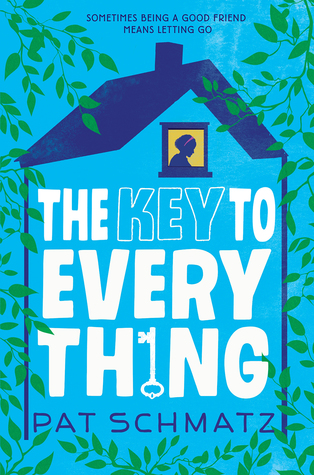
The Key to Everything by Pat Schmatz, 2018

Click to view
on Goodreads 
For eleven-year-old Tash, Cap'n Jackie isn't just the elderly next-door neighbor — she's family. When she disappears, only Tash holds the key that might bring her back.

Tash didn't want to go to camp, didn't want to spend the summer with a bunch of strangers, didn't want to be separated from the only two people she has ever been able to count on: her uncle Kevin, who saved her from foster care, and Cap'n Jackie, who lives next door. Camp turns out to be pretty fun, actually, but when Tash returns home, Cap'n Jackie is gone. And Tash needs her — the made-up stories of dolphin-dragons, the warm cookies that made everything all right after a fight, the key Cap'n Jackie always insisted had magic in it. The Captain always said all Tash had to do was hold it tight and the magic would come. Was it true? Could the key bring Cap'n Jackie back? In a heartfelt and stunningly written story, Pat Schmatz introduces readers to a tenacious, fiercely loyal girl struggling to let go of the fantasies and fears of her childhood . . . and say yes to everything that lies ahead.

(208 pages)

Hmm. I enjoyed reading The Key to Everything while I was in it, but once I set it down I frankly just put it out of my mind entirely. I'm actually reviewing it several months after I read it, because I had no interest in reviewing it for so long and now I kind of have to.

It's hard to understand why I had this reaction after putting the book down, because it really is an interesting and engaging read. It does rather jump straight into the middle of a story by cutting to Tash's return home from summer camp after a big row with her next door neighbor/mother figure Cap'n Jackie. We basically just have to pick up the pieces of the story as the book goes along, which is fine but kind of disorienting at first because Tash's home situation is quite unique.

Cap'n Jackie is suddenly in a nursing home, and Tash is desperate to figure out how to reach her and save her, using the "magic" key from their childhood stories and finding a way to apologize for the nasty things she said before leaving for camp. It's an interesting and engaging (and emotional!) premise, and it's fairly well done.

But at the same time, I think I just didn't have enough personal experience with the characters and their dynamics to feel the full impact of the blows the Captain's injuries caused. I felt bad for Tash, but I also didn't really know Tash well enough to be fully invested in her story.

Perhaps that's just the curse of shorter books, which I'm not used to reading. Whatever it is, I do still recommend The Key to Everything if you're interested (with the caveat that there is a gay couple, so be warned if that's something you don't want). Maybe you can get more out of it than I did.

I'm surely not the only person who's enjoyed a book well enough but put it down feeling rather empty.  If that has happened to you, I want to hear about it in the comments!

Disclaimer: I received a complimentary copy of this novel from the publisher in exchange for an honest review.
14 August 2017

Summer on Earth by Peter Thompson, 2017

Click to view
on Goodreads 
The night that eleven-year-old Grady Johnson looked out his window and wished upon a shooting star, his life changed forever. Grady, his Ma, and younger sister Luanne are having a hard summer. Dad has died and the family isn't the same. Though Ma is trying her best, Grady knows they don't have enough money to get by. The shooting star he saw was a space craft plunging to Earth, and landing at the back of their farm. Extraterrestrial engineer Ralwil Turth has one goal, to fix his power drive and go back home. But things don't go as planned. Stuck in human form, he gets to know Grady and his family as he works on their farm. He starts to learn about what it means to be human, and the exotic charms of this planet like the taste of potatoes, and how amazing bugs are. As Ralwil grows to care for Grady and his family, he comes up with a plan to help them, sure it will solve all their problems. But when trouble comes, the family's survival and Ralwil's very life are on the line. Can Grady find the courage to help his family and save his friend?
(296 pages)


When Peter Thompson reached out to me to review his new MG novel, Summer on Earth, I leaped at the chance to read it. I'm a huge sucker for sci-fi stories, and MG books, so Summer on Earth looked like a really good combination for me.

And it was. I really loved the combination of futuristic alien tech, realistic small-town ambiance, and meaningful relationship growth between the characters. I was fascinated by Ralwil's exploration of earth, I loved watching him experience everything we take for granted for the first time. His enthusiasm for corn, for example, and his analysis of human family dynamics were both thought-provoking and funny. I especially loved when he observed Grady's widowed mother in control of the children and the farm and decided that earth must feature matriarchal societies. I wish!

If I had to pick one book that Summer on Earth most reminded me of, I would say Alexander Key's The Forgotten Door. There's a little bit of the same underlying story, the idea of an alien from a futuristic world becoming stuck on earth and learning about human ways as he attempts to find a way back home. I wouldn't be surprised, actually, if Thompson got some of his inspiration for Summer on Earth from reading The Forgotten Door as a kid. And as someone who absolutely loved the earlier book but hated how short it was, I have to say that I totally love getting that vibe from Summer on Earth.

Honestly, there's not much else to say. I suppose my one "complaint" is that Summer on Earth doesn't dive quite as deep into some of the issues it brings up as it might have done, but I also recognize and appreciate that it's written for a middle school audience and thus isn't meant to go as far as I would sometimes prefer. I really liked Summer on Earth, but I think I'm also a little older than its target audience. When I handed it off to a younger boy a little closer to the middle-grade target he loved it even more than I did.


Basically, if you're looking for an interesting and engaging sci-fi book aimed at middle schoolers but still interesting for any age group, then Summer on Earth fits the bill. If you do decide to read it, comment below to let us know what you think!

Disclaimer: I received a complimentary copy of this novel from the author in exchange for an honest review.

27 March 2017

Matylda, Bright and Tender by Holly M. McGhee, 2017

Click to view
on Goodreads 
In a courageous debut novel, Holly M. McGhee explores the loss that shakes one girl’s world — and the unexpected consequences of the things we do for love.
Sussy and Guy are best friends, fourth-graders who share their silliest thoughts and deepest hopes. One afternoon, the two of them decide they must have something of their very own to love. After a trip to the pet store, they bring home a spotted lizard, the one with the ancient face and starfish toes, and they name her Matylda (with a y so it’s all her own). With Guy leading the way, they feed her and give her an origin story fit for a warrior lizard. A few weeks later, on a simple bike ride, there is a terrible accident. As hard as it is, Sussy is sure she can hold on to Guy if she can find a way to love Matylda enough. But in a startling turn of events, Sussy reconsiders what it means to grieve and heal and hope and go on, for her own sake and Matylda’s. By turns both devastating and buoyant, this story is a brave one, showing how far we can justify going for a real and true friend.

(224 pages)

Oof, this is a sad one.

Honestly, I was not emotionally prepared to handle such a heartbreaking topic. That's why I kept pushing it down my TBR list. But now I'm to the end of March, and it came out in March, so I really have to review it. I downed it in a single sitting last night.

I just . . . I don't like books about death. No, scratch that. Sometimes I love books about people getting over the deaths of loved ones (case in point: Suzanne LaFleur's Love, Aubrey). I like reading about the turmoil, watching characters face the very worst-case scenarios and come out the other side still living. There's something very poetic and encouraging about seeing someone recover from the unthinkable. And we get some of that in Matylda, as Sussy takes baby steps to begin functioning again after Guy's death, but I would have liked to see even more.

Actually, my biggest struggle with the book is that it was so short. Cut out the lizard trivia (and let's be honest, I want to cut out the lizard trivia–I am so not an amphibian person!) and the book becomes even shorter. We get a few chapters of background that gets us to care about Guy (who, for the record, is way more well-spoken than any nine-year-old I've ever known), one chapter in which the accident actually occurs, and then about a hundred pages dealing with the aftermath.

For the book's short length, it packs in a lot of details about Sussy's grieving process. She has wonderful parents, who know just when to push and when to leave her be, and Matylda is a great focus for Sussy's evolving emotions about Guy's death. I thought everything was very well done, and what I would imagine the grieing processing could be like (though I've never gone through it on such a scale as Sussy does). I did wish we got a little more background with Guy, a few more scenes with his grieving parents, more details about Sussy's and Guy's school life, an explanation about why these little kids run around saying they love each other all the time (no nine-year-old I know would be caught dead saying the word "love!"), and a little background on why all these nine-year-olds are allowed to roam free on their bikes all the time (even after Guy's totally-preventable death) . . . but, you know, maybe all that would have detracted from the raw story.

Anyway, I do recommend Matylda. I think if you're in the right mood, and a little less squeamish than I, you'll enjoy it much more than I did. Every once in a while a person is just itching for a good sad book to wallow in for a while; this is just that sort of book.


Disclaimer: This is an Amazon affiliate link, and I received a complimentary copy of this novel from the publisher in exchange for an honest review.

02 December 2016

A Blind Guide to Normal by Beth Vrabel, 2016

Click to view
on Goodreads 
Richie “Ryder” Raymond has a gift. He can find the punchline in any situation, even in his limited vision and prosthetic eye. During the past year at Addison School for the Blind, Ryder’s quick wit earned the respect and friendship of his classmates. Heading to mainstream, or “normal,” school for eighth grade is going to be awesome.

After all, what’s not to like? At Addison, Ryder was everyone’s favorite person. He could make anyone laugh, especially his best friend Alice. So long as he can be first to make all of the one-eyed jokes, Ryder is sure he’ll fit in just as quick at Papuaville Middle School, home of the Fighting Guinea Pigs. But Alice warns him fitting in might not be as easy as he thinks.

Turns out, Alice was right. In just the first hour of “normal” school, Ryder is attacked by General MacCathur II (aka, Gramps’s cat), causes his bio teacher to pass out cold, makes an enemy out town hero Max, and falls for Jocelyn, the fierce girl next door who happens to be Max’s girlfriend. On top of that, Ryder struggles to hold onto his dignity in the face of students’ pity and Gramps’s non-stop practical jokes.

Ryder quickly sees the only thing worse than explaining a joke is being the punchline. But with help from his stuck-in-the-70s Gramps and encouragement from Alice, Ryder finds the strength to not only fight back, but to make peace.

This exciting sequel to A Blind Guide to Stinkville weaves humor, recovery and second chances into an unforgettable story, with characters who will hook you from page one.

(272 pages)

I always meant to read A Blind Guide to Stinkville. I even went so far as to check it out from the library one time about a year ago, but then life happened and I had to turn it back in before I got around to reading it. When I got an email from Sky Pony Press asking whether I'd like to review its sequel/companion, A Blind Guide to Normal, I figured this was my chance to read a book at least connected to Stinkville. I went in with very high hopes.

Coming out of the book I'm a little less enthusiastic. I liked it, sure, but I just didn't really connect with the characters the way everyone else seemed to with Stinkville. I could see and understand the pain Ryder buried deep inside his chest, the way he shoved aside his fear and anger and insecurity and masked it with corny jokes. I saw that, but I still didn't really like him. Ryder treats his grandfather like a laughingstock throughout most of the book, even though the old man is still mourning the death of his wife; he makes new friends in school but treats them absolutely horribly; he does some very insensitive things, then never really apologizes for them. To be honest, I feel bad for Ryder–I really do. But I feel even worse for Jocelyn and Max and Gramps.

And really, Jocelyn and Max and Gramps are the main reason I liked Normal. Jocelyn was probably my favorite character, just because I loved the glimpses we got of her past and how she fought to move forward. Max is, basically, an ideal boyfriend. I loved him throughout the book, even when he was going head-to-head with Ryder. And Gramps? Gramps is just straight-up awesome. When he tells the story of his past, it's so touching to see how much in love he still is with his wife–even though she's been gone for around thirty years. Ryder was too busy being embarrased by his grandfather's old-fashioned sense of style to realize how sweet and cool the old man really was.

Do I recommend A Blind Guide to Normal? Meh. I suppose if you want to read it I'm not going to warn you off it, it really is funny in some parts and meaningful in others. Just go in knowing that Ryder isn't the nicest person in the world, and that there is way too much romantic angst in this book about a bunch of thirteen-year-olds. If you do/have read it, definitely let me know what you think! In the meantime, I think I'm going to send my copy off to my local Little Free Library.

Disclaimer: I received a complimentary copy of this novel from the publisher in exchange for an honest review.

18 November 2016

Be Light Like a Bird by Monika Schröder, 2016

Click to view
on Goodreads 
After the death of her father, twelve-year-old Wren finds her life thrown into upheaval. And when her mother decides to pack up the car and forces Wren to leave the only home she's ever known, the family grows even more fractured. As she and her mother struggle to build a new life, Wren must confront issues with the environment, peer pressure, bullying, and most of all, the difficulty of forgiving those who don't deserve it. A quirky, emotional middle grade novel set in Michigans Upper Peninsula, Be Light Like a Bird features well-drawn, unconventional characters and explores what it means to be a family and the secrets and lies that can tear one apart.
(240 pages)


This is a fairly melancholy book, but not in an overpowering way. I was a little worried about reading Be Light Like a Bird right now, just because I'm already emotionally overextended from stressing out about college stuff, but it actually turned out to be an almost cathartic read for me. Nothing like reading about a girl with a dead dad to put things in perspective, you know?

I'm moved tons of times, so I know how hard it can be to let go of a past home and live somewhere new, but Wren's moves are like a thousand times worse than any I've ever done. She lived in one place–one house–her entire life, and suddenly she's forced to leave all of that behind and start completely from scratch! Add to that the reason for their sudden move (her father's plane crash, which didn't even leave behind a body to be buried), the fact that she didn't even have anything of her father's to remember him by, and things become extremely bleak.

Considering how horrible her experiences were, I can completely understand Wren's anger at her mother and her desperation to put down roots and be absorbed into a support system–any support system. That's why I really kind of despised her mom for most of the book. Even at the end, when we learn a little more about the reasons for her actions, I'm still not really okay with them. Wren shouldn't have had to befriend strangers just to talk about how much she missed her father.

Now that we're on the topic of Wren's new friends, though, I have to say that I really loved them for the most part. I didn't particularly like Carrie, the popular girl Wren decides to befriend as a way of fusing herself into the social hierarchy at school, but I thought the way Wren responded to Carrie's nastiness was much more mature and realistic than the ways characters in other books have handled similar situations. Theo was another slightly stereotypical character (the nerdy unpopular boy who's secretly an ideal best friend for the main character), but somehow I didn't really mind. He and Wren bond over interesting things like bird-watching and photography, and Theo–who's mother died a few years before–is as a compassionate friend who knows exactly what Wren is going through. I hope the two of them stay side-by-side for a very long time.

Honestly, though, I can't put my finger on it but I just wanted . . . more from Be Light Like a Bird. I don't mean more in the sense of having a heavier dosage of Wren's grief, because I think Schröder handled that aspect of the story beautifully, but I just mean more details. If Wren lived her entire life in that one town, why does she barely even think about it? You'd think she'd feel the loss of her old classmates, who were at least familiar even if they weren't her best friends, and that she'd spend more time comparing her old home with this new one. More than anything, though, I honestly felt like we don't get a very good description of her father. We get flashbacks and memories with him in them, but I never feel like I truly know him as a complex and nuanced human being.

To be fair, the focus of Be Light Like a Bird really isn't on Wren's father or her old town, or even on her mother. The focus is on Wren's struggle to move on from her father's death, and I think it does a great job of that. Be Light Like a Bird is a beautiful book in its own way, and I recommend it to anyone who thinks they'd like it.

Disclaimer: I received a complimentary copy of this novel from the author in exchange for an honest review.

18 September 2015

Counting by 7s by Holly Goldberg Sloan, 2013

Click to view
on Goodreads 
Willow Chance is a twelve-year-old genius, obsessed with nature and diagnosing medical conditions, who finds it comforting to count by 7s. It has never been easy for her to connect with anyone other than her adoptive parents, but that hasn’t kept her from leading a quietly happy life... until now.
Suddenly Willow’s world is tragically changed when her parents both die in a car crash, leaving her alone in a baffling world. The triumph of this book is that it is not a tragedy. This extraordinarily odd, but extraordinarily endearing, girl manages to push through her grief. Her journey to find a fascinatingly diverse and fully believable surrogate family is a joy and a revelation to read.

(380 pages)

On one hand, I absolutely loved this book. Sloan has a wonderful, magical way with prose and I could just sit here quoting page after page of wonderful narration from Counting by 7s and never grow tired.

But then she sometimes randomly jumped into the heads of different people around Willow, and it was really confusing because I kept thinking a chapter was being told in someone else's POV only to realize no, wait, this is actually still Willow narrating. 

And I absolutely loved Willow for being so smart, and so clever, and so strong even with everything that's happened. She's a beautiful character because she really, truly cares about the world around her. She may be an oddball, but she's a wonderfully clever oddball, and one you can't help but love.

But I don't really like the way Willow is some sort of under-the-radar genius child, because I feel like that's getting to be a bit over-done. And the genius kid doesn't always have to be the socially inept oddball, you know? I mean, I get that it's just a story, and that it's so much more powerful because Willow is the way she is, but at the same time I can't help but wish smart kids could be portrayed as the popular kids for once.

And I love how Counting by 7s feels kind of random, the way everything at the beginning seems so out-of-the-blue and how there are so many random people drawn into Willow's life and how she becomes the lynch-pin that holds all of them together, when normally they wouldn't have even met in the first place. Sometimes life really is that random, and it's beautiful watching the way events unfold.

But - you guessed it - I didn't really like how random it was. For example, what exactly was the point of the scene with Willow's parents, where we discover why her dad forgot to check the intersection before going forward? I can understand if Willow was going to discover the information that we learn there, and maybe it helped her come to grips with things or made her come to some profound realization about the meaning of life. As it was, I just didn't get the point.

Or what about the taxi driver? I love him, and he seems really nice, and I liked the whole side-plot about all the ways Willow helped him. But then he also seemed a little superfluous, because we already had Dell to fill the role of male screw-up needing Willow's help. And I didn't quite understand the choice to bring Dell into the story, and make him so important, and then make Jairo (the taxi driver) suddenly also important in the end.

As for the big announcement a certain someone makes at the end? Come on! That is a) so incredibly unrealistic and b) just sad. So sad. I feel so bad for some certain people, whose mother so obviously didn't pay attention to their feelings at all.

But anyway, despite all of my griping Counting by 7s is still a gorgeous book. When the prose is that beautiful, I simply can't help but enjoy the book. There are some very touching themes running throughout the novel, and I loved the way Willow turns facts about her plants into lessons about life. I am sure I'll be re-reading Counting by 7s in the future, and that I'll pull even more from it, but I just had a few too many bones to pick to be completely satisfied.

06 March 2015

All Fall Down by Ally Carter, 2015

Click to view on Goodreads
A new series of global proportions -- from master of intrigue, NEW YORK TIMES bestselling author Ally Carter. 
This exciting new series from NEW YORK TIMES bestselling author Ally Carter focuses on Grace, who can best be described as a daredevil, an Army brat, and a rebel. She is also the only granddaughter of perhaps the most powerful ambassador in the world, and Grace has spent every summer of her childhood running across the roofs of Embassy Row.
Now, at age sixteen, she's come back to stay--in order to solve the mystery of her mother's death. In the process, she uncovers an international conspiracy of unsettling proportions, and must choose her friends and watch her foes carefully if she and the world are to be saved
(320 pages)

I have a love/hate relationship with hyped books. I love them because everyone is talking about them, so it's like one big happy family of fans talking about one special book. I hate hyped books because I almost always don't really like them once I actually read them. They make me feel left out and peculiar because I have no driving passion for a book series where children kill children (ala The Hunger Games) or main characters die tragic deaths at a young age (I'm looking at you, The Fault in Our Stars!). I always approach a new and popular book with the air of one determined to find utter enjoyment in what probably holds anything but. This was my attitude when I checked All Fall Down out of the library and the reason it sat around for half a week before I got around to picking it up. Once I began it, though, I could not put it down. It grabbed me up, swirled me around, and spat me back out disoriented, heartbroken, and gasping for air.

I'll tel you what this book is not. It is not about a shallow girl with a bunch of ridiculous insecurities and two best-friend boys that both want to be with her.

Well, I mean, it is that on a certain level. But Grace's insecurities aren't about her looks or her popularity: they're about her mother's death. Her mother's murder. Because she was there the night her mother died, and she knows what she saw: she saw her mother shot by a man with a creepy scar. And no matter how much the people around her try to convince her she's delusional, she knows she's not. As the story goes along and the waters become murkier, though, she begins to doubt her own sanity - because after all, if she really was sane why would she have to work so hard to make people believe that?

As for the boys, there is and there isn't a love triangle, it really depends on who you ask. When I read the book, I saw no triangle. When other reviewers read the book, they did. There are two main boys in the book: Noah, the charmingly silly son of two ambassadors who initially becomes Grace's best friend by assignment and later by choice, and Alexei, son of the Russian ambassador, who has been best friends with Grace's big brother for as long as Grace can remember. It's Alexei (whom Grace internally refers to as "the boy next door") who is the only real potential love interest, and I loved the romance spattered throughout the book. Grace has her own band of friends helping her with her investigations, and only turns to Alexei when she has nowhere else to turn. He is her safety net when all else falls apart, and it is so sweet! I can't wait to watch the two of them slowly evolve into closer dependence throughout the series - this has the potential to be one of the best slow-burns I've ever read.

While this isn't a book for everyone, it's definitely a book for me. I loved every minute of anguish, confusion, and heartbreak that Grace put me through, and I can't wait to see how she learns to cope with her terrible past as the series continues. Embassy Row #2 just can't come out fast enough!

20 February 2015

Love, Aubrey by Suzanne LaFleur, 2009

Click to view on
Goodreads
A tragic accident has turned eleven-year-old Aubrey’s world upside down. Starting a new life all alone, Aubrey has everything she thinks she needs: SpaghettiOs and Sammy, her new pet fish. She cannot talk about what happened to her. Writing letters is the only thing that feels right to Aubrey, even if no one ever reads them.
With the aid of her loving grandmother and new friends, Aubrey learns that she is not alone, and gradually, she finds the words to express feelings that once seemed impossible to describe. The healing powers of friendship, love, and memory help Aubrey take her first steps toward the future.
Readers will care for Aubrey from page one and will watch her grow until the very end, when she has to make one of the biggest decisions of her life.
Love, Aubrey is devastating, brave, honest, funny, and hopeful, and it introduces a remarkable new writer, Suzanne LaFleur. No matter how old you are, this book is not to be missed. 
(262 pages)


Gosh, I love this book so much. And oh, how it makes me cry! I have read many sad fictional books, from Harry Potter and the Deathly Hallows (honestly, so many people die in that book!) to books about the Titanic and the last Romanovs, but most of them can't bring me to tears. They can make me really, really sad, it's true, but they can't make me actually cry. This book, though, gets the waterworks flowing in the first three chapters and never lets them stop. And this may sound miserable, but it's actually wonderful.

You see, this is a story of pain and grief and abandonment, but it's also the story of love and friendship and strength at the worst of times. It is the story of Aubrey, whose father and sister died in a car accident. Her mother was so incredibly consumed with grief she ran away from home a few months after the funeral, leaving Aubrey behind to take care of herself. The story is told in first person past tense, which worked well for the story by providing a compelling contrasts with the first person present flashback scenes in which Aubrey remembers life before the car accident. Instead of an info-dump at the beginning of the story we gradually find out the events of Aubrey's past as she is forced to remember them, which (you guessed it!) provides haunting snapshots throughout the story of how much Aubrey has lost.

The saddest parts of the narrative, however, are probably the letters Aubrey writes. At the beginning of the book she writes letters to her sister's imaginary friend Jilly as a way to sort of indirectly talk to a piece of her sister. As she begins to come to grips with everything that has happened to her, she starts to write more directly to her mother, father, and sister, telling them what she wishes she could say to them in person. She signs each letter "Love, Aubrey," which is the source of the title.

This is, without a doubt, one of my all-time favorite books. It's heart-wrenching, but it's also realistic and  heartwarming. Aubrey has had the unthinkable happen to her family, and she responds the way any real person would - through denial, through tears, and through shutting down at any reminder of what has happened. But as the story goes along, she learns to cope and to forgive and to live her new life with her grandmother and best friend/neighbor Bridget.

This is an amazing book, and I wholeheartedly recommend it. But please, know what you are getting into. This is not a light or easy read, and if you don't want to read a book that will make you cry, then don't pick this one up. But know that it does not just toy with the emotions: it is sad because terrible, tragic things happen in life, and sometimes you have to cry about them.

Note: I have also read the author's other books, and they were really good as well. She is a master at portraying difficult emotions and reactions to traumatic situations. While I liked the other ones, though, this is still my favorite of her books.

17 February 2015

Teaser Tuesdays: Love, Aubrey by Suzanne LaFleur (Feb 17)


Okay, so for those of you who are new to this meme, here's how it works:

Teaser Tuesdays is a weekly bookish meme, hosted by MizB of Should Be Reading. Anyone can play along! Just do the following:
• Grab your current read
• Open to a random page
• Share two (2) “teaser” sentences from somewhere on that page
• BE CAREFUL NOT TO INCLUDE SPOILERS! (make sure that what you share doesn’t give too much away! You don’t want to ruin the book for others!)
• Share the title & author, too, so that other TT participants can add the book to their TBR Lists if they like your teasers!

My current (re)read is Love, Aubrey by Suzanne LaFleur.

Synopsis (from Goodreads):
Click to view
on Goodreads
A tragic accident has turned eleven-year-old Aubrey’s world upside down. Starting a new life all alone, Aubrey has everything she thinks she needs: SpaghettiOs and Sammy, her new pet fish. She cannot talk about what happened to her. Writing letters is the only thing that feels right to Aubrey, even if no one ever reads them.
With the aid of her loving grandmother and new friends, Aubrey learns that she is not alone, and gradually, she finds the words to express feelings that once seemed impossible to describe. The healing powers of friendship, love, and memory help Aubrey take her first steps toward the future.Readers will care for Aubrey from page one and will watch her grow until the very end, when she has to make one of the biggest decisions of her life. Love, Aubrey is devastating, brave, honest, funny, and hopeful, and it introduces a remarkable new writer, Suzanne LaFleur. No matter how old you are, this book is not to be missed.


Here´s my quote, taken from page 12:
"Gram, read to me?"
 "Okay, darling, like when you were little? You always loved a story . . . " Gram doesn't finish her thought, but I hear it finish in my head. She used to say it a lot, and the same words always came next: "Savannah, she wouldn't ever sit for a story . . . "
Does this sound interesting to you? Check back on Friday for my review.

26 January 2015

A Simple Christmas Wish by Melody Carlson, 2013

Rachel Milligan is caring for her seven-year-old niece, Holly, at her home in Chicago when she receives devastating news: Holly's parents have been killed in a plane crash. Because Rachel is Holly's only known relative, she assumes that she will be her beloved niece's guardian. However, custody is awarded to Lydia, a distant aunt who happens to be Amish. Just a week before Christmas, Rachel takes Holly to the Amish community in the hopes of persuading Aunt Lydia to relinquish custody. Instead, Lydia sets out to teach Holly to live according to the Amish way. As family secrets emerge and old wounds are healed, Rachel realizes that she will do whatever it takes to ensure that Holly has the loving family she needs. 
Combining an Amish family saga with the anticipation of Christmas cheer and the promise of a budding romance, this newest Christmas story from beloved author Melody Carlson is sure to please.

I realize I probably should have written this review before Christmas, considering it's a Christmas book and all, but I was pretty swamped with other reviews to write, not to mention all the presents to buy. I haven't forgotten it, though, and it still sits on my dresser waiting to be reviewed so I can move it to my "done" pile on the floor. So let's do this!

This was a fun little read that took me about an hour, maybe an hour and a half. I was sick when I read it, and it was the perfect sick read: interesting enough to hold my attention, but not long enough to lose me in the middle. Carlson portrays Rachel and Holly's grieving very realistically, showing the transition from grief to exhaustion to beginning to move on very realistically.

I also really liked the way she depicted the Amish in this book: most Amish books I read are really bad (which is why I don't read very many) and leave me with the feeling that if an Amish person read them he or she would be ashamed. This book, however, shows the Amish as real people who happen to live a different way. They grieve, they get annoyed, they love each other - first and foremost they are human, not Amish.

I had never read the author before, but I have a friend who's a huge fan of hers. I don't know that I'm going to run out buy all of Carlson's other books, but if I see another one at the library I'll probably check it out.

21 January 2015

The 13th Gift by Joanne Huist Smith, 2014

Click to view
on Goodreads
After the unexpected death of her husband, Joanne Huist Smith had no idea how she would keep herself together and be strong for her three children--especially with the holiday season approaching. But 12 days before Christmas, presents begin appearing on her doorstep with notes from their "True Friends." As the Smiths came together to solve the mystery of who the gifts were from, they began to thaw out from their grief and come together again as a family. This true story about the power of random acts of kindness will warm the heart, a beautiful reminder of the miracles of Christmas and the gift of family during the holiday season.
(224 pages)

I am so jealous of the Smiths.

No, wait, that came out wrong. The Smiths had a horrible, terrible thing happen to them when Mr. Smith died. Joanne is heartbroken and limp, unsure if she is even capable of continuing on without her husband. I don't envy that! But what I do envy is the joyous mystery of the Twelve Days of Christmas gifts. How exciting it would be to have a different kind gift show up on your doorstep the twelve days before Christmas! What a wonderful way to get into the holiday spirit!

And, of course, that's what the gifts were for. They were given because the Smiths were in mourning, and they needed some holiday cheer. And while Joanne may have begun the twelve days of Christmas covering her ears at the hint of a Christmas carol, she certainly ended them in much better shape.

This book reads like fiction, and well-written fiction at that. Joanne is a reporter and you can definitely tell that she's got a way with words. She wrote this book almost fifteen years after the events it describes took place, so she had time to step back and analyze her own condition and the conditions of her three kids at the time, and portray them brutally honestly.

That brings me to the children. I feel so bad for those kids! The youngest girl, Megan, was only ten when her father died. How horrible. She is actually the one who deals with it the best, though, as she gets wrapped up in the excitement of Christmas and acts as peacemaker between her mother and her oldest brother Ben. Ben was seventeen when his father died, and you can see how hard it was for him to lose his male authority figure at such a difficult time. He struggles to deal with his emotions, and (especially early in the book) winds up hurting his mother with his rebellious behavior more than he means to. Nick, the middle child, was so cute! He spent most of the book rotating between being a kid who just lost his father, and a kid who wants a new computer, a new bed, a new room, and a new video game console for Christmas. All three kids are drawn realistically with the eye for detail only a mother can furnish.

A word of warning to those who want to read it for the heartwarming Christmas book that it is: there are, like, three instances of bad language in the book, all toward the beginning. I think there are two or so uses of the word "damn" and in one instance someone in the parking lot yells "a-hole" at a rude driver. I really wish she hadn't put these words in, because the book could have flowed just as well without them, and it makes me leery to wholeheartedly recommend the book to many people who would otherwise love it.

Besides that, though, it's a beautiful story and a heartwarming read that I am very glad I was able to spend a few hours enjoying. If you don't mind the minor amount of language, then you should find nothing at all wrong with this story of love, loss, family, and Christmas.

Disclaimer: I received a free copy of this book through Blogging for Books in exchange for an honest review.

17 January 2014

Riding the Flume by Patricia Curtis Pfitsch, 2002

Don't tell anyone -- the only safety is in secrecy. During the summer of 1894 the giant sequoia trees -- the oldest living things on earth -- are being felled for lumber in northern California. When fifteen-year-old Francie finds a note hidden in the stump of an old sequoia, she immediately recognizes her sister's handwriting. But Carrie died in an accident six years ago. Could Carrie's secret still be important?

Francie's search for the truth turns dangerous, and she needs to get to St. Joseph fast. She's faced with the choice of either giving up, or riding the flume, a rickety track that carries lumber from the mills in the mountains to the lumberyard in St. Joseph. Should Francie risk her life for the secret her sister fought to keep?


This is a beautiful book that I first read 6/7 years ago, and I have loved it ever since.

Francie lives in a logging town situated by a large forest of sequoia trees which are rapidly being cut down for lumber. Her father runs a hotel that prospers due to the logging, and is all for it. Francie is not as enthusiastic as her father, but there is nothing she can do. She is busy helping at the hotel and counting the tree rings on a dead sequoia for a man who is writing a newspaper article to try to make people see how bad it is to cut down the trees. But Francie also has a ghost to live with - a memory of her older sister Carrie, the headstrong, adventurous girl who died years before in a land slide up on the mountain. As the years have passed Francie has grown to resemble Carrie a great deal, much to the sorrow of her parents. In little things like wearing her hair differently she tries to mask the resemblance, but she knows that every time they look at her, they see her more vibrant, more alive sister - the one she thinks more deserved to live.


This is a touching, sad story about a girl finding her own place in a world that will always remember her vibrant sister, and about learning to step up to the plate and speak your mind about things. Because when Francie and her cousin (Carrie's best friend) find a note Carrie wrote before her death, they uncover a secret - a beautiful tree, a king of the forest, that Carrie claims belonged to her. And the loggers will do anything to bring it down.

Although the actual flume riding is a very small portion of the book, I can't think of any title that would fit this book better. Parents, this book has nothing bad in it whatsoever, except for dealing with Francie and her family's very real pain, and the horror they feel from Carrie's accident. It is not gruesome, it is not vulgar, there is absolutely no romance, and it even mixes in some very real history that makes you want to google the real sequoias! I read it at seven, and absolutely adored it. Of course, don't take this to mean older people won't like it! I started reading very young, and as I get older I discover more layers to the books I read when I was younger, things I skipped as a little girl. This is a wonderful book that will make you cry, and will leave you with a great feeling of finality and triumph.