Showing posts with label friendship. Show all posts

27 November 2017

Crossing the Line by Bibi Belford, 2017

Click to view
on Goodreads 
Billy’s family has fallen on hard times, what with his da hospitalized after the war and his ma barely scraping by. But it’s no hardship for him when there’s not enough money to pay the tuition for Nativity of Our Lord, the private Catholic school everyone in his neighborhood attends. Billy’s not big on education.

When he transfers to James Ward, a Chicago public school, he finds out there’s a big difference at public school: the kids aren’t all Irish—in fact, they aren’t even all white. It isn’t long before Billy’s found a new best friend in Foster, another fifth grader who also doesn’t have any money, loves baseball, and just happens to be black.


Billy is pretty sure skin color doesn’t matter. Not when he and Foster are just horsing around, playing baseball, working on the docks of the canal, and building a raft at their secret hideout on Bridgeport’s Bubbly Creek. But in the Red Summer of 1919, it does matter.


Whew. I had no idea what I was getting into when I picked up Crossing the Line: I thought it was going to be a rather run-of-the-mill middle-grade novel about some kids who learn to be friends across color lines and defend their choices to the outside world (along the lines of Kristin Levine's The Lions of Little Rock). I suppose it did feature those topics, but there's so much more going on in Crossing the Line than just "crossing social boundaries."

The main character Billy learns some very hard truths over the course of the book. Truths like that some of his friends and family are racist. And that in 1919, with not enough money or jobs to go around, racism can rear its head in terrible, gruesome ways. He learns to walk a thin line, staying pleasant to his racist white friends and keeping distant from his black friends in public but spending all of his free time playing in the woods with his best friend Foster (who is black) and Foster's two older brothers. He hates hiding his friendship with the black boys, feels like a coward for pretending not to know them in public, but he grows to realize over time that by being "selfish" and protecting himself he's actually protecting them from all sorts of terrible things at the hands of the racists.

Belford has said that she decided to write Crossing the Line after gradually becoming aware of her own white privilege, and I definitely see that influence in the book. Billy is forced throughout the story to notice and despise all the ways, little and big, that the color of his skin grant him access to both places and freedoms that Foster isn't allowed. He goes from being nearly oblivious to the inequalities in his world to seeing them everywhere, and he struggles with feeling guilty and trying to find ways to help Foster and his brothers that don't put them in even more danger.

Billy's struggle to recognize, internalize, and prevent the evils of racism is the biggest focus of the book, but there are many other themes tied into the story that make it even more meaningful and thought-provoking. There are no absolutes in this book, no pure good guys and very few total bad guys. Billy's racist best friend Tommy seems like a monster when he's talking about "the blacks who steal our jobs," but he also comes from a deeply troubled, abusive home and has still been a wonderful friend to Billy in some of his most vulnerable moments (including when his da returned with debilitating shell-shock from WWI). Billy's da himself was a wonderful man on the race issue, teaching his children to respect people of all races, but he was also quite sexist: he didn't think his oldest daughter needed to go to high school because all a woman needed to know was how to cook and keep house. And don't even get me started on the policeman, the secretive Russian lodger, Billy's put-upon older sister Mary, and the myriad other side characters who are each drawn with their own nuanced personalities.

Honestly, I absolutely loved Crossing the Line. It's gritty and real and honest in a way that's still okay for younger readers. But that same grittiness and realness and honesty forces me to put a qualification on my recommendation of it: beware giving this book to the gentle children you know, because I promise it will upset (and possibly traumatize) them. There's a scene involving a puppy getting hit with a glass bottle that's not described in detail, but which could also be very upsetting for animal lovers. But once a kid is old enough, this is a book that they need to read. Honestly, I would say that this is a book that everyone needs to read at some point or another. It's definitely far and away one of the best books I've read this year–and that's really saying something.

Disclaimer: I received a complimentary copy of this novel from the publisher in exchange for an honest review.

20 March 2017

Loyal by Rebecca Ascher-Walsh, 2017

Click to view
on National Geographic 
This treasury features heartwarming photographs and touching stories of dedicated working dogs who have gone above and beyond the call of duty and proven themselves as true heroes.
This special collection of dog stories and photographs features four-legged heroes who have worked side by side with soldiers, searched the wreckage of natural and man-made disasters, changed families' lives through emotional support, and administered aid around the world and at home in the United States. Heart-warming photographs and touching anecdotes bring to life thirty-eight caring canines who have served the people who mean the most to them, from a German Shepherd who leads a blind man on his marathon training mission to a belly rub-loving Sheltie who supports at-risk youth in the classroom. For anyone who has experienced the extraordinary affection of a dog, 
Loyal is a lasting celebration of the joys of canine companionship.
(160 pages)

I love my dog to pieces, but she is so useless.

That's my main takeaway from Loyal. All of these dogs are so loyal, heroic, and dedicated; they spend the best years of their lives entirely devoted to doing their job and improving lives for the humans around them. In the meanwhile, my boxer Daisy has lived a life of luxury surrounded by fluffy pillows and caresses from humans who homeschool and therefore never leave her alone for more than a few hours at a stretch. Don't get me wrong, Daisy is an amazing dog–she never barks, never growls, never steals from the table, and devotes her life to loving us unconditionally–but she's never provided nearly the level of service that some of these dogs have. I actually think she would have made an amazing therapy dog if we'd ever taken the time to go through the training and testing, but it's too late for my old fur-baby now.

But seriously, the stories in here are just incredible. There are dogs that find trapped victims after earthquakes, docs that monitor their human companions and warn them before they start to have a seizure, dogs that spend their days comforting soldiers with horrible PTSD . . . the list goes on and on. The book packs a lot of stories into its 160-word format, each one taking anywhere from a single two-page spread to about four of them to tell its tale. There are gorgeous pictures of each dog, including several different pictures of the ones whose stories take up more pages, and for many of them there's also an insert that gives some basic information about the personality traits of their breed.

It's a very attractive book, too–rectangular, hard-back, with glossy pages. It would make a great coffee table book, or even more perfect for a vet's office waiting room. The short stories are just the right size for a dog lover to flip through and read one or two while they're waiting to take their own dog in for a check-up.

The big emphasis throughout the book is on dogs who nobody wanted, who were on the shelter list to be put down, who were instead rescued and turned into heroes for the community. I think this is amazing, and it's "show, don't tell" approach to pushing shelter dogs would I'm sure be very convincing for anyone who's on the fence about where to get their next dog. My favorite rehabilitation stories, though, were the ones about the prison programs some counties run: they adopt dogs off of the kill lists at shelters and have the prison inmates train them into model house pets and even service dogs. That's such an amazing way to provide a second chance for the dogs as well as a sense of purpose and inspiration for the inmates, isn't it? I think all prisons should have a program like that!

Basically, this book is exactly what it promises to be: a heartwarming book about dogs whose love for humans makes the world a better place. If you think that sounds like what you're looking for, then I definitely recommend it!


Disclaimer: This is an Amazon affiliate link, and I received a complimentary copy of this novel for the purpose of participating in a TLC Book Tour.

23 December 2016

Famous Friends by Jennifer Castle and Bill Spring, 2017

Click to view
on Goodreads 
Did you know that John Adams and Thomas Jefferson, friends and political rivals, died only hours apart from each other on the 50th anniversary of the signing of the Declaration of Independence? Or that famed magician Harry Houdini and Sherlock Holmes creator Arthur Conan Doyle were besties until a séance gone wrong ruined their friendship? Famous Friends explores fascinating stories like these to find out what happens when someone who is really famous becomes friends with someone ELSE who's really famous.

From the original "bromance" to Taylor Swift's #squadgoals, get ready to learn about the coolest friendships of all time in Famous Friends!
(112 pages)

When this slim, brightly-colored book showed up on my doorstep a few weeks ago my first reaction was "wait, seriously?" The unsolicited ARCs I get from Scholastic are usually YA fictional novels, often on the grittier side and not really the sort of books I would usually pick up. This, on the other hand, is exactly the sort of book I don't pick up for a very different reason: it's a cartoony-looking flimsy book claiming in colorful letters to be about "famous friends from history!" while displaying very prominent pictures of Taylor Swift, Selena Gomez, and Lorde. I've read my share of "documentary" booklets like these over the years (including several about Taylor Swift, I'm ashamed to admit), and developed quite a distaste for them as a result.

Once I actually cracked it open, though, I realized I'd misjudged. I fell into the usual trap of judging a book by its outward appearance! The contents are actually really interesting, and I enjoyed reading them. Taylor Swift and co. don't actually show up until the very last entry, because they're entered in chronological order, so I got to read all the way from Thomas Jefferson and John Adams to Ian McKellen and Patrick Stewart before getting to the description of Taylor's "girl power" squad–and actually, I was pleasantly surprised even there: while her latest romantic hijinks aren't included (perhaps they took place after the ARCs were printed?), the possibility that her high-profile friendships are just publicity stunts or trophies is acknowledged and discussed. It's not nearly as saccharine a description as I'd thought it would be.

But honestly, Taylor Swift is more a footnote in this book than anything. The real magic comes from the rest of the friendships, many of which I knew nothing about before reading Famous Friends, that are given their own spotlights. There are fifteen completely separate friendships included in the collection, each of which get about six pages devoted to them. Every one of these full-color spreads features a plethora of full-color photos of the individuals (or at least all the individuals who lived in a time that had cameras), descriptions of the basic plot points of both of their lives, a sketching of the major moments of their friendship (when they met, how they stayed in touch, if/how they ever fell apart, etc.), and some interesting facts about one or both of the friends. My favorites chapters were probably Arthur Conan Doyle and Houdini (they got in a fight because Houdini refused to agree with Doyle in the supernatural!), C.S. Lewis and J.R.R. Tolkien (who were also friends with Lloyd Alexander, though this book doesn't mention it), and Ian McKellen and Patrick Stewart (because seriously, who can't love those two?!). Some of the other friendships included in this book are Lewis and Clark, Ella Fitzgerald and Marilyn Monroe, John Lennon and Paul McCartney, and Chris Evert and Martina Navratilova. All of the sections were really good, and very educational. I'm actually taking AP US History this year, a college-level course, and this little kid-oriented book still taught me some really interesting facts about people I'd already studied!

Basically, if you're interested in random facts about history or you like reading about high-profile friendships, then this is the book for you. Never mind that it's short and looks like a little kid book, its looks are definitely deceiving (they deceived me, that's for sure!). Similarly, I think this is a great book for kids–and I'm actually glad that its cover makes it so glossy and appealing to a younger audience, because that means it will be able to draw in their attention the way a more traditional historical trivia book wouldn't. Either way, if you read Famous Friends definitely let us know in the comments section below what you think!

Disclaimer: I received an unsolicited ARC of this book from the publisher.

31 October 2016

The Bicycle Spy by Yona Zeldis McDonough, 2016

Click to view
on Goodreads 
Marcel loves riding his bicycle, whether he's racing through the streets of his small town in France or making bread deliveries for his parents' bakery. He dreams of someday competing in the Tour de France, the greatest bicycle race. But ever since Germany's occupation of France began two years ago, in 1940, the race has been canceled. Now there are soldiers everywhere, interrupting Marcel's rides with checkpoints and questioning.

Then Marcel learns two big secrets, and he realizes there are worse things about the war than a canceled race. When he later discovers that his friend's entire family is in imminent danger, Marcel knows he can help -- but it will involve taking a risky bicycle ride to pass along covert information. And when nothing ends up going according to plan, it's up to him to keep pedaling and think quickly... because his friend, her family, and his own future hang in the balance.

(208 pages)

When I requested The Bicycle Spy, I envisioned a group of kids smuggling covert information in their bike baskets, biking heroically over the border of some European country (possibly over a snow-covered mountain) to do their part in getting some Jews get away from the Nazis.

Yeah. I should have read the description a little more carefully. This is about a boy from a small town in France, whose parents are bakers and who loves to bike. He becomes good friends with the new girl who just moved to town, but soon discovers that she and her family are hiding a secret that puts them in danger from the French soldiers who are loyal to the Nazis and have taken over the countryside. There's lots of biking, to be sure, and certainly quite a bit of smuggling in bike baskets, but no border-crossing or snow-covered mountains. I don't really mind, though, because The Bicycle Spy is just about perfect all on its own.

The only reason I say "just about," rather than that it "is" perfect, is that I wish the book were longer. There were some storylines (especially those having to do with Marcel and Delphine's relationships with the other kids) that would have been interesting to see be developed more thoroughly. Considering that The Bicycle Spy is written for middle-school kids, though, I suppose I can't really hold its shortness against it. McDonough actually does an amazing job packing so much material into just 200 pages.

I thought the details about bike riding were really great. I personally haven't actually ridden a bike in over two years (ever since I injured my wrist falling off a horse–I'm a little paranoid about crashing and hurting it again), but I bet a lot of kids will be drawn to the discussions/descriptions of cycling that come up periodically. Marcel's obsession with the Tour de France, and the way he pretends to be competing in it whenever he's biking, adds a great dimension to the book. The fact that Delphine is also obsessed with biking also makes their friendship very natural–because they actually have something in common! People in books becoming best friends/falling in love when they don't even have any shared interests is a pet peeve of mine, so I was happy about how genuine Marcel's and Delphine's friendship felt.

Honestly, I think genuine is a good word for the book as a whole. All of the characters, from Marcel's parents to Delphine to the boys at school, simply seem real. They read like actual human beings, not just fictional characters. Marcel is not some wonder-child hero out of a romantic novel. He's a real kid, brave yet flawed, who wants desperately to do the right thing but is terrified that he'll make a mistake and bring destruction down on himself and the people he cares most about.

I truly enjoyed reading The Bicycle Spy. There are so many WWII books out there, and pretty much every part of the war has been explored in detail, but I don't think I'd ever read a story set in German-controlled rural France before. It was a very interesting angle, one that is particularly fitting for middle schoolers (not nearly as violent as many books set during the war). I highly recommend The Bicycle Spy to any and all who are interested in it.

Disclaimer: I received a complimentary ARC of this novel from the publisher in exchange for an honest review.

22 September 2016

Truth or Dare by Barbara Dee, 2016

Click to view
on Goodreads 
A few white lies during a simple game of truth or dare spin out of control and make life very complicated for Lia in this brand-new novel from Barbara Dee.
When Lia returns after a summer with her eccentric aunt, it feels like everything has changed within her group of five friends. Everyone just seems more…dramatic. And after playing a game of Truth or Dare, Lia discovers how those divides are growing wider, and tells a few white lies about what really happened over the summer in order to “keep up.” But is “keeping up” with her BFFs really worth it?

(256 pages)

When I got an email from Barbara Dee asking me if I wanted to review her latest novel, I was absolutely thrilled. I'd only read one of her books before - the amazing Solving Zoe - but I'd loved it so much that I can't believe I never looked up Dee's other books. That's why I jumped at the chance to read Truth or Dare, even though I probably normally would have said no - I figured, just this once, I could read a book about girls going through puberty and trust in the author that it wouldn't be cringe-worthy.

And you know what? I was right to say yes; I was happy to read Truth or Dare. I enjoyed it. The puberty drama was mixed in with much more serious storylines about grief, parental relationships, peer relationships, and bullying. Lia and her friends play truth or dare, sure, and Lia lies about hitting milestones that she hasn't. But the reason for this isn't just some lame one-upmanship game - instead it's the result of a complex cocktail of emotions and social politics.

I will say, though, that I never once competed with my friends in this arena the way Lia does. Heck, it never even came up! With that in mind, maybe the girls' obsession with puberty isn't exactly the most realistic thing in the world to me, but I'm willing to turn on my suspension of disbelief and accept this as the compelling, meaningful story that it is. Because Lia's dealing with some really hard things in her life: she's still trying to move past her mother's death, she's struggling to see her (rather eccentric) aunt as a mother figure, she's trying to one-up her friends because they're slightly cliquey and she's terrified of being left behind. These and many more storylines intertwine themselves throughout the book, grounding it. Making it feel real, and honest, and true-to-life even when the troubles Lia's dealing with aren't ones that I can personally relate to.

I'm not going to recommend this book to "anyone and everyone," because I don't think it would do well with such a broad audience. Most boys would be turned off by the mentions of bras and periods; some girls who actually are Lia's age might get the wrong idea about what sort of emphasis to place on the milestones of puberty. But for the rest of us, Truth or Dare is a good book. If you've read this far and you're sitting there thinking it looks cool, then I can almost guarantee that Truth or Dare will be a great book for you.

Disclaimer: I received a complimentary ARC of this novel from the author in exchange for an honest review.

26 October 2015

Class Dismissed by Allan Woodrow, 2015

Click to view
on Goodreads 
Class 507 is the worst class Ms. Bryce has ever taught. And she would know — she’s been teaching forever. They are so terrible that when a science experiment goes disastrously wrong (again), Ms. Bryce has had it and quits in the middle of the lesson. But through a mix-up, the school office never finds out.
Which means ... Class 507 is teacher-free!
The class figures if they don’t tell anyone, it’ll be one big holiday. Kyle and his friends can play games all day. Samantha decides she’ll read magazines and give everyone (much needed) fashion advice. Adam can doodle everywhere without getting in trouble. Eric will be able to write stories with no one bothering him. And Maggie ... well, as the smartest kid in the class she has an ambitious plan for this epic opportunity.
But can Class 507 keep the principal, the rest of the students, and their parents from finding out ... or will the greatest school year ever turn into the worst disaster in school history?

(272 pages)

I saw this on Edelweiss, and I knew I had to get my hands on it because I am a huge sucker for MG books about kids interacting in and around school (books like Rob Buyea's Because of Mr. Terupt, Dan Gutman's The Homework Machine, etc.), and I always jump at the opportunity to read them. With Class Dismissed I especially loved the idea of a class without a teacher, and I couldn't wait to see how the kids dealt with all the responsibilities that came with keeping a classroom running.

I'll start with the negatives, just to get them out of the way: this is one of those books where I really wish all of the kids were just a little bit older. Because the kids are ten years old, and they act like they're fifteen. And I love reading books about fifteen-year-olds, so it wasn't a massive issue, but I just had to suspend belief a few times while reading about the boy and girl who were "in love" with each other, and the girl so obsessed with the future that she thought her fifth-grade track record could ruin her chances for getting into Harvard, and the super-shallow girl with the father made of money and the fixation on reading fashion magazines. Because ten-year-olds don't fall in love with each other (heck, I'm sixteen and I've never been on a date), nothing you do in fifth grade affects your ability to get into a top-tier school (unless you, like, killed someone in cold blood or something), and I find it very hard to swallow that a girl with super-rich parents and a penthouse suite would go to public school alongside someone like, say, Kyle - the boy living in a cramped apartment with his single mother and pack of younger siblings - and there never once be mention of any reason her parents aren't sending her to some posh private school.

Believability issues aside, though, I really loved Class Dismissed. It's got a great variety of characters, and Woodrow does a great job balancing the POVs so it never begins to feel overwhelming. Each of the narrating kids has their own distinct voice that makes them easy to pick out of the crowd, and I enjoyed reading about each of their personal problems, as well as the overarching issue of trying to keep their big class secret. My favorite main character was Kyle, because he was such a fascinating mixed bag: he wanted desperately to be the mature, helpful, successful boy who did well in school and helped his single mom take care of the kids, but he just kept getting distracted and messing things up. Watching his internal struggle as he tries to decide what sort of person he really is was very compelling. The play at the end was also fabulous, and I loved reading all of the really goofy stuff the kids kept adding and subtracting from the script. When I was reading Class Dismissed, I kept grabbing people and reading particularly hilarious quotes out loud. Luckily, they didn't get annoyed - my siblings thought they were just as funny as I did!

Class Dismissed reminds me a lot of Gordon Korman's books (fans of No More Dead Dogs, take note!), or of the Terupt books (but maybe for a slightly younger audience). It was a great read, and I highly recommend it to any kid looking for a book about school, friendship, responsibility, and history.

Actually, scratch that last part. I don't think any elementary-school-aged kids should read this until they know exactly how large a part George Washington's wooden teeth really had in the Revolutionary War (spoiler: even less than you think).


Disclaimer: This is an Amazon affiliate link, and I received a complimentary ARC of this book from Scholastic in exchange for an honest review.

23 October 2015

Frosted Kisses by Heather Hepler, 2015

Click to view
on Goodreads 
A delicious follow-up to Heather Hepler's smash hit The Cupcake Queen!
Former Manhattan girl Penny has quickly discovered that life in a small town is never dull. Not when there's a festival for every occasion, a Queen Bee to deal with, an animal shelter to save, and a cute boy to crush on.
There's a new girl in town: Esmeralda. She's beautiful, French, and just happens to be Queen Bee Charity's best friend. Penny hopes the arrival of Esmeralda means Charity might be too busy to keep making her life miserable.
But Penny doesn't have a lot of time to worry about Charity. Her best friend, Tally, has recruited her to help raise money to save the local animal shelter. Then there's Marcus, the adorable and mysterious boy who Penny thinks maybe likes her as much as she likes him. Plus, this is Penny's first holiday season as a "divorced" kid--although she has no idea what this means.
Can Penny help her friends save the shelter, navigate her new family dynamics, and get the boy, or will Charity and Esmeralda find a way to ruin everything?

(272 pages)

I'll be honest: this is the second book in a series, and I haven't read the first book. I don't really know what's spoilers and what isn't for the first book, so check The Cupcake Queen out on Goodreads here if you want to read it before my review. I don't make a habit of starting series halfway through, but I got an ARC of Frosted Kisses in August, and I just couldn't resist diving into what looked like the perfect end-of-summer read.

The MC Penny is fine, a bit of a vanilla character really, and I honestly felt like the other characters were the ones who stole the show. I appreciated the depth of Penny's worries, though, because mixed right in there with the petty school-girl pranks and fretting about her budding relationship with Marcus are some serious scenes about her absentee father, and about her realization that she can't keep excusing his behavior away. I don't know what happened between Penny's parents in the first book, and I'm not really a fan of divorce in general, but it's compelling to watch Penny struggle to come to terms with her father's parenting fails.

Trouble with bad parents brings me to Penny's best friend Tally, who may or may not have been a little over-the-top (okay, yeah, she was), but was still likable enough. I feel like Hepler probably wanted me to love her even more, but I just didn't really click with her. I didn't dislike her, though, and I enjoyed reading about some of the scrapes she pulled Penny into. I also appreciate that she was dealing with some truly terrible issues, bringing further depth to the story. What I didn't enjoy as much was the way she kept switching back and forth between being friendly and being mysteriously moody, for a reason that wasn't explained until Chapter 17. I think the decision to reveal it so far into the book was a bad one, because it made the entire novel feel more contrived and little bit like a soap opera. If she had just told Penny sooner, or been a little subtler about the whole thing until later, the entire book would have been much stronger.

As for Penny's love interest, Marcus has it all: he's sweet, he's kind, he's loyal, and he's motherless. Marcus isn't really "mysterious," though. I'm really not sure where the synopsis comes off saying that. He's not (unlike most of the other characters) hiding any big secrets, he's not brooding, he's not erratic. All in all he's a nice, normal, sweet boy and the only mystery to be found in connection with him is wondering why Penny could ever doubt his affection for her. He and Penny have a very sweet relationship, and I loved the way they weren't just "Boyfriend and Girlfriend!" with no room for thinking about anything other than impressing each other, and trying to find the privacy to have their first kiss. They were also just friends, and very good ones at that.

All in all, Frosted Kisses is a lot deeper than I was expecting. At the same time, it's still just as shallow. For the first 150 pages I had hope that it would, despite its flaws, end up a meaningful, original, stereotype-bending novel. It didn't - I mean, it had its meaningful parts and its fairly original components, but it also featured a few too many cliches. The mean girl is so shallow and petty I couldn't help finding her funny, and once or twice the action felt forced (like when Blake knew the answer to a question Penny had, and was sitting right there when she asked it, but didn't tell her because he "wasn't going to get involved." I mean, seriously?).

So yeah. I'm not sure whether I'll be going out of my way to recommend Frosted Kisses, but I won't be warning people off of it either. And if you think it looks good, then you should definitely give it a try! Just, um, maybe start with the first book. I can see Frosted Kisses being even sweeter to read if you actually know everyone's backstories.

Disclaimer: I received an ARC of this book from the publisher in exchange for my honest review.

12 June 2015

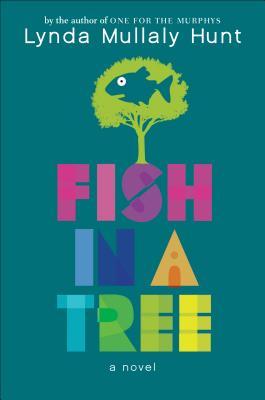
Fish In A Tree by Lynda Mullaly Hunt, 2015

Click to view
on Goodreads
“Everybody is smart in different ways. But if you judge a fish by its ability to climb a tree, it will live its life believing it is stupid.”
Ally has been smart enough to fool a lot of smart people. Every time she lands in a new school, she is able to hide her inability to read by creating clever yet disruptive distractions. She is afraid to ask for help; after all, how can you cure dumb? However, her newest teacher Mr. Daniels sees the bright, creative kid underneath the trouble maker. With his help, Ally learns not to be so hard on herself and that dyslexia is nothing to be ashamed of. As her confidence grows, Ally feels free to be herself and the world starts opening up with possibilities. She discovers that there’s a lot more to her—and to everyone—than a label, and that great minds don’t always think alike. 

(288 pages)

I'm back to using speech recognition software to write my reviews. I can't tell you how frustrating this is - my own body is betraying me. For those of you who don't know, I fell off a horse last September and tore a ligament in my left (dominant) wrist. After a few months of splinting, I got an MRI in November and had surgery two weeks before Christmas. I spent about a month using speech recognition software because it was too hard to type school assignments, emails, and blog posts all with one hand. I've been off the software for a few months now, but in May I had three AP tests and this past Saturday I took the SAT. I guess I over did it, because my wrist hasn't felt this bad for a very long time. I'm back to speech recognition software, splints, and even using a sling when the pain is at its worst.

I've had a pretty hard time this last school year. My temporary disability has caused me stress, multiplied the effort it takes to complete an assignment, and very likely hurt my grades. In a way, this is sort of like Ally's dyslexia: she has spent her whole life stressing about her inability to read, laboring over what should have been simple assignments and getting terrible grades because she literally could not do the work. However, my struggles have been with a (hopefully!) temporary issue that has caused me physical pain. Ally's struggles have existed since she first began learning to read; her pain is not physical, which is often easier to deal with, but mental. She has grown up believing that she is stupid and worthless, living in fear of being discovered as the practically illiterate girl she really is. This mental and emotional pain is far and above anything that I have ever experienced, and hopefully ever will experience.

Because Ally doesn't just have dyslexia; she has spent her whole life hiding that dyslexia (though she doesn't know what it's called) from the world. She has moved often enough, because her father is in the military, that no one has ever caught on to the fact that she doesn't complete schoolwork because she can't, not because she is lazy or trying to be a troublemaker. She has grown shall around herself and is used to living very lonely life, a life of being teased and made fun of and getting sent to the principal's office. It is truly beautiful to watch her leave that shell behind. Hunt does a lovely job of showing how Ally blooms under the mentorship of a teacher who not only cares about her academic struggles, but about her emotional struggles as well.

I can't tell you how much I loved this book. You're just going to have to repeat yourself to discover what a gem it really is. The themes are serious but not overwhelmingly dark, the characters are nuanced and compelling, and Ally's dyslexia is painted in a very realistic light. By all means, go read this book!

24 April 2015

Graceful by Wendy Mass, 2015

Stop right there! Don't go any further unless you've read the other four books in the Willow Falls series. I've done my best to avoid spoilers, but when you're reviewing the fifth book in a series you're bound to ruin something from the earlier books. Click the links to go to my reviews of the firstsecondthird, and fourth books in the series. And if you read on and spoil the entire series for yourself? Well, don't say I didn't warn you.

Click to view
on Goodreads
An exciting new story in the bestselling Willow Falls series from Wendy Mass!
Angelina D'Angelo has left town to see the world. It's now Grace's turn to use her magic to protect the people of Willow Falls, and she is up to the challenge. This is her destiny, after all. But destiny is a funny thing-it doesn't always behave the way you'd expect it to.
Mysterious postcards from Angelina begin showing up in the mail, Grace's parents are freaking out with worry, and something BIG is coming to town that will affect everybody who lives there. But all Grace is powerful enough to do is turn leftover meatloaf into pizza.

Fortunately, she's not alone. She has Team Grace on her side! Amanda, Leo, Rory, Tara, David, and Connor know a thing or two about magic and how it works. But none of them are prepared for what's coming, and none of them know how to stop it. Life in Willow Falls is about to change forever.
(272 pages)

Every Willow Falls book is told in first person present tense from the main character's POV, and Graceful is no exception. This time around it's Grace, learning to deal with her new magical abilities, who takes center stage. However, in this book Mass also adds snippets of narration from the other characters: there are diary entries by Amanda, letters from Tara to her pen pal/friend Julie, texts to and from Rory (who finally got a real phone!), poems written by Leo, inventor's notes from Connor, and more. I really like how Mass did that because it keeps the narration focused equally on all of the many characters. Otherwise she would've had to include long pages of second-hand descriptions as characters waited in line to tell Grace everything important that happened to them since the last time they talked to her. And that would not be fun.

The things that I expected to feel fake/annoying (like the middle school couples popping up every time I turn around) turned out to be perfectly fine, and actually pretty enjoyable. I think a large part of this success is the more disjointed technique of using all the different mediums to tell the story, because it dilutes the effect of having so many people running around with different things on their mind. Learning about the magic of Willow Falls was also really interesting - Mass does a good job of explaining it without sucking out all of the mystery and wonder.

Despite how much I did enjoy it, Graceful is not a perfect book. For one thing, I disagree with Grace's decision in regards to her parents. Just because they're stressed about your magical powers, does not mean you should use said abilities to make your parents forget about them! I'm not saying whether Grace succeeds in inflicting amnesia on her parents; it's the fact that this is treated like such a great idea by everyone involved that slightly annoys me. Surely someone would have pointed out that it wasn't really the ten-year-old's place to wipe her parents' memories? Another quibble is that the book can feel a bit disjointed. This wasn't a big deal for me, because I don't know of any other way for a story with that many characters to be told, but I know some might find it annoying. Also, did I mention there are three middle school couples? Yes, that's three. As in 3. As in two more than one.

To be fair, though, they're not just a bunch of random couples off the street; they're our couples, the ones we've watched from the very beginning, the ones we've rooted for and laughed at with and cried over. So I can't really fret too much about how many of them there are, because just in this one series, it doesn't really matter. I love them all with a passion that makes chapter fifteen particularly amazing for me - oh, you want to know what happens in chapter fifteen? I'm sorry, but you'll have to read Graceful and find out for yourself because I just can't bring myself to spoil it for you.

Bottom line: I love this book. A lot. It's the perfect ending to the series, and now that I've read it I can't imagine the series being complete without it. Is Graceful a standalone? Never! Is it the perfect close to an amazing series? Absolutely! So please take the time to read just one more Willow Falls book. But definitely make sure to re-read the other books before you delve into this one: trust me, Graceful is that much better if you understand all the references to the earlier books. And by "better," I mean "funnier." This book is hilarious!


Disclaimer: This is an Amazon affiliate link, and I received a free ARC from Scholastic Press in exchange for an honest review.
23 March 2015

The Chosen Prince by Diane Stanley, 2015

Click to view
on Goodreads 
From master storyteller Diane Stanley comes a spellbinding tale based on Shakespeare's The Tempest of two princes--one chosen, one lost--and a mysterious girl on a magical island, all caught in a great web of destiny.
On the day of his birth, Prince Alexos is revealed to be the long-awaited champion of Athene. He grows up lonely, conscious of all that is expected of him. But Alexos discovers that being a champion isn't about fame and glory--it's about sacrifice and courage.
Alexos follows the course of his destiny through war and loss and a deadly confrontation with his enemy to its end: shipwreck on a magical, fog-shrouded island. There he meets the unforgettable Aria and faces the greatest challenge of his life. 

(368 pages)

I . . . really don't know if I liked this book. I suppose if I have to think so hard the answer is "no," but it just isn't that simple. On one hand, I loved it. It was deep, moving, and meaningful, with a lovable main character and an emotionally manipulative plot. On the other hand, I spent most of the book semi-loathing said main character, because I didn't know if I could bring myself to love someone who had done what he did. I both empathized with and despised Alexos, and my stomach twisted (and still twists right now, actually) at the horrible event that happens a third of the way into the book.

On the other hand, I loved Alexos for how much his father and the gods put him through. He never really gets a childhood, loses his ability to walk correctly to a summer sickness that sounds a lot like polio, and is practically cast aside by his ruthless father after becoming crippled. Despite all this (and perhaps even because of some of it), he is strong, good, and kind, wishing for nothing more than to make his kingdom a better place. I only wish a certain event had not happened, or at least not happened the way it did, because I could have really, really, loved Alexos for everything he went through. As it was, I couldn't help feeling (horrible as it sounds) like perhaps he deserved everything that happened to him. If I read the book again now I would probably like it a lot better, but I still hate The Chosen Prince for the way it utterly horrified me just far enough in that I couldn't stop reading, but early enough that I spent the majority of the book miserable.

A lot of the other reviews I've read of this book complain about the narration, which is third person present, calling it clumsy and distracting. The only times I had any trouble with it were when something was being talked about in past tense. I'm so used to reading third person in past tense that I had a hard time remembering that when say, the narration talks about what Alexos did, it's talking about something that happened before the scene I'm currently reading. This was a relatively minor issue, though, and overall it worked fine for me. Props to Stanley for trying something new!

I absolutely love Diane Stanley's Silver Bowl trilogy, and her standalone Bella at Midnight is a fun fairy tale retelling that isn't wonderful, but isn't horrible. This, however, almost feels like a different author wrote it altogether, and I don't think I'm as big a fan of this author as I am of the other. I do love The Chosen Prince, but I also hate it. And I don't think I'll be recommending it to anyone any time soon, just because I don't want to be the one to recommend something so horrifying, but I can't really give a very good warning about it without spoiling the whole story. So if you're deciding whether or not to read it, I can't really help you. I'm sorry!

20 February 2015

Love, Aubrey by Suzanne LaFleur, 2009

Click to view on
Goodreads
A tragic accident has turned eleven-year-old Aubrey’s world upside down. Starting a new life all alone, Aubrey has everything she thinks she needs: SpaghettiOs and Sammy, her new pet fish. She cannot talk about what happened to her. Writing letters is the only thing that feels right to Aubrey, even if no one ever reads them.
With the aid of her loving grandmother and new friends, Aubrey learns that she is not alone, and gradually, she finds the words to express feelings that once seemed impossible to describe. The healing powers of friendship, love, and memory help Aubrey take her first steps toward the future.
Readers will care for Aubrey from page one and will watch her grow until the very end, when she has to make one of the biggest decisions of her life.
Love, Aubrey is devastating, brave, honest, funny, and hopeful, and it introduces a remarkable new writer, Suzanne LaFleur. No matter how old you are, this book is not to be missed. 
(262 pages)


Gosh, I love this book so much. And oh, how it makes me cry! I have read many sad fictional books, from Harry Potter and the Deathly Hallows (honestly, so many people die in that book!) to books about the Titanic and the last Romanovs, but most of them can't bring me to tears. They can make me really, really sad, it's true, but they can't make me actually cry. This book, though, gets the waterworks flowing in the first three chapters and never lets them stop. And this may sound miserable, but it's actually wonderful.

You see, this is a story of pain and grief and abandonment, but it's also the story of love and friendship and strength at the worst of times. It is the story of Aubrey, whose father and sister died in a car accident. Her mother was so incredibly consumed with grief she ran away from home a few months after the funeral, leaving Aubrey behind to take care of herself. The story is told in first person past tense, which worked well for the story by providing a compelling contrasts with the first person present flashback scenes in which Aubrey remembers life before the car accident. Instead of an info-dump at the beginning of the story we gradually find out the events of Aubrey's past as she is forced to remember them, which (you guessed it!) provides haunting snapshots throughout the story of how much Aubrey has lost.

The saddest parts of the narrative, however, are probably the letters Aubrey writes. At the beginning of the book she writes letters to her sister's imaginary friend Jilly as a way to sort of indirectly talk to a piece of her sister. As she begins to come to grips with everything that has happened to her, she starts to write more directly to her mother, father, and sister, telling them what she wishes she could say to them in person. She signs each letter "Love, Aubrey," which is the source of the title.

This is, without a doubt, one of my all-time favorite books. It's heart-wrenching, but it's also realistic and  heartwarming. Aubrey has had the unthinkable happen to her family, and she responds the way any real person would - through denial, through tears, and through shutting down at any reminder of what has happened. But as the story goes along, she learns to cope and to forgive and to live her new life with her grandmother and best friend/neighbor Bridget.

This is an amazing book, and I wholeheartedly recommend it. But please, know what you are getting into. This is not a light or easy read, and if you don't want to read a book that will make you cry, then don't pick this one up. But know that it does not just toy with the emotions: it is sad because terrible, tragic things happen in life, and sometimes you have to cry about them.

Note: I have also read the author's other books, and they were really good as well. She is a master at portraying difficult emotions and reactions to traumatic situations. While I liked the other ones, though, this is still my favorite of her books.

30 January 2015

A Snicker of Magic by Natalie Lloyd, 2014

  
Synopsis (from Goodreads):
Click to view on Goodreads
Introducing an extraordinary new voice---a magical debut that will make your skin tingle, your eyes glisten . . .and your heart sing.
Midnight Gulch used to be a magical place, a town where people could sing up thunderstorms and dance up sunflowers. But that was long ago, before a curse drove the magic away. Twelve-year-old Felicity knows all about things like that; her nomadic mother is cursed with a wandering heart.
But when she arrives in Midnight Gulch, Felicity thinks her luck's about to change. A "word collector," Felicity sees words everywhere---shining above strangers, tucked into church eves, and tangled up her dog's floppy ears---but Midnight Gulch is the first place she's ever seen the word "home." And then there's Jonah, a mysterious, spiky-haired do-gooder who shimmers with words Felicity's never seen before, words that make Felicity's heart beat a little faster.

Felicity wants to stay in Midnight Gulch more than anything, but first, she'll need to figure out how to bring back the magic, breaking the spell that's been cast over the town . . . and her mother's broken heart. 
(311 pages)

It's funny, I really liked this book while I was reading it, but I'm having a terrible time reviewing it. Well, not really a "terrible" time, because that implies I've actually made a serious attempt at writing a review at all. In reality, I've thumped down a sentence or two and then quit and worked on other projects. On another note, guess who just joined Blogging For Books?


Okay, focus. Time to write a review. I think the thing that's so hard about this book is that it's really cool and creative and fun, but at the same time it's . . . not. It reminded me of so many other "zany," "unique" books I've read, that I couldn't really pin down why exactly I liked this one. I mean, I had a lot of fun bing sucked into the story. But  I spent a lot of time wondering in the back of my head "when will this blow my mind? When will it wow me?" 

And it never really wowed me. It's sad, because this was not a bad book by any stretch of the imagination. In fact, it was a really good book! It just felt like a remix of some of my favorite quirky reads: Remarkable, Savvy, and Drizzle. If I'd read Snicker before reading those books, I would have fallen in love. But because I'd already read and adored them, I was a bit tougher to impress with this read. I needed more.

The characters are good, fairy well-rounded, and hold your attention. Felicity's mother has a case of wanderlust stronger than anything I've ever seen, and I felt bad that she couldn't even see what she was putting her kids through by constantly moving. Felicity was sweet, and cute, and I loved the way she collected words throughout the book. It made for a great descriptive device, giving the reader glimpses into other people's minds without straying from a first person narrative. That was probably my favorite aspect of the story, and I kind of wish Lloyd had explored it further.

I really did enjoy reading this, though I doubt I'll go out of my way to reread it any time soon. It's especially impressive as a debut, and I am definitely keeping an eye out for Lloyd's next book. If it sounds interesting to you, then by all means read it! Just because I didn't adore it to pieces doesn't mean you won't. It's well-written and engaging, with a meaningful story. If you do decide to read it, I'd love to hear your opinion of Snicker!

22 November 2014

Masterpiece by Elise Broach, 2008

Synopsis (from Goodreads):
Marvin lives with his family under the kitchen sink in the Pompadays’ apartment. He is very much a beetle. James Pompaday lives with his family in New York City. He is very much an eleven-year-old boy.After James gets a pen-and-ink set for his birthday, Marvin surprises him by creating an elaborate miniature drawing. James gets all the credit for the picture and before these unlikely friends know it they are caught up in a staged art heist at the Metropolitan Museum of Art that could help recover a famous drawing by Albrecht Dürer. But James can’t go through with the plan without Marvin’s help. And that’s where things get really complicated (and interesting!). This fast-paced mystery will have young readers on the edge of their seats as they root for boy and beetle.


First, an important note to my readers: Two months ago I fell off a horse (during my third and final horse-back riding lesson), spraining my left and dominant hand. We went to the doctor and got a wrist brace which helped it get better, but in the last two weeks it has become painful once more and so I'm under orders not to use it for anything. Sadly, that "anything" includes typing. I'm left to do my school-work and blog writing either one-handed or with my computer's pretty faulty dictation device. So if I miss a typo here or there, just let me know in the comments and I'll fix it.

Anyway, on to the review.
I read this book for the first time several years ago, back when I was actually part of the target audience.  The first time I read it, I picked it up because I had loved Shakespeare's Secret by the same author.  I didn't really know what to expect with this one, but once I got into this book, I was enthralled.  Now, a few years later, I am not quite as in love as I was the first time (and caught a couple logistical issues that escaped my notice the first time), but it is still the fun, sweet story I remember - and even cuter than I thought it was!

I'm not really going to nit-pick through this one. The fact that the beetles are so similar to humans requires a leap of faith (I mean, Marvin has an uncle who fixes the electronic devices when they malfunction!), but the charming picture of a tiny family living in the walls and mimicking the lives of the larger inhabitants is indubitably an appealing one to elementary and middle school-aged children. You only have to look at the success of The Littles and The Borrowers to see this. Stuart Little and The Cricket in Time's Square are some  more successful additions to this sub-genre about tiny people or animals who behave like people. Masterpiece joins the ranks of these stretch-of-the-imagination classics with all the charm that can be desired, if not all the logic (at one point Marvin can't see and knows he's in an  elevator because of the swooping feeling in his stomach - how can this pubescent beetle who has never left home before possibly know what it feels like to be in an elevator?).
The story is told third person past tense from Marvin's point of view. Marvin is the hero of this book, no doubt about it. It's his decisions that carry the story, starting with his impulsive present to James. Marvin doesn't really have much unique characterization. The novelty is in what Marvin is and what he can do, not who Marvin is. Marvin is pretty straight-forward (kind, curious, artistic, etc), and you can't help but automatically be on his side.

James, the main human character in the book, is just as nice as Marvin, and is also very perceptive. James is probably my favorite character in the book not only because of his shy kindness, but because his mother and step-father walk all over him and you can't help but be on his side. Even James's real father Karl (divorced from James's mother several years before the book begins) seems oblivious to James's real desires in life: he gives James a pen and ink set for his birthday, clueless to the fact that James can't even draw. James doesn't throw a fit about getting a pen and ink set for his birthday (which is what most bratty kids in today's MG would do). He thanks his dad with as much enthusiasm as he can muster, and goes upstairs to start testing the kit out. See why I like this kid? There have been too many self-absorbed MCs lately, and I enjoyed reading a book with two kind and even compassionate main characters. Maybe I should read younger kid books more often.

As for the plot, it's a fun adventure through art, history, and museum security with a clever twist ending. As I mentioned above, James's parents are divorced. It's handled neatly throughout the book, and younger readers will quickly catch on to the fact that James's parents just weren't compatible because of their completely different approaches to life. While I may not agree with the idea of "incompatibility" divorce, there's no fault in the way it's handled.

Now, I keep saying this is a book for younger kids. This is true, but keep in mind: it's 292 pages long. It packs quite a heft for a middle grade book, so be careful that you only give it to kids who've got some endurance training under their belt. Also, older people are not excluded from reading it. I'm a high school junior and I read it, and I'm even admitting to reading it online!

Disclaimer: I received a copy of this book for free through Barnes & Noble's summer reading program this past summer. No one asked me to review it, and it didn't affect my review in any way.

31 January 2014

The Lions of Little Rock by Kristin Levine, 2012


Two girls separated by race form an unbreakable bond during the tumultuous integration of Little Rock schools in 1958
Twelve-year-old Marlee doesn't have many friends until she meets Liz, the new girl at school. Liz is bold and brave, and always knows the right thing to say, especially to Sally, the resident mean girl. Liz even helps Marlee overcome her greatest fear - speaking, which Marlee never does outside her family.
But then Liz is gone, replaced by the rumor that she was a Negro girl passing as white. But Marlee decides that doesn't matter. Liz is her best friend. And to stay friends, Marlee and Liz are willing to take on integration and the dangers their friendship could bring to both their families.


When I'm out somewhere new, I find myself shrinking inward. I have to clear my throat before I talk and when it does come out my voice is somehow softer. When visiting new small groups I'm the one who goes and sits in a corner, unable to join in the merriment until someone pulls me in and makes me forget to be shy. When I'm at home, no one could ever call me shy. But when I'm out, sometimes I am.

Marlee? Marlee is like me, but a hundred times amplified. And then doubled again. She has a list in her head of people she can talk to, and it boils down to her family members (not so much her mother, though) and - well, and nobody. Her best friend is math, math that doesn't change or give wonky answers. She sticks to her math, and to her family, and doesn't pay attention to anything else. Even though she lives in Little Rock, Arkansas (the year after the Little Rock Nine), it really doesn't affect her other than when her sister's high school closes so white kids don't have to go to school with black kids.

So then what happens when a new girl comes to Marlee's junior high? Liz is confident, smart, and pretty. Black hair, brown eyes - and a deep tan, even though Marlee never saw her at the pool. Before Marlee knows it, she realizes that she can talk to Liz without any problems. They work together on their social studies project, and Liz even manages to convince Marlee to speak her part of the history presentation. But then. Then. The day of the presentation, Liz isn't at school. Marlee's teacher pulls her aside and tells her, "Liz was a negro passing as a white. She's not coming back."

And Marlee's world collapses. The one true friend she ever really had, is a negro. Liz is in big trouble with people of both skin colors, and Marlee can never see her again. Or so they say.

Marlee is determined to keep the best friend she's ever had, but there's a whole world of prejudice standing between them. Marlee has to decide what exactly she stands for, and how far she'll go to defend it. And she might just find her voice in the process.
I actually read this book on Martin Luther King, Jr. Day. It was a total coincidence, and it wasn't until I was halfway through both the book and the day that I glanced at my calendar and put two and two together. Then I went, "oh, cool!" and took that as an excuse to ignore everything around me and finish the rest of the book.

This really was a great book, and it didn't just focus on the problem of segregation. Marlee also had to deal with the boy at school who looked like an angel (and made her do his math homework), her suffering relationship with the mother she had nothing in common with, and the sister she always relied on growing up and moving away both physically and emotionally. 

Marlee learns that to stand for what you believe in, sometimes you have to defy the rules and take the plunge. And that sometimes, even when you know you're right, the rest of the world might disagree. 
And just because you do something with good intentions, doesn't mean innocent people can't get hurt.