Showing posts with label France. Show all posts

09 January 2017

The Missing Matisse by Pierre H. Matisse, 2016

Click to view
on Goodreads 
Nazi planes were bombing Paris the day a lifelong, more personal war began for Pierre. It was the day he lost his identity.

Born into a famous family, Pierre Matisse grew up immersed in the art world of Paris and the French Riviera, spending time with some of the most famous artists of the twentieth century. The man he knew as his grandfather, legendary artist Henri Matisse, encouraged Pierre from a young age, creating a strong desire in him to become a great artist in his own right.

Being a Matisse was an important part of young Pierre's identity. So he was crushed and bewildered when, at the outbreak of WWII, that identity was suddenly snatched from him with no explanation.

So began Pierre's lifelong search to solve the mystery of who he really was, a quest that forms the intriguing backdrop to this memoir of a fascinating and adventurous life on three continents. Spanning the insider art world of 1930s Paris, the battles of WWII, the occupation of France by the Nazis, Pierre's involvement with the French resistance, his post-war work restoring art and historical monuments, and his eventual decision to create a new life in North America, The Missing Matisse is a story of intrigue, faith, and drama as Pierre journeys to discover the truth before it's too late.

(352 pages)

Hmm, wow. This is a very unique outlook on WWII. Pierre's life was so dramatic, full of famous painters and exquisite art when he was small and terrible warfare and underground resistance adventures once France was pulled into war with Germany. His childhood essentially ended when he was about eleven years old, and he saw so many horrible atrocities perpetrated by the Germans (or "Boches," as the French called them). It's heartbreaking to read about the murders he witnessed, and even more stunning to read about his adventures as an underground freedom fighter since this is a true story. It reads like many of the fictional WWII books I've read over the years, but it actually happened! That's both horrifying and amazing to me.

I do have to say, though, that I had a few problems with the book. For one thing, it's told in present tense; I find this to be extremely confusing in non-fiction when the author is talking about things that happened in the past, because it makes me constantly have to guess "is he talking about something he did back then, or something that he does all the time/found out later?" Also, and please don't take this the wrong way, I honestly don't think I like Pierre as a person. He was extraordinarily brave, of course, but he was also an extremely ornery child who never felt any remorse; he stole and lied throughout most of his youth (and not always just against the Germans); after the war ended, he served his time in the French military oppressing Arabian citizens in the French-occupied Algiers; and he was divorced three times (including once after fathering four children, none of whom he took the time to see again for thirty years) before marrying the "love of his life" who was about thirty years his junior.

Also, I simply don't understand his obsession with connecting himself with the Matisse name. His story is very sad, and I do feel sorry for him because it must have been hard to grow up not knowing who his father really was, but it seems like the Leroys were actually nicer to him than the Matisses were. Why couldn't he have just stuck with their name? I for one wouldn't want to be a part of a family that treated both me and my mother like garbage, but then again I suppose I haven't been in his shoes.

The bottom line, though, is that Pierre went through so much–suffered so much–and he's part of that dying generation of WWII survivors (and heroes) who faced the atrocities and uncertainties of life under the German terror and managed to keep hold of their humanity despite everything. I may not respect his principles or all of his life choices, but I do respect him for the actions he chose during the war and pity him for the atrocities that he saw committed during the war. He was a part of action that no one else saw (or at least no one who lived to tell of it), and The Missing Matisse serves as an invaluable record of pieces of history that would have been lost forever if he hadn't written them down. I am grateful that he did.

Disclaimer: I received a complimentary copy of this book from the publisher in exchange for an honest review.

31 October 2016

The Bicycle Spy by Yona Zeldis McDonough, 2016

Click to view
on Goodreads 
Marcel loves riding his bicycle, whether he's racing through the streets of his small town in France or making bread deliveries for his parents' bakery. He dreams of someday competing in the Tour de France, the greatest bicycle race. But ever since Germany's occupation of France began two years ago, in 1940, the race has been canceled. Now there are soldiers everywhere, interrupting Marcel's rides with checkpoints and questioning.

Then Marcel learns two big secrets, and he realizes there are worse things about the war than a canceled race. When he later discovers that his friend's entire family is in imminent danger, Marcel knows he can help -- but it will involve taking a risky bicycle ride to pass along covert information. And when nothing ends up going according to plan, it's up to him to keep pedaling and think quickly... because his friend, her family, and his own future hang in the balance.

(208 pages)

When I requested The Bicycle Spy, I envisioned a group of kids smuggling covert information in their bike baskets, biking heroically over the border of some European country (possibly over a snow-covered mountain) to do their part in getting some Jews get away from the Nazis.

Yeah. I should have read the description a little more carefully. This is about a boy from a small town in France, whose parents are bakers and who loves to bike. He becomes good friends with the new girl who just moved to town, but soon discovers that she and her family are hiding a secret that puts them in danger from the French soldiers who are loyal to the Nazis and have taken over the countryside. There's lots of biking, to be sure, and certainly quite a bit of smuggling in bike baskets, but no border-crossing or snow-covered mountains. I don't really mind, though, because The Bicycle Spy is just about perfect all on its own.

The only reason I say "just about," rather than that it "is" perfect, is that I wish the book were longer. There were some storylines (especially those having to do with Marcel and Delphine's relationships with the other kids) that would have been interesting to see be developed more thoroughly. Considering that The Bicycle Spy is written for middle-school kids, though, I suppose I can't really hold its shortness against it. McDonough actually does an amazing job packing so much material into just 200 pages.

I thought the details about bike riding were really great. I personally haven't actually ridden a bike in over two years (ever since I injured my wrist falling off a horse–I'm a little paranoid about crashing and hurting it again), but I bet a lot of kids will be drawn to the discussions/descriptions of cycling that come up periodically. Marcel's obsession with the Tour de France, and the way he pretends to be competing in it whenever he's biking, adds a great dimension to the book. The fact that Delphine is also obsessed with biking also makes their friendship very natural–because they actually have something in common! People in books becoming best friends/falling in love when they don't even have any shared interests is a pet peeve of mine, so I was happy about how genuine Marcel's and Delphine's friendship felt.

Honestly, I think genuine is a good word for the book as a whole. All of the characters, from Marcel's parents to Delphine to the boys at school, simply seem real. They read like actual human beings, not just fictional characters. Marcel is not some wonder-child hero out of a romantic novel. He's a real kid, brave yet flawed, who wants desperately to do the right thing but is terrified that he'll make a mistake and bring destruction down on himself and the people he cares most about.

I truly enjoyed reading The Bicycle Spy. There are so many WWII books out there, and pretty much every part of the war has been explored in detail, but I don't think I'd ever read a story set in German-controlled rural France before. It was a very interesting angle, one that is particularly fitting for middle schoolers (not nearly as violent as many books set during the war). I highly recommend The Bicycle Spy to any and all who are interested in it.

Disclaimer: I received a complimentary ARC of this novel from the publisher in exchange for an honest review.
26 September 2016

Eden's Escape by M. Tara Crowl, 2016 (+ Giveaway!)

This is my review of the second Eden of the Lamp book. Don't read on unless you've read Eden's Wish (my review–which includes a giveaway for both books).

Click to view
on Goodreads 
Eden's new life on earth begins in New York City under the guidance of her new guardian: Pepper, a petite, bubbly genie alum who's also a Broadway actress. Before she has a chance to settle in, though, Eden is whisked away for a granting--only to find herself trapped in a laboratory. David Brightly, owner of the world's leading tech company, cares more about tapping into the lamp's power than making a wish and starts performing tests on Eden. With Brightly's plasma shield around the lamp, Eden has no way home. Left without a choice, she escapes the lab and goes on the run. After her daring exit, Eden finds herself on the streets of Paris--home to Electra's headquarters. Left in a strange city with a price on her head (courtesy of scheming Brightly), Eden has to keep her wits about her. She dons a chic disguise and flits around Paris incognito, investigating Brightly Tech. Assisted by Pepper and her old adversary Bola, as well as some new friends, Eden embarks on a quest to retrieve the lamp and protect the secrets of the genie legacy.
(320 pages)

Okay, well it's time for my review of Eden's Escape. It just came out earlier this month, and I got copies of both books from the author so I could participate in the blog tour. I'm posting my tour stop with all its goodies today too, so click here to check it out–I've got an excerpt from Eden's Escape on there, plus an exclusive Top Ten list written by Ms. Crowl herself just for Read Till Dawn.

Now for the review itself. I wasn't sure exactly what to expect after the ending of Eden's Wish with the announcement that Eden would be going to live on earth. I thought Eden would probably be struggling to fit in, going to school, making friends, doing all the things she did in the first book but on a much grander scale. Instead, Eden spends most of the book in hiding after a granting goes horribly wrong: a scientist named David Brightly has tracked her lamp down and rubbed it, for the express purpose of performing experiments on Edem until he can figure out how to get unlimited wishes. She makes a desperate escape, but has to leave the lamp behind; the rest of the book covers Eden's attempts to avoid being found by Brightly (a feat made a thousand times harder by the fact that his company made all the phones, and he's not at all shy about tapping phones to get the information he needs), find allies, get the lamp back, and generally set everything to rights. It seems like a pretty hopeless mess at some points, and it was interesting to watch the magic of the lamp collide with all the advantages of cutting-edge technology.

It was also fun watching Eden try to interact with modern technology for the very first time. Xavier completely neglected to teach her anything about it, because he thought it was a waste of time, so she's stuck figuring things out on her own. One of my favorite scenes is when she sits down at a computer to get on the internet. She stares at the screen for a minute, clicks the Word icon on the bottom because she thinks the "w" stands for "web," and then proceeds to type in what she needs and wait for the results to pop up. It was funny, and really realistic! It may have been slightly less realistic to see how quickly she caught on to the internet after that–I've spent some solid time teaching my grandmother how to navigate the web, and it definitely wasn't as intuitive for her. I guess being a genie makes Eden better at figuring things out than my human grandmother, though. That's one of the perks of being, you know, a magical immortal being with supernatural powers.

I don't want to talk too much about the story itself, for fear of spoilers. I would like to just touch on the interpersonal relationships, though, because I think they're both the main weakness and the greatest strength of Eden's Escape.

My only real complaint is Eden's relationship with Pepper. Now, don't get me wrong: I love Pepper. She seems like a fascinating character, and a very kind one. I would happily spend a whole book just learning about her backstory or watching her move forward in the present. My trouble, though, is that she and Eden develop a strong bond too quickly. They're together in New York for just two weeks, yet when they're separated and then reunited both act as though they were in a legitimate mother-daughter relationship. I love that Eden adores Pepper–because I do, too–but I was just a little turned off by the way she saw her as a mother figure so soon after leaving Xavier and Goldie (the couple who actually raised her, and who she recognized as her true family in Eden's Wish). You'd think there'd be a little more homesickness for her masters, but Eden barely thinks of them throughout the novel except in relation to her attempts to rescue the lamp.

The relationships are also a huge strength to the book, though, simply because they're so compelling. Whether it's Eden's relationships with the main characters from Eden's Wish, or with her new friend Melodie, or even with some of the members of Electra, there's always an interesting dynamic to watch. This goes to the character-building, too: Crowl builds dynamic characters, so that–for the most part, anyway–there are no stock characters. This is a huge plus, and it really makes the entire novel for me.

Overall, I'd say that Eden's Escape is a very strong MG fantasy novel (that's perhaps not quite as strong as its prequel). I really enjoyed reading both books, and I look forward to finding out whether there will be a third installment in the series. There's certainly room for one!

And now it's time for the giveaway. Enter below in the Rafflecopter form (the same one that's on the main blog tour post). Good luck!

a Rafflecopter giveaway

Disclaimer: I received complimentary copies of both Eden of the Lamp books so I could participate in the blog tour for Eden's Escape. I'm also being entered into a random $50 giftcard giveaway for posting my review and the blog tour stop during the month of September.

20 November 2015

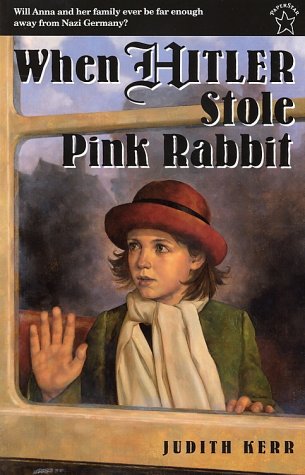
When Hitler Stole Pink Rabbit by Judith Kerr, 1971

Click to view
on Goodreads 
Nine-year-old Anna was too busy with schoolwork and friends in 1933 to take much notice of Adolf Hitler's rise to power in her native Germany. But when her father is suddenly, unaccountably missing, and her family flees Berlin in secrecy, Anna is forced to learn the skills needed to be a refugee and finds she's much more resilient than she thought.
(191 pages)

I like to say that I don't like to read WWII books, but I don't think that's actually true - if I'm being completely honest, I love WWII books. Just not the gritty, horrifying Holocaust books about concentration camps and Nazis and horrible treatment that can make you tremble for humanity. I can read maybe one of those a year - or, actually, every other year - but I can down the other sorts of WWII books by the barrel: books about displacement and identity and bravery, and all the different ways people struggled to find their way in the wake of the most terrible war in human history.

In When Hitler Stole Pink Rabbit, we get the perspective of a little girl whose family flees Germany before the war begins. It's not a tale of cruelty or hatred (though we see hints of that leaking in around the edges through what happens to people they used to know), but instead a book about moving, about trying to fit in, about looking for a place in the world when your own place was destroyed in a way that means it's never coming back.

As I've mentioned before on this blog, I myself have moved many times. I'm actually in the process of moving again - by the time this review goes live, all my earthly possessions will be packed up on a moving truck and on their way back to the Midwest once more. This makes move #7 (not that I'm counting or anything, Mom and Dad!), and I'm beginning to feel like an old pro at this. There's something precious to me about watching Anna and her brother move away from home for the first time, watching them struggle to adapt to their new lives first in Switzerland (where I actually lived for a year, when I was younger!) and then in France. There's something strangely touching in watching the kids become acquainted with homesickness for the first time, with watching Anna bounce back up every time she hits a rock in the road. There's a certain toughness you have to develop when you move, a certain agility that allows you to adapt to your new community, and I loved watching my own experience magnified a thousand-fold as Anna develops these same abilities on a much larger scale than I had to.

I actually chose to write a report for Spanish (yeah, long story) on Judith Kerr, whose own path out of Germany mirrored Anna's. She seems like a fascinating woman, one of the last still alive to have grown up in pre-WWII Germany, and I would absolutely love to sit down and talk with her sometime. Barring that, I will definitely be on the lookout for the sequels to When Hitler Stole Pink Rabbit - and if I ever find them, I will be sure to review them on here. Because this sort of WWII book is my absolutely favorite: the kind that shows the adaptability of the human race, the kind that shows how we can have a "troubled childhood" full of displacement and poverty yet still be perfectly content with the bare necessities of food, friends, and - above all - family to sustain us.