Showing posts with label Tyndale. Show all posts

21 September 2018

Breaking Cover by Michele Rigby Assad, 2018

Click to view
on Goodreads
The CIA is looking for walking contradictions. Recruiters seek people who can keep a secret, yet pull classified information out of others; who love their country, but are willing to leave it behind to head into dangerous places; who live double lives, but can be trusted with some of the nation's most highly sensitive tasks.

Michele Rigby Assad was one of those people.

As a CIA agent, Michele soon found that working undercover was an all-encompassing job. The threats were real. The mission was a perilous one. Trained as a counterterrorism expert, Michele spent over a decade in the agency--a woman leading some of the most highly skilled operatives on the planet, secretly serving in some the most treacherous areas of the Middle East. But deep inside, Michele wondered: Could she really do this job? Was she in the right place at the right time, or had she misunderstood what she thought was God's calling on her life? Did she have what it would take to survive?

The answer came when Michele faced a life-or-death choice--one that had secretly been the plan for her all along.

In Breaking Cover, Michele has at last been cleared to drop cover and tell her story: one of incredible struggle; of thwarted plans and expectations; and most of all, of discovering a faith greater than all her fears.

(272 pages)

I feel terrible about this, but I completely forgot to review Breaking Cover. I planned to do it right before leaving for college, and somehow I thought I had but then when I came home again I saw it lying there and couldn't find my review online. Maybe I accidentally deleted it or something?

Anyway, moving on from my organizational woes. Breaking Cover is a pretty cool book about people who really lived a lifestyle that is usually only depicted in fiction. Michele seems like a very cool, relatable person, and so does her husband. I loved seeing what the life of married CIA agents was like, even though I cringed along with them when they kept being sent into the most dangerous spots on the planet.

Michele really shows what it's like to deal with sensitive information, interview potential terrorists/informants, etc. It's truly fascinating. Plus she was a woman serving a very important role in the Middle East, so most of her interviewees disrespected her for her gender from the moment she walked in the door. She describes in detail some of the strategies she used to manipulate their assumptions and use them to her advantage in the interview room, but it sounds like she also had to deal with similar snubs with American superiors and co-workers. It's pretty depressing.

Perhaps the scariest scene in the entire book is when Michele is driving through a town in the Middle East, alone and stopped at a stoplight, and a man begins to jeer and advance on her and then a bunch of other men step forward to come at her, too. She manages to get out of the situation relatively unscathed, but I can't believe the CIA didn't think to give her more protection (and perhaps a driver) in a country where women drivers are susceptible to being murdered.

It's hard to gather all my thoughts back together about a book that I read so long ago (so I can't warn about any bad language/material–sorry!). I definitely remember a lot more about Breaking Cover than I do about many of the other books I read around then, though, so I can vouch that it's a memorable read. I also have vivid memories of being fascinated by Michele's story (and even bothering my family with lots of cool anecdotes from the book), so I know I really enjoyed it. If you're interested, go ahead and pick it up for yourself!

Disclaimer: I received a complimentary copy of this book in exchange for an honest review.

23 February 2018

Loved Journal from Tyndale Publishing, 2015

This beautiful journal offers a lovely space to record your thoughts, prayers, and dreams. Scattered throughout its pages are quotes from Women of Faith speakers and friends, plus encouraging Scriptures to inspire reflections and personal insights. Lined pages make it easy to pen daily blessings, answers to prayer, or love letters to the One who loves you best.
(224 pages)

I have way too many journals. I always seem to get them as presents or pick them up at garage sales and the like, but my average rate of actually filling a journal has been about one per three years. I've already got my next two diaries, and I'm only halfway through the one I'm on now!

So why did I choose to get the Loved journal, you ask? Simple: because it was free. And because I thought it looked cool. It's got this great faux leather vibe to it that I wanted to check out.

Anyway, this is a pretty journal that's about the size of a hardback novel, and has some nice inspirational quotes on the tops/bottoms of some of the pages without sucking up too much of the actual writing space. I brought it on holiday with me over the winter break and my siblings and I scribbled down elaborate shopping lists in it and competed in tic-tac-toe championships (and I may or may not have ripped pages out of the back when we needed paper *cringe*). Not exactly the intended use of the journal, I know, but it certainly came in handy.

My main issue with the Loved journal, however, is that after just a few weeks of fairly heavy use the faux-leather was beginning to peel. It doesn't look nearly as nice now as it did out of the box. That may just be my fault for carelessly throwing it in my backpack a time or two, but I don't think that a journal meant to record your private thoughts and be stored for years should start to go bad that early (if at all).

It's too bad, because I do like journals, but I'm afraid I have to recommend you give this one a pass.

Disclaimer: I received a complimentary copy of this journal through the MyReader Rewards Club.

04 December 2017

Just Sayin' by Dandi Daley Mackall, 2017

Click to view
on Goodreads 
Just Sayin' tells the story of an almost-blended family that almost falls apart before it even begins. 11 year-old Cassie Callahan is staying with her grandmother while her mom, Jennifer, recovers from a difficult breakup from her fiance, Trent. Cassie, along with Trent's kids, Nick and Julie, are trying to figure out why their parents' relationship ended so abruptly and searching for a way to bring them back together. Meanwhile, the kids get caught up in a game show that encourages the "art" of insults, and learn along the way that our words have much more power than they think.

In a way that only Dandi can accomplish, this story weaves together, in a contemporary way, an old-time game show, letter writing, outstanding vocabulary, and reminders from God's word that taming our tongue is both difficult and important!

(178 pages)

Man, Dandi Daley Mackall is versatile. I originally grew to love her Starlight Animal Shelter horse series a long time ago, and then I rediscovered her when I started receiving books for review from her publishing company Tyndale and they sent me Larger-Than-Life Lara (a book told in "school assignment" format by a girl whose overweight classmate was bullied) and With Love, Wherever You Are (a retelling of her grandparents' romance while both were serving in Europe during WWII). Now we get something quite different yet again with Just Sayin,' which is told entirely through letters and texts exchanged between the characters.

It's a very interesting narration gimmick, and one that works really well here. I had a little trouble suspending disbelief for the duration of the book (because let's be honest, no one–let alone children–regularly writes such detailed, vulnerable letters to friends, family members, and new acquaintances). I managed, though, and I'm glad I did because Just Sayin' really is a very good read.

The story of the split between Nick's dad and Cassie's mom so soon before their marriage is an interesting one, if a little simplified at times. With just 180 pages to work with, Mackall didn't really have space to flesh the nuances of the situation out as well as she could have otherwise. I was rooting for them to join together as a family once more, of course, but I cared a lot more about Cassie, Nick, and Nick's little sister Julie than I did about the parents. I was particularly mad at Cassie's mom–because I don't care what sort of emotional drama you're going through, up and abandoning your daughter at your mom's house indefinitely is not okay.

But forget the parents, it's really all about the kids. Cassie's and Nick's letters are so warm and funny, and I love the way they try out all sorts of nasty insults on each other. They're big fans of insults, and they're almost professional-level good at dishing them out. Cassie begins to have a sort of "crisis of faith" during the book, in which she starts reading the Bible at her pastor's urging and realizes that some insults are unkind and un-Christlike. This is an interesting side story, though I also struggle with the idea that a kid her age would be mature enough to come up with these sorts of complex biblical analyses (let alone be convicted enough to consider implementing them!).

Really, my main issue with Just Sayin' is that the characters act pretty unrealistically both for their age and for the format of their correspondence. But it's such a fun and heartwarming book–and the kids' letters are just so laugh-out-loud hilarious!–that I can't help but love it anyway.

Disclaimer: I received a complimentary copy of this novel from the publisher in exchange for an honest review.
01 December 2017

Almost There by Bekah DiFelice, 2017

Click to view
on Goodreads 
Home, by definition, is where you feel comfortable, where you are established, where relationships are worn in and familiar. It is where you are known, a place to belong. It is a universal longing, but an elusive destination.

Why does life often move us far from this secure, primal comfort? We transfer to different locations or simply live unsettled in our own hometown. We rebuild, make new friends, find new jobs, and forge new ties. Our blanket of security becomes a whole host of unknowns. Underneath it all, sure as the evening taps, there is a homesickness for belonging.

What if this homesickness is not just a series of challenges to be overcome, but a vehicle for God to draw us to Himself? What if God is orchestrating our circumstances to bring us into the knowledge of who He is? What if all along He is inviting us home?

Is it possible to build a home in a life that marches to the cadence of constant change and transition? In Almost There, Bekah DiFelice, a military wife familiar with the impermanence of home, offers encouragement and wisdom to those who struggle with a search for belonging in a world where home is constantly shifting. God, the grand home builder with an eternal guarantee, invites us to build a home that resides in the privacy of our hearts, a settlement that is fundamentally immovable. If we put roots down in a God who is unchangeable, He promises to be a steady anchor in the unpredictability of life.

(192 pages)

I am not a military kid, but people often think I am.

My family has moved eight times since I was born, at an average of every three years or so. When I tell people we've moved because of my father (a scientist), the first assumption for many is that my father has a military job.

All that to say . . . I can relate on a very personal level to DiFelice's descriptions of the trials and tribulations of moving somewhere new every so often. I know what it's like to hunt for a new church, to make awkward small talk with people who might be new friends (or possibly new frenemies), to unpack all my belongings and make an impersonal new house into a home.

Or at least, to make it some part of a home. The whole point of DiFelice's book is detailing her search for home. She was thrust from her childhood home to marry her husband and follow him first to Yuma, Arizona (a tiny base in the middle of nowhere) and then, after three years and every three years after that, to a new location somewhere around the world. She was definitely a lot less prepared for moving out into the world than I am, because she'd lived her whole life in the same place surrounded by family; her quest to discover what home really is was interesting to read (and often hilarious), but I don't know that it was specifically that helpful to me.

After all, I already know where my home is: it's wherever I'm living at the moment. And also with my family. And also, to varying extents, every place I've ever lived. Because personally, I don't believe that home has to be just one place. My home is a physical place and an emotional one–it's every place I've ever lived that I still have fond memories of, it's the house of my parents and siblings who love me (no matter where that house happens to be at the moment), and it's the physical address where I live my day-to-day life at the moment. Home is like a running tally sheet, not a single focal point that almost always stays the same.

And I think, really, that DiFelice reached the same conclusion that I did. She also had some more insight into God's role in things, which I hadn't really given much thought to. But the real reason I loved reading Almost There has nothing to do with the deep philosphical insights: Bekah DiFelice is simply hilarious. I loved the funny, realistic ways she had of describing the experience of moving around and living life. I can't think of much else to say about the book (other than that it's really good and I very highly recommend it!), so I think I'll just end with a quote from her describing the drive to her first home away from her parents, in Arizona:
When night set in, headlights flashed bright and aggressive from the opposite direction. So many people, it seemed, were fleeing from the very place I was headed. I departed Colorado armed with Cheez-Its and gusto, and in the desert I realized that both were gone.
Disclaimer: I received a complimentary copy of this book from the publisher in exchange for an honest review. 

30 October 2017

The Shadow of Your Smile by Susan May Warren, 2011

Click to view
on Goodreads 
A beautiful blanket of snow may cover the quaint town of Deep Haven each winter, but it can't quite hide the wreckage of Noelle and Eli Hueston's marriage. After twenty-five years, they're contemplating divorce . . . just as soon as their youngest son graduates from high school. But then an accident erases part of Noelle's memory. Though her other injuries are minor, she doesn't remember Eli, their children, or the tragedy that has ripped their family apart. What's more, Noelle is shocked that her life has turned out nothing like she dreamed it would. As she tries to regain her memory and slowly steps into her role as a wife and mother, Eli helps her readjust to daily life with sometimes-hilarious, sometimes-heartwarming results. But can she fall in love again with a man she can't remember? Will their secrets destroy them . . . or has erasing the past given them a chance for a future?
(344 pages)


The Shadow of Your Smile has a nice premise (very similar to a movie that came out a few years ago, right?), and I thought it was pretty well done. I liked the idea of a ruined marriage being "restarted" with the wife's sudden amnesia, even if the possibility of such amnesia is scientifically iffy. It's rather sad to watch Noelle realize that she gave up all of her dreams of pursuing her art and establishing a career, and that she's just an average housewife now. The cynical part of me wonders whether there's some sort of sexist reason she's not working, because it's not like she's staying home to homeschool her kids or something that would actually prevent her from working during the day, but I don't think that's where my mind is supposed to go with this scenario. I can't say I really agree that her husband is such a catch, because he does a lot of things I'm not really a fan of, but I suppose she's looking for something different from what I would want in her shoes.

There are several side plots that I liked better than the main one, including Noelle's grown son's growing romance with a childhood acquaintance and the family's attempts to move past the brutal death of Noelle and Eli's daughter, Kelsey. The storyline about Kelsey is actually my favorite, just because it's so brutal and honest and real. Reading about the parts where the family is remember (or, in Noelle's case, forgetting) Kelsey is heartbreaking. The rest of the book is kind of soft and cheesy in comparison.

And also really cheesy. Keep in mind that the cheese levels in The Shadow of Your Smile are practically out of the roof. It was an entertaining read that passed a few nice hours, though, and I'm glad I took the time to give it a try. Sometimes a fluffy, clean, slightly cheesy romance novel is just what the doctor ordered.

Disclaimer: I received a copy of this book through the Tyndale Rewards program (click here to check it out–by using my link you'll get 25 credits, which is enough to get a book).

16 June 2017

Catching the Wind by Melanie Dobson, 2017

Click to view
on Goodreads 
What happened to Brigitte Berthold?

That question has haunted Daniel Knight since he was thirteen, when he and ten-year-old Brigitte escaped the Gestapo agents who arrested both their parents. They survived a harrowing journey from Germany to England, only to be separated upon their arrival. Daniel vowed to find Brigitte after the war, a promise he has fought to fulfill for more than seventy years.

Now a wealthy old man, Daniel's final hope in finding Brigitte rests with Quenby Vaughn, an American journalist working in London. He believes Quenby's tenacity to find missing people and her personal investment in a related WWII espionage story will help her succeed where previous investigators have failed. Though Quenby is wrestling her own demons--and wary at the idea of teaming up with Daniel's lawyer, Lucas Hough--the lure of Brigitte's story is too much to resist. Together, Quenby and Lucas delve deep into the past, following a trail of deception, sacrifice, and healing that could change all of their futures.
(416 pages)

Of all the many WWII books I've read over the years, I can't even think of any that split the narrative between the war-time era and modern day the way Catching the Wind does. I really love the way we discover Brigitte's story alongside Quenby, as the modern-day reporter is hired to track down leads about her aged employer's childhood best friend lost during the tumult of emigrating from Germany to England. I got just as swept up in the investigation as Quenby did, and I was impressed by the way Dobson managed to incorporate pieces of Brigitte's story into letters and the like so that Quenby could mostly stay on the same page as the reader (without the benefit of chapters dedicated to telling her tale!), and to do so in a way that didn't make things redundant.

If I'm really nitpicking this aspect of the story, though, I do have to admit that I can't really believe that none of the other searchers found the trail of clues that Quenby does. A well-trained investigator should have been able to find all the same leads, yet everyone else Daniel hired couldn't. That didn't quite add up to me, because he was supposed to have been hiring the very best people for the search. An everyday journalist does not have the experience or training to beat out a real investigator, I don't care how passionate and empathetic she may be about the case. This is no dig to Quenby, of course, because she does make some incredible discoveries–I'm just saying there must have been something wrong with Daniel's hiring process before.

Anyway, I really enjoyed this book. It's extremely dramatic–some might even say melodramatic–but in a way that still seems almost possible. Plus, the most unbelievable stuff happens during WWII, a time period known for incredible happenings, so I can mostly buy all the plot twists that happen throughout the course of the book. Except possibly the last one. I totally saw that one coming but I still think it's just too much of a coincidence.

Basically, I highly recommend Catching the Wind. It's a fast-paced and engaging read split between the challenges and deceits of WWII and a modern-day pursuit for truth (sprinkled with a just-right amount of romantic tension, to boot!). While it does skate close to becoming ridiculous a few times, Dobson keeps ahold of the story and manages to steer it safely into port. I do wish the characters had debriefed a little more, because I felt like a lot of relationship issues were brushed past a little too quickly for my liking, but I suppose that just leaves more room for the imagination. Anyway, I hope you like Catching the Wind! Have you read it? If so, let us know in the comments what you thought of it!


Disclaimer: I received a complimentary copy of this novel from the publisher in exchange for an honest review.

29 May 2017

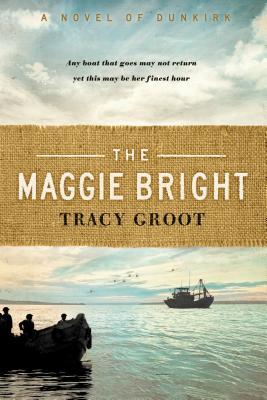
The Maggie Bright by Tracy Groot, 2017

Click to view
on Goodreads 
"England, 1940." Clare Childs knew life would change when she unexpectedly inherited the "Maggie Bright"--a noble fifty-two-foot yacht. In fact, she's counting on it. But the boat harbors secrets. When a stranger arrives, searching for documents hidden onboard, Clare is pulled into a Scotland Yard investigation that could shed light on Hitler's darkest schemes and prompt America to action. Across the Channel, Hitler's "Blitzkrieg" has the entire British army in retreat with little hope for rescue at the shallow beaches of Dunkirk. With time running out, Churchill recruits civilian watercraft to help. Hitler is attacking from land, air, and sea, and any boat that goes might not return. Yet Clare knows "Maggie Bright" must answer the call--piloted by an American who has refused to join the war effort until now and a detective with a very personal motive for exposing the truth.The fate of the war hinges on this rescue. While two men join the desperate fight, a nation prays for a miracle.
(360 pages)

Oof. The Maggie Bright book deals with a lot of heavy topics. I mean, WWII isn't known for being a light or happy period in human history, but sometimes books set during that period focus on the homefront and on happier parts of the story. I don't think I'd ever read a book with such a focus on the beaches of Dunkirk. I also hadn't read a book that painted such a bleak picture of the war effort before America joined in. There are some snide comments made throughout the book about isolationist Americans, because even through the end of the book America has not decided to join the war yet. It's fascinating to read a book set in the thick of WWII before the tide had turned and our triumph was ensured. It's also really scary to see how close the Nazis came to winning everything.

The book takes a surprisingly dark angle on the Nazis as well. I mean, we all know that they were awful–that's not up for debate, of course–but a lot of book that are set more on the homefront don't really focus much on the enemy powers as much more than potential bombers. We get an intimate, horrible look into the atrocious acts committed by the Nazis throughout the book. I won't go too much into the circumstances because those would be spoilers, but suffice it to say that the main characters talk about the Nazi T4 program.

Anyway, moving on to the book as entertainment rather than just as history. I liked it, I did, but I have to say that my main appreciation for the book comes from its historical insights rather than from the characters. Murray is definitely my favorite, and then Jamie and then probably Clare, but there were so many characters that things got rather confusing by the end. Everyone also had a chronic over-sharing problem: perfect strangers would walk up to each other, exchange some pleasantries, and then spill huge secrets to each other. The worst offenders were the two Scotland Yard agents who literally introduced themselves to Clare, invited her to coffee, and then told her big state secrets known only by a few (as well as a plethora of little personal details they surely should have been trained not to reveal to a complete stranger). Along the same vein as this ever-so-convenient openness, there's a dreadful case of insta-love in the book as well. Within the case of a single week and just a few encounters, Clare and a man she just met fall completely in love with each other. It's rather painful to watch.

Also, there's a whole side-plot with Clare's colorful family history, but we never even get to meet her oppresive uncle or learn anything important about her parents or watch her properly process something else she stumbles across over the course of the book. I would have really liked to see more in this area, because I liked what we got.

But really, though, I devoured The Maggie Bright because it's about a fascinating, and little-known, period of WWII. I lapped up the historical details and the new perspective on both the war as a whole and America's role in it, and I read anxiously to see what would happen to my favorite characters on every fresh page because I knew that so many real soldiers faced similar situations to theirs. It's a gripping story, even if parts are rather contrived, and I am glad I had the opportunity to read it.


Disclaimer: I received a complimentary copy of this novel from the publisher in exchange for an honest review.

13 March 2017

With Love, Wherever You Are by Dandi Daley Mackall, 2017

Click to view
on Goodreads 
Everyone knows that war romances never last. . . .Helen Eberhart always had to fight for what she wanted. Survival in a family of thirteen gave her the grit to push through nurse’s training and support herself. But after the attack on Pearl Harbor, she can’t stand catering to the pampered patients on Chicago’s North Shore. Enlisting as an Army nurse, Helen is transferred to a military hospital in Battle Creek, Michigan. There she comes face-to-face with the waves of broken bodies of the wounded soldiers, many no older than her beloved brothers.

Frank Daley wasn’t trying to be a hero. He’d only enlisted to finish medical school, confident that the war would be over before his deferment ran out. Life just worked out for him that way. But Lieutenant Frank R. Daley, MD, is sent straight from his graduation to boot camp in Battle Creek as his last stop before a battlefield hospital in Europe. And none of his training prepares him for the chance encounter with the spirited nurse who steals his heart.

After a whirlwind romance and courthouse wedding, Helen and Frank are sent to the front lines of Europe with only letters to connect them for months at a time. Surrounded by danger and desperately wounded patients, they soon find that only the war seems real—and their marriage more and more like a distant dream. If they make it through the war, will their marriage survive?

(466 pages)

I've been a long-time casual fan of Dandi Daley Mackall's books for years now, ever since I got hooked on the Starlight Animal Rescue series when I was younger. Mackall always writes children's books filled with equal parts thrills and heart, my favorite combination. When I saw the option to review this book, though, I knew straight away that it was a different beast. This is no 200-word animal rescue book for kids; rather, it's a 450+ page adult novel about a married couple serving as medical personnel in different parts of Europe during WWII.

The first thing I have to say is that this is a fascinating book. It provides an intimate, and often startling, perspective on WWII by focusing explicitly on the lives of Helen and Frank, army nurse and doctor, who are both serving in Europe during the height of the war. The scenes they each see throughout the course of the war and even after it are terrible, yes, but also educational–they show us the depths of human evil, the horrors of human-on-human violence, and the unalterable fact that we need to never engage in such a terrible world war ever again.

Maybe it's because I'm the daughter of two physicians myself, but I've always seen doctors and nurses as some of the greatest heroes during wars. They're the ones who go out to the front lines, risk their lives, do anything it takes . . . to save lives. When everyone around them is focused on destroying the enemy and throwing their men in front of bullets, medical personnel are the ones who stay focused on keeping soldiers alive. I especially appreciate that Helen chooses to help treat German soldiers in the French hospital, despite the flack she gets for it from the other nurses; her determination to help every patient and save every life she can, no matter the stigma, is truly admirable in a time when so many people were focused on mistreating anyone they didn't perceive as being "worth" common decency.

As for the story's central romance, well, I personally didn't care for it that much. Since I figured out who the real Helen and Frank were (hint: their last name is Daley, which is Mackall's maiden name), I was pretty sure I knew how it would turn out. I still don't really agree with the super-fast way they jumped into marriage, which strikes me as very stupid, but the characters themselves do acknowledge the insanity of their decision and spend most of the book building up their marriage bond through daily correspondence. Since they're a newlywed couple who are forcibly separated most of the time, when they rendezvous every few months there are some definite innuendos about what they do together alone–they're not even approaching explicit, though, so I was fine with them. Mainly, though, I just thought their emotions were really strong and rather volatile, and I couldn't get over the fact that they felt so intimate with each other when they'd barely even spent a few weeks together in person before getting married. I guess it was just a different world back then, one where a whirlwind romance like that actually has a chance at success. Plus, memories of their horrible experiences during the war probably helped them bond in later years.

Anyway, Dandi Daley Mackall definitely has the writing skills to try her hand at any genre she chooses. I'm so glad I gave With Love a try, and I look forward to seeing what else she'll be doing in the upcoming future!


Disclaimer: This is an Amazon affiliate link, and I received a complimentary copy of this novel from the publisher in exchange for an honest review.

30 January 2017

The Complete Book of Zingers by Croft M. Pentz, 1990

Click to view
on Goodreads 
Volumes in the “Complete Book of” series are an excellent resource for any home library or for pastors and lay leaders to use for sermon preparation, small group, and Sunday school.

The Complete Book of Zingers is a collection of amusing one-sentence sermons, proverbs, adages, illustrations, dictums, and truisms.
(384 pages)

I think the title is pretty misleading, because the word "zingers" implies that it's a compilation of zippy put-downs. That's why I got it, honestly: I wanted to read a bunch of hilarious insults that I'd never actually use in real life. What this book, though, is actually 5,000 "cute" quotes for pastors to use in their sermons. That might still be fun, if they were really all snappy, but flipping through the book I can see that quite a few of them are not even that catchy.

I haven't read the book cover to cover, of course, since there are literally 5,000+ pithy quotes in it. I did read snippets from a variety of sections, though, so I'm basing my review on that. It's sorted like an encyclopedia, alphabetical by topic (from "Ambition" to "Zeal"). Here are some of the ones I especially liked:
Even the turtle would get nowhere if he didn't stick out his neck.
Failure is one thing that can be achieved without effort.
Ideas are like children–your own are wonderful.
A lot of them, though, are a little too "preachy" for my taste–and some are downright moralizing. Then there's a subset of one-liners, especially in the "Marriage" section, which I just find flat-out wrong. A few of those:
A man needs a woman to take care of him so she can make him strong enough for her to lean on. 
Marriage is like two people riding a horse–one must ride behind.
The ship of matrimony will move more smoothly if the wife stays away from the sails. 
Don't get me wrong, the author included quite a few sweet/funny lines about marriage as well, but there were enough of these rather sexist comments to annoy me. I don't plan on letting any future husband of mine lead the way in our family, nor do I plan on letting him be the sole breadwinner; I think every single line in this book relied on at least one of those two assumptions about the way married relationships work.

Anyway, if you're looking for a book of cute, pithy remarks to throw into your conversations, then maybe this could be something to look into. I can't say I highly recommend it, but then again maybe you'll see something in it what I don't.

Disclaimer: I received a copy of this book through the Tyndale Rewards program (click here to check it out, and by using my link to make an account you'll get 25 credits (enough to order a book) just to start and I'll get 10!).

23 January 2017

American Patriots by Rick Santorum, 2012

Click to view
on Goodreads 
The United States of America was founded and established by ordinary citizens just like you and me. In their struggle for independence, these heroic men and women willingly shed their blood, sweat, and tears--often sacrificing their own lives and fortunes in order to hand down the precious legacy of freedom we all enjoy today. Now is the time for a new generation of American patriots to rise up and join in the fight. Now is the time for every American to return to the virtues, values, and ideals that formed our foundation of freedom, and enable America to remain a great nation, a powerful democracy, and a beacon of hope for the world.

American Patriots highlights the heroic men and women who valiantly fought to secure our God-given rights of life, liberty, and the pursuit of happiness--not only for themselves and their children, but for countless future generations. Their stories are a true reminder of the extraordinary faith, courage, and determination that set this country on the path to greatness centuries ago, and an inspiration for future generations of great American patriots.
(148 pages)

This may not put me in the best light here, but when I chose to receive a copy of American Patriots I honestly didn't know that Rick Santorum was a politician. His name on the cover looked vaguely familiar, so I assumed he was some historian or author I'd read something from a long time ago. When I actually cracked the cover open and read the author description, I realized my mistake. He's a pretty conservative Republican, right? I honestly haven't read up on him at all, but after reading this book I'm pretty sure that must be the case.

Basically, he takes everything and makes it about religion. And I guess that's not entirely unreasonable, since people were so focused on faith back then and several of the patriots he described were literally pastors, but when he started explaining how "the pursuit of happiness" from the Declaration really meant "the pursuit of virtue," he lost me. I'm a Christian, sure, but I don't believe in twisting history to make it fit your personal outlook. Then again, I don't worship either the Declaration or the Constitution (and there's no way I think all those slave-owning men really meant for the rights given to "all men" to go to minorities and women!), so I'm probably not Santorum's target audience. Every time he mentioned how modern-day America is "under attack" from liberals who want to destroy the principles established by the Founding Fathers, I could barely suppress an eye roll. I'm not exactly stirred to action by that sort of rhetoric; I'm mainly just annoyed by the constant finger-pointing and devil-calling that goes on in modern politics.

Anyway, that aside, I did enjoy reading about all these little-known people from history. I think the only historical figures I recognized in the entire book were Phillis Wheatley and Nathan Hale; the rest of them were completely new to me. My favorite was probably Haym Salomon, the Polish-born Jew who single-handedly kept the revolution financially stable through the war and into its first years as a nation. He seemed like a great guy! Each little chapter focuses on a different historical character (or sometimes a couple characters who have attributes in common). There's a little description of their backstory, key details about their dramatic contributions to the revolution, and then a summary of what happened to them later in life.

Also, just a note: out of twenty-five people mentioned in the book, only six of them are women–and only one of them get a chapter to themselves. Four of them (Emily Geiger, Elizabeth Maxwell Steele, Phillis Wheatley, and Elizabeth Lewis) were lumped into a single chapter. I know that the world was a much more man-dominated place in the 18th century, so it might have been impossible to get enough details to flesh out a lot of character sketches of women patriots, but I for one would have  liked to see a little more emphasis given to the women from history.

Basically, I enjoyed learning some more about important characters from history (even if I'm a little hesitant to apply the word "hero" to all of them). If you don't mind the messages Santorum is trying to mix in with his history lesson, then you might love this handy little anthology. Otherwise, though, it's probably best to steer clear.

Disclaimer: I received a copy of this book through the Tyndale Rewards program (click here to check it out, and by using my link to make an account you'll get 25 credits (enough to order a book) just to start and I'll get 10!).

09 January 2017

The Missing Matisse by Pierre H. Matisse, 2016

Click to view
on Goodreads 
Nazi planes were bombing Paris the day a lifelong, more personal war began for Pierre. It was the day he lost his identity.

Born into a famous family, Pierre Matisse grew up immersed in the art world of Paris and the French Riviera, spending time with some of the most famous artists of the twentieth century. The man he knew as his grandfather, legendary artist Henri Matisse, encouraged Pierre from a young age, creating a strong desire in him to become a great artist in his own right.

Being a Matisse was an important part of young Pierre's identity. So he was crushed and bewildered when, at the outbreak of WWII, that identity was suddenly snatched from him with no explanation.

So began Pierre's lifelong search to solve the mystery of who he really was, a quest that forms the intriguing backdrop to this memoir of a fascinating and adventurous life on three continents. Spanning the insider art world of 1930s Paris, the battles of WWII, the occupation of France by the Nazis, Pierre's involvement with the French resistance, his post-war work restoring art and historical monuments, and his eventual decision to create a new life in North America, The Missing Matisse is a story of intrigue, faith, and drama as Pierre journeys to discover the truth before it's too late.

(352 pages)

Hmm, wow. This is a very unique outlook on WWII. Pierre's life was so dramatic, full of famous painters and exquisite art when he was small and terrible warfare and underground resistance adventures once France was pulled into war with Germany. His childhood essentially ended when he was about eleven years old, and he saw so many horrible atrocities perpetrated by the Germans (or "Boches," as the French called them). It's heartbreaking to read about the murders he witnessed, and even more stunning to read about his adventures as an underground freedom fighter since this is a true story. It reads like many of the fictional WWII books I've read over the years, but it actually happened! That's both horrifying and amazing to me.

I do have to say, though, that I had a few problems with the book. For one thing, it's told in present tense; I find this to be extremely confusing in non-fiction when the author is talking about things that happened in the past, because it makes me constantly have to guess "is he talking about something he did back then, or something that he does all the time/found out later?" Also, and please don't take this the wrong way, I honestly don't think I like Pierre as a person. He was extraordinarily brave, of course, but he was also an extremely ornery child who never felt any remorse; he stole and lied throughout most of his youth (and not always just against the Germans); after the war ended, he served his time in the French military oppressing Arabian citizens in the French-occupied Algiers; and he was divorced three times (including once after fathering four children, none of whom he took the time to see again for thirty years) before marrying the "love of his life" who was about thirty years his junior.

Also, I simply don't understand his obsession with connecting himself with the Matisse name. His story is very sad, and I do feel sorry for him because it must have been hard to grow up not knowing who his father really was, but it seems like the Leroys were actually nicer to him than the Matisses were. Why couldn't he have just stuck with their name? I for one wouldn't want to be a part of a family that treated both me and my mother like garbage, but then again I suppose I haven't been in his shoes.

The bottom line, though, is that Pierre went through so much–suffered so much–and he's part of that dying generation of WWII survivors (and heroes) who faced the atrocities and uncertainties of life under the German terror and managed to keep hold of their humanity despite everything. I may not respect his principles or all of his life choices, but I do respect him for the actions he chose during the war and pity him for the atrocities that he saw committed during the war. He was a part of action that no one else saw (or at least no one who lived to tell of it), and The Missing Matisse serves as an invaluable record of pieces of history that would have been lost forever if he hadn't written them down. I am grateful that he did.

Disclaimer: I received a complimentary copy of this book from the publisher in exchange for an honest review.

05 December 2016

Larger-Than-Life Lara by Dandi Daley Mackall, 2016

Click to view
on Goodreads

This isn't about me. This story, I mean. So already you got a reason to hang it up. At least that's what Mrs. Smith, our English teacher, says.
But the story 
is about ten-year-old Laney Grafton and the new girl in her class--Lara Phelps, whom everyone bullies from the minute she shows up. Laney is just relieved to have someone else as a target of bullying. But instead of acting the way a bullied kid normally acts, this new girl returns kindness for a meanness that intensifies . . . until nobody remains unchanged, not even the reader.

In a unique and multi-layered story, with equal parts humor and angst, Laney communicates the art of storytelling as it happens, with chapter headings, such as: 
Character, Setting, Conflict, Rising Action, Climax. And she weaves an unforgettable tale of a new girl who transforms an entire class and, in the process, reveals the best and worst in all of us.
(176 pages)

I've been a long-time casual fan of Dandi Daley Mackall's books ever since I picked up a copy of her the first Winnie the Horse-Gentler book at a yard sale a few years ago. I was getting rather sick of horse books at the time because I was realizing they all had the same rather vapid and predictable plot lines, but the book reinvigorated my passion for horse novels. I also later loved Mackall's Starlight Animal Rescue series, which is connected to the Winnie books, and loved them even more. Mackall has a gift for blending realistic characters, hard facts about life, and inspirational messages all together and offering them to her readers in slim, engaging novels. That's why I leaped at the opportunity to review Larger-Than-Life Lara: it looked like a very different book than the other ones I'd read by Mackall, but I was pretty sure she'd still be able to pull off a great story.

And she did. I really enjoyed reading Lara, it felt kind of like a grittier version of The Hundred Dresses. Actually, now that I think about it, I would be surprised if Mackall got the inspiration to write Lara from Dresses. Since I always loved Dresses growing up, that is a very good impression for me to come away with.

The narration in Lara comes from Laney, who has to be on of the best narrators I've read in a while. She's writing the "true" story down the way her teacher taught her to, using all the tricks they learned in school. Every chapter is titled with exactly what it introduces (Villain, Setting, Dialogue, etc.), and Laney prefaces her plot devices or narration decisions with funny, candid explanations like this one:
Mrs. Smith says stories have a beginning, middle, and end. They should get told in a chronological order, which is a fancy way of saying making stuff happen like it did in real life, without jumping back and forth in time like some kind of time traveler. I tried to do that, which is why you can find words like first and next and then, if you go back looking for them in this story.
But I can't figure out how else to tell this one conflict without time traveling backwards. So Mrs. Smith, if you're reading this, I just apologize for this.
Isn't that just so cute? I don't know what it is, but I just really love this sort of fourth-wall-breaking narration style.

Anyway, moving on. Laney is a really great character, not just a fun narrator, and I definitely felt for her. The situation at her home is not so great (think three older brothers, no mother, and an alcoholic/likely abusive father), and she is constantly covering for her family at school and hiding her school life from her family. It's not good, at all, and I felt terrible watching her hold everything in. The focus in the end of the book, though, isn't really on her home life; it's on Lara and the way she was being treated at school. Now I haven't had much experience with bullying, but I thought it was absolutely horrible the way everyone treated Lara from day one. The minute she walked in the classroom door, people were calling her ugly names and making fun of her. That's despicable! If she's really that overweight, that's her parents' fault–or the fault of some disorder, maybe, I don't know–but it's definitely not her fault. She's ten years old, people! I don't know, fifth graders are just so barbaric sometimes.

As for Lara as a character, I never really felt like I got to know her that well. She seems sweet, and extraordinarily brave, but almost rather one-dimensional: we never really see Laney have a heart-to-heart with Lara and find out what makes her tick. There were honestly a lot of characters and plotlines whose stories I would have loved to see expanded, which is why I wish the book were a little longer. Barring an updated and heftier re-release of the novel, I'm hoping for a sequel sometime down the road. I think there's a lot of material in Larger-Than-Life Lara that Mackall could use to develop a whole series, actually. It could be, I don't know, "The Paris, Missouri series." Or something catchier. I'm not really a title developer. But anyway, I definitely enjoyed Larger-Than-Life Lara and I'm glad I had the chance to read it. If you've read it, comment below and let me know what you thought!

Disclaimer: I received a complimentary copy of this novel from the publisher in exchange for an honest review.