Showing posts with label family. Show all posts

21 August 2017

Back on the Map by Lisa Ann Scott, 2017

Click to view
on Goodreads 
With their mother long dead and their father unknown, eleven-year-old Penny Porter and her twin brother Parker have been bouncing around foster homes for as long as they can remember. Inspired by the historical figures in her favorite book, Penny likes to imagine who she could be related to. Sacagawea? Her genes would be good ones to have. Or maybe Ghandi, or Harriet Tubman. There are endless possibilities!

But while Penny embraces the question marks in her family tree, she and Porter are both ready for a real home. Living with their aging, ornery Grauntie isn’t easy, but it’s better than other places they’ve been, and they don’t want to get moved again—or worse, split up. Penny believes the key to keeping them from being bounced to another new home is getting their town of New Hope, North Carolina back on the state map. And what better way to do that than to spruce up and sell New Hope’s Finest—an old orphanage that was supposed to reopen years ago as the best attraction ever, but never did.

She’s got the creativity and the gumption to do it. And maybe knowing who you are doesn’t matter so much as knowing what you can do. But will that be enough to finally keep her and Parker in one place for good?

(306 pages)

There are a lot of books on the market out there about kids living in quirky small towns, learning some valuable lesson about life while trying to overcome a challenge. They often have quite a Southern twang to them. I've liked a few of them, but they often ring rather hollow/cliche for me.

If that category of books is a circle, then Back to the Map is lying on the edge of that circle with part of its body in the circle and part of it outside it. I think it actually gains a lot for keeping the quirkiness a little more contained than some of the other books do. Penny's passion for trading items around town and fixing junk up into art is very fun to read about, and the interesting side characters add fun distractions to the story. The central project of fixing up New Hope's Finest (a decrepit, abandoned orphanage) is very interesting to read about. I never quite could follow Penny's logic that tied selling New Hope's Finest and getting the town back on the map to gaining a forever home there, but I suppose 11-year-olds aren't known for having the soundest reasoning skills.

I think the bits I mainly didn't care for revolved around characters' quirky semi-magic "gifts" that popped up here and there, just because I don't really care for that particular trope. Others might like it more than I did, though. I also didn't really like the depiction of Porter, which offered a rather stereotypical "behaves like he has autism and has special powers" character, but I don't know enough about the issue to know whether it's actually offensive or not.

There was also a plotline about Penny's search for information about her father, whom she and her twin brother Porter have never met because their mother gave birth out of wedlock without him. All they know is that he must have been some dark ethnicity because their mother was white and they look Black. Racism is lightly touched on (Penny thinks her mother's family is extra ashamed that she and her brother were born out of wedlock and dark, and she remembers times when strangers called her a mutt), with a subtlety that I think works well in a book which is really focused on other issues. There are a lot of snippets of information about historical figures who Penny likes to "try on" as potential ancestors on her father's side, which is sweet and sad and educational all at the same time.

Basically, Back on the Map is a sweet, fun read that I enjoyed. It's probably not going on my top twenty favorites list, but that's not really saying much about its quality since I've literally read hundreds (if not thousands) of books. If you're interested in it, then go ahead and read it. You won't be disappointed.

Disclaimer: I received a complimentary copy of this novel from the publisher in exchange for an honest review.

14 August 2017

Summer on Earth by Peter Thompson, 2017

Click to view
on Goodreads 
The night that eleven-year-old Grady Johnson looked out his window and wished upon a shooting star, his life changed forever. Grady, his Ma, and younger sister Luanne are having a hard summer. Dad has died and the family isn't the same. Though Ma is trying her best, Grady knows they don't have enough money to get by. The shooting star he saw was a space craft plunging to Earth, and landing at the back of their farm. Extraterrestrial engineer Ralwil Turth has one goal, to fix his power drive and go back home. But things don't go as planned. Stuck in human form, he gets to know Grady and his family as he works on their farm. He starts to learn about what it means to be human, and the exotic charms of this planet like the taste of potatoes, and how amazing bugs are. As Ralwil grows to care for Grady and his family, he comes up with a plan to help them, sure it will solve all their problems. But when trouble comes, the family's survival and Ralwil's very life are on the line. Can Grady find the courage to help his family and save his friend?
(296 pages)


When Peter Thompson reached out to me to review his new MG novel, Summer on Earth, I leaped at the chance to read it. I'm a huge sucker for sci-fi stories, and MG books, so Summer on Earth looked like a really good combination for me.

And it was. I really loved the combination of futuristic alien tech, realistic small-town ambiance, and meaningful relationship growth between the characters. I was fascinated by Ralwil's exploration of earth, I loved watching him experience everything we take for granted for the first time. His enthusiasm for corn, for example, and his analysis of human family dynamics were both thought-provoking and funny. I especially loved when he observed Grady's widowed mother in control of the children and the farm and decided that earth must feature matriarchal societies. I wish!

If I had to pick one book that Summer on Earth most reminded me of, I would say Alexander Key's The Forgotten Door. There's a little bit of the same underlying story, the idea of an alien from a futuristic world becoming stuck on earth and learning about human ways as he attempts to find a way back home. I wouldn't be surprised, actually, if Thompson got some of his inspiration for Summer on Earth from reading The Forgotten Door as a kid. And as someone who absolutely loved the earlier book but hated how short it was, I have to say that I totally love getting that vibe from Summer on Earth.

Honestly, there's not much else to say. I suppose my one "complaint" is that Summer on Earth doesn't dive quite as deep into some of the issues it brings up as it might have done, but I also recognize and appreciate that it's written for a middle school audience and thus isn't meant to go as far as I would sometimes prefer. I really liked Summer on Earth, but I think I'm also a little older than its target audience. When I handed it off to a younger boy a little closer to the middle-grade target he loved it even more than I did.


Basically, if you're looking for an interesting and engaging sci-fi book aimed at middle schoolers but still interesting for any age group, then Summer on Earth fits the bill. If you do decide to read it, comment below to let us know what you think!

Disclaimer: I received a complimentary copy of this novel from the author in exchange for an honest review.

01 May 2017

Claiming Noah by Amanda Ortlepp, 2017

Click to view
on Goodreads 
This riveting debut novel of psychological suspense explores the dilemmas that arise when motherhood and science collide.

Catriona Sinclair has always had a well-developed sense of independence--in fact the one sore point in her otherwise happy marriage is her husband James's desire to take care of her. As she's often tried to explain to him, she took care of herself before she met him, and did a good job of it. But James has been especially attentive lately as they struggle to have a baby. They succeed at last through in vitro fertilization, but unwilling to risk the heartbreak of another miscarriage, they decide to make their "spare" frozen embryo available to another family.

Diana and Liam Simmons are desperate for a child. Unable to conceive, they are overjoyed to learn that as the closest genetic match to the Sinclairs they are the recipients of the embryo donation. Diana's only concern is her mother's disapproval of IVF, but any doubts raised are quickly eclipsed by Diana's joy of being pregnant.

As Diana is finding delight in every aspect of motherhood, Catriona keeps waiting for the rush of adoration she knows she is supposed to feel, but instead slips into a deep depression. Just as Catriona begins to find her way back to normalcy, one of the babies is kidnapped. Suddenly, all of their lives begin to unravel and intertwine, and none of them will ever be the same.

(384 pages)

This is a very interesting premise, isn't it? The moral issues and shades of gray introduced through in vitro fertilization make for bizarre sci-fi issues that seem a little too plausible to be comfortable.

To be perfectly honest, I never really saw the fight over Noah as a shades of gray case. He clearly belonged, both morally and legally, to his adoptive parents. The entire scenario of the custody battle that is the focus of the second half of the book rang false to me because I just couldn't believe it was a seriously-contested issue. I could be wrong, though–if anyone has any links to similar real-life cases, please do share them with me so I can read up on the issue!

Anyway, the actual fight over "Claiming Noah" doesn't really start until about halfway through the book. The focus is instead on the four parents, beginning with the two couples' complex journey to getting pregnant and then through the first few months of parenthood before things really got intense as one of the babies disappeared. These early stages were pretty interesting, though the description of Catriona's IVF procedures were a little more detailed than they probably needed to be. I immediately took the greatest liking to Diana, the adoptive mom who becomes pregnant with Catriona and James's extra embryo. She was just such a nice, warm, loving person who was desperate to be a mom! Her husband was a total domineering jerk from day one, though. I never liked him.

As for Catriona, she has a very . . . interesting path. I really blame her husband for a lot of the stress and bad reactions that she had, because he clearly wanted to have a baby way more than she did. He essentially pushed her into continuing the IVF treatment, even when she felt miserable after a failed attempt, by making puppy dog eyes at her and guilt-tripping her with descriptions of how desperately he's always wanted to have a child of his own.

I can't go too much into the story details without spoiling things, so I suppose I'll stop there. Suffice it to say that I was absolutely horrified by something Catriona did not too far into the book, which I felt like everyone skated past a little too quickly, and she makes some moral (sexual) choices later in the book that are described in way too much detail for my liking.

Anyway, before I end this review I have to touch on the issue of IVF. I'm one of those people who doesn't love the idea of creating a viable embryo and then destroying it, so I liked that Catriona and James decided to donate theirs and that Diana and Liam took it. But at the same time, as a foster sister who's heard way too many horror stories over the years, I'm rather horrified that people with fertility problems can be so selfish in their pursuit of the "experience" of being pregnant and having their "own" baby that they completely ignore all of the helpless children of the world who have already been born and desperately need homes. I understand the emotions involved in making these sorts of decisions, and I know it's not my place to tell either of them that I have a personal issue with their choice, but part of me says both couples should have just adopted babies and donated the IVF money to charity. In this case at least, it certainly would have saved a lot of trauma in the long run.

Anyway, I can't really recommend this book because of one or too scenes that are a little too sexually explicit. There's also one (fairly justifiable, at least in my opinion) use of the F-word. It's an interesting story, though, and there's a lot going on in both couples' lives. If you don't mind the issues I've described and you're interested to learn more about the book, you can check it out here or via the widget below.


Disclaimer: I received a complimentary copy of this novel from the publisher in exchange for an honest review.

09 January 2017

The Missing Matisse by Pierre H. Matisse, 2016

Click to view
on Goodreads 
Nazi planes were bombing Paris the day a lifelong, more personal war began for Pierre. It was the day he lost his identity.

Born into a famous family, Pierre Matisse grew up immersed in the art world of Paris and the French Riviera, spending time with some of the most famous artists of the twentieth century. The man he knew as his grandfather, legendary artist Henri Matisse, encouraged Pierre from a young age, creating a strong desire in him to become a great artist in his own right.

Being a Matisse was an important part of young Pierre's identity. So he was crushed and bewildered when, at the outbreak of WWII, that identity was suddenly snatched from him with no explanation.

So began Pierre's lifelong search to solve the mystery of who he really was, a quest that forms the intriguing backdrop to this memoir of a fascinating and adventurous life on three continents. Spanning the insider art world of 1930s Paris, the battles of WWII, the occupation of France by the Nazis, Pierre's involvement with the French resistance, his post-war work restoring art and historical monuments, and his eventual decision to create a new life in North America, The Missing Matisse is a story of intrigue, faith, and drama as Pierre journeys to discover the truth before it's too late.

(352 pages)

Hmm, wow. This is a very unique outlook on WWII. Pierre's life was so dramatic, full of famous painters and exquisite art when he was small and terrible warfare and underground resistance adventures once France was pulled into war with Germany. His childhood essentially ended when he was about eleven years old, and he saw so many horrible atrocities perpetrated by the Germans (or "Boches," as the French called them). It's heartbreaking to read about the murders he witnessed, and even more stunning to read about his adventures as an underground freedom fighter since this is a true story. It reads like many of the fictional WWII books I've read over the years, but it actually happened! That's both horrifying and amazing to me.

I do have to say, though, that I had a few problems with the book. For one thing, it's told in present tense; I find this to be extremely confusing in non-fiction when the author is talking about things that happened in the past, because it makes me constantly have to guess "is he talking about something he did back then, or something that he does all the time/found out later?" Also, and please don't take this the wrong way, I honestly don't think I like Pierre as a person. He was extraordinarily brave, of course, but he was also an extremely ornery child who never felt any remorse; he stole and lied throughout most of his youth (and not always just against the Germans); after the war ended, he served his time in the French military oppressing Arabian citizens in the French-occupied Algiers; and he was divorced three times (including once after fathering four children, none of whom he took the time to see again for thirty years) before marrying the "love of his life" who was about thirty years his junior.

Also, I simply don't understand his obsession with connecting himself with the Matisse name. His story is very sad, and I do feel sorry for him because it must have been hard to grow up not knowing who his father really was, but it seems like the Leroys were actually nicer to him than the Matisses were. Why couldn't he have just stuck with their name? I for one wouldn't want to be a part of a family that treated both me and my mother like garbage, but then again I suppose I haven't been in his shoes.

The bottom line, though, is that Pierre went through so much–suffered so much–and he's part of that dying generation of WWII survivors (and heroes) who faced the atrocities and uncertainties of life under the German terror and managed to keep hold of their humanity despite everything. I may not respect his principles or all of his life choices, but I do respect him for the actions he chose during the war and pity him for the atrocities that he saw committed during the war. He was a part of action that no one else saw (or at least no one who lived to tell of it), and The Missing Matisse serves as an invaluable record of pieces of history that would have been lost forever if he hadn't written them down. I am grateful that he did.

Disclaimer: I received a complimentary copy of this book from the publisher in exchange for an honest review.

01 January 2016

Under Their Skin by Margaret Peterson Haddix, 2016

Click to view
on Goodreads 
From New York Times bestselling author Margaret Peterson Haddix comes the first book in a brand-new thrilling series about twins who are on a quest to discover the secrets being kept by their new family.
Nick and Eryn's mom is getting remarried, and the twelve-year-old twins are skeptical when she tells them their lives won't change much. Well, yes, they will have to move. And they will have a new stepfather, stepbrother, and stepsister. But Mom tells them not to worry. They won't ever have to meet their stepsiblings.
This news puzzles Nick and Eryn, so the twins set out on a mission to find out who these kids are - and why they're being kept hidden.

(320 pages)

Wow. Just, wow. I can see Under Their Skin becoming so popular in the future. Haddix is at her best when it comes to her series (The Shadow Children and The Missing both make my top five favorites, easy), and she pulls no punches this time around. I absolutely love the premise of the entire series, and I can't wait to see what she does with it in the future! There's one fundamental trouble I have with it, though: it's just about murder to review without spoilers.

How do you review a book that is so much better when the reader doesn't know anything about it? Very, very carefully. Let's see, how to do this . . . Well, parts of Under Their Skin remind me of Haddix's other sci-fi books (most especially a touch of The Always War, a little bit of the Missing series, and a dab of Double Identity), all of which I absolutely adore. Unfortunately, they're all horrible books to review, too, which is why I've avoided reviewing them (except for Double Identity, which I reviewed years ago and posted to my blog here). The very things that make Under Their Skin similar to Haddix's other books (the fascinating topics, the huge reveals, the intriguing ethical dilemmas) are what make it almost impossible to discuss Under Their Skin without taking away some of the magic of that first read-through.

Because seriously, I was mulling over the central conflict for days - how would I feel in Eryn's and Nick's place? What would I do, how could I make the decisions they will have to face? I still have no idea, but I'm letting myself be neutral for now - because after all, the twins are just as confused and conflicted as I am right now. I'm sure that the next book will expand both the conundrum and its nuances, laying things out as they must come to grips with their discoveries, and I'm waiting until then to decide what I think as well.

If I'm being completely honest, though, I did have some serious believability issues with the central concept of the story. I felt like it was a rather large leap of the imagination to believe that - argh, back to the no-spoilers barrier! Well, anyway, it was a bit unrealistic. But you know what? I'm totally suspending judgement until I've read at least one or two more books in the series - because I've been reading Haddix's writing for long enough that I know she can get me to believe anything. Heck, I read an eight-book series about time travel and popped out the other side full of jargon like "tracer," "time ripple," and "elucidator." If anyone can parse something down into the nitty-gritty and make me believe in it, it's Margaret Peterson Haddix.

At the end of the day, Under Their Skin is a captivating read full of breathtaking twists, heart-stopping dilemmas, and a fascinating scenario that can only become more exciting as the series continues. My only real complaint is that the sequel isn't here already - because seriously, I need to know what happens next!

Disclaimer: I received a complimentary ARC from the publisher in exchange for an honest review.

18 August 2015

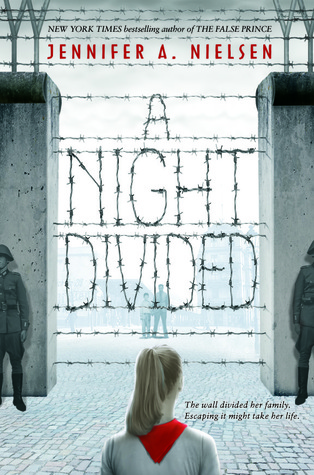
Teaser Tuesdays: A Night Divided by Jennifer A. Nielsen, 2015 (August 18)

Okay, so for those of you who are new to this meme, here's how it works:

Teaser Tuesdays is a weekly bookish meme, hosted by MizB of A Daily Rhythm. Anyone can play along! Just do the following:
• Grab your current read
• Open to a random page
• Share two (2) “teaser” sentences from somewhere on that page
• BE CAREFUL NOT TO INCLUDE SPOILERS! (make sure that what you share doesn’t give too much away! You don’t want to ruin the book for others!)
• Share the title & author, too, so that other TT participants can add the book to their TBR Lists if they like your teasers!

My current read is A Night Divided by Jennifer A. Nielsen.

Synopsis (from Goodreads):
From New York Times bestselling author Jennifer A. Nielsen comes a stunning thriller about a girl who must escape to freedom after the Berlin Wall divides her family between east and west.
With the rise of the Berlin Wall, twelve-year-old Gerta finds her family divided overnight. She, her mother, and her brother Fritz live on the eastern side, controlled by the Soviets. Her father and middle brother, who had gone west in search of work, cannot return home. Gerta knows it is dangerous to watch the wall, to think forbidden thoughts of freedom, yet she can't help herself. She sees the East German soldiers with their guns trained on their own citizens; she, her family, her neighbors and friends are prisoners in their own city.
But one day, while on her way to school, Gerta spots her father on a viewing platform on the western side, pantomiming a peculiar dance. Then, when she receives a mysterious drawing, Gerta puts two and two together and concludes that her father wants Gerta and Fritz to tunnel beneath the wall, out of East Berlin. However, if they are caught, the consequences will be deadly. No one can be trusted. Will Gerta and her family find their way to freedom?
(384 pages)
Here's this week's teaser, from page 1:
It was Sunday, August 13, 1961, a day I would remember for the rest of my life. When a prison had been built around us as we slept.
Let me know what you think of the book, and check back on Friday for my ARC review!

29 June 2015

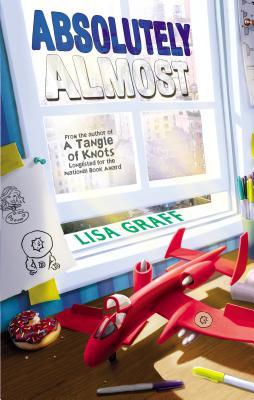
Absolutely Almost by Lisa Graff, 2014

Click to view
on Goodreads 
From the author of the National Book Award nominee A TANGLE OF KNOTS comes an inspiring novel about figuring out who you are and doing what you love.
Albie has never been the smartest kid in his class. He has never been the tallest. Or the best at gym. Or the greatest artist. Or the most musical. In fact, Albie has a long list of the things he's not very good at. But then Albie gets a new babysitter, Calista, who helps him figure out all of the things he is good at and how he can take pride in himself.
A perfect companion to Lisa Graff's National Book Award-nominated A Tangle of Knots, this novel explores a similar theme in a realistic contemporary world where kids will easily be able to relate their own struggles to Albie's. Great for fans of Rebecca Stead's Liar and Spy, RJ Palacio's Wonder and Cynthia Lord's Rules.

(320 pages)


I've been sitting here for like fifteen minutes trying to start this review. The words I already wrote and deleted could fill a whole paragraph, and I have nothing to show for it. I don't usually have such a hard time getting into a review - most times, I just sit down and spout out a bunch of random thoughts and then go back and edit them into a coherent piece of writing. With this one, however, I am literally sitting here typing about blogger's block because I can't think what else to write. The words look good on the page, though (I'm finally getting a paragraph written!), and even if I wind up deleting this at least I'm finally getting the words flowing. [I kept this in, even though I thought I wouldn't, because it's part of my reaction to the book.]

I guess my blogger's block stems from my inability to connect with what Albie's going through. Usually, I can start right off the bat by recounting something from my own life that can segue into a discussion of the book. Hey, when I was neck-deep in Richard III research for my final English project I actually used a discussion of Richard III to review Margaret Peterson Haddix's Claim to Fame (which, BTW, has nothing to do with ancient English kings from the Middle Ages). But this time, I honestly can't find anything to talk about. I've struggled with many things, from loneliness to melancholy, but I've never (and I'm really not trying to brag here) had any real trouble in school. I've disliked subjects, sure, but I've never been unable to do them. So when Albie is struggling to study for his spelling tests and can never get more than four out of ten words correct any given week, I feel his agony but I'm also just frustrated at the idea that he has to work so hard for such little results.

The metaphor that just popped into my head about the spelling tests is "having your hands tied," and I think it actually applies to the entire book. Albie's hands are tied when it comes to school, because no matter how hard he works he still can't do well. His hands are tied at home, because his father commands Albie to do well in school but never spends any time with him. Albie's hands are tied in his social life, because no matter how hard he tries he still doesn't understand what makes people tick. He honestly believes that the popular kids are nice to him because they like him (and not because his best friend's family just got their own reality TV show), and that his "uncool" friend with a dreadful stutter can become cool if she just follows his tips for being popular (tips such as "Don't ever be last in the line to go to lunch" and "Sing fake words to the songs during chorus").

Besides Albie, everyone's hands are tied in some way or other. His best friend, brand-new reality TV star, is hedged in on every side by camera crew and people wanting to be his friends for nothing more than the fame. Albie's mother's hands are tied because she desperately wants to help her son succeed . . . but is horrified that, by her way of measuring success, Albie keeps coming up short. Albie's babysitter Calista's hands are tied because her ways of helping Albie sometimes go against what his parents think is best for him. Even the reader's hands are tied, because Albie is narrating and he often doesn't pick up on things that should be fairly obvious. So when I, at least, read the book, I spent half the time wishing I could pass Albie notes about things. He gets so confused sometimes, and takes things at face value that obviously need to be evaluated more deeply, and it's frustrating to be unable to help him.

Absolutely Almost frustrated me a lot, but that doesn't mean I didn't like it. I am glad I read it, and I'll be sure to recommend it to people I think who would like it, but I personally don't think I'll be rereading it or fangirling over it any time soon. It pulled me in, though, and made me think. And that's what really counts.

22 May 2015

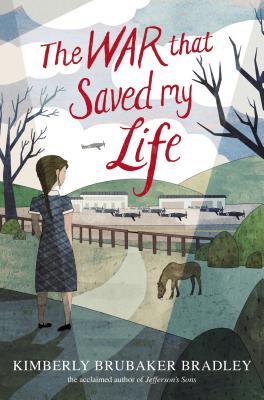
The War that Saved my Life by Kimberly Brubaker Bradley, 2015

Click to view
on Goodreads 
Nine-year-old Ada has never left her one-room apartment. Her mother is too humiliated by Ada’s twisted foot to let her outside. So when her little brother Jamie is shipped out of London to escape the war, Ada doesn’t waste a minute—she sneaks out to join him.
So begins a new adventure of Ada, and for Susan Smith, the woman who is forced to take the two kids in. As Ada teaches herself to ride a pony, learns to read, and watches for German spies, she begins to trust Susan—and Susan begins to love Ada and Jamie. But in the end, will their bond be enough to hold them together through wartime? Or will Ada and her brother fall back into the cruel hands of their mother?
This masterful work of historical fiction is equal parts adventure and a moving tale of family and identity—a classic in the making.
(316 pages)

The War That Saved My Life is a great book for several reasons - several separate reasons. That's because so much is going on, emotionally and physically, that a couple books could have been made off of each separate theme.

One book could provide a fascinating look at what life was like for the uneducated kids from London slums, sent to live with (relatively) rich families in the countryside. Chapters could have been written focusing on the struggles those city kids faced, missing their families and living with complete strangers in a world completely foreign to their own. Many children were actually summoned back to London by parents who missed their kids, and thought that since the Germans hadn't bombed London yet, they never would. This description of events is so different from those in The Lion, the Witch, and the Wardrobe that right there I would have been fascinated!

But that's not all Bradley did. There was also Susan's story, a story of rejection and loss and solitude. Susan's best friend (or maybe more, but I prefer to ignore the signs) Becky died a few years earlier, leaving Susan the house they had shared and remembrances everywhere of what Susan had lost. At the beginning of the book Susan is sad and lonely, and doesn't believe that anything can change that. She is forced to step forward by Ada and Jamie's arrival, and it is great to watch her begin to move on from her own troubles as she helps the kids move on from theirs. From the teaser I was afraid it would be one of those "she initially hates them but gradually comes to love them, then admits it in the end" kind of book. On the contrary, Susan only refuses to take the kids because she fears she's not emotionally fit to care for anyone other than herself. It's soon obvious to the reader that she, while struggling to adapt to their presence, quickly comes to love them. It's far from obvious to the affection-starved children, however, and Ada struggles through much of the book to reconcile Susan's kindness with the actions of someone who by her own admission didn't want kids.

And then of course there's the story of Ada and Jamie. The other stories weave themselves into a background tapestry, combining with a thousand smaller story bits to form a gigantic backing for the central figures - or really, figure. Sorry Jamie, but Ada is the star of this story! It's Ada who tells the tale, her limited understanding of the world painting a harsher picture than any master needle could stitch. She doesn't know what grass is. She doesn't know how to work a flush toilet. She has never heard of crutches. The word "clubfoot" has literally never entered her vocabulary, even though it is the condition that defines her entire life. She thinks that Susan will hit her. And as all the imperfections of Ada's past come to light, it is easy to see that the war does, indeed, save Ada's life. She is just so damaged it takes her a while to understand this.

It's funny, I didn't love The War That Saved My Life when I started writing this review - I only really, really liked it. But the only negatives I can think of are so minor when compared to the positives that they don't really feel worth mentioning - so I guess that means I do love The War That Saved My Life! I'm not going to run out and buy my own copy any time soon, but I will definitely be re-reading it in the future. And I highly recommend it to anyone and everyone who's old enough to appreciate it.

Because the more I think about it, the more I love this book.

23 March 2015

The Chosen Prince by Diane Stanley, 2015

Click to view
on Goodreads 
From master storyteller Diane Stanley comes a spellbinding tale based on Shakespeare's The Tempest of two princes--one chosen, one lost--and a mysterious girl on a magical island, all caught in a great web of destiny.
On the day of his birth, Prince Alexos is revealed to be the long-awaited champion of Athene. He grows up lonely, conscious of all that is expected of him. But Alexos discovers that being a champion isn't about fame and glory--it's about sacrifice and courage.
Alexos follows the course of his destiny through war and loss and a deadly confrontation with his enemy to its end: shipwreck on a magical, fog-shrouded island. There he meets the unforgettable Aria and faces the greatest challenge of his life. 

(368 pages)

I . . . really don't know if I liked this book. I suppose if I have to think so hard the answer is "no," but it just isn't that simple. On one hand, I loved it. It was deep, moving, and meaningful, with a lovable main character and an emotionally manipulative plot. On the other hand, I spent most of the book semi-loathing said main character, because I didn't know if I could bring myself to love someone who had done what he did. I both empathized with and despised Alexos, and my stomach twisted (and still twists right now, actually) at the horrible event that happens a third of the way into the book.

On the other hand, I loved Alexos for how much his father and the gods put him through. He never really gets a childhood, loses his ability to walk correctly to a summer sickness that sounds a lot like polio, and is practically cast aside by his ruthless father after becoming crippled. Despite all this (and perhaps even because of some of it), he is strong, good, and kind, wishing for nothing more than to make his kingdom a better place. I only wish a certain event had not happened, or at least not happened the way it did, because I could have really, really, loved Alexos for everything he went through. As it was, I couldn't help feeling (horrible as it sounds) like perhaps he deserved everything that happened to him. If I read the book again now I would probably like it a lot better, but I still hate The Chosen Prince for the way it utterly horrified me just far enough in that I couldn't stop reading, but early enough that I spent the majority of the book miserable.

A lot of the other reviews I've read of this book complain about the narration, which is third person present, calling it clumsy and distracting. The only times I had any trouble with it were when something was being talked about in past tense. I'm so used to reading third person in past tense that I had a hard time remembering that when say, the narration talks about what Alexos did, it's talking about something that happened before the scene I'm currently reading. This was a relatively minor issue, though, and overall it worked fine for me. Props to Stanley for trying something new!

I absolutely love Diane Stanley's Silver Bowl trilogy, and her standalone Bella at Midnight is a fun fairy tale retelling that isn't wonderful, but isn't horrible. This, however, almost feels like a different author wrote it altogether, and I don't think I'm as big a fan of this author as I am of the other. I do love The Chosen Prince, but I also hate it. And I don't think I'll be recommending it to anyone any time soon, just because I don't want to be the one to recommend something so horrifying, but I can't really give a very good warning about it without spoiling the whole story. So if you're deciding whether or not to read it, I can't really help you. I'm sorry!

09 March 2015

Why Me? by Deborah Kent, 1992

Click to
view on Goodreads
Rachel wakes up one morning to find her world has been smashed to smithereens. Her whole body feels heavy and painful, and she can barely sit up. Rushed to the hospital, she learns that she has a kidney diseases. Rachel will have to be on dialysis for the rest of her life . . . or until an organ donor can be found. 
The doctors tell Rachel that the best donor would be a blood relative. But she is adopted, and knows nothing about her biological mother. All Rachel can think is, "Why did this have to happen to me?"
As she struggles to live with her illness, Rachel must also handle the emotional ups and downs of trying to find her birth mother. Will they be able to locate her? What will she be like? And will she agree to give Rachel what she needs - a second chance for life?
(184 pages)


This was a book I picked up for free at a book swap. The plot - about a medical and identity crisis rolled together - appealed to me, and I hoped it would be as good as it sounded. The short version of this review: it was.

Poor Rachel's life becomes a living hell when she suffers kidney failure and goes on dialysis. She quits ballet, the love of her life, and feels sluggish and snappy. She deals with her body's "betrayal" (as she puts it) very realistically, with tears and anger. She grows over the course of the book as she realizes that she must accept the fact that her life will never be the same. She also must come to grips with her birth mother's identity and reason for giving her up. This struggle also is extremely realistic, and I thought it was very well done.

The only flaw I can find with the book is its pacing: apparently it spans about a year of Rachel's life, starting with when her kidneys fail, but it doesn't feel like it. In fact, time seems to pass rather sporadically with detailed scenes intermingled with statements to the effect of "time passed." The passage of time is a recurring theme throughout the book, as the process of finding Rachel's birth mother takes a really long time. However, this didn't really work for me as sufficient proof: from Rachel's character growth, you would think that only a few months at most have passed.

I would highly recommend this book to anyone interested in what it's like to live after a kidney failure: the food restrictions, the dialysis, the sluggishness, etc. It's also a great story about identity and the difference between biological and adoptive family. It's perfectly fine for younger readers, so you can be comfortable handing this book to anyone whose reading comprehension is up to it. I'm very glad I found this little treasure; it gave me an up-close view of what it's like to suffer kidney failure. I just hope it's the closest look I'll ever get!

20 February 2015

Love, Aubrey by Suzanne LaFleur, 2009

Click to view on
Goodreads
A tragic accident has turned eleven-year-old Aubrey’s world upside down. Starting a new life all alone, Aubrey has everything she thinks she needs: SpaghettiOs and Sammy, her new pet fish. She cannot talk about what happened to her. Writing letters is the only thing that feels right to Aubrey, even if no one ever reads them.
With the aid of her loving grandmother and new friends, Aubrey learns that she is not alone, and gradually, she finds the words to express feelings that once seemed impossible to describe. The healing powers of friendship, love, and memory help Aubrey take her first steps toward the future.
Readers will care for Aubrey from page one and will watch her grow until the very end, when she has to make one of the biggest decisions of her life.
Love, Aubrey is devastating, brave, honest, funny, and hopeful, and it introduces a remarkable new writer, Suzanne LaFleur. No matter how old you are, this book is not to be missed. 
(262 pages)


Gosh, I love this book so much. And oh, how it makes me cry! I have read many sad fictional books, from Harry Potter and the Deathly Hallows (honestly, so many people die in that book!) to books about the Titanic and the last Romanovs, but most of them can't bring me to tears. They can make me really, really sad, it's true, but they can't make me actually cry. This book, though, gets the waterworks flowing in the first three chapters and never lets them stop. And this may sound miserable, but it's actually wonderful.

You see, this is a story of pain and grief and abandonment, but it's also the story of love and friendship and strength at the worst of times. It is the story of Aubrey, whose father and sister died in a car accident. Her mother was so incredibly consumed with grief she ran away from home a few months after the funeral, leaving Aubrey behind to take care of herself. The story is told in first person past tense, which worked well for the story by providing a compelling contrasts with the first person present flashback scenes in which Aubrey remembers life before the car accident. Instead of an info-dump at the beginning of the story we gradually find out the events of Aubrey's past as she is forced to remember them, which (you guessed it!) provides haunting snapshots throughout the story of how much Aubrey has lost.

The saddest parts of the narrative, however, are probably the letters Aubrey writes. At the beginning of the book she writes letters to her sister's imaginary friend Jilly as a way to sort of indirectly talk to a piece of her sister. As she begins to come to grips with everything that has happened to her, she starts to write more directly to her mother, father, and sister, telling them what she wishes she could say to them in person. She signs each letter "Love, Aubrey," which is the source of the title.

This is, without a doubt, one of my all-time favorite books. It's heart-wrenching, but it's also realistic and  heartwarming. Aubrey has had the unthinkable happen to her family, and she responds the way any real person would - through denial, through tears, and through shutting down at any reminder of what has happened. But as the story goes along, she learns to cope and to forgive and to live her new life with her grandmother and best friend/neighbor Bridget.

This is an amazing book, and I wholeheartedly recommend it. But please, know what you are getting into. This is not a light or easy read, and if you don't want to read a book that will make you cry, then don't pick this one up. But know that it does not just toy with the emotions: it is sad because terrible, tragic things happen in life, and sometimes you have to cry about them.

Note: I have also read the author's other books, and they were really good as well. She is a master at portraying difficult emotions and reactions to traumatic situations. While I liked the other ones, though, this is still my favorite of her books.

06 February 2015

A Million Ways Home by Dianna Dorisi Winget, 2014

A moving middle-grade story about love, loss, and the unlikely places we find home.
Poppy's life has been turned upside down after her grandma (and guardian) had a stroke and ended up in the hospital. But Poppy is working on a plan to help Grandma Beth so their life together can go back to normal. But when she witnesses an armed robbery, "back to normal" slips even further out of her reach. To keep Poppy safe, the budget-strapped police devise an unusual "witness protection program," wherein Poppy will stay with Detective Brannigan's mother. Soon Poppy is feeling almost at home, even making sort-of friends with a girl named Lizzie and definitely friending Gunner, a beautiful dog with an uncertain fate. But it's still not home. So while she and Lizzie navigate a rocky friendship and plot to save Gunner's life, Poppy also tries to figure out a new plan to save Grandma Beth and their home, all while avoiding a dangerous robber who might be searching for her. But what if Grandma Beth can never come home and the robber is put behind bars? What will happen to Poppy then?
(272 pages)

What a good book! I went into it expecting a book with nothing special to offer, that thought it was offering the world. Instead I found a sweet, poignant tale of family, loss, and love (familial love, not romantic love - I was worried about that when I read the synopsis!), and all the different types of "home." I enjoyed myself greatly while reading the entire book, and then after finishing it read back through to watch the development of a certain relationship throughout the book. Which one, you ask? It doesn't really matter; they're all great. The particular one I wanted to retrace was between Poppy and Trey, but it could have just as easily been between Poppy and pretty much any other main character, or even just between two other main characters with no Poppy involved.

You  see, this is a book about relationships. Not even just Poppy's relationships, though those often take center stage, but all sorts relationships. The relationships between Poppy and Lizzie, Lizzie and her unseen dad (Lizzie's parents recently got divorced), Trey and Poppy, Poppy and Grandma Beth - honestly, it goes on and on. And it's beautiful.

Now, Poppy was a great if sometimes infuriating character. She wandered away way too often for someone under a modified version of witness protection. To be fair, though, she had a ton on her plate so I think she just kind of didn't have room in her head to worry about the robber coming after her. When your grandmother/legal guardian is in the hospital because she keeps having strokes and you're only out of the Children's Center because you are a witness from a murder case . . . well, either you're going to crack with stress or you're going to kind of ignore one of the stressing factors. So while I don't love her to pieces, I do love her just a little bit. Because she went through so much, and was so brave, and - well, I don't know. I guess that kind of sums it up.

The story is both sad and sweet, and its tale of loss is offset by a thread of love and friendships. It's the kind of book that makes you give a happy sigh as you put it down, and makes you reread it every few years if you spot it on a library shelf. I don't know if I'd want to own it, because it's not quite that good, but I'll definitely reread it down the road.

30 January 2015

A Snicker of Magic by Natalie Lloyd, 2014

  
Synopsis (from Goodreads):
Click to view on Goodreads
Introducing an extraordinary new voice---a magical debut that will make your skin tingle, your eyes glisten . . .and your heart sing.
Midnight Gulch used to be a magical place, a town where people could sing up thunderstorms and dance up sunflowers. But that was long ago, before a curse drove the magic away. Twelve-year-old Felicity knows all about things like that; her nomadic mother is cursed with a wandering heart.
But when she arrives in Midnight Gulch, Felicity thinks her luck's about to change. A "word collector," Felicity sees words everywhere---shining above strangers, tucked into church eves, and tangled up her dog's floppy ears---but Midnight Gulch is the first place she's ever seen the word "home." And then there's Jonah, a mysterious, spiky-haired do-gooder who shimmers with words Felicity's never seen before, words that make Felicity's heart beat a little faster.

Felicity wants to stay in Midnight Gulch more than anything, but first, she'll need to figure out how to bring back the magic, breaking the spell that's been cast over the town . . . and her mother's broken heart. 
(311 pages)

It's funny, I really liked this book while I was reading it, but I'm having a terrible time reviewing it. Well, not really a "terrible" time, because that implies I've actually made a serious attempt at writing a review at all. In reality, I've thumped down a sentence or two and then quit and worked on other projects. On another note, guess who just joined Blogging For Books?


Okay, focus. Time to write a review. I think the thing that's so hard about this book is that it's really cool and creative and fun, but at the same time it's . . . not. It reminded me of so many other "zany," "unique" books I've read, that I couldn't really pin down why exactly I liked this one. I mean, I had a lot of fun bing sucked into the story. But  I spent a lot of time wondering in the back of my head "when will this blow my mind? When will it wow me?" 

And it never really wowed me. It's sad, because this was not a bad book by any stretch of the imagination. In fact, it was a really good book! It just felt like a remix of some of my favorite quirky reads: Remarkable, Savvy, and Drizzle. If I'd read Snicker before reading those books, I would have fallen in love. But because I'd already read and adored them, I was a bit tougher to impress with this read. I needed more.

The characters are good, fairy well-rounded, and hold your attention. Felicity's mother has a case of wanderlust stronger than anything I've ever seen, and I felt bad that she couldn't even see what she was putting her kids through by constantly moving. Felicity was sweet, and cute, and I loved the way she collected words throughout the book. It made for a great descriptive device, giving the reader glimpses into other people's minds without straying from a first person narrative. That was probably my favorite aspect of the story, and I kind of wish Lloyd had explored it further.

I really did enjoy reading this, though I doubt I'll go out of my way to reread it any time soon. It's especially impressive as a debut, and I am definitely keeping an eye out for Lloyd's next book. If it sounds interesting to you, then by all means read it! Just because I didn't adore it to pieces doesn't mean you won't. It's well-written and engaging, with a meaningful story. If you do decide to read it, I'd love to hear your opinion of Snicker!

21 January 2015

The 13th Gift by Joanne Huist Smith, 2014

Click to view
on Goodreads
After the unexpected death of her husband, Joanne Huist Smith had no idea how she would keep herself together and be strong for her three children--especially with the holiday season approaching. But 12 days before Christmas, presents begin appearing on her doorstep with notes from their "True Friends." As the Smiths came together to solve the mystery of who the gifts were from, they began to thaw out from their grief and come together again as a family. This true story about the power of random acts of kindness will warm the heart, a beautiful reminder of the miracles of Christmas and the gift of family during the holiday season.
(224 pages)

I am so jealous of the Smiths.

No, wait, that came out wrong. The Smiths had a horrible, terrible thing happen to them when Mr. Smith died. Joanne is heartbroken and limp, unsure if she is even capable of continuing on without her husband. I don't envy that! But what I do envy is the joyous mystery of the Twelve Days of Christmas gifts. How exciting it would be to have a different kind gift show up on your doorstep the twelve days before Christmas! What a wonderful way to get into the holiday spirit!

And, of course, that's what the gifts were for. They were given because the Smiths were in mourning, and they needed some holiday cheer. And while Joanne may have begun the twelve days of Christmas covering her ears at the hint of a Christmas carol, she certainly ended them in much better shape.

This book reads like fiction, and well-written fiction at that. Joanne is a reporter and you can definitely tell that she's got a way with words. She wrote this book almost fifteen years after the events it describes took place, so she had time to step back and analyze her own condition and the conditions of her three kids at the time, and portray them brutally honestly.

That brings me to the children. I feel so bad for those kids! The youngest girl, Megan, was only ten when her father died. How horrible. She is actually the one who deals with it the best, though, as she gets wrapped up in the excitement of Christmas and acts as peacemaker between her mother and her oldest brother Ben. Ben was seventeen when his father died, and you can see how hard it was for him to lose his male authority figure at such a difficult time. He struggles to deal with his emotions, and (especially early in the book) winds up hurting his mother with his rebellious behavior more than he means to. Nick, the middle child, was so cute! He spent most of the book rotating between being a kid who just lost his father, and a kid who wants a new computer, a new bed, a new room, and a new video game console for Christmas. All three kids are drawn realistically with the eye for detail only a mother can furnish.

A word of warning to those who want to read it for the heartwarming Christmas book that it is: there are, like, three instances of bad language in the book, all toward the beginning. I think there are two or so uses of the word "damn" and in one instance someone in the parking lot yells "a-hole" at a rude driver. I really wish she hadn't put these words in, because the book could have flowed just as well without them, and it makes me leery to wholeheartedly recommend the book to many people who would otherwise love it.

Besides that, though, it's a beautiful story and a heartwarming read that I am very glad I was able to spend a few hours enjoying. If you don't mind the minor amount of language, then you should find nothing at all wrong with this story of love, loss, family, and Christmas.

Disclaimer: I received a free copy of this book through Blogging for Books in exchange for an honest review.