Showing posts with label art. Show all posts

22 September 2017

Landscape with Invisible Hand by M.T. Anderson, 2017

Click to view
on Goodreads 
When the vuvv first landed, it came as a surprise to aspiring artist Adam and the rest of planet Earth — but not necessarily an unwelcome one. Can it really be called an invasion when the vuvv generously offered free advanced technology and cures for every illness imaginable? As it turns out, yes. With his parents’ jobs replaced by alien tech and no money for food, clean water, or the vuvv’s miraculous medicine, Adam and his girlfriend, Chloe, have to get creative to survive. And since the vuvv crave anything they deem classic Earth culture (doo-wop music, still life paintings of fruit, true love), recording 1950s-style dates for the vuvv to watch in a pay-per-minute format seems like a brilliant idea. But it’s hard for Adam and Chloe to sell true love when they hate each other more with every passing episode. Soon enough, Adam must decide how far he’s willing to go — and what he’s willing to sacrifice — to give the vuvv what they want.
(160 pages)

Okay . . . what?

This book is pretty awful. And kind of pointless. Why is everyone giving it such high ratings on Goodreads? I must be missing something big here.

I mean, if I switch on my AP English brain and squint a little, I guess I can see Landscape with Invisible Hand as some sort of social commentary–almost. Or maybe it's just supposed to be artistic or something, and everyone likes that. I don't know. I'm not a particularly artistic person–at least not when it comes to stories about human teens in an alien-dominated future Earth society who swear like sailers (I'm talking the f-word multiple times on every page!) and decide to turn their romance into a reality TV show even though one of them struggles with explosive diarrhea.

You read that right. Explosive. Diarrhea. For some strange reason that makes zero sense to me, the vuvv decided to quit purifying city tap water and so Adam has developed a fake illness called "Merrick's Disease" (pronounced, bizarrely enough, like a real-life chicken disease). I don't remember the explanation, but basically he has bad bacteria messing up his gut and giving him gas and sudden attacks of diarrhea. It's really disgusting. Chloe's awful about it, but I have to be honest: I probably wouldn't want to make out with a boyfriend who had Merrick's, either.

The story is oddly short, focusing mainly on the build-up and destruction of Adam's and Chloe's relationship and Adam's struggles to help his family survive (despite being abandoned by his father) while keeping his artistic integrity intact. There are a surprising amount of details included in the story for its short length, but I thought it needed to be longer to really capture more of the creative sci-fi world Anderson invented. Also, I don't like how sudden the ending is. Or at least, I wouldn't if I'd been enjoying the book. By page 160, I didn't really care how it ended anymore.

But can we just go back to the explosive diarrhea? I found that detail incredibly unecessary. And why on earth did the vuvv do away with clean water?! That makes no sense, they're supposed to be health geniuses. Water purification is pretty basic. But even with the dirty tap water, this is supposed to be in the future. Why do characters have fancy 3D technology at their fingertips but no simple water filtration devices? Why is there not a whole market of bottled water available? Adam mumbles something mildly economics-sounding once or two to explain the way things are, but I just don't buy it. There are still humans on the earth, aren't there? So what happened to the government regulations about sanitation? And why does the fact that human money doesn't work with the vuvv mean that our societies basically collapse? It all goes back to the basic rule of supply and demand: if the vuvv services are too expensive, why are there no human alternatives that are cheap enough for people to afford? An influx of new market options should not wipe out all of our previous inventions and accomplishments.

Gah, but this is me approaching a fictional novel as a future economics major. I think I'll just give up now, because I am clearly missing whatever the point of Landscape with Invisible Hand was. If anyone else feels differently about it, please do comment below explaining to me what it is that I'm missing.
Disclaimer: I received a complimentary copy of this novel from the publisher in exchange for an honest review.

17 February 2017

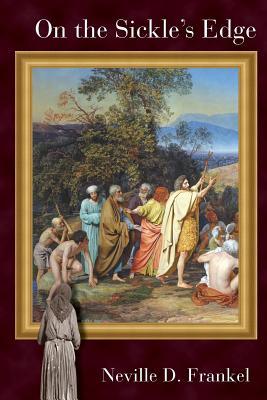
On the Sickle's Edge by Neville D. Frankel, 2017

Click to view
on publisher's site  
What we cannot keep. What we cannot lose.
A sweeping masterwork of love and loss, secrets and survival, On the Sickle's Edge is told through the voices of three characters who lay bare their family's saga: the endearing, scrappy South-African born Lena, transported to Latvia and later trapped in the USSR; her granddaughter Darya, a true Communist whose growing disillusionment with Soviet ideology places her family at mortal risk; and Steven, a painter from Boston who inadvertently stumbles into the tangled web of his family's past. Against the roiling backdrop of twentieth-century Russia and Eastern Europe, the novel delivers equal parts historical drama, political thriller and poignant love story.
(432 pages)

Okay, first, full disclosure: there is no way on earth that I would have finished reading On the Sickle's Edge if it weren't for the fact that I hadn't promised to review it for a TLC book tour. As it is, I wound up skipping in the second half. It's not that the book is poorly written, because it actually grabs the attention very well for an over 400-page historical novel. I've always been fascinated by the horrors of life under the USSR regime (in part because they're given far too little attention in literature due to WWII), and the actual story of this increasingly-growing Jewish family hiding in plain sight in Moscow is gripping and very meaningful for me to read. My favorite point-of-view was Lena's, because she had the most dramatic and fascinating life of all three of the main characters. Also, most of the drama Darya and Steven faced was self-inflicted; Lena was the true innocent of the story, the girl whose life was ripped away from her by the cruelty of the USSR dictatorship.

So . . . what happened? Why did I almost put On the Sickle's Edge down, and why did I finish it with a sour taste in my mouth? I think a lot of my distaste for the book boils down to the fact that it's an adult novel, and I very much prefer middle-grade and young-adult books. I forgot, in my excitement about this book's topic, that so many fictional adult books have way more graphic content than I'm used to. And I'm not talking about violence–there was that too, of course, but that was to be expected. No, I'm talking about sex. For one thing, all three characters are way to easy about it; Steven is particularly promiscuous. I could still mostly forgive the book for its characters' loose morals, excusing them away as accurate depictions of the way people in their situations behaved, but what I can't be okay with are the graphic sex scenes (including ones between distant cousins–still kind of ew!) that are sprinkled into the text. I have no desire to read content like that, so I did my best to skip over them and plow through in honor of my pledge to review the book. When the author started throwing important dialogue pieces into the middle of those scenes, though, that's when I got really frustrated and started skipping pages to just get through the book already. There's some horrible stuff in there, including several times where Darya's husband clearly rapes her, and I just don't want to read that!

Call me a baby if you want, but that's how I feel. I don't have much more to say about the book, besides the fact that it's so complex and historically significant that more liberal readers than I will probably love it. Oh, and also that Darya's husband was so evil I actually found him very unrealistic. Were there men like him in the USSR? Maybe, but it seems strange that he never showed even the slightest sign of humanity or weakness–ever.

Maybe I'm just not the right audience for this book, so maybe you will like it more than I did. If you've read the description, and what I've described doesn't turn you off, then try On the Sickle's Edge for yourself. Be sure to comment below with your thoughts once you've finished it!

Disclaimer: I received a complimentary copy of this novel for the purpose of participating in a TLC Book Tour.

22 November 2014

Masterpiece by Elise Broach, 2008

Synopsis (from Goodreads):
Marvin lives with his family under the kitchen sink in the Pompadays’ apartment. He is very much a beetle. James Pompaday lives with his family in New York City. He is very much an eleven-year-old boy.After James gets a pen-and-ink set for his birthday, Marvin surprises him by creating an elaborate miniature drawing. James gets all the credit for the picture and before these unlikely friends know it they are caught up in a staged art heist at the Metropolitan Museum of Art that could help recover a famous drawing by Albrecht Dürer. But James can’t go through with the plan without Marvin’s help. And that’s where things get really complicated (and interesting!). This fast-paced mystery will have young readers on the edge of their seats as they root for boy and beetle.


First, an important note to my readers: Two months ago I fell off a horse (during my third and final horse-back riding lesson), spraining my left and dominant hand. We went to the doctor and got a wrist brace which helped it get better, but in the last two weeks it has become painful once more and so I'm under orders not to use it for anything. Sadly, that "anything" includes typing. I'm left to do my school-work and blog writing either one-handed or with my computer's pretty faulty dictation device. So if I miss a typo here or there, just let me know in the comments and I'll fix it.

Anyway, on to the review.
I read this book for the first time several years ago, back when I was actually part of the target audience.  The first time I read it, I picked it up because I had loved Shakespeare's Secret by the same author.  I didn't really know what to expect with this one, but once I got into this book, I was enthralled.  Now, a few years later, I am not quite as in love as I was the first time (and caught a couple logistical issues that escaped my notice the first time), but it is still the fun, sweet story I remember - and even cuter than I thought it was!

I'm not really going to nit-pick through this one. The fact that the beetles are so similar to humans requires a leap of faith (I mean, Marvin has an uncle who fixes the electronic devices when they malfunction!), but the charming picture of a tiny family living in the walls and mimicking the lives of the larger inhabitants is indubitably an appealing one to elementary and middle school-aged children. You only have to look at the success of The Littles and The Borrowers to see this. Stuart Little and The Cricket in Time's Square are some  more successful additions to this sub-genre about tiny people or animals who behave like people. Masterpiece joins the ranks of these stretch-of-the-imagination classics with all the charm that can be desired, if not all the logic (at one point Marvin can't see and knows he's in an  elevator because of the swooping feeling in his stomach - how can this pubescent beetle who has never left home before possibly know what it feels like to be in an elevator?).
The story is told third person past tense from Marvin's point of view. Marvin is the hero of this book, no doubt about it. It's his decisions that carry the story, starting with his impulsive present to James. Marvin doesn't really have much unique characterization. The novelty is in what Marvin is and what he can do, not who Marvin is. Marvin is pretty straight-forward (kind, curious, artistic, etc), and you can't help but automatically be on his side.

James, the main human character in the book, is just as nice as Marvin, and is also very perceptive. James is probably my favorite character in the book not only because of his shy kindness, but because his mother and step-father walk all over him and you can't help but be on his side. Even James's real father Karl (divorced from James's mother several years before the book begins) seems oblivious to James's real desires in life: he gives James a pen and ink set for his birthday, clueless to the fact that James can't even draw. James doesn't throw a fit about getting a pen and ink set for his birthday (which is what most bratty kids in today's MG would do). He thanks his dad with as much enthusiasm as he can muster, and goes upstairs to start testing the kit out. See why I like this kid? There have been too many self-absorbed MCs lately, and I enjoyed reading a book with two kind and even compassionate main characters. Maybe I should read younger kid books more often.

As for the plot, it's a fun adventure through art, history, and museum security with a clever twist ending. As I mentioned above, James's parents are divorced. It's handled neatly throughout the book, and younger readers will quickly catch on to the fact that James's parents just weren't compatible because of their completely different approaches to life. While I may not agree with the idea of "incompatibility" divorce, there's no fault in the way it's handled.

Now, I keep saying this is a book for younger kids. This is true, but keep in mind: it's 292 pages long. It packs quite a heft for a middle grade book, so be careful that you only give it to kids who've got some endurance training under their belt. Also, older people are not excluded from reading it. I'm a high school junior and I read it, and I'm even admitting to reading it online!

Disclaimer: I received a copy of this book for free through Barnes & Noble's summer reading program this past summer. No one asked me to review it, and it didn't affect my review in any way.