Showing posts with label identity. Show all posts

26 June 2017

Call Me Sunflower by Miriam Spitzer Franklin, 2017

Click to view
on Goodreads 
Sunny Beringer hates her first name—her real first name—Sunflower. And she hates that her mom has suddenly left behind her dad, Scott, and uprooted their family miles away from New Jersey to North Carolina just so she can pursue some fancy degree. Sunny has to live with a grandmother she barely knows, and she’s had to leave her beloved cat and all her friends behind. And no one else seems to think anything is wrong.

So she creates “Sunny Beringer’s Totally Awesome Plan for Romance”—a list of sure-fire ways to make her mom and Scott fall madly in love again, including:

Send Mom flowers from a “Secret Admirer” to make Scott jealous and make him regret letting them move so far away.
Make a playlist of Scott’s favorite love songs—the mushier the better—and make sure it’s always playing in the car.
Ask them about the good old days when they first fell in love.
But while working on a photo album guaranteed to make Mom change her mind and rush them right back home, Sunny discovers a photo—one that changes everything.

Sunny’s family, the people she thought she could trust most in the world, have been keeping an enormous secret from her. And she’ll have to reconcile her family’s past and present, or she’ll lose everything about their future.

(256 pages)

Call Me Sunflower is a rather . . . odd book. I guess that's a good thing, but I think it doesn't quite hit the mark with me.

For one thing, I'm rather horrified that Sunny's parents kept her so in the dark about her past and their present relationship. No one should be that clueless and uncertain about their family dynamics, and her mother has done both Sunny and her sister a huge disservice by keeping everything murky. Also, this whole idea of a fractured family that was never truly together (where the mom adopted a baby and the dad agreed to act as the father to a kid he had no direct ties to) seemed really odd. Sunny's mother and the father should have either married and adopted together, or should have gone their separate ways altogether.

I don't know, I just feel like the whole dynamic was really weird. Don't get me wrong here, I have no issue with a single mother adopting babies–in fact, a friend of mine and her sister were both adopted as babies by a single mother! It's really the father figure role that doesn't quite add up for me. Besides that, I also thought the way the relationship between Sunny and her grandmother played out was a little strange (and the plotline surrounding her grandmother's fur store was especially forced). I did like her interactions in school, which were slightly along the beaten path of middle school drama but which nevertheless rang true. The increasingly-distant emails between Sunny and her best friend Madeline from her old hometown felt especially real to me, as someone who has exchanged more than her fair share of those moving-away conversations over the years.

To be honest, I think that this particular type of quirky story is going to sit really well with some readers and just not be quite right for others. I fall into the latter category, but you might be in the former; if you do decide to give Call Me Sunflower a try, let us know in the comments section what you think of it!

Disclaimer: I received a complimentary copy of this novel from the publisher in exchange for an honest review.

01 May 2017

Claiming Noah by Amanda Ortlepp, 2017

Click to view
on Goodreads 
This riveting debut novel of psychological suspense explores the dilemmas that arise when motherhood and science collide.

Catriona Sinclair has always had a well-developed sense of independence--in fact the one sore point in her otherwise happy marriage is her husband James's desire to take care of her. As she's often tried to explain to him, she took care of herself before she met him, and did a good job of it. But James has been especially attentive lately as they struggle to have a baby. They succeed at last through in vitro fertilization, but unwilling to risk the heartbreak of another miscarriage, they decide to make their "spare" frozen embryo available to another family.

Diana and Liam Simmons are desperate for a child. Unable to conceive, they are overjoyed to learn that as the closest genetic match to the Sinclairs they are the recipients of the embryo donation. Diana's only concern is her mother's disapproval of IVF, but any doubts raised are quickly eclipsed by Diana's joy of being pregnant.

As Diana is finding delight in every aspect of motherhood, Catriona keeps waiting for the rush of adoration she knows she is supposed to feel, but instead slips into a deep depression. Just as Catriona begins to find her way back to normalcy, one of the babies is kidnapped. Suddenly, all of their lives begin to unravel and intertwine, and none of them will ever be the same.

(384 pages)

This is a very interesting premise, isn't it? The moral issues and shades of gray introduced through in vitro fertilization make for bizarre sci-fi issues that seem a little too plausible to be comfortable.

To be perfectly honest, I never really saw the fight over Noah as a shades of gray case. He clearly belonged, both morally and legally, to his adoptive parents. The entire scenario of the custody battle that is the focus of the second half of the book rang false to me because I just couldn't believe it was a seriously-contested issue. I could be wrong, though–if anyone has any links to similar real-life cases, please do share them with me so I can read up on the issue!

Anyway, the actual fight over "Claiming Noah" doesn't really start until about halfway through the book. The focus is instead on the four parents, beginning with the two couples' complex journey to getting pregnant and then through the first few months of parenthood before things really got intense as one of the babies disappeared. These early stages were pretty interesting, though the description of Catriona's IVF procedures were a little more detailed than they probably needed to be. I immediately took the greatest liking to Diana, the adoptive mom who becomes pregnant with Catriona and James's extra embryo. She was just such a nice, warm, loving person who was desperate to be a mom! Her husband was a total domineering jerk from day one, though. I never liked him.

As for Catriona, she has a very . . . interesting path. I really blame her husband for a lot of the stress and bad reactions that she had, because he clearly wanted to have a baby way more than she did. He essentially pushed her into continuing the IVF treatment, even when she felt miserable after a failed attempt, by making puppy dog eyes at her and guilt-tripping her with descriptions of how desperately he's always wanted to have a child of his own.

I can't go too much into the story details without spoiling things, so I suppose I'll stop there. Suffice it to say that I was absolutely horrified by something Catriona did not too far into the book, which I felt like everyone skated past a little too quickly, and she makes some moral (sexual) choices later in the book that are described in way too much detail for my liking.

Anyway, before I end this review I have to touch on the issue of IVF. I'm one of those people who doesn't love the idea of creating a viable embryo and then destroying it, so I liked that Catriona and James decided to donate theirs and that Diana and Liam took it. But at the same time, as a foster sister who's heard way too many horror stories over the years, I'm rather horrified that people with fertility problems can be so selfish in their pursuit of the "experience" of being pregnant and having their "own" baby that they completely ignore all of the helpless children of the world who have already been born and desperately need homes. I understand the emotions involved in making these sorts of decisions, and I know it's not my place to tell either of them that I have a personal issue with their choice, but part of me says both couples should have just adopted babies and donated the IVF money to charity. In this case at least, it certainly would have saved a lot of trauma in the long run.

Anyway, I can't really recommend this book because of one or too scenes that are a little too sexually explicit. There's also one (fairly justifiable, at least in my opinion) use of the F-word. It's an interesting story, though, and there's a lot going on in both couples' lives. If you don't mind the issues I've described and you're interested to learn more about the book, you can check it out here or via the widget below.


Disclaimer: I received a complimentary copy of this novel from the publisher in exchange for an honest review.

17 February 2017

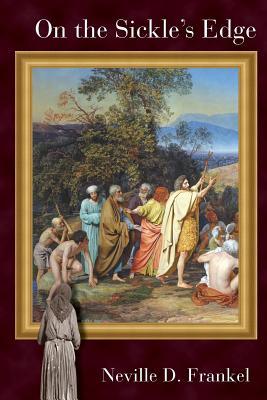
On the Sickle's Edge by Neville D. Frankel, 2017

Click to view
on publisher's site  
What we cannot keep. What we cannot lose.
A sweeping masterwork of love and loss, secrets and survival, On the Sickle's Edge is told through the voices of three characters who lay bare their family's saga: the endearing, scrappy South-African born Lena, transported to Latvia and later trapped in the USSR; her granddaughter Darya, a true Communist whose growing disillusionment with Soviet ideology places her family at mortal risk; and Steven, a painter from Boston who inadvertently stumbles into the tangled web of his family's past. Against the roiling backdrop of twentieth-century Russia and Eastern Europe, the novel delivers equal parts historical drama, political thriller and poignant love story.
(432 pages)

Okay, first, full disclosure: there is no way on earth that I would have finished reading On the Sickle's Edge if it weren't for the fact that I hadn't promised to review it for a TLC book tour. As it is, I wound up skipping in the second half. It's not that the book is poorly written, because it actually grabs the attention very well for an over 400-page historical novel. I've always been fascinated by the horrors of life under the USSR regime (in part because they're given far too little attention in literature due to WWII), and the actual story of this increasingly-growing Jewish family hiding in plain sight in Moscow is gripping and very meaningful for me to read. My favorite point-of-view was Lena's, because she had the most dramatic and fascinating life of all three of the main characters. Also, most of the drama Darya and Steven faced was self-inflicted; Lena was the true innocent of the story, the girl whose life was ripped away from her by the cruelty of the USSR dictatorship.

So . . . what happened? Why did I almost put On the Sickle's Edge down, and why did I finish it with a sour taste in my mouth? I think a lot of my distaste for the book boils down to the fact that it's an adult novel, and I very much prefer middle-grade and young-adult books. I forgot, in my excitement about this book's topic, that so many fictional adult books have way more graphic content than I'm used to. And I'm not talking about violence–there was that too, of course, but that was to be expected. No, I'm talking about sex. For one thing, all three characters are way to easy about it; Steven is particularly promiscuous. I could still mostly forgive the book for its characters' loose morals, excusing them away as accurate depictions of the way people in their situations behaved, but what I can't be okay with are the graphic sex scenes (including ones between distant cousins–still kind of ew!) that are sprinkled into the text. I have no desire to read content like that, so I did my best to skip over them and plow through in honor of my pledge to review the book. When the author started throwing important dialogue pieces into the middle of those scenes, though, that's when I got really frustrated and started skipping pages to just get through the book already. There's some horrible stuff in there, including several times where Darya's husband clearly rapes her, and I just don't want to read that!

Call me a baby if you want, but that's how I feel. I don't have much more to say about the book, besides the fact that it's so complex and historically significant that more liberal readers than I will probably love it. Oh, and also that Darya's husband was so evil I actually found him very unrealistic. Were there men like him in the USSR? Maybe, but it seems strange that he never showed even the slightest sign of humanity or weakness–ever.

Maybe I'm just not the right audience for this book, so maybe you will like it more than I did. If you've read the description, and what I've described doesn't turn you off, then try On the Sickle's Edge for yourself. Be sure to comment below with your thoughts once you've finished it!

Disclaimer: I received a complimentary copy of this novel for the purpose of participating in a TLC Book Tour.

13 April 2015

Claim to Fame by Margaret Peterson Haddix, 2009 (also, a lot of rambling about Richard III)

It was a talent that came out of nowhere. One day Lindsay Scott was on top of the world, the star of a hit TV show. The next day her fame had turned into torture.
Every time anyone said anything about her, she heard it. And everyone was talking about Lindsay: fans, friends, enemies, enemies who pretended to be friends....
Lindsay had what looked like a nervous breakdown and vanished from the public eye. But now she's sixteen and back in the news: A tabloid newspaper claims that Lindsay is being held hostage by her father.
The truth? Lindsay has been hiding out in a small Illinois town, living in a house that somehow provides relief from the stream of voices in her head. But when two local teenagers try to "rescue" Lindsay by kidnapping her, Lindsay is forced to confront everything she's been hiding from. And that's when she discovers there may be others who share her strange power. Lindsay is desperate to learn more, but what is she willing to risk to find the truth?

(272 pages)

My Richard III books (no, I'm
not using Sent for research - I
just used this as an excuse
to re-read it)
I'm in a bit of a review-writing slump right now. I've been so busy in my personal life lately that blogging has had to go on the back-burner. Speaking of busy, my capstone project in AP English is a speech about Richard III. I've been really swamped researching it - and by swamped, I mean "my floor has been devoured by history books" -  but it's been incredibly fascinating learning so much about a period I never really knew much about. I piled all of my research books up and took a picture. I've got quite a stash, haven't I?

But I digress. I'm not supposed to be talking about Richard III, am I? I'm supposed to be talking about Lindsay Scott. As I sit here typing, trying really hard to stay focused but not succeeding very well, it occurs to me that on the surface Richard and Lindsay are so different there is literally no real comparison that can be made between them that would segue into the review at hand. They're just about polar opposites, completely different in so many respects - most noticeably in the fact that Richard was a real person, and Lindsay is not. Also, they would have lived 500 years apart.

Actually, the more I think about it the more similarities I see between them. Being king of England 500 years ago was a lot like being a TV-star today: you were rich, famous, powerful, and under constant public scrutiny. Most striking in this (slightly ridiculous, I know) comparison is the fact that both kings and TV-stars are subject (pun intended!) to some serious double-talking. A king's subjects pretend to adore him so much, then turn around and curse him behind his back. A TV-star's costars and fans may offer her nothing but smiles and roses on set - but then go home and privately rant about how much they hate her. It takes a thick hide to live surrounded by such duplicity. Well, a thick hide or complete innocence about the vindictiveness of human nature.

And this is where I manage to segue into talking about the book at hand! Lindsay is an ex-TV-star. She was at the top of her game, a queen in her own court by the time she was eleven. She had that innocence that goes with childhood, and honestly believed that the entire world adored her. Then one day she was able to hear everything that was said about her, everywhere. Her naivety was shattered, her trust broken, and her confidence destroyed. Unable to cope with the stress of hearing exactly what everyone around said about her, she became a virtual recluse. She moved halfway across the country to a new house, one that somehow blocks her debilitating ability - though how, she had no idea. And didn't really care.

The book follows Lindsay five years after moving to Springdale as she is forced to come to terms with everything that has happened to her and learn how to function in the real world. She unearths some very hard truths about her relationship with her (newly deceased) father and the fate of the mother she never knew, even as she forges new relationships and decides whether she will spend her life hiding from the world, or will go out and actually live her life. Haddix introduces a lot of deep themes in Claim to Fame, and it's a very grabbing/thought-provoking read. The book's biggest flaw in my eyes is actually that it doesn't dig as deep as it could into these themes. I suppose that's just a sign that I'm past the target age, though - the first time I read Claim to Fame, I thought it was perfect. 

It's not perfect. I can see that now. But it's still very good, and raises a lot of interesting points about everything from transcendentalism to parent-child communication in a manner that just about anyone can digest. If anything I've said about the book interests you, then I highly recommend it.

19 January 2014

The False Prince by Jennifer A. Nielsen, 2012


Choose to lie...or choose to die.
In a discontent kingdom, civil war is brewing. To unify the divided people, Conner, a nobleman of the court, devises a cunning plan to find an impersonator of the king's long-lost son and install him as a puppet prince. Four orphans are recruited to compete for the role, including a defiant boy named Sage. Sage knows that Conner's motives are more than questionable, yet his life balances on a sword's point -- he must be chosen to play the prince or he will certainly be killed. But Sage's rivals have their own agendas as well.
As Sage moves from a rundown orphanage to Conner's sumptuous palace, layer upon layer of treachery and deceit unfold, until finally, a truth is revealed that, in the end, may very well prove more dangerous than all of the lies taken together
.


So the author has a giveaway going right now on her website, which is what finally got me to actually post a review. I kept thinking I wanted to get one up for The False Prince, but I'm a rather lazy person. If anyone's interested, Ms. Nielsen's giving away signed copies of False Prince, its sequal The Runaway King, AND an ARC of The Shadow Throne, the third and final book in the trilogy which comes out next month. That is at http://www.jennielsen.com/archives/1100.

Now, the review itself. I've actually written two reviews before for False Prince, one on Goodreads and one on a message board I frequent. The Goodreads one is incredibly short and mainly consists of "Eeeh! I love it! I just reread it AGAIN!!" The message board one is really long and sounds incredibly unenthusiastic, which was my attempt at being evenhanded about a book I well and truly adore. So here's a third go at it, and maybe it will land somewhere in the middle.

"If I had to do it all over again, I would not have chosen this life. Then again, I'm not sure I ever had a choice." Thus goes the first line of the entire book, a line that goes deeper than the just started reader could ever guess.

But wait. First, just have a look at the cover picture. Isn't it gorgeous? Even if the book was just horrible, wouldn't you still just love to gaze at that book? I know I would, and I do with my copy all the time. And then you get Runaway King, which is a beautiful emerald green, and - sorry, off topic. Back to Sage.

Oh, wait, I haven't even introduced Sage yet. Well, Sage is the machinery that makes the whole story (actually, the whole series) tick. He's the delightfully unreliable narrator, the eyes through which we get a clear picture of everything - except for the most important thing of all.

And so what is the story? Street rat Sage is plucked off the streets, forced to the estate of rich nobleman Conner along with two (well, three, but only two of them are important) other orphans. There, Conner forces them into a deadly competition. They must learn in just two weeks everything they need to impersonate a prince who's been dead for years, because the royal family is dead and Conner's ready to put forward a replacement ruler.

There's just one eensy, weensy teeny little problem. Sage is stubborn. Like a mule. And he has this thing where he goes out of his way to disobey. Not to mention the fact that he always winds up covered in mud. So how can he make it out of this alive, if he refuses to cooperate? For there can only be one prince, and all three boys know only too well what will happen to those who don't get chosen.

So, the characters. I adore Sage, my friend adores Sage, all the random people on Twitter adore Sage - I haven't met a person yet, no matter how they feel about the rest of the book, who could resist going "Sage is so clever and witty and stubborn! I LOVE him!!" (No joke, that's what they say. I may be paraphrasing a bit, though.) Sage is absolutely one of my favorite characters, possibly all time. He's like Gen from the Queen's Thief series, but less dark and brooding all the time. Which frankly, I like better.

And the other characters? Because, of course, more than one character makes or breaks a book. The other orphans, Roden and Tobias, both have very unique personalities. The kind where you think you've got them sized up the first time you meet them, and then later you realize that there's way more going on in their head, and not all of it nice/mean. Conner, well, he truly put my teeth on edge. You could see he was human, through his flaws, his temper, his fear. But he was also a bully, a man who would do anything he had to in order to get what he wanted. Anything at all. And the depth of that willingness struck deep, because you knew he had all three of the orphans in his absolute control.

And I could go on through every single person who appeared in the book (because from the amount of times I've read it, yes, I've just about got them all memorized), but this review is getting a tad long and I read somewhere you don't want to bore your readers with extraneous length. I'll just say that everyone had a purpose, and frankly I probably shouldn't talk about them anymore because it would be really hard without spoilers (Imogen comes to mind - keep an eye out for her!)

So in summary? One time I saw someone compare it to a mix of The Hunger Games and Harry Potter. Um, I don't see the connection. There's no magic, no boarding school, no evil government - and I could go on. But what this IS is a great read, with enough violence that I wouldn't give it to anyone under ten (though I know many people who would), and the suspense to keep anyone reading. Bottom line? I love this book to bits, I've read it more times than I can ever count. Read it, cherish it, and pass it on to anyone you know.