Showing posts with label diversity. Show all posts

26 May 2017

How To Be Everything by Emilie Wapnick, 2017

Click to view on
publisher's website 
What do you want to be when you grow up? It's a familiar question we're all asked as kids. While seemingly harmless, the question has unintended consequences. It can make you feel like you need to choose one job, one passion, one thing to be about. Guess what? You don't.

Having a lot of different interests, projects and curiosities doesn't make you a "jack-of-all-trades, master of none." Your endless curiosity doesn't mean you are broken or flaky. What you are is a multipotentialite: someone with many interests and creative pursuits. And that is actually your biggest strength.

How to Be Everything helps you channel your diverse passions and skills to work for you. Based on her popular TED talk, "Why some of us don't have one true calling", Emilie Wapnick flips the script on conventional career advice. Instead of suggesting that you specialize, choose a niche or accumulate 10,000 hours of practice in a single area, Wapnick provides a practical framework for building a sustainable life around ALL of your passions.
You'll discover:
• Why your multipotentiality is your biggest strength, especially in today's uncertain job market.
• How to make a living and structure your work if you have many skills and interests.
• How to focus on multiple projects and make progress on all of them.
• How to handle common insecurities such as the fear of not being the best, the guilt associated with losing interest in something you used to love and the challenge of explaining "what you do" to others.

Not fitting neatly into a box can be a beautiful thing. How to Be Everything teaches you how to design a life, at any age and stage of your career, that allows you to be fully you, and find the kind of work you'll love.
(240 pages)

I've always had a huge variety of interests. I had a terrible time deciding what major to pursue in college next year because there were so many careers I wanted to try: publicity, computer science, economics, accounting, and history were all subjects that I seriously considered majoring in at one point or another. I struggled with the idea of shutting doors on my future, of choosing one path and eliminating my chance to pursuing the rest of them. I eventually wound up choosing to double major in computer science and economics, which are two of my favorite subjects and ensure I will have a wide variety of appealing career paths to choose from down the road.

I say all this to provide some insight into my background approaching How To Be Everything. I have never considered myself to be a "straight arrow" person, which means that by Wapnick's definition of the word I must be a "multipotentialite" (a person with multiple passions and potential pursuits). The book is designed to introduce its readers to this term, a convenient label to put on those of us who have more than one interest, and then to offer different strategy ideas for incorporating diverse interests or even total career switches into one's working life. While I do like Wapnick's advice about following your passions (while always still keeping one eye on the finances!), I'm not sure I agree with her idea that some portion of the population are multipotentialites, that they are a misunderstood and often oppressed bunch, and that they must basically "come out of the closet" about the fact that they are a multipotentialite and try to fight against restricting social norms that seek to make them have only one interest their entire life.

Why do I not agree with this? Because I've never met anyone who wasn't a multipotentialite. If there's truly someone with only one interest out there, who never gets sick of their job or passionate about a side hobby or occasionally daydream about hopping careers, then they are the minority in this world. Honestly, I think most people pursue what Wapnick calls the "Einstein Approach," which is basically just having a good enough job and doing things that interest them in their free time. Gobs of people also follow the "Group Hug Approach," pursuing a career that encapsulates most of their greatest interests. I, to be perfectly honest, will probably do both of those: I'll have a "group hug" job that combines my love of tech and economics, and then I'll spend my free time reading and doing art projects and other things my job doesn't offer. This won't make me any sort of strange person or outlier–it's really a pretty normal path! The outliers are truly the ones who follow Wapnick's other models: the "Slash Approach," which is basically when you have a few different rewarding jobs simultaneously, and the "Phoenix Approach," which is when you pursue one career to an expert level and then start over in a new one. These subsets of Wapnick's "multipotentialites" are really the more rare ones, and these are the people who would find that the world isn't really designed for their eclectic career path. I suppose it's good that they are encouraged to pursue what really fascinates them, but I do hope they give things a full try before getting discouraged and moving on (and if they only have one year left in their PhD program, then for heaven's sake they should finish it!!).

All in all, though, this was a pretty interesting self-help book that was very different from any other one I've ever read. It was quite engaging and easy to read, unlike most books of the genre that I have to drag myself through, and I honestly liked thinking about Wapnick's tips even if I didn't agree with all of her points. If you think this book is interesting, by all means do give it a try!

Disclaimer: I received a complimentary copy of this book in order to participate in a TLC book tour.

10 March 2017

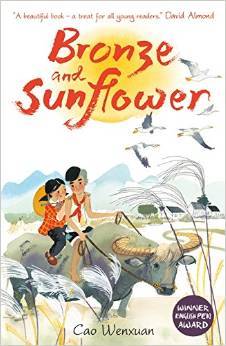
Bronze and Sunflower by Cao Wenxuan, 2017

Click to view
on Goodreads 
When Sunflower, a young city girl, moves to the countryside, she grows to love the reed marsh lands - the endlessly flowing river, the friendly buffalo with their strong backs and shiny, round heads, the sky that stretches on and on in its vastness. However, the days are long, and the little girl is lonely. Then she meets Bronze, who, unable to speak, is ostracized by the other village boys. Soon the pair are inseparable, and when Bronze's family agree to take Sunflower in, it seems that fate has brought him the sister he has always longed for. But life in Damaidi is hard, and Bronze's family can barely afford to feed themselves. Can the little city girl stay here, in this place where she has finally found happiness?
A classic, heartwarming tale set to the backdrop of the Chinese cultural revolution.

(384 pages)

I honestly have no idea how to review Bronze and Sunflower.

I don't know what it is about the book, but I just can't wrap my head around it. I'm actually a little puzzled by the ending, which is still not entirely clear to me even after I've read it a few times. I think that's a translation trouble–in fact, I think a lot of my confusion comes either from translation ambiguousness or cultural differences. Since I know nothing about the Chinese cultural revolution–or indeed about anything in Chinese history, culture, or politics–I have the overwhelming feeling that all sorts of important themes and references are passing right over my head throughout the story.

Because of that, I advise you to take my review with a grain of salt. After all, I'll be the first to admit that I am on very shaky ground here. But anyway, I did enjoy the book. It was very different from my usual fare, rather strange to my American mind (though Chinese readers might find it perfectly normal, I don't know), and very interesting. It felt like a fairytale in many parts, in large part due to its fairly unrealistic characters. Both Bronze and Sunflower seem unrealistically perfect (never squabbling, never selfish, never unpleasant). The levels of sacrifice they're willing to go through for each other makes their relationship very sweet, but also makes both of them ring false to me.

The troubles they face definitely aren't fairytale-like, though. The family is very poor, and they struggle to afford school (eventually deciding to send just Sunflower because, you know, they hadn't thought about the fact that Bronze wouldn't be able to attend school too before they invited her to stay with them). Toward the middle of the story a swarm of locusts comes through and devours everyone's crops, and people begin to starve. Things get really hard, and Wenxuan doesn't pull any punches when he describes what it's like for them.

I may have a few issues with the choices made by the adults throughout the book, but those pale in comparison to the sense of wonder I feel reading a book that was written in an entirely different language from my own, in a world and a culture entirely distinct from mine, and which has given me a peek into the world of Chinese literature. I loved diving into the world of Bronze and Sunflower for a time, as theirs was an engrossing story that provided a fascinating cultural insight for me, but now I'm ready to set it down and return to my usual fare that strikes closer to home. I'l definitely be keeping an eye out for more international novels in the future.


Disclaimer: This is an Amazon affiliate link, and I received a complimentary copy of this novel from the publisher in exchange for an honest review.

20 January 2017

Crossing the Thinnest Line by Lauren Leader-Chivée, 2016

Click to view
on Goodreads 
FROM THE VERY FOUNDING OF OUR NATION, diversity has been one of our greatest strengths but also the greatest source of conflict. In less than a generation, America will become "minority-majority," and the world economy, already interconnected, will be even more globalized. The stakes for how we handle this evolution couldn't be higher. Will diversity be a source of growth, prosperity, and progress-or perpetual division and strife?

America has the potential to realize huge gains economically and socially by more fully capitalizing on diversity, but significant challenges remain and it's a problem that all Americans should be focused on solving. Despite tremendous progress, women and minorities still face barriers to accessing the full promise of the American dream. It doesn't have to be this way. Many of the solutions are right in front of us, and many exceptional, committed Americans are doing their part to make a difference.

In the twenty-first century, nations will prosper only insofar as they embrace and celebrate the individuals, organizations, and collective efforts to advance every kind of diversity. Lauren Leader-Chivée believes America must lead the way. In CROSSING THE THINNEST LINE, she explores the state of our diverse union and shares important stories of progress and potential, highlighting those who are crossing dividing lines of race, gender, culture, and political party to build a more united and prosperous nation. Her revelations will transform the discussion and set the agenda for America's progress on these critical issues. A work of originality and ambition, CROSSING THE THINNEST LINE changes our understanding of diversity and offers lessons to change our lives and our country.

(336 pages)

Okay, first, I have to admit that I didn't read this whole thing. About halfway through I got so sick of it that I started skimming. The author claims to be striving for adversity, and she does concede that Republicans are probably people too right near the very end of the book, but most of the 300+ pages consist of her presenting one passionate argument after another for why America should follow every single left-leaning Democrat policy ever.

From the bitter way I say that, you might think that I'm a Republican. I'm not. I think of myself as being in the middle of the road, conservative about some things but liberal about others. I am not inherently opposed to diversity in any way, and in fact I do think we need more diversity in this nation. That's why I chose to review Crossing the Thinnest Line in the first place! I just got annoyed by the author's tone: she spends the entire time talking about how awesome and amazing her beliefs are, and uses the words "Republican" and "conservative" like they're slightly insulting. She interprets every single possible thing that happens to a person of color as being about race (even when they don't seem remotely related to me), and refuses to consider the fact that people who disagree with her are just as entitled to their opinions as she is to hers.

Anyway, I jotted down a few quotes that particularly struck me. Here are the ones that stuck out the most, in no particular order:
  • This might be controversial because of the media, but I had to include it: Freddie Gray. The author says that his death was purely because of race, despite the fact that Baltimore is extremely diverse and several of the policemen charged with his murder were black. As someone who lived in Baltimore for five years (including when all of that happened), I am so sick of the way people turn Freddie Gray's death into something it isn't. Police brutality is an issue here, yes. Racism? I seriously doubt it.
  • She writes "In 2013, when Republicans forced a shutdown of the US government in a standoff over the budget . . . " Right. Because a standoff between two political parties is totally only one of those parties' fault. I don't even remember the details of their conflicts, but I doubt the Democrats were innocent victims.
  • This is probably my favorite: "By some estimates, given the changing demographics of the nation, even a candidate who won 60 percent of the white male vote could not win the presidency without meaningful support from women and minorities. It's a reality that may ensure a democratic president for a generation–unless the Republican Party changes course and returns to the politically sound and morally decent tradition of inclusion that George W. Bush exemplified." Whew! First, it's kind of hilarious to think about how wrong Leader-Chivée is right here (even though Donald Trump becoming president isn't something I normally find very funny). Second, "returns to the . . . morally decent tradition of inclusion" sounds a lot to me like Leader-Chivée is calling current Republicans immoral and indecent. Yeah, very open-minded of her.
Well, great, there goes my resolve to never discuss politics on here. Blast this book for being way more political than I thought it would be! Anyway, I suppose what really grated on my nerves was that in a book all about encouraging diversity, the author constantly just focused on using her platform to push her own political agenda at the expense of all others. We need ethnic and religious diversity, sure. But we also need ideological diversity, we need people who think about the world in different ways. We need to be able to recognize that some people have morals that are different from our own, and to respect that. I don't think Leader-Chivée has much respect for anyone who isn't a flaming Democrat, which is a pity. I hope that her experience near the end of the book meeting George W. Bush (and realizing he isn't as horrible a human being as she'd thought) might help her reach across the aisle and find respect for conservative Americans.

Disclaimer: I received a complimentary copy of this book from the publisher in exchange for an honest review.

18 September 2015

Counting by 7s by Holly Goldberg Sloan, 2013

Click to view
on Goodreads 
Willow Chance is a twelve-year-old genius, obsessed with nature and diagnosing medical conditions, who finds it comforting to count by 7s. It has never been easy for her to connect with anyone other than her adoptive parents, but that hasn’t kept her from leading a quietly happy life... until now.
Suddenly Willow’s world is tragically changed when her parents both die in a car crash, leaving her alone in a baffling world. The triumph of this book is that it is not a tragedy. This extraordinarily odd, but extraordinarily endearing, girl manages to push through her grief. Her journey to find a fascinatingly diverse and fully believable surrogate family is a joy and a revelation to read.

(380 pages)

On one hand, I absolutely loved this book. Sloan has a wonderful, magical way with prose and I could just sit here quoting page after page of wonderful narration from Counting by 7s and never grow tired.

But then she sometimes randomly jumped into the heads of different people around Willow, and it was really confusing because I kept thinking a chapter was being told in someone else's POV only to realize no, wait, this is actually still Willow narrating. 

And I absolutely loved Willow for being so smart, and so clever, and so strong even with everything that's happened. She's a beautiful character because she really, truly cares about the world around her. She may be an oddball, but she's a wonderfully clever oddball, and one you can't help but love.

But I don't really like the way Willow is some sort of under-the-radar genius child, because I feel like that's getting to be a bit over-done. And the genius kid doesn't always have to be the socially inept oddball, you know? I mean, I get that it's just a story, and that it's so much more powerful because Willow is the way she is, but at the same time I can't help but wish smart kids could be portrayed as the popular kids for once.

And I love how Counting by 7s feels kind of random, the way everything at the beginning seems so out-of-the-blue and how there are so many random people drawn into Willow's life and how she becomes the lynch-pin that holds all of them together, when normally they wouldn't have even met in the first place. Sometimes life really is that random, and it's beautiful watching the way events unfold.

But - you guessed it - I didn't really like how random it was. For example, what exactly was the point of the scene with Willow's parents, where we discover why her dad forgot to check the intersection before going forward? I can understand if Willow was going to discover the information that we learn there, and maybe it helped her come to grips with things or made her come to some profound realization about the meaning of life. As it was, I just didn't get the point.

Or what about the taxi driver? I love him, and he seems really nice, and I liked the whole side-plot about all the ways Willow helped him. But then he also seemed a little superfluous, because we already had Dell to fill the role of male screw-up needing Willow's help. And I didn't quite understand the choice to bring Dell into the story, and make him so important, and then make Jairo (the taxi driver) suddenly also important in the end.

As for the big announcement a certain someone makes at the end? Come on! That is a) so incredibly unrealistic and b) just sad. So sad. I feel so bad for some certain people, whose mother so obviously didn't pay attention to their feelings at all.

But anyway, despite all of my griping Counting by 7s is still a gorgeous book. When the prose is that beautiful, I simply can't help but enjoy the book. There are some very touching themes running throughout the novel, and I loved the way Willow turns facts about her plants into lessons about life. I am sure I'll be re-reading Counting by 7s in the future, and that I'll pull even more from it, but I just had a few too many bones to pick to be completely satisfied.

21 July 2015

Top Nine Books That Feature Diversity

Okay, this week's prompt is a tricky one for me. I don't really think about diversity in my books, or at least I don't proactively go "I am looking for diversity." I just read what I read, and don't really think about whether specific books are "diverse" or not, so I'm not really sure about the criteria for identifying books as diverse. If any of the books on my list don't count as diverse, let me know in the comments section and I'll switch them out.

1. The Heroes of Olympus series by Rick Riordan
This one is easy. Riordan inserted diversity into the Percy Jackson universe with the subtlety of a sledgehammer when he devised this series. There are three girls and four boys. The races are: three caucasians, one Native American, one African American, one Chinese Canadian, and one Hispanic. One character (not part of the main seven) is gay. The whole series basically revolves around resolving differences between two "types" of demigods (Greek and Roman). It's all wonderfully diverse, and only sort of makes me dizzy.

2. All Fall Down by Ally Carter (my review)
Diversity is certainly not the focus of this great book about the granddaughter of an ambassador, but it's still ever-present on "Embassy Row," where people from dozens of different countries live side by side in their embassies. Grace's friends range from Russian to Israeli, just because all of her neighbors happy to be the kids/grandkids of ambassadors from other countries.

3. The War That Saved My Life by Kimberly Brubaker Bradley (my review)
This isn't a book about racial diversity, but instead focuses on a girl with a clubfoot. She has spent her entire life living in a single room under the tyranny of her abusive mother, and the onset of World War II spells salvation for her as she flees to a world so completely different from her own.

4. Absolutely Almost by Lisa Graff (my review)
There aren't many books written about below-average kids, so I think this can count as diversity. The main character provides a very different sort of "hero" than the usual super-talented smart kid.

5. Full Ride by Margaret Peterson Haddix (my review)
Again, diversity really isn't the focus of this amazing book. But it still plays a role, as Becca becomes friends with a group of kids from very diverse backgrounds/races and struggles in school. I think their varying identities help her to become comfortable with her own identity, even as she struggles to hide her past from them.

6. The Princess and the Foal by Stacy Gregg (my review)
This is a book about a Middle-Eastern princess, so I think diversity can be assumed. It doesn't deal directly with "diversity" per se, but the entire book paints the picture of a life very, very different from our American ones.

7. Ungifted by Gordon Korman (my review)
I can't even remember if there are any minority races in Ungifted, but I do know that the entire book is about a school for smart kids, where an average kid accidentally becomes enrolled. Donovan teaches his classmates lessons about living life off the academic path, and the contrast between "gifted" and "ungifted" is a good showing of diversity. Right? I don't know if I'm reaching a little too far here . . .

8. Wonderstruck by Brian Selznick
This is a gorgeous book, by the way! The main character loses his hearing in a thunderstorm when he gets struck by lightning, so it's told partly in pictures. The whole book revolves around being deaf, and I'd say that's pretty diverse.

9. The Septimus Heap series by Angie Sage
This seven-book series isn't really about diversity . . . but then, it also is. Some of Septimus's siblings go through some pretty wild periods, and their parents never, ever give up on them. Even when Simon goes evil, and the four middle boys go live in the Forest for like two years, and Jenna turns out to be the heir to the throne, they never for a moment pause to question why they still sacrifice everything for their kids. This sort of love and devotion is what should be at the core of diversity, I believe, because true diversity is simply loving others regardless of what they've done or how they look.

Whew, done! What do you think? Do you actively seek out books that feature diversity?