Showing posts with label WW2. Show all posts

25 January 2019

Secret Soldiers: How the U.S. Twenty-Third Special Troops Fooled the Nazis by Paul B. Janeczko, 2019

Click to view
on Goodreads 
What do set design, sound effects, and showmanship have to do with winning World War II? Meet the Ghost Army that played a surprising role in helping to deceive -- and defeat -- the Nazis.

In his third book about deception during war, Paul B. Janeczko focuses his lens on World War II and the operations carried out by the Twenty-Third Headquarters Special Troops, aka the Ghost Army. This remarkable unit included actors, camouflage experts, sound engineers, painters, and set designers who used their skills to secretly and systematically replace fighting units -- fooling the Nazi army into believing what their eyes and ears told them, even though the sights and sounds of tanks and war machines and troops were entirely fabricated. Follow the Twenty-Third into Europe as they play a dangerous game of enticing the German army into making battlefield mistakes by using sonic deceptions, inflatable tanks, pyrotechnics, and camouflage in more than twenty operations. From the Normandy invasion to the crossing of the Rhine River, the men of the Ghost Army -- several of whom went on to become famous artists and designers after the war -- played an improbable role in the Allied victory.

(304 pages)

Okay, this is actually really funny. When I read Secret Soldiers, I made a mental note to mention another book that I read for review last year which was what first taught me about the role of deception in wars, including World War II. I just looked it back up, and it's called Double Cross: Deception Techniques in War (here's my review).

The funny part? It was also written by Janeczko! The man clearly has a focused passion for deception tactics in combat, which is a strangely specific topic, but I said in my review of Double Cross that I learned a lot from reading it and enjoyed myself in the process and I would say that holds roughly true for Secret Soldiers as well.

It was a bit harder to keep track of all the moving parts since the Twenty-Third was split into several smaller groups that specialized in different parts of the deception (building the dummies, playing the audio sounds, etc.). It almost became a bit tedious at times, too, since several of their missions basically consisted of showing up, getting all set up, and then leaving pretty soon afterwards. And then, because of miscommunication with the regular soldiers they were working with, they were often not deployed where they could be the most helpful so all of their efforts may or may not have actually done anything.

There were certainly some times when they definitely made a difference, though, and it was cooler to learn about those. And I appreciated Janeczko's thoroughness, for the sake of a complete history book, even if it didn't all thrill me.

He does a good job of including details about all the people in the Twenty-Third. There were so many people who would go on to be famous artists, or actors, and he gives many of them their own inserts so we get to learn their unique stories alongside the story of the "Ghost Army" as a mass.

All in all, this is a well-researched and cohesive book that will be perfect for some readers, and perhaps a bit dry for others. If you're at all interested in the Ghost Army, though, then this is definitely a great place to start.

Disclaimer: I received a complimentary copy of this book from the publisher in exchange for an honest review.

12 October 2018

Voices from the Second World War from Candlewick Press, 2018

Click to view
on Goodreads 
In an intergenerational keepsake volume, witnesses to World War II share their memories with young interviewers so that their experiences will never be forgotten.

The Second World War was the most devastating war in history. Up to eighty million people died, and the map of the world was redrawn. More than seventy years after peace was declared, children interviewed family and community members to learn about the war from people who were there, to record their memories before they were lost forever. Now, in a unique collection, RAF pilots, evacuees, resistance fighters, Land Girls, U.S. Navy sailors, and survivors of the Holocaust and the Hiroshima bombing all tell their stories, passing on the lessons learned to a new generation. Featuring many vintage photographs, this moving volume also offers an index of contributors and a glossary.

(320 pages)

I both really loved this book and also didn't really like it.

I really love what it's doing. It takes the stories of people alive during WWII and records them in a format that is accessible for children (though perhaps sometimes a bit too heavy for them, for obvious reasons), saving them for posterity. There are stories from all different angles, from people who were soldiers during the war and people who were children, Jews and Germans and Poles and Brits and Americans and more telling their individual slivers of the grand narrative of the war.

On the other hand, I didn't really like it in parts because some of the stories–especially toward the beginning–were kind of boring: basically, "I was evacuated and lived on a farm for a while." Plus there was clearly some strong editing done, because most of the narratives were told in the same way, even though they came from vastly different people and were recorded in the first-person narrative.

I flipped forward after a while, and once we get into the later parts of the war and its end, then the really impactful stories begin. There are stories from several Jewish children who survived death camps, or whose parents went into them. There are pictures of the people back then, too, which made the stories so much more real. The one that is absolutely most shattering is a two-page spread of Hungarian Jews fresh off the cattle trucks at Auschwitz-Birkenau, waiting to be sorted. The caption informs us that only the strong were spared from being immediately sent to the gas chambers, and it's a thousand times more horrifying than just reading the fact because you can look into the faces of all these people about to be murdered.

It's - it's pretty hard, to be honest. Some of the material in this book is extremely horrifying and depressing. Add in a little bit of bad language (mainly a couple of "hell"s) and this is definitely not a book you should be handing off to your young children any time soon. But it is a pretty good collection of stories from across the war, tied together with explanations of the historical context, and I think it is important that we carry these stories with us into the future generations.

Disclaimer: I received a complimentary copy of this book in exchange for an honest review.

28 September 2018

The Length of a String by Elissa Brent Weissman, 2018

Click to view
on Goodreads 
Imani knows exactly what she wants as her big bat mitzvah gift: to meet her birthparents. She loves her family and her Jewish community in Baltimore, but she has always wondered where she came from, especially since she's black and almost everyone she knows is white. When her mom's grandmother--Imani's great-grandma Anna--passes away, Imani discovers an old diary among her books. It's Anna's diary from 1941, the year she was twelve--the year she fled Nazi-occupied Luxembourg alone, sent by her parents to seek refuge in Brooklyn. Written as a series of letters to the twin sister she had to leave behind, Anna's diary records her journey to America and her new life with an adopted family. Anna's diary and Imani's birthparent search intertwine to tell the story of two girls, each searching for family and identity in her own time and in her own way.
(384 pages)

I loved it.

There's no point beating around the bush. I really, really enjoyed reading this book. I love reading about Imani's struggles to fit in as a black adoptee in a white Jewish neighborhood. I love how Weissman portrayed Imani's thirst for knowledge about her birth family, while still loving her adoptive family more than anything. I love that her little brother is also adopted but has no interest in his birth parents, which represents the diversity in outlooks of adoptees.

Anna's story is a lot less fun to read than Imani's in places, but it was just as well done. Her story was similar to many other WWII refugee books I've read over the years, but there were enough details–such as the coat piecing plant, where Anna comes to help her foster father and the stingy uncles.

The uncles themselves were a great addition to the story, because they were both horrible and pathetic. I love nuance in a children's book. The details about Anna's family and her relationship with her siblings (especially her identical twin Belle) were both wonderfully done and incredibly sad. Watching her unravel her parents' thought process as they chose which of their children to send to safety was especially heartbreaking. So was seeing Anna's struggle to balance her love for America with her homesickness and, later, her sorrow for what European Jews were being subjected to.

It was kind of cool to be learning Anna's story alongside Amani, as Amani read each entry in her great-grandmother's diary and reacted emotionally to each new development. When there was information we readers needed that wasn't available from Anna's diary perspective, Amani would Google a topic or ask an older family member to get the answer. It was a smart storytelling technique, a story within a story, and I kind of wish more books did it.

Having made it very clear that there was a lot I liked about The Length of a String, I should add a few negatives. Anna's story is an interesting one but, as I said before, I've read a lot of WWII refugee books. Without Amani's story and reactions to reading her diary, I probably would have been a little less absorbed with it. Also, I felt like Amani was pretty selfish, digging into her adoption against her mother's express wishes. I would have preferred if she had been brave enough to convince her parents before she started searching, rather than reacting after she was caught. But then, she's only twelve and she has her heart set on finding her biological roots. It makes sense that her decision-making process isn't quite as mature as it could have been. Anyway, I really loved how that storyline was concluded.

All in all, this is just such a nice, solid, thought-provoking read which I very much enjoyed. If you like the looks of the description, then you probably will enjoy it, too!

Disclaimer: I received a complimentary copy of this book in exchange for an honest review.

31 August 2018

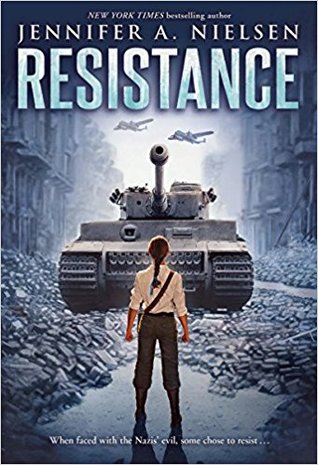
Resistance by Jennifer A. Nielsen, 2018

Click to view
on Goodreads 
Chaya Lindner is a teenager living in Nazi-occupied Poland. Simply being Jewish places her in danger of being killed or sent to the camps. After her little sister is taken away, her younger brother disappears, and her parents all but give up hope, Chaya is determined to make a difference. Using forged papers and her fair features, Chaya becomes a courier and travels between the Jewish ghettos of Poland, smuggling food, papers, and even people.

Soon Chaya joins a resistance cell that runs raids on the Nazis' supplies. But after a mission goes terribly wrong, Chaya's network shatters. She is alone and unsure of where to go, until Esther, a member of her cell, finds her and delivers a message that chills Chaya to her core, and sends her on a journey toward an even larger uprising in the works -- in the Warsaw Ghetto.

Though the Jewish resistance never had much of a chance against the Nazis, they were determined to save as many lives as possible, and to live -- or die -- with honor.

(400 pages)

Wow.

Just, wow. I mean, I've been a fan of Nielsen's for ages, and I adored her East Berlin book A Night Divided, so I knew going in that I was going to love Resistance. But I had no idea how blown away by it I was going to be.

World War II is pretty well-trodden ground by this point, but Nielsen still managed to find an aspect–the Jewish resistance movement–that I didn't know anything about. I never knew that the Jews worked so hard to organize themselves and fight against the Nazis, but they did. They were incredibly brave, risking their lives every day to undermine the war effort, warn the people imprisoned in ghettos about the death camps, and smuggle some out into safe houses.

Chava and her fellow fighters know from day one that they will most likely die for their cause, but they know that they will face death no matter what they do–they want to use their lives to do the most good before they are killed, either for fighting or for being Jewish. It's a horrible situation, the ultimate "rock and a hard place" dilemma, and they are beyond brave for choosing to do what they can to help.

I love how Nielsen doesn't just leave it at that, though. Over the course of Chaya and Esther's journey, they meet lots of different people from all walks of life and religion. They meet some Poles who ignore them, others who attack them for being Jewish, and still others who risk life and limb to help them. They meet some Jews who refuse to fight back out of fear, and some who don't fight out of disbelief, but also some who won't fight because their faith forbids murder–so they fight for the Jewish religion by not taking up arms. Nielsen's focus on these moral nuances, on portraying the various ways people responded to the Nazis without judging them, is a great strength throughout the book.

I realize I haven't really discussed the main characters much yet. It's hard to focus on them when there are so many incredible details about history to pull from Resistance's pages, but Chava is the perfect core to the book. She doesn't see herself as a hero, and she doesn't romanticize anything. She is a very pragmatic person, treating herself almost like an object and calculating how best to use herself for the good of the Jews and downfall of the Nazis. Her initial impatience with/distaste for Esther is completely reasonable, since the younger girl really is pretty useless, but I loved watching them come to understand and respect each other as the story went on. I rooted for both of them, as well as for their cause, though I knew the story couldn't possibly have a picture-perfect happy ending.

I wouldn't recommend Resistance for very young readers, just because the vast majority of the characters in this book either die or expect themselves to die at any moment (and the climax, which is masterfully done by the way, is set in the Warsaw Ghetto during a doomed revolt). There's no bad language or graphic descriptions of the gruesome scenes Chava encounters, though, so as far as books about Polish Jews during WWII goes, this is about as "clean" as it's going to get.

I'm sure it's no surprise when I say that I highly recommend Resistance. I try to always list pros and cons in my reviews, but I literally don't have any cons for this one. It's a wonderfully well-written book, and it gives proper due to the incredible men and women who fought for their people. I hope many children read Resistance and learn the story of these heroes.

Disclaimer: I received a complimentary copy of this novel from the publisher in exchange for an honest review.