 |
| Click to view on Goodreads |
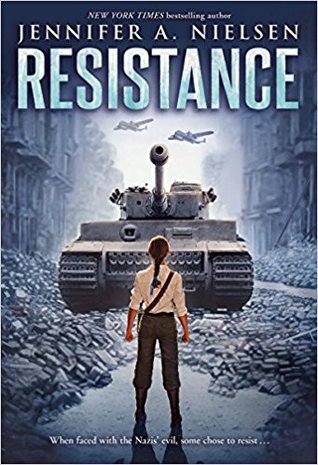
Soon Chaya joins a resistance cell that runs raids on the Nazis' supplies. But after a mission goes terribly wrong, Chaya's network shatters. She is alone and unsure of where to go, until Esther, a member of her cell, finds her and delivers a message that chills Chaya to her core, and sends her on a journey toward an even larger uprising in the works -- in the Warsaw Ghetto.
Though the Jewish resistance never had much of a chance against the Nazis, they were determined to save as many lives as possible, and to live -- or die -- with honor.
(400 pages)
Wow.
Just, wow. I mean, I've been a fan of Nielsen's for ages, and I adored her East Berlin book A Night Divided, so I knew going in that I was going to love Resistance. But I had no idea how blown away by it I was going to be.
World War II is pretty well-trodden ground by this point, but Nielsen still managed to find an aspect–the Jewish resistance movement–that I didn't know anything about. I never knew that the Jews worked so hard to organize themselves and fight against the Nazis, but they did. They were incredibly brave, risking their lives every day to undermine the war effort, warn the people imprisoned in ghettos about the death camps, and smuggle some out into safe houses.
Chava and her fellow fighters know from day one that they will most likely die for their cause, but they know that they will face death no matter what they do–they want to use their lives to do the most good before they are killed, either for fighting or for being Jewish. It's a horrible situation, the ultimate "rock and a hard place" dilemma, and they are beyond brave for choosing to do what they can to help.
I love how Nielsen doesn't just leave it at that, though. Over the course of Chaya and Esther's journey, they meet lots of different people from all walks of life and religion. They meet some Poles who ignore them, others who attack them for being Jewish, and still others who risk life and limb to help them. They meet some Jews who refuse to fight back out of fear, and some who don't fight out of disbelief, but also some who won't fight because their faith forbids murder–so they fight for the Jewish religion by not taking up arms. Nielsen's focus on these moral nuances, on portraying the various ways people responded to the Nazis without judging them, is a great strength throughout the book.
I realize I haven't really discussed the main characters much yet. It's hard to focus on them when there are so many incredible details about history to pull from Resistance's pages, but Chava is the perfect core to the book. She doesn't see herself as a hero, and she doesn't romanticize anything. She is a very pragmatic person, treating herself almost like an object and calculating how best to use herself for the good of the Jews and downfall of the Nazis. Her initial impatience with/distaste for Esther is completely reasonable, since the younger girl really is pretty useless, but I loved watching them come to understand and respect each other as the story went on. I rooted for both of them, as well as for their cause, though I knew the story couldn't possibly have a picture-perfect happy ending.
I wouldn't recommend Resistance for very young readers, just because the vast majority of the characters in this book either die or expect themselves to die at any moment (and the climax, which is masterfully done by the way, is set in the Warsaw Ghetto during a doomed revolt). There's no bad language or graphic descriptions of the gruesome scenes Chava encounters, though, so as far as books about Polish Jews during WWII goes, this is about as "clean" as it's going to get.
I'm sure it's no surprise when I say that I highly recommend Resistance. I try to always list pros and cons in my reviews, but I literally don't have any cons for this one. It's a wonderfully well-written book, and it gives proper due to the incredible men and women who fought for their people. I hope many children read Resistance and learn the story of these heroes.
Disclaimer: I received a complimentary copy of this novel from the publisher in exchange for an honest review.