Showing posts with label adoption. Show all posts

28 September 2018

The Length of a String by Elissa Brent Weissman, 2018

Click to view
on Goodreads 
Imani knows exactly what she wants as her big bat mitzvah gift: to meet her birthparents. She loves her family and her Jewish community in Baltimore, but she has always wondered where she came from, especially since she's black and almost everyone she knows is white. When her mom's grandmother--Imani's great-grandma Anna--passes away, Imani discovers an old diary among her books. It's Anna's diary from 1941, the year she was twelve--the year she fled Nazi-occupied Luxembourg alone, sent by her parents to seek refuge in Brooklyn. Written as a series of letters to the twin sister she had to leave behind, Anna's diary records her journey to America and her new life with an adopted family. Anna's diary and Imani's birthparent search intertwine to tell the story of two girls, each searching for family and identity in her own time and in her own way.
(384 pages)

I loved it.

There's no point beating around the bush. I really, really enjoyed reading this book. I love reading about Imani's struggles to fit in as a black adoptee in a white Jewish neighborhood. I love how Weissman portrayed Imani's thirst for knowledge about her birth family, while still loving her adoptive family more than anything. I love that her little brother is also adopted but has no interest in his birth parents, which represents the diversity in outlooks of adoptees.

Anna's story is a lot less fun to read than Imani's in places, but it was just as well done. Her story was similar to many other WWII refugee books I've read over the years, but there were enough details–such as the coat piecing plant, where Anna comes to help her foster father and the stingy uncles.

The uncles themselves were a great addition to the story, because they were both horrible and pathetic. I love nuance in a children's book. The details about Anna's family and her relationship with her siblings (especially her identical twin Belle) were both wonderfully done and incredibly sad. Watching her unravel her parents' thought process as they chose which of their children to send to safety was especially heartbreaking. So was seeing Anna's struggle to balance her love for America with her homesickness and, later, her sorrow for what European Jews were being subjected to.

It was kind of cool to be learning Anna's story alongside Amani, as Amani read each entry in her great-grandmother's diary and reacted emotionally to each new development. When there was information we readers needed that wasn't available from Anna's diary perspective, Amani would Google a topic or ask an older family member to get the answer. It was a smart storytelling technique, a story within a story, and I kind of wish more books did it.

Having made it very clear that there was a lot I liked about The Length of a String, I should add a few negatives. Anna's story is an interesting one but, as I said before, I've read a lot of WWII refugee books. Without Amani's story and reactions to reading her diary, I probably would have been a little less absorbed with it. Also, I felt like Amani was pretty selfish, digging into her adoption against her mother's express wishes. I would have preferred if she had been brave enough to convince her parents before she started searching, rather than reacting after she was caught. But then, she's only twelve and she has her heart set on finding her biological roots. It makes sense that her decision-making process isn't quite as mature as it could have been. Anyway, I really loved how that storyline was concluded.

All in all, this is just such a nice, solid, thought-provoking read which I very much enjoyed. If you like the looks of the description, then you probably will enjoy it, too!

Disclaimer: I received a complimentary copy of this book in exchange for an honest review.

09 April 2018

Ghosts of Greenglass House by Kate Milford, 2017

Warning: this is the sequel to Greenglass House. Do not read ahead unless you're okay with major spoilers from the first book!

Click to view
on Goodreads 
Welcome back to the irresistible world of Greenglass House where thirteen-year-old Milo is, once again, spending the winter holidays stuck in a house full of strange guests who are not what they seem. There are fresh clues to uncover as friends old and new join in his search for a mysterious map and a famous smuggler’s lost haul.
(464 pages)

When I reviewed Greenglass House about three years ago,  I wrote that it was a cozy and nice read that I enjoyed, even when some of the plot twists were a tad creepy. Now that I'm here reviewing the second one, and have had quite a bit of time to process the first one, I want to start out by saying that the fact that Meddie is a ghost added a whole layer of ambiance and character to the story that really enhanced it as a whole.

Ghosts of Greenglass House exploits this a bit with its title, I think, since while there are ghosts in Ghosts in Greenglass House that is just one storyline among many. throughout the book. I don't mind too much, though, because it does match the quirky style of the book.

Anyway, I really enjoyed reading this book. There's just something really cozy about reading a 450-page thick book set in a rambling old mansion trapped full of secretive characters, you know? It's largely a character-driven book, rather than being plot-focused like most books I read, and I enjoyed coming along for the ride rather than just rushing toward a climax. The ambiance in these books is awesome.

I don't think it's quite as good as its prequel, though, so I should touch on the negatives. First, it took me quite a bit longer to care about the new guests this time around. I came to be very interested in a couple of them, but I got many of the rest mixed up in my head even through to the end, which kind of muddled the conclusion. There may have been just a few too many characters in the story this time around.

Also, I wrote in my review of Greenglass House that I really appreciated reading about Milo's experience struggling with his identity after being adopted from China by white parents as a baby. Ghosts of Greenglass House continues to deal with his adoption, but it does it in a very different way: basically, when it comes up several times throughout the book, it focuses on Milo's attempts to learn more about Chinese culture, his hurt feelings due to some missteps by his schoolteacher, and his annoyance that people always make assumptions or ask rude questions when they first meet him and see him with his parents. I do appreciate that these are all valid topics to cover, and as a white person I am the first to admit that this is not really my area, but I have to say that Milford's treatment of Milo's experience felt extremely preachy and kind of nit-picky. She basically just uses him to teach the audience how really small comments can still hurt people, which is a good point, but I also think that Milo's reaction to some minor comments seem way out of proportion to their intent.

I think my biggest gripe is with the way his parents handle things: rather than really taking him by the hand and helping him, they offer to talk about it once or twice and then completely abandon him with something that has obviously been really bothering him. I think they're meant to be good parents because they recognize that they are inexperienced in racial issues since they're white, but really: they are his parents. If something is hurting him, it's their job to either fix the situation or help him cope with it and move past it.

Anyway, I really enjoyed reading Ghosts of Greenglass House as a nice, lazy, relaxing read. It's a tad more convoluted than the first one, a tad less enjoyable, and in parts does feel like a rehash of its prequel, but Ghosts of Greenglass House was such a lovely read that it can afford to be a bit diminished and still be a very pleasurable read. If you read an enjoyed Greenglass House, then I recommend you give Ghosts of Greenglass House a try!

26 June 2017

Call Me Sunflower by Miriam Spitzer Franklin, 2017

Click to view
on Goodreads 
Sunny Beringer hates her first name—her real first name—Sunflower. And she hates that her mom has suddenly left behind her dad, Scott, and uprooted their family miles away from New Jersey to North Carolina just so she can pursue some fancy degree. Sunny has to live with a grandmother she barely knows, and she’s had to leave her beloved cat and all her friends behind. And no one else seems to think anything is wrong.

So she creates “Sunny Beringer’s Totally Awesome Plan for Romance”—a list of sure-fire ways to make her mom and Scott fall madly in love again, including:

Send Mom flowers from a “Secret Admirer” to make Scott jealous and make him regret letting them move so far away.
Make a playlist of Scott’s favorite love songs—the mushier the better—and make sure it’s always playing in the car.
Ask them about the good old days when they first fell in love.
But while working on a photo album guaranteed to make Mom change her mind and rush them right back home, Sunny discovers a photo—one that changes everything.

Sunny’s family, the people she thought she could trust most in the world, have been keeping an enormous secret from her. And she’ll have to reconcile her family’s past and present, or she’ll lose everything about their future.

(256 pages)

Call Me Sunflower is a rather . . . odd book. I guess that's a good thing, but I think it doesn't quite hit the mark with me.

For one thing, I'm rather horrified that Sunny's parents kept her so in the dark about her past and their present relationship. No one should be that clueless and uncertain about their family dynamics, and her mother has done both Sunny and her sister a huge disservice by keeping everything murky. Also, this whole idea of a fractured family that was never truly together (where the mom adopted a baby and the dad agreed to act as the father to a kid he had no direct ties to) seemed really odd. Sunny's mother and the father should have either married and adopted together, or should have gone their separate ways altogether.

I don't know, I just feel like the whole dynamic was really weird. Don't get me wrong here, I have no issue with a single mother adopting babies–in fact, a friend of mine and her sister were both adopted as babies by a single mother! It's really the father figure role that doesn't quite add up for me. Besides that, I also thought the way the relationship between Sunny and her grandmother played out was a little strange (and the plotline surrounding her grandmother's fur store was especially forced). I did like her interactions in school, which were slightly along the beaten path of middle school drama but which nevertheless rang true. The increasingly-distant emails between Sunny and her best friend Madeline from her old hometown felt especially real to me, as someone who has exchanged more than her fair share of those moving-away conversations over the years.

To be honest, I think that this particular type of quirky story is going to sit really well with some readers and just not be quite right for others. I fall into the latter category, but you might be in the former; if you do decide to give Call Me Sunflower a try, let us know in the comments section what you think of it!


Disclaimer: I received a complimentary copy of this novel from the publisher in exchange for an honest review.

27 November 2015

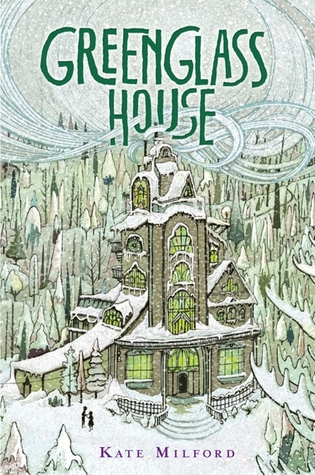
Greenglass House by Kate Milford, 2014

Click to view
on Goodreads 
A rambling old inn, a strange map, an attic packed with treasures, squabbling guests, theft, friendship, and an unusual haunting mark this smart middle grade mystery in the tradition of the Mysterious Benedict Society books and Blue Balliet's Chasing Vermeer series.
It's wintertime at Greenglass House. The creaky smuggler's inn is always quiet during this season, and twelve-year-old Milo, the innkeepers' adopted son, plans to spend his holidays relaxing. But on the first icy night of vacation, out of nowhere, the guest bell rings. Then rings again. And again. Soon Milo's home is bursting with odd, secretive guests, each one bearing a strange story that is somehow connected to the rambling old house. As objects go missing and tempers flare, Milo and Meddy, the cook's daughter, must decipher clues and untangle the web of deepening mysteries to discover the truth about Greenglass House-and themselves.


(384 pages)

I remember when this first came out last year, when everyone was talking about it. I thought it looked really good, and told myself I'd read it someday, and then promptly forgot about it. Two weeks ago I was reading through my Goodreads TBR list and thought to myself, "I should totally read this!"

And then I forgot again.

And then my mom went to the library without me, and she brought home one random book that she'd pulled off the MG bookshelves for me. And you know what book it was? This one. It was Greenglass House, the book I'd just forgotten about for the second time. Some coincidence, huh? Well, I'm glad things worked out for me to read Greenglass House, because it's definitely an interesting gem of a book.

It's got that cozy, closed-in feeling that only comes from a book set during a massive snow-storm. Then it's got all those layers of mysteries and hidden motives, which reminded me a lot of an Agatha Christie novel. Then there was a layer of history tied throughout the novel, tying it back to events from throughout the house's past, which was pretty cool.

The big reveals, on the whole, were pretty original and interesting (though maybe not completely believable), and I was completely shocked by the big twist at the end. At the same time I really liked it - and was way impressed with Milford for barely making me suspect anything! - and was kind of weirded out by it. I can't really say anything else about that without spoiling it, though. A few of the smaller reveals, the ones about the characters, did feel a little bit contrived, but I just took them with a grain of salt. It's the sort of book where you can just kind of roll with things, accepting everything that comes. Fact and fiction and fantasy all sort of blend together until you're picking through and figuring out what's real and what's lies - and what is and isn't possible inside the novel's universe.

I really liked that Milo was struggling with being adopted. Too often I read about orphans or foundlings or castaways; here I got the opportunity to read about a boy who has loving parents, and is really just struggling like any kid to find his place in the world. Reading the author's note in the end, it was pretty cool to read about how she and her husband are in the process of adopting a child from China. It's clear that Milford was using Greenglass House to depict the message she wants to send to her future son or daughter: that it's okay to wonder about your birth family, that it's natural to yearn for your own heritage, and that you can daydream about having a family tree that stretches back farther than one generation without being disloyal to your adoptive parents. If I was adopted, I would get a lot out of Greenglass House - though I might not like it very much. People don't usually like books that hit too close to home.

Do I recommend Greenglass House? I think so. It's a little strange, though, and I'm still not sure what I think about the plot-twist-which-I-cannot-reveal. It's kind of creepy, and changes the tone of the entire story in hindsight. The book's an odd little gem, though, and despite its flaws I'm glad I read it.

Also, now I really want to look up the game Odd Trails, which Meddy and Milo play throughout the game. Does anyone know if this is a real thing?

09 March 2015

Why Me? by Deborah Kent, 1992

Click to
view on Goodreads
Rachel wakes up one morning to find her world has been smashed to smithereens. Her whole body feels heavy and painful, and she can barely sit up. Rushed to the hospital, she learns that she has a kidney diseases. Rachel will have to be on dialysis for the rest of her life . . . or until an organ donor can be found. 
The doctors tell Rachel that the best donor would be a blood relative. But she is adopted, and knows nothing about her biological mother. All Rachel can think is, "Why did this have to happen to me?"
As she struggles to live with her illness, Rachel must also handle the emotional ups and downs of trying to find her birth mother. Will they be able to locate her? What will she be like? And will she agree to give Rachel what she needs - a second chance for life?
(184 pages)


This was a book I picked up for free at a book swap. The plot - about a medical and identity crisis rolled together - appealed to me, and I hoped it would be as good as it sounded. The short version of this review: it was.

Poor Rachel's life becomes a living hell when she suffers kidney failure and goes on dialysis. She quits ballet, the love of her life, and feels sluggish and snappy. She deals with her body's "betrayal" (as she puts it) very realistically, with tears and anger. She grows over the course of the book as she realizes that she must accept the fact that her life will never be the same. She also must come to grips with her birth mother's identity and reason for giving her up. This struggle also is extremely realistic, and I thought it was very well done.

The only flaw I can find with the book is its pacing: apparently it spans about a year of Rachel's life, starting with when her kidneys fail, but it doesn't feel like it. In fact, time seems to pass rather sporadically with detailed scenes intermingled with statements to the effect of "time passed." The passage of time is a recurring theme throughout the book, as the process of finding Rachel's birth mother takes a really long time. However, this didn't really work for me as sufficient proof: from Rachel's character growth, you would think that only a few months at most have passed.

I would highly recommend this book to anyone interested in what it's like to live after a kidney failure: the food restrictions, the dialysis, the sluggishness, etc. It's also a great story about identity and the difference between biological and adoptive family. It's perfectly fine for younger readers, so you can be comfortable handing this book to anyone whose reading comprehension is up to it. I'm very glad I found this little treasure; it gave me an up-close view of what it's like to suffer kidney failure. I just hope it's the closest look I'll ever get!