Showing posts with label world war 2. Show all posts

12 October 2018

Voices from the Second World War from Candlewick Press, 2018

Click to view
on Goodreads 
In an intergenerational keepsake volume, witnesses to World War II share their memories with young interviewers so that their experiences will never be forgotten.

The Second World War was the most devastating war in history. Up to eighty million people died, and the map of the world was redrawn. More than seventy years after peace was declared, children interviewed family and community members to learn about the war from people who were there, to record their memories before they were lost forever. Now, in a unique collection, RAF pilots, evacuees, resistance fighters, Land Girls, U.S. Navy sailors, and survivors of the Holocaust and the Hiroshima bombing all tell their stories, passing on the lessons learned to a new generation. Featuring many vintage photographs, this moving volume also offers an index of contributors and a glossary.

(320 pages)

I both really loved this book and also didn't really like it.

I really love what it's doing. It takes the stories of people alive during WWII and records them in a format that is accessible for children (though perhaps sometimes a bit too heavy for them, for obvious reasons), saving them for posterity. There are stories from all different angles, from people who were soldiers during the war and people who were children, Jews and Germans and Poles and Brits and Americans and more telling their individual slivers of the grand narrative of the war.

On the other hand, I didn't really like it in parts because some of the stories–especially toward the beginning–were kind of boring: basically, "I was evacuated and lived on a farm for a while." Plus there was clearly some strong editing done, because most of the narratives were told in the same way, even though they came from vastly different people and were recorded in the first-person narrative.

I flipped forward after a while, and once we get into the later parts of the war and its end, then the really impactful stories begin. There are stories from several Jewish children who survived death camps, or whose parents went into them. There are pictures of the people back then, too, which made the stories so much more real. The one that is absolutely most shattering is a two-page spread of Hungarian Jews fresh off the cattle trucks at Auschwitz-Birkenau, waiting to be sorted. The caption informs us that only the strong were spared from being immediately sent to the gas chambers, and it's a thousand times more horrifying than just reading the fact because you can look into the faces of all these people about to be murdered.

It's - it's pretty hard, to be honest. Some of the material in this book is extremely horrifying and depressing. Add in a little bit of bad language (mainly a couple of "hell"s) and this is definitely not a book you should be handing off to your young children any time soon. But it is a pretty good collection of stories from across the war, tied together with explanations of the historical context, and I think it is important that we carry these stories with us into the future generations.

Disclaimer: I received a complimentary copy of this book in exchange for an honest review.

28 September 2018

The Length of a String by Elissa Brent Weissman, 2018

Click to view
on Goodreads 
Imani knows exactly what she wants as her big bat mitzvah gift: to meet her birthparents. She loves her family and her Jewish community in Baltimore, but she has always wondered where she came from, especially since she's black and almost everyone she knows is white. When her mom's grandmother--Imani's great-grandma Anna--passes away, Imani discovers an old diary among her books. It's Anna's diary from 1941, the year she was twelve--the year she fled Nazi-occupied Luxembourg alone, sent by her parents to seek refuge in Brooklyn. Written as a series of letters to the twin sister she had to leave behind, Anna's diary records her journey to America and her new life with an adopted family. Anna's diary and Imani's birthparent search intertwine to tell the story of two girls, each searching for family and identity in her own time and in her own way.
(384 pages)

I loved it.

There's no point beating around the bush. I really, really enjoyed reading this book. I love reading about Imani's struggles to fit in as a black adoptee in a white Jewish neighborhood. I love how Weissman portrayed Imani's thirst for knowledge about her birth family, while still loving her adoptive family more than anything. I love that her little brother is also adopted but has no interest in his birth parents, which represents the diversity in outlooks of adoptees.

Anna's story is a lot less fun to read than Imani's in places, but it was just as well done. Her story was similar to many other WWII refugee books I've read over the years, but there were enough details–such as the coat piecing plant, where Anna comes to help her foster father and the stingy uncles.

The uncles themselves were a great addition to the story, because they were both horrible and pathetic. I love nuance in a children's book. The details about Anna's family and her relationship with her siblings (especially her identical twin Belle) were both wonderfully done and incredibly sad. Watching her unravel her parents' thought process as they chose which of their children to send to safety was especially heartbreaking. So was seeing Anna's struggle to balance her love for America with her homesickness and, later, her sorrow for what European Jews were being subjected to.

It was kind of cool to be learning Anna's story alongside Amani, as Amani read each entry in her great-grandmother's diary and reacted emotionally to each new development. When there was information we readers needed that wasn't available from Anna's diary perspective, Amani would Google a topic or ask an older family member to get the answer. It was a smart storytelling technique, a story within a story, and I kind of wish more books did it.

Having made it very clear that there was a lot I liked about The Length of a String, I should add a few negatives. Anna's story is an interesting one but, as I said before, I've read a lot of WWII refugee books. Without Amani's story and reactions to reading her diary, I probably would have been a little less absorbed with it. Also, I felt like Amani was pretty selfish, digging into her adoption against her mother's express wishes. I would have preferred if she had been brave enough to convince her parents before she started searching, rather than reacting after she was caught. But then, she's only twelve and she has her heart set on finding her biological roots. It makes sense that her decision-making process isn't quite as mature as it could have been. Anyway, I really loved how that storyline was concluded.

All in all, this is just such a nice, solid, thought-provoking read which I very much enjoyed. If you like the looks of the description, then you probably will enjoy it, too!

Disclaimer: I received a complimentary copy of this book in exchange for an honest review.
31 August 2018

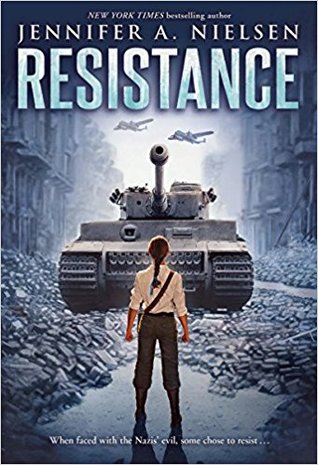
Resistance by Jennifer A. Nielsen, 2018

Click to view
on Goodreads 
Chaya Lindner is a teenager living in Nazi-occupied Poland. Simply being Jewish places her in danger of being killed or sent to the camps. After her little sister is taken away, her younger brother disappears, and her parents all but give up hope, Chaya is determined to make a difference. Using forged papers and her fair features, Chaya becomes a courier and travels between the Jewish ghettos of Poland, smuggling food, papers, and even people.

Soon Chaya joins a resistance cell that runs raids on the Nazis' supplies. But after a mission goes terribly wrong, Chaya's network shatters. She is alone and unsure of where to go, until Esther, a member of her cell, finds her and delivers a message that chills Chaya to her core, and sends her on a journey toward an even larger uprising in the works -- in the Warsaw Ghetto.

Though the Jewish resistance never had much of a chance against the Nazis, they were determined to save as many lives as possible, and to live -- or die -- with honor.

(400 pages)

Wow.

Just, wow. I mean, I've been a fan of Nielsen's for ages, and I adored her East Berlin book A Night Divided, so I knew going in that I was going to love Resistance. But I had no idea how blown away by it I was going to be.

World War II is pretty well-trodden ground by this point, but Nielsen still managed to find an aspect–the Jewish resistance movement–that I didn't know anything about. I never knew that the Jews worked so hard to organize themselves and fight against the Nazis, but they did. They were incredibly brave, risking their lives every day to undermine the war effort, warn the people imprisoned in ghettos about the death camps, and smuggle some out into safe houses.

Chava and her fellow fighters know from day one that they will most likely die for their cause, but they know that they will face death no matter what they do–they want to use their lives to do the most good before they are killed, either for fighting or for being Jewish. It's a horrible situation, the ultimate "rock and a hard place" dilemma, and they are beyond brave for choosing to do what they can to help.

I love how Nielsen doesn't just leave it at that, though. Over the course of Chaya and Esther's journey, they meet lots of different people from all walks of life and religion. They meet some Poles who ignore them, others who attack them for being Jewish, and still others who risk life and limb to help them. They meet some Jews who refuse to fight back out of fear, and some who don't fight out of disbelief, but also some who won't fight because their faith forbids murder–so they fight for the Jewish religion by not taking up arms. Nielsen's focus on these moral nuances, on portraying the various ways people responded to the Nazis without judging them, is a great strength throughout the book.

I realize I haven't really discussed the main characters much yet. It's hard to focus on them when there are so many incredible details about history to pull from Resistance's pages, but Chava is the perfect core to the book. She doesn't see herself as a hero, and she doesn't romanticize anything. She is a very pragmatic person, treating herself almost like an object and calculating how best to use herself for the good of the Jews and downfall of the Nazis. Her initial impatience with/distaste for Esther is completely reasonable, since the younger girl really is pretty useless, but I loved watching them come to understand and respect each other as the story went on. I rooted for both of them, as well as for their cause, though I knew the story couldn't possibly have a picture-perfect happy ending.

I wouldn't recommend Resistance for very young readers, just because the vast majority of the characters in this book either die or expect themselves to die at any moment (and the climax, which is masterfully done by the way, is set in the Warsaw Ghetto during a doomed revolt). There's no bad language or graphic descriptions of the gruesome scenes Chava encounters, though, so as far as books about Polish Jews during WWII goes, this is about as "clean" as it's going to get.

I'm sure it's no surprise when I say that I highly recommend Resistance. I try to always list pros and cons in my reviews, but I literally don't have any cons for this one. It's a wonderfully well-written book, and it gives proper due to the incredible men and women who fought for their people. I hope many children read Resistance and learn the story of these heroes.

Disclaimer: I received a complimentary copy of this novel from the publisher in exchange for an honest review.

10 July 2017

My Brother's Keeper by Rod Gragg, 2016

Click to view
on Goodreads 
Thirty captivating profiles of Christians who risked everything to rescue their Jewish neighbors from Nazi terror during the Holocaust. 

MY BROTHER'S KEEPER unfolds powerful stories of Christians from across denominations who gave everything they had to save the Jewish people from the evils of the Holocaust. This unlikely group of believers, later honored by the nation of Israel as "The Righteous Among the Nations," includes ordinary teenage girls, pastors, priests, a German army officer, a former Italian fascist, an international spy, and even a princess.
In one gripping profile after another, these extraordinary historical accounts offer stories of steadfast believers who together helped thousands of Jewish individuals and families to safety. Many of these everyday heroes perished alongside the very people they were trying to protect. There is no doubt that all of their stories showcase the best of humanity--even in the face of unthinkable evil.
(352 pages)

I asked to review My Brother's Keeper because it looked like a really great compilation of nonfictional stories from WWII, but once it actually showed up on my doorstep I continually put off cracking it open because I thought it would be too depressing (and also because it looked kind of boring).

It wasn't boring, though. Come to think of it, I've never read a book about the treatment of Jews during WWII that was boring–everything was just so horrific back then that even the most snooze-inducing historian couldn't dull the horrifying tales. As for my other concern, yes, My Brother's Keeper was definitely depressing. Its description of the systematic hunting down and wiping out of an entire race is horrifyingly detailed, and primary source quotes and images are used hauntingly throughout the book. Every chapter opens with a black and white image, occasionally of the featured person/family but often of German soldiers or real children who were murdered in concentration camps. In the beginning of the chapter there's a little bit of background on the featured figures, a detailed description of the historical context and the evils that they faced (including some truly horrific descriptions of German murder techniques), and then a detailed account of how they risked their lives to help the Jews and what happened to them afterward. I'd say that most of the featured people wound up surviving the war, though a large amount of them spent at least some time in a concentration camp. In one or two instances, the heroes–and their entire families–were murdered outright for their "crimes" under German law.

Honestly, it's pretty amazing to read about the people who risked everything to help save hundreds (sometimes thousands) of Jews from the Germans. Many heroes found it incomprehensible that the Jewish children were also being targeted, so they set up elaborate systems that rescued thousands of young innocents right out from under the Germans' grasp. It's amazing. But at the same time, I can't believe the depths of inhumanity that went on during the war. It's great that there were some heroes who rescued children, sure, but it's also horrifying to learn that 1.5 million kids died during the Holocaust. That's obscene. That's . . . I can't even find words for it. Monstrous fits, but it's not even enough. The actions of the people described in the book were amazing, incredibly brave, but they didn't even begin to conquer out the terrible evil of all the people who perpetrated the murder of innocents–or all of those who sat by and watched them do it. Gragg discusses the fact that many Christians throughout Europe allowed themselves to get swept up by the Germans, swearing their loyalty to the Third Reich and turning their backs on their Jewish neighbors, but he says that all of the people in My Brother's Keeper channeled their belief in God toward a conviction that they had to help the Jews in whatever way they could. I think that's amazing, but again–I only wish that more people, Christian or atheist or whatever, had stood up to the monstrosity of the Nazis.

But then I stop and wonder what I would have done in their shoes, and I'm afraid that I would have shut up and put my head down in order to save myself. And even if I worked up the courage to sacrifice myself, it's hard to decide whether it's worth saving others at the risk of having all of my loved ones murdered. It was an impossible time, an impossible situation. The Nazis were truly monsters in every sense of the word, and the noble secret actions of these thirty heroes (and of many more, I'm sure!) are even more incredible in contrast to the inhumanity surrounding them. I weep for all those they couldn't save, but I still celebrate every life they managed to save.


Disclaimer: I received a complimentary copy of this book from the publisher in exchange for an honest review.

13 March 2017

With Love, Wherever You Are by Dandi Daley Mackall, 2017

Click to view
on Goodreads 
Everyone knows that war romances never last. . . .Helen Eberhart always had to fight for what she wanted. Survival in a family of thirteen gave her the grit to push through nurse’s training and support herself. But after the attack on Pearl Harbor, she can’t stand catering to the pampered patients on Chicago’s North Shore. Enlisting as an Army nurse, Helen is transferred to a military hospital in Battle Creek, Michigan. There she comes face-to-face with the waves of broken bodies of the wounded soldiers, many no older than her beloved brothers.

Frank Daley wasn’t trying to be a hero. He’d only enlisted to finish medical school, confident that the war would be over before his deferment ran out. Life just worked out for him that way. But Lieutenant Frank R. Daley, MD, is sent straight from his graduation to boot camp in Battle Creek as his last stop before a battlefield hospital in Europe. And none of his training prepares him for the chance encounter with the spirited nurse who steals his heart.

After a whirlwind romance and courthouse wedding, Helen and Frank are sent to the front lines of Europe with only letters to connect them for months at a time. Surrounded by danger and desperately wounded patients, they soon find that only the war seems real—and their marriage more and more like a distant dream. If they make it through the war, will their marriage survive?

(466 pages)

I've been a long-time casual fan of Dandi Daley Mackall's books for years now, ever since I got hooked on the Starlight Animal Rescue series when I was younger. Mackall always writes children's books filled with equal parts thrills and heart, my favorite combination. When I saw the option to review this book, though, I knew straight away that it was a different beast. This is no 200-word animal rescue book for kids; rather, it's a 450+ page adult novel about a married couple serving as medical personnel in different parts of Europe during WWII.

The first thing I have to say is that this is a fascinating book. It provides an intimate, and often startling, perspective on WWII by focusing explicitly on the lives of Helen and Frank, army nurse and doctor, who are both serving in Europe during the height of the war. The scenes they each see throughout the course of the war and even after it are terrible, yes, but also educational–they show us the depths of human evil, the horrors of human-on-human violence, and the unalterable fact that we need to never engage in such a terrible world war ever again.

Maybe it's because I'm the daughter of two physicians myself, but I've always seen doctors and nurses as some of the greatest heroes during wars. They're the ones who go out to the front lines, risk their lives, do anything it takes . . . to save lives. When everyone around them is focused on destroying the enemy and throwing their men in front of bullets, medical personnel are the ones who stay focused on keeping soldiers alive. I especially appreciate that Helen chooses to help treat German soldiers in the French hospital, despite the flack she gets for it from the other nurses; her determination to help every patient and save every life she can, no matter the stigma, is truly admirable in a time when so many people were focused on mistreating anyone they didn't perceive as being "worth" common decency.

As for the story's central romance, well, I personally didn't care for it that much. Since I figured out who the real Helen and Frank were (hint: their last name is Daley, which is Mackall's maiden name), I was pretty sure I knew how it would turn out. I still don't really agree with the super-fast way they jumped into marriage, which strikes me as very stupid, but the characters themselves do acknowledge the insanity of their decision and spend most of the book building up their marriage bond through daily correspondence. Since they're a newlywed couple who are forcibly separated most of the time, when they rendezvous every few months there are some definite innuendos about what they do together alone–they're not even approaching explicit, though, so I was fine with them. Mainly, though, I just thought their emotions were really strong and rather volatile, and I couldn't get over the fact that they felt so intimate with each other when they'd barely even spent a few weeks together in person before getting married. I guess it was just a different world back then, one where a whirlwind romance like that actually has a chance at success. Plus, memories of their horrible experiences during the war probably helped them bond in later years.

Anyway, Dandi Daley Mackall definitely has the writing skills to try her hand at any genre she chooses. I'm so glad I gave With Love a try, and I look forward to seeing what else she'll be doing in the upcoming future!


Disclaimer: This is an Amazon affiliate link, and I received a complimentary copy of this novel from the publisher in exchange for an honest review.