Showing posts with label Jew. Show all posts

28 September 2018

The Length of a String by Elissa Brent Weissman, 2018

Click to view
on Goodreads 
Imani knows exactly what she wants as her big bat mitzvah gift: to meet her birthparents. She loves her family and her Jewish community in Baltimore, but she has always wondered where she came from, especially since she's black and almost everyone she knows is white. When her mom's grandmother--Imani's great-grandma Anna--passes away, Imani discovers an old diary among her books. It's Anna's diary from 1941, the year she was twelve--the year she fled Nazi-occupied Luxembourg alone, sent by her parents to seek refuge in Brooklyn. Written as a series of letters to the twin sister she had to leave behind, Anna's diary records her journey to America and her new life with an adopted family. Anna's diary and Imani's birthparent search intertwine to tell the story of two girls, each searching for family and identity in her own time and in her own way.
(384 pages)

I loved it.

There's no point beating around the bush. I really, really enjoyed reading this book. I love reading about Imani's struggles to fit in as a black adoptee in a white Jewish neighborhood. I love how Weissman portrayed Imani's thirst for knowledge about her birth family, while still loving her adoptive family more than anything. I love that her little brother is also adopted but has no interest in his birth parents, which represents the diversity in outlooks of adoptees.

Anna's story is a lot less fun to read than Imani's in places, but it was just as well done. Her story was similar to many other WWII refugee books I've read over the years, but there were enough details–such as the coat piecing plant, where Anna comes to help her foster father and the stingy uncles.

The uncles themselves were a great addition to the story, because they were both horrible and pathetic. I love nuance in a children's book. The details about Anna's family and her relationship with her siblings (especially her identical twin Belle) were both wonderfully done and incredibly sad. Watching her unravel her parents' thought process as they chose which of their children to send to safety was especially heartbreaking. So was seeing Anna's struggle to balance her love for America with her homesickness and, later, her sorrow for what European Jews were being subjected to.

It was kind of cool to be learning Anna's story alongside Amani, as Amani read each entry in her great-grandmother's diary and reacted emotionally to each new development. When there was information we readers needed that wasn't available from Anna's diary perspective, Amani would Google a topic or ask an older family member to get the answer. It was a smart storytelling technique, a story within a story, and I kind of wish more books did it.

Having made it very clear that there was a lot I liked about The Length of a String, I should add a few negatives. Anna's story is an interesting one but, as I said before, I've read a lot of WWII refugee books. Without Amani's story and reactions to reading her diary, I probably would have been a little less absorbed with it. Also, I felt like Amani was pretty selfish, digging into her adoption against her mother's express wishes. I would have preferred if she had been brave enough to convince her parents before she started searching, rather than reacting after she was caught. But then, she's only twelve and she has her heart set on finding her biological roots. It makes sense that her decision-making process isn't quite as mature as it could have been. Anyway, I really loved how that storyline was concluded.

All in all, this is just such a nice, solid, thought-provoking read which I very much enjoyed. If you like the looks of the description, then you probably will enjoy it, too!

Disclaimer: I received a complimentary copy of this book in exchange for an honest review.
31 August 2018

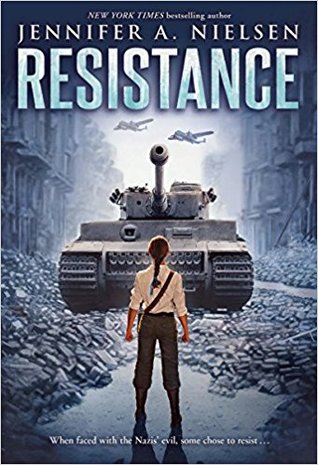
Resistance by Jennifer A. Nielsen, 2018

Click to view
on Goodreads 
Chaya Lindner is a teenager living in Nazi-occupied Poland. Simply being Jewish places her in danger of being killed or sent to the camps. After her little sister is taken away, her younger brother disappears, and her parents all but give up hope, Chaya is determined to make a difference. Using forged papers and her fair features, Chaya becomes a courier and travels between the Jewish ghettos of Poland, smuggling food, papers, and even people.

Soon Chaya joins a resistance cell that runs raids on the Nazis' supplies. But after a mission goes terribly wrong, Chaya's network shatters. She is alone and unsure of where to go, until Esther, a member of her cell, finds her and delivers a message that chills Chaya to her core, and sends her on a journey toward an even larger uprising in the works -- in the Warsaw Ghetto.

Though the Jewish resistance never had much of a chance against the Nazis, they were determined to save as many lives as possible, and to live -- or die -- with honor.

(400 pages)

Wow.

Just, wow. I mean, I've been a fan of Nielsen's for ages, and I adored her East Berlin book A Night Divided, so I knew going in that I was going to love Resistance. But I had no idea how blown away by it I was going to be.

World War II is pretty well-trodden ground by this point, but Nielsen still managed to find an aspect–the Jewish resistance movement–that I didn't know anything about. I never knew that the Jews worked so hard to organize themselves and fight against the Nazis, but they did. They were incredibly brave, risking their lives every day to undermine the war effort, warn the people imprisoned in ghettos about the death camps, and smuggle some out into safe houses.

Chava and her fellow fighters know from day one that they will most likely die for their cause, but they know that they will face death no matter what they do–they want to use their lives to do the most good before they are killed, either for fighting or for being Jewish. It's a horrible situation, the ultimate "rock and a hard place" dilemma, and they are beyond brave for choosing to do what they can to help.

I love how Nielsen doesn't just leave it at that, though. Over the course of Chaya and Esther's journey, they meet lots of different people from all walks of life and religion. They meet some Poles who ignore them, others who attack them for being Jewish, and still others who risk life and limb to help them. They meet some Jews who refuse to fight back out of fear, and some who don't fight out of disbelief, but also some who won't fight because their faith forbids murder–so they fight for the Jewish religion by not taking up arms. Nielsen's focus on these moral nuances, on portraying the various ways people responded to the Nazis without judging them, is a great strength throughout the book.

I realize I haven't really discussed the main characters much yet. It's hard to focus on them when there are so many incredible details about history to pull from Resistance's pages, but Chava is the perfect core to the book. She doesn't see herself as a hero, and she doesn't romanticize anything. She is a very pragmatic person, treating herself almost like an object and calculating how best to use herself for the good of the Jews and downfall of the Nazis. Her initial impatience with/distaste for Esther is completely reasonable, since the younger girl really is pretty useless, but I loved watching them come to understand and respect each other as the story went on. I rooted for both of them, as well as for their cause, though I knew the story couldn't possibly have a picture-perfect happy ending.

I wouldn't recommend Resistance for very young readers, just because the vast majority of the characters in this book either die or expect themselves to die at any moment (and the climax, which is masterfully done by the way, is set in the Warsaw Ghetto during a doomed revolt). There's no bad language or graphic descriptions of the gruesome scenes Chava encounters, though, so as far as books about Polish Jews during WWII goes, this is about as "clean" as it's going to get.

I'm sure it's no surprise when I say that I highly recommend Resistance. I try to always list pros and cons in my reviews, but I literally don't have any cons for this one. It's a wonderfully well-written book, and it gives proper due to the incredible men and women who fought for their people. I hope many children read Resistance and learn the story of these heroes.

Disclaimer: I received a complimentary copy of this novel from the publisher in exchange for an honest review.

05 June 2017

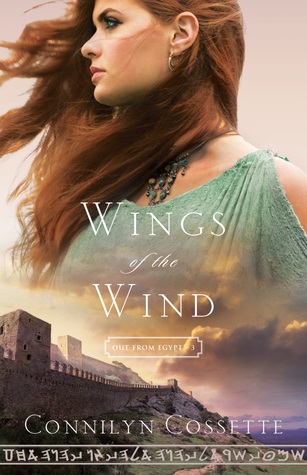
Wings of the Wind by Connilyn Cossette, 2017

Click to view
on Goodreads 
Alanah, a Canaanite, is no stranger to fighting and survival. When her family is killed in battle with the Hebrews, she disguises herself and sneaks onto the battlefield to avenge her family. The one thing she never counted on was surviving.
Tobiah, a Hebrew warrior, is shocked to find an unconscious, wounded woman among the Canaanite casualties. Compelled to bring her to a Hebrew healer back at their camp, he is soon confronted with a truth he can’t ignore: the only way to protect this enemy is to marry her.
Unused to being weak and vulnerable, Alanah submits to the marriage—for now. As she comes to know and respect Tobiah and his people, however, she begins to second-guess her plans of escape. But when her past has painfully unanticipated consequences, the tentative peace she’s found with Tobiah, the Hebrews, and Yahweh is shaken to the core. Can Alanah’s fierce heart and strength withstand the ensuing threats to her life and all she’s come to love?

(352 pages)

I have read very, very few books set before the lifetime of Christ.

Actually, make that books set before the Renaissance. Or maybe even books set before the 1700s. Really, most of the novels I read seem to either be fantasy stories (i.e. not set in our timeline) or based in more modern times. That's why I was really intrigued by Wings of the Wind, which promised to tell a fascinating romance story set during the battles between the Canaanites and the Israelites near the end of the forty years in the desert after God's people had fled from Egypt.

And it delivered. I honestly really, really enjoyed reading Wings of the Wind. I have no idea how historically accurate it was, but it seemed well-researched and relatively plausible. The characters are all realistic, and though I saw some of the plot twists coming from a mile away I definitely didn't foresee how everything wound wind up tying back to the biblical narrative. The romance between Alanah and Tobiah is relatively gradual and realistic, and not as creepy as the whole forced marriage plotline could have gone. I liked them together and was rooting throughout everything for them to stay together throughout everything that was happening. I also really liked the depiction of Yahweh, because he was so active in the Israelites' lives during this period and I think Cossette depicted his powerful justice and simultaneous mercy very skillfully.

That being said, I do want to warn potential readers that this book doesn't pull any punches. There are many references to what soldiers do to unarmed women they come across, and of Alanah's desperation not to let that happen to her, especially at the beginning of the book. Then there are some scenes that describe a couple in love and some *ahem* morning after scenes. Later in the book, Alanah encounters another city that is teeming with vice and prostitutes. Basically, there are a lot of references to both having sex and avoiding molestation throughout the book that I thought were a little bit much. In her author's note, however, Cossette explains her choice to include the atrocities committed by the Canaanites by describing her desire to provide a clear-eyed look at the people who were being wiped out. I still don't know that I can totally be okay with wiping out a whole people in order to steal their land, but I suppose God must have known what he was doing.

Anyway, this is one of the most well-written and fascinating Christian fiction/romance books I've ever read, and–with a warning about the mature material it includes–I do recommend it highly. If you're in the mood for this sort of book, then just know that Wings of the Wind is one of the good ones.


Disclaimer: I received a complimentary copy of this novel from the publisher in exchange for an honest review.

09 December 2016

An Extra Seat by Shmuel Herzfeld, 2016

Click to view
on Goodreads 
This children's book, based on Rabbi Shmuel Herzfeld's personal story growing up in 1970's New York, focuses on the plight of the Jewish Zionist prisoners brought to the world's attention by the highly publicized arrest of Anatoly Sharansky. Herzfeld's mentor, Rabbi Avi Weiss, plays a central role, encouraging his congregation to see the refuseniks (whose simple aim was making aliyah to Israel) as brothers and sisters whose rights should be fought for with unremitting public protest. The two child protagonists, Sarah and Joseph, experience the reward of these efforts as they witness Sharansky's remarkable release, nine years into his 14-year sentence. The book provides a message of hope especially to children who are encouraged to see the value of their ideals, values and actions.

This book is has as its central premise human and Torah-based Jewish values, such as:

While it may not be our job to complete a task, we are obligated to try.

We have the greatest responsibility to help our own family. All of the Jewish people are one family. Thus we are all responsible to help each other.

(32 pages)

I'm going to preface this review by saying that I'm not Jewish and I'm not a little kid. Right there I think I miss being in either of the two target demographics for this book. I entered to win it anyway, though, because many of the nicest people I know are Jewish and I've been wanting to learn more about their culture. I figured An Extra Seat would be a fun place to start.

So as the description says, this is just 32 pages long. Every two-page spread features a few sentences and background art that goes along with the theme of the text. Most of the artwork is done in pretty pastel, with what I think are watercolors (but could be something else since I know next to nothing about art). Two of the spreads, though, feature completely different artwork with black backgrounds and snapshots of what looks like figures made out of modeling clay representing the focus of their pages. I didn't really like the clay pictures because they felt a little harsh and slightly bizarre coming right in between the muted pastel pages. Also, I'm not even a fan of claymation movies so that tells you how enthusiastic I am about characters being cast in clay in general.

Anyway, that just about sums up every observation this art novice can make about the pictures in the book. Now on to the writing itself. I have to say that it's been a while since I read a picture book, so I was definitely very frustrated with the sparse text and limited explanations that the book provided. I wanted a little more historical and cultural context for Sharansky's arrest in the Soviet Union, and a little more explanation about the advocacy work done to get him out of jail. We read about two rallies the kids went to, and some bracelets they wore on their wrists out of solidarity with their Jewish brothers being kept in Soviet prisons, but the explanation of how Sharansky was actually released by the Soviet government goes something along the lines of "after a few years, the main characters got the news out of the blue that Sharansky had been freed. They were ecstatic, and they took to heart the realization that even children can make a difference if they put their minds to it!" That's a great lesson, of course, but I still don't see how the kids actually convinced the Soviet government to change its mind.

Okay, I decided to google it. According to Wikipedia (a trusty resource, I know), Sharansky wasn't imprisoned by the Soviets just for trying to move to Israel as the picture book claims; rather, he was accused of being an American spy and . . . um, something to do with messing with the process of Jews getting visas to leave the country. I'm still a little confused. Anyway, the reason he was eventually released early was because of a "larger exchange of detainees" between the USSR and America. Apparently, the advocacy on his behalf was important because it made him famous enough that American politicians actually cared enough about him to ask for his release as part of the exchange. So I suppose in a way the efforts of the kids really did save him, even if things weren't quite as straightforward as the book suggests.

But then, maybe I'm just trying to read too much into a children's book. I'd be interested to hear someone else's thoughts on An Extra Seat. Let me know in the comments below if you have any fresh light to shine on the story or whether you've ever used the picture book with your kids!

Disclaimer: I won a complimentary Early Reviewers copy of this book from Library Thing. I was encouraged, but not required, to write an honest review. All thoughts are my own.