Showing posts with label war. Show all posts

23 October 2017

Whistling in the Dark by Shirley Hughes, 2015

Click to view
on Goodreads 
"Well-written and well worth reading." The Bookseller. Liverpool, 1940: thirteen-year-old Joan’s home is under threat from the Nazi’s terrifying nightly air-raids. It is not an easy time to be a teenager, especially with the sweet rationing, strict curfews and blackouts. Joan and best friend Doreen love going to the cinema until the bombings intensify and then even that becomes too dangerous, especially when an army deserter is found lurking near their home. Who is he and why does he think Joan can help him? As the Blitz worsens, Joan and her friends make a discovery that will tear the whole community apart…
(240 pages)

I've read a lot of historical fiction book centered around WWII, and they all take a slightly different angle on the terrible time. A lot of them involve the homefront in some way, so I was a little worried that Whistling in the Dark would struggle to carve its own unique spot in the literature, but I needn't have worried.

One thing I didn't know going into the book is that the author, Shirley Hughes, actually lived through WWII as a teenager living in Liverpool (the town where the book is set). I think that detail adds a little spark to the story that many other books about the time period don't have, just because we know the author really knows what she's talking about when she describes life there at the time.

And really, though it's a little book, there's quite a lot going on. I don't really want to go into the individual plotlines very much, because there would be lots of spoilers, but suffice it to say that Joan is confronted with issues ranging from personal/familial crises to meeting a loner refugee girl in school who doesn't speak English to dealing with the army deserter who is lurking around. They're all resolved in satisfactory and interesting ways, and I really liked reading about it.

Honestly, with all the amazing WWII books out there, I can't say that Whistling in the Dark stands out from the crowd a huge amount. But it's a good book, especially for younger readers who aren't prepared for the full horror of, say, a European Jewish girl's experiences during the war, and I for one really liked it. If you read it, please let us know your thoughts in the comments section down below!

Disclaimer: I received a complimentary copy of this novel from the publisher in exchange for an honest review.

14 July 2017

Dog Company by Lynn Vincent and Roger Hill, 2017

Click to view
on Goodreads 
Two decorated American war heroes survive combat in Afghanistan only to find themselves on an unfamiliar battlefield - the courtroom - in this true story by the commander of Delta Company, 1/506th a.k.a. Dog Company.

The deaths of two of his men is agony for Captain Roger Hill and the agony is intensified when he realizes those responsible - 12 Taliban spies- have been working right under his nose on the American base.

When unreasonable military regulations demand that he free the spies within 96 hours, and Hill can't get his superior officer to respond to the deadline, he takes action to intimidate the prisoners to confess - and to protect his company from another attack.

Instead of being thanked, Hill's superior brings him up on charges making this decorated officer's next battle a personal one - for his honor and for that of 1st Sergeant Tommy Scott, his second in command.

Combining the camaraderie and battle action of
Band of Brothers with the military courtroom drama of A Few Good Men, Roger Hill's story will leave you impassioned, inspired and forever changed.
(448 pages)

I'm not sure what was going through my mind when I asked to review Dog Company. It's not exactly my typical read, you know? I've been trying to become a little more informed about modern international relations, though, so I guess I thought a true story about soldiers deployed in Afghanistan could be a beneficial read.

I guess I forgot that I really don't like war. I mean sure, I've read lots of stories set during wars–about Jews fleeing the Holocaust, for example, or the brother-against-brother quandaries confronting soldiers during the Civil War–but the main characters in my books almost uniformly are either civilians or green soldiers. Captian Hill is just that: a captain. At the time of the events in the book, he'd served for eight years, and most of his men for far longer. They're all just such complete . . . well, soldiers. And I'm really not one. And I never really want to be. Lots of respect to the men and women who risk their lives to keep the nation safe, of course, but I could never stand the idea of shooting anyone; if I felt the call to join the service, I'd do it as a medic of some sort rather than as a soldier. The other reason I'd never want to be a soldier–and this is a huge one for me–is that I'd dread the day my higher-ups ordered me to do something that went against my moral code.

And really, that's what happened to Captain Hill. He was under orders to release the twelve men who were unequivocally spies for the Taliban, men whose intel had directly led to the deaths of two of his men, back into their freedom because his higher-ups wouldn't accept custody of them. Before they went, he wanted to get some good information out of them that would help them take down the Taliban and, presumably, prevent the loss of more men. To do so, one or two of the soldiers first slapped around a few of the prisoners (something that, in and of itself, was definitely illegal). When that didn't work, Hill grabbed one of them and pulled him outside, dumped him on the ground and shot at nothing so the other prisoners thought he'd killed their comrade. When they still didn't talk, he pretended to shoot two more men and then one of the remaining men cracked, spilling valuable information.

That's . . . pretty awful. I mean, I know the prisoners were probably all horrible people who would have done even worse to the soldiers if the roles had been reversed, but that still doesn't excuse that sort of behavior. We're supposed to be better than the Taliban; that moral high ground is our only real excuse for being in Afghanistan in the first place. So while I can understand the emotional reasons why Captain Hill decided to break the law and use such violent scare tactics on his prisoners, I actually agree with the decision to punish him. Was completely kicking him out of the army necessary? Definitely not, that seems rather disproportionate to his crimes. He should have just been demoted a rank or two (or however they call it) and posted somewhere where he could be monitored a little more closely.

Anyway, while the core moral dilemma is an interesting one, I didn't really enjoy reading Dog Company. It's broken up into units that jumble the chronology just enough to be rather confusing, and just kind of randomly jumps into the backstory of soldiers that were interesting but not exactly relevant. It also covers more than I really needed to know of the months leading up to the prisoner situation, which shifted from intriguing and educational to just straight-up boring by some point. I wound up skimming through a lot of the second half of the book. People more interested in military stuff might find those parts more entertaining than I did, though. Also, the language in the book is atrocious–gobs of f-words are littered in all over the place along with a whole alphabet of other (mildly less offensive) swear words. I pushed past them to read the book, but it wasn't pleasant.

If you've reading this review to the end, then you probably have a pretty good idea of whether Dog Company is for you. I can't say that I really recommend it personally, but it might do something for you that it didn't for me.


Disclaimer: I received a complimentary copy of this book from the publisher in exchange for an honest review.

16 June 2017

Catching the Wind by Melanie Dobson, 2017

Click to view
on Goodreads 
What happened to Brigitte Berthold?

That question has haunted Daniel Knight since he was thirteen, when he and ten-year-old Brigitte escaped the Gestapo agents who arrested both their parents. They survived a harrowing journey from Germany to England, only to be separated upon their arrival. Daniel vowed to find Brigitte after the war, a promise he has fought to fulfill for more than seventy years.

Now a wealthy old man, Daniel's final hope in finding Brigitte rests with Quenby Vaughn, an American journalist working in London. He believes Quenby's tenacity to find missing people and her personal investment in a related WWII espionage story will help her succeed where previous investigators have failed. Though Quenby is wrestling her own demons--and wary at the idea of teaming up with Daniel's lawyer, Lucas Hough--the lure of Brigitte's story is too much to resist. Together, Quenby and Lucas delve deep into the past, following a trail of deception, sacrifice, and healing that could change all of their futures.
(416 pages)

Of all the many WWII books I've read over the years, I can't even think of any that split the narrative between the war-time era and modern day the way Catching the Wind does. I really love the way we discover Brigitte's story alongside Quenby, as the modern-day reporter is hired to track down leads about her aged employer's childhood best friend lost during the tumult of emigrating from Germany to England. I got just as swept up in the investigation as Quenby did, and I was impressed by the way Dobson managed to incorporate pieces of Brigitte's story into letters and the like so that Quenby could mostly stay on the same page as the reader (without the benefit of chapters dedicated to telling her tale!), and to do so in a way that didn't make things redundant.

If I'm really nitpicking this aspect of the story, though, I do have to admit that I can't really believe that none of the other searchers found the trail of clues that Quenby does. A well-trained investigator should have been able to find all the same leads, yet everyone else Daniel hired couldn't. That didn't quite add up to me, because he was supposed to have been hiring the very best people for the search. An everyday journalist does not have the experience or training to beat out a real investigator, I don't care how passionate and empathetic she may be about the case. This is no dig to Quenby, of course, because she does make some incredible discoveries–I'm just saying there must have been something wrong with Daniel's hiring process before.

Anyway, I really enjoyed this book. It's extremely dramatic–some might even say melodramatic–but in a way that still seems almost possible. Plus, the most unbelievable stuff happens during WWII, a time period known for incredible happenings, so I can mostly buy all the plot twists that happen throughout the course of the book. Except possibly the last one. I totally saw that one coming but I still think it's just too much of a coincidence.

Basically, I highly recommend Catching the Wind. It's a fast-paced and engaging read split between the challenges and deceits of WWII and a modern-day pursuit for truth (sprinkled with a just-right amount of romantic tension, to boot!). While it does skate close to becoming ridiculous a few times, Dobson keeps ahold of the story and manages to steer it safely into port. I do wish the characters had debriefed a little more, because I felt like a lot of relationship issues were brushed past a little too quickly for my liking, but I suppose that just leaves more room for the imagination. Anyway, I hope you like Catching the Wind! Have you read it? If so, let us know in the comments what you thought of it!


Disclaimer: I received a complimentary copy of this novel from the publisher in exchange for an honest review.

17 April 2017

Double Cross: Deception Techniques in War by Paul B. Janeczko, 2017

Click to view
on Goodreads 
How does deception factor into fighting wars, and is it effective? In an intriguing companion to The Dark Game, Paul B. Janeczko reveals the truth about the strategic lies of war. The biblical account of Gideon. The ancient story of the Trojan horse. Deceptive techniques have been used in war through the ages. But while the principles have changed very little, the technology behind fooling the enemy has evolved dramatically. Paul B. Janeczko s fascinating chronology focuses on the American Civil War, World Wars I and II, and the Korean War, the Vietnam War, and the Gulf Wars to reveal evolving attitudes toward the use and effectiveness of deceptive operations. Find out the secret plan behind the invasion of Normandy and the details of General Schwarzkopf s "Hail Mary play" during the Gulf War, among many other strategies and maneuvers designed to pull the wool over enemies' eyes. Back matter includes source notes, a bibliography, and an index."
(256 pages)

It's funny how things work out sometimes. I agreed to review Double Cross months ago, but didn't get around to it until now–which just so happens to be the exact same time that we're covering WWII and the Cold War era in my APUSH class. Deception techniques from WWII, the Korean war, and the Vietnam war make up the bulk of the content, so it works out perfectly for me: I get to study and work on my blog at the same time!

Because Double Cross is definitely educational. It talks a lot about military maneuvers on the Allied side during WWII, and on the American/UN side in the more recent wars. It also touches on the Trojan Horse story, but I already knew about that. What I really enjoyed reading about was the new stuff. Did you know that Britain invented a whole new army that was going to invade Europe at Pas-de-Calais (rather than Normandy), and that they had a group of people driving around Scotland to send out telegraph messages simulating conversations between the different parts of the army? Not only that, but they also built props on the ground to look like trucks. And they put little articles in the newspaper about how, say, the presence of thousands of soldiers was demoralizing the young Scottish women. The attention to detail that went into the operation was incredible–and it worked beautifully. Hitler actually kept a large amount of his troops near Pas-de-Calais even after the invasion of Normandy because he thought a second attack would still be coming from there!

There are way more stories in here than just the one about Scotland's notional (fake) army, though. I don't want to go into all of them too much, because Janeczko does a better job explaining all of them than I ever could, but suffice it to say that there have been some very fascinating deception operations over the years. I don't love reading about war as a rule, just because it's too horrible to think of all that death, but I really enjoyed learning about all the stranger-than-fiction ideas people had that actually worked and fooled the enemy. It's also cool to see how, in some instances, these deception tactics saved many thousands of lives. I'm all for cutting down on the casualties!

Anyway, this is a very interesting book that I actually enjoyed more than I thought I would. If you're interested at all in trickery, or war-time strategy, or a combination of both, then I definitely recommend you give Double Cross a try. It's also a great bouncing-off book for a variety of other war-time topics, because it has inserts with information about cool spy stuff and technology scattered throughout its pages as well.


Disclaimer: I received a complimentary copy of this book from the publisher in exchange for an honest review.

10 April 2017

That Burning Summer by Lydia Syson, 2017

Click to view
on Goodreads 
It’s July 1940 on the south coast of England. A plane crash-lands in the marsh, and sixteen-year-old Peggy finds its broken pilot—a young Polish airman named Henryk. Afraid and unwilling to return to the fight, Henryk needs a place to hide, and Peggy helps him find his way to a remote, abandoned church.

Meanwhile, Peggy’s eleven-year-old brother Ernest is doing his best to try to understand the war happening around him. He’s reading all the pamphlets—he knows all the rules, he knows exactly what to do in every situation. He’s prepared, but not for Peggy’s hidden pilot.

Told in alternating points of view, this is a beautifully written story about growing up in wartime and finding the difference between following the rules and following your heart.

(298 pages)

I've read a huge amount of WWII books over the past few years, so I've gotten rather picky about them. No, not exactly picky–not bored, either–just really eager to read books that approach the war from unique angles. I don't grow sick of reading about, say, Jews in hiding, but I do like to learn something new from the books I read rather than always focusing on the same (albeit terrible) things.

All that to say . . . I thought That Burning Summer stands out, but isn't incredibly unique. I've never read a book about a Polish airman before, and the details about his past ordeal are absolutely fascinating and horrifying, but the whole idea of someone harboring a fallen pilot in rural England was already covered wonderfully in Dan Smith's My Friend the Enemy. I've read a lot of books that included details about the paranoia the Brits felt about an imminent German invasion, so those details also weren't novel to me, but I did appreciate seeing them carried to the level of almost Cold War-era paranoia–I hadn't realized just how much "doom and gloom" many average Brits felt about the war.

Moving on to analyzing the book as a novel, though, I have to point out that everyone (hopefully!) knows going in that the British isles were never invaded during WWII. This takes a lot of tension out of the read for us, because we never seriously worry about this the way Ernest does. Watching him obsess over the impending invasion does give us an insight into his personality, though, so it does serve some purpose.

To be honest, I enjoyed reading That Burning Summer but I didn't absolutely fall in love with it. I liked the different components of the story–learning about Henryk's past, the paranoia in town, Ernest's feelings of inadequacy, the whole storyline about their father that leaks out as the story goes on (and that gave me more new historical perspective!), etc.–but I also felt like many of them could have been fleshed out more. And the ending is fairly abrupt, jumping forward several years and then ending rather suddenly. I would have liked more detail about what had gone on between everyone in the interim years.

Overall, though, this was a pretty good read. If you're interested in it, then by all means do check it out!

Disclaimer: I received a complimentary copy of this novel from the publisher in exchange for an honest review, and this post includes Amazon affiliate links.

13 March 2017

With Love, Wherever You Are by Dandi Daley Mackall, 2017

Click to view
on Goodreads 
Everyone knows that war romances never last. . . .Helen Eberhart always had to fight for what she wanted. Survival in a family of thirteen gave her the grit to push through nurse’s training and support herself. But after the attack on Pearl Harbor, she can’t stand catering to the pampered patients on Chicago’s North Shore. Enlisting as an Army nurse, Helen is transferred to a military hospital in Battle Creek, Michigan. There she comes face-to-face with the waves of broken bodies of the wounded soldiers, many no older than her beloved brothers.

Frank Daley wasn’t trying to be a hero. He’d only enlisted to finish medical school, confident that the war would be over before his deferment ran out. Life just worked out for him that way. But Lieutenant Frank R. Daley, MD, is sent straight from his graduation to boot camp in Battle Creek as his last stop before a battlefield hospital in Europe. And none of his training prepares him for the chance encounter with the spirited nurse who steals his heart.

After a whirlwind romance and courthouse wedding, Helen and Frank are sent to the front lines of Europe with only letters to connect them for months at a time. Surrounded by danger and desperately wounded patients, they soon find that only the war seems real—and their marriage more and more like a distant dream. If they make it through the war, will their marriage survive?

(466 pages)

I've been a long-time casual fan of Dandi Daley Mackall's books for years now, ever since I got hooked on the Starlight Animal Rescue series when I was younger. Mackall always writes children's books filled with equal parts thrills and heart, my favorite combination. When I saw the option to review this book, though, I knew straight away that it was a different beast. This is no 200-word animal rescue book for kids; rather, it's a 450+ page adult novel about a married couple serving as medical personnel in different parts of Europe during WWII.

The first thing I have to say is that this is a fascinating book. It provides an intimate, and often startling, perspective on WWII by focusing explicitly on the lives of Helen and Frank, army nurse and doctor, who are both serving in Europe during the height of the war. The scenes they each see throughout the course of the war and even after it are terrible, yes, but also educational–they show us the depths of human evil, the horrors of human-on-human violence, and the unalterable fact that we need to never engage in such a terrible world war ever again.

Maybe it's because I'm the daughter of two physicians myself, but I've always seen doctors and nurses as some of the greatest heroes during wars. They're the ones who go out to the front lines, risk their lives, do anything it takes . . . to save lives. When everyone around them is focused on destroying the enemy and throwing their men in front of bullets, medical personnel are the ones who stay focused on keeping soldiers alive. I especially appreciate that Helen chooses to help treat German soldiers in the French hospital, despite the flack she gets for it from the other nurses; her determination to help every patient and save every life she can, no matter the stigma, is truly admirable in a time when so many people were focused on mistreating anyone they didn't perceive as being "worth" common decency.

As for the story's central romance, well, I personally didn't care for it that much. Since I figured out who the real Helen and Frank were (hint: their last name is Daley, which is Mackall's maiden name), I was pretty sure I knew how it would turn out. I still don't really agree with the super-fast way they jumped into marriage, which strikes me as very stupid, but the characters themselves do acknowledge the insanity of their decision and spend most of the book building up their marriage bond through daily correspondence. Since they're a newlywed couple who are forcibly separated most of the time, when they rendezvous every few months there are some definite innuendos about what they do together alone–they're not even approaching explicit, though, so I was fine with them. Mainly, though, I just thought their emotions were really strong and rather volatile, and I couldn't get over the fact that they felt so intimate with each other when they'd barely even spent a few weeks together in person before getting married. I guess it was just a different world back then, one where a whirlwind romance like that actually has a chance at success. Plus, memories of their horrible experiences during the war probably helped them bond in later years.

Anyway, Dandi Daley Mackall definitely has the writing skills to try her hand at any genre she chooses. I'm so glad I gave With Love a try, and I look forward to seeing what else she'll be doing in the upcoming future!


Disclaimer: This is an Amazon affiliate link, and I received a complimentary copy of this novel from the publisher in exchange for an honest review.

21 October 2016

Our Man in Charleston by Christopher Dickey, 2015

Click to view
on Goodreads 
Between the Confederacy and recognition by Great Britain stood one unlikely Englishman who hated the slave trade. His actions helped determine the fate of a nation.
As the United States threatened to break into civil war, the Southern states found themselves in an impossible position: Their economic survival would require reopening the slave trade, banned in America since 1807, but the future of the Confederacy could not be secured without official recognition from Great Britain, which would never countenance such a move. How, then, could the first be achieved without dooming the possibility of the second? Believing their cotton monopoly would provide sufficient leverage, the Southerners publically declared the slave trade dead, even as rapacious traders quickly landed more and more ships on the American coast.
The unlikely man at the roiling center of this intrigue was Robert Bunch, the ambitious young British consul in Charleston, S.C. As he soured on the self-righteousness of his slave-loving neighbors, Bunch used his unique perch to thwart their plans, sending reams of damning dispatches to the Foreign Office in London and eventually becoming the Crown's best secret source on the Confederacy—even as he convinced those neighbors that he was one of them.
In this masterfully told story, Christopher Dickey introduces Consul Bunch as a key figure in the pitched battle between those who wished to reopen the floodgates of bondage and misery, and those who wished to dam the tide forever. Featuring a remarkable cast of diplomats, journalists, senators, and spies,
Our Man in Charleston captures the intricate, intense relationship between great powers as one stood on the brink of war.
(400 pages)

I actually read this over the summer, but I was just so busy working on applications and starting my classes that I couldn't find time to review it. Then I got a bunch more books to review, with actual deadlines staring me in the face, that kept distracting me from doing Our Man in Charleston. I'm finally getting more organized now–I put all the books I have for review into a calendar, and I force myself to methodically go through and read/review them in that order–and it's made me actually efficient at something for once, so now I'm reviewing Our Man in Charleston.

And honestly, I loved it. Every single word. This is the sort of historical nonfiction I adore, full of character studies and firsthand quotes and vivid descriptions that make it feel like a fictional novel. Books like Our Man in Charleston (and The Family Romanov, and A Night to Remember) are so amazing, because they really make the events they describe feel real. When I put down Our Man in Charleston, I not only finally understood the American Civil War (the motives, the conflict, the nature of the fighting), but I also saw how it fit into a grander global context. Before reading this, I had no idea that the rest of the world was even watching the Civil War, let alone how close Britain came to coming into it on the side of the South.

It's a horrible book at times, though. Bunch lived in Charleston, the heart of Southern rebellion, and some of the stories he tells about the way Southerners treated their slaves are absolutely sickening. Also, one of the biggest conflicts that sprung up between the North and the South, and one of the most hotly debated ones inside the South, was the question of whether or not America should reopen the slave trade with Africa. I kid you not, there was a shortage of slave labor and the most common Southern reaction was "okay, let's just go capture fresh Africans and ship them here. That will solve all of our problems!" I just . . . can't even think of anything to say about that. It takes a special kind of evil to think like that.

I don't know what else to say, besides read this! If you're at all confused by the forces behind the Civil War, read it. If you're a Civil War geek looking for an intimate, international angle, read it. If you're still trying to argue that the war had nothing to do with slavery and was really just about the right to secede, then please read it–and I dare you to come out the other side still talking about the "War of Northern Aggression."

I don't usually quote specific lines from the books I review, but I'll do it just this once because there's a quote I want to end with that perfectly encapsulate's South Carolina's attitude at the onset of the Civil War:
"Other nations, especially those enlightened and more old-fashioned in their notions, rebel, fight, and die for Liberty," wrote Bunch, while South Carolina "is prepared to do the same for slavery."
Disclaimer: I received a complimentary copy of this book from the publisher through the Blogging for Books program in exchange for an honest review. 

03 June 2016

The Always War by Margaret Peterson Haddix, 2011

Click to view
on Goodreads 
In a war-torn future United States, fifteen-year-old Tessa, her childhood friend Gideon, now a traumatized military hero, and Dek, a streetwise orphan, enter enemy territory and discover the shocking truth about a war that began more than seventy-five years earlier.
(256 pages)

The first time I read this book, I was absolutely floored by the plot twist. Margaret Peterson Haddix is a genius when it comes to inventing mind-bending scenarios, and The Always War is one of her very bendiest books. Unfortunately, it's also one of her shortest.

And that's what always frustrates me when I re-read it. Just when things are really getting hot, just when the plot twists are falling hard and fast and the world is about to change forever, the book ends. I know there's something to be said for letting the reader fill in their own ending (which I did, vividly, as a twelve-year-old girl after reading it for the first time), but I'd much rather have just read her description.

Besides its shortness, though, I love everything about this book. The worldbuilding is intriguing, the characters are realistically flawed and yet still lovable, and the plot - oh, gosh, that plot. I just can't get over it. I wish I could talk about it more, but I can't spoil the twists for you!

Anyway, this is a good book but doesn't make my list of favorite Margaret Peterson Haddix books because of its short length and rather abrupt ending. If you've never read one of her books, don't start with this one - maybe try Double Identity or Turnabout first; if you've read several of her other novels, then definitely give The Always War a go!


11 January 2016

I Don't Know How the Story Ends by J.B. Cheaney, 2015

Click to view
on Goodreads 
The bustling beginning of Hollywood comes to life in this funny yet touching novel.
When Isobel Ransom is dragged on a long vacation to Hollywood, she anticipates nothing more than homesickness, especially with her father away at war. But that's before she meets her cousin, Ranger. Ranger's making his very own motion picture, and he insists that Isobel and her little sister, Sylvie, be a part of this secret project. But it soon appears that Ranger hasn't yet found a story to tell - that is, until Isobel's injured father returns from the front. Movie stars, eccentric directors, and the wild-west atmosphere of early Hollywood form a lively context to this story of learning how to make sense of an unexpected world.

(288 pages)

I know pretty much nothing about the history of filmmaking. What little I do know comes from Brian Selznick's The Invention of Hugo Cabret. I know much more now, though - I Don't Know How the Story Ends is a very educational book! That's not its priority, though, that's not what it's first and foremost meant to be. It's just that it's set during WWI, in Hollywood, and the main characters happen to be making a movie.

This is a rather strange book, filled with a mixture of old movie-making and timeless relationship issues. Isobel is torn apart between missing her father - who is serving as a doctor in the war - being proud of him, and worrying that her mother is forgetting about him. Charlie Chaplin approaches Isobel's mother partway through the story, offering her a role in his next movie, and Isobel is afraid to see her mother blushing and laughing with him. When her father comes home injured - pretty mutilated, really - Isobel's internal conflict takes center stage for a while as she can't cope with the fact that her handsome father has been turned into such a scarred, hideous creature.

As I'm completely uninterested in movie-making both past and present, some parts of the story kind of dragged for me as the kids wandered around filming shot after shot. By the end of the story I was a little more invested in the movie-making process, though, and the movie itself intrigued me because it was like a puzzle: they had all these scenes, shot out of order, and no idea what sort of story they would make. It was pretty cool seeing the story evolve as shooting went along. The movie they eventually produced was really great, too, though the scene where they reveal it fell a bit flat for me. I'm not sure why - perhaps I just wasn't invested in the characters enough.

That's probably my main issue with the book, really, is that I wasn't quite as absorbed into the story and the characters as I usually am. Perhaps it was just me, perhaps I was having an off-day, but I never truly reached the place where I abandoned my surroundings and dived whole-heartedly into Isobel's. I liked Isobel, but I kind of hated the way she reacted toward her father; I liked Ranger, but he sometimes struck me as being a rather contrived character; I like Isobel's little sister Sylvie, but - actually, no buts there. Sylvie was perfect, just as annoying and gullible and precious as any real-life little sister. I think she may have actually been my favorite character.

Anyway, I do recommend this book to you if you like the history of filmmaking or reading about the families of men who went off to war. I think many people will like this book more than I did, so don't skip it because I liked but didn't love it. There are a lot of different things to chew on in I Don't Know How the Story Ends, a lot of different themes that different people will draw out of the story, but I personally didn't get anything out of it besides a few hours of entertainment.

And really, a few hours of entertainment is benefit enough all on its own.

01 March 2015

The Invisible Front by Yochi Dreazen, 2014

Major General Mark Graham is a decorated two-star officer whose integrity and patriotism inspired his sons, Jeff and Kevin, to pursue military careers of their own. When Kevin and Jeff die within nine months of one another—Kevin, a student enrolled in the University of Kentucky’s Reserve Officers’ Training Corps program, commits suicide and Jeff, who served in the Army as a second lieutenant, dies as a result of an IED attack in Iraq—Mark and his wife Carol find themselves reeling after the loss of two of their three children. As they begin to gather their bearings and contemplate a life without their sons, they must also come to terms with the terrible stigma that surrounds suicide in the military. This stigma is brought into high relief through the Grahams’ own experience of how their tight-knit military community marked their sons’ very different deaths.
The Grahams commit themselves to fighting the military’s suicide epidemic and making sure that the families of troops who take their own lives receive the dignity and compassion that were the hallmarks of both of their sons’ lives. The Invisible Front is the story of their quest to do so. As Mark ascends the military hierarchy and eventually takes command of Fort Carson, Colorado—a sprawling base with one of the highest suicide rates in the armed forces—the Grahams assume a larger platform from which to work to reduce the stigma that surrounds mental health in the military and to develop new ways of keeping troubled troops from killing themselves. Their efforts put them in direct conflict with an entrenched military bureaucracy that considered mental health problems to be a display of weakness and that refused to acknowledge, until far too late, the severity of its suicide problem. The Grahams refuse to back down, using the pain and grief that their sons’ deaths inspired to fight to change the institution that is the cornerstone of their lives.

Yochi Dreazen, an award-winning journalist who has covered the military since 1999, has been granted remarkable access to the Graham family and, as a result, is able to tell the story of Kevin and Jeff’s legacy in the full context of America’s two long wars. The Invisible Front places the Graham family’s story against the backdrop of the military’s suicide spike, caused in part by the military’s own institutional shortcomings and its resistance to change. With great sympathy and deep understanding, The Invisible Frontexamines America's problematic treatment of its soldiers and offers the Graham family’s work as a new way of understanding how to minimize the risk of suicide, substance abuse and PTSD in the military

This is going to be a very tricky book to review, because I honestly don't know how to approach the material. This is probably the saddest nonfictional book I've reviewed yet, including The Family Romanov, which is literally subtitled "Murder, Rebellion, and the Fall of Imperial Russia."

The first half of The Invisible Front traces the Graham family all the way from Mark and Carol's early years of courtship and marriage through the death of both of their sons. The narration goes mainly in order, but skips around rather confusingly every once in a while. I would say that some of the level of detail is a bit excessive (meaning not all of it is strictly relevant to the topic of depression/suicide), but on the other hand it's a book about the Grahams as well as about depression and suicide in the army, so it's perfectly natural for the first half of the book to focus almost entirely on them.

Okay, about Jeff and Kevin Graham. I have to say that after reading about their personal lives, these are not the sort of people I would have been friends with if I met them in college. I don't drink, I don't party, and I don't sleep with people - all things that one, the other, or both Graham boys did with gusto. However, both of their deaths still hit me very hard, and I had tears in my eyes when their deaths were described (in detail - this book is not for the faint of heart). Lifestyle choices aside, they both sound like genuinely nice people who could have made the world a better place for a very long time if they hadn't died at such tragically young ages.

The second half of the book discusses depression and suicide in the army, citing anecdote after anecdote about real soldier who really attempted suicide - many of them succeeding. It also follows Mark's time working as general at a fort where he worked to implement techniques to decrease PTSD-related depression and suicide. I frankly would have preferred to read more about what Mark did than about all these random deaths and almost-deaths. It is definitely talked about, but Dreazen could have gone a lot deeper into talking about what worked, what didn't work, etc. I came away with a feeling of helplessness more than anything else; it didn't really feel like Mark did any good. Of course, standing back a step I see clearly that he saved many lives (likely more than he could have by going overseas), and I register the fact that his techniques have been implemented across the country. But while actually read the narrative, it felt a bit disjointed. I would have preferred to have the pieces placed together neatly in front of me, instead of scattered around for me to pick through and piece together.

Basically, that's the only flaw I can come up with: it's a bit disjointed. Besides that, there is really nothing I can possibly criticize. It's a book about suicide in the military, what is there to say? The only thing I can say is that it is incredibly tragic that the best and bravest of our nation are not given the proper mental care they need. They do and see unspeakable things in order to keep us, the citizens of America, safe. We need to ensure that when they come home, they will be greeted with proper medical care not just for their physical wounds, but their mental wounds as well.

Disclaimer: I received a complementary copy of this book through the Blogging for Books program in exchange for an honest review.

27 February 2015

My Friend the Enemy by Dan Smith, 2014

Summer, 1941. For Peter in rural Britain, the war is a long way away, being fought by a faceless enemy. Until the night a German plane is shot down over woods that his missing dad looked after before he went off to fight.
Peter rushes to the crash site to see if there’s something he can keep, but what he finds instead is an injured young German airman. The enemy. Here.

And helping him seems like the right thing to do...
(368 pages)

I originally learned about this book at Becky's Book Reviews, and thought it sounded intriguing. It also sounded right up my alley. A World War II novel about English children harboring a German in the woods? Now that's a story I want to read!

This is really more of a message/story book than it is a character book - or at least, that's what it felt like to me. I felt like both main characters were very unrealistic, and their friendship became too deep and too lasting too fast. It was like insta-friendship instead of insta-love! The characterization of the German, Erik, was very well done considering he didn't actually speak English. I really liked him, and was probably more emotionally invested in him than I was in either Peter or Kim. He wasn't a picture on a propaganda poster, or a German solider-clone. He was a real person, with parents and a little brother back home, forced into a war he didn't want to fight and stuck in a miserable situation with little hope of evading discovery.

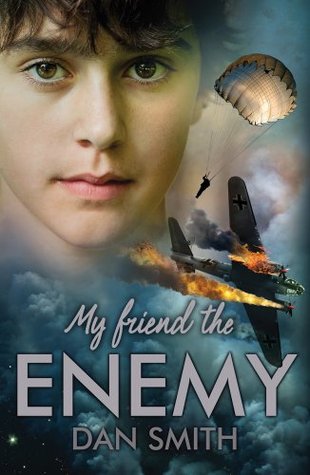
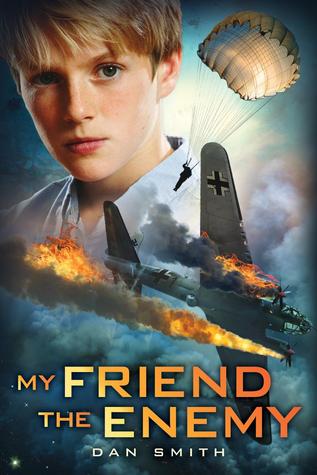
As I was getting the cover image off of Goodreads, I discovered that there were two different versions of the cover. They are practically identical except for one thing: the model. In the version I read (which I put to the right so you can see what I'm talking about), Peter is much younger and fresh-cheeked. In the other cover, which I like better and put next to the synopsis, Peter looks older and more serious. These two different covers are a great illustration of the big quandary with this book: who is the target audience? After a lot of hard thought, I'm still not sure.

You see, the young age of the main characters implies a younger audience, but the honest depiction of scenes such as the crash and the carnage inside the plane make it a bit too much for younger readers. The story line with Erik (the nineteen-year-old injured German they hide in the woods) is a great tale of impossible, forbidden friendship against the odds. I also love the way Smith explores the idea that there is a difference between what war propaganda says about the enemy, and what the enemy is really like. The most obvious example of this is the scene where Peter is comparing the Germans on the war posters to Erik, and he decides that Erik doesn't look anything like a German because he isn't blond and menacing. More subtle messages about the humanity of the enemy are scattered throughout the book, making for a very touching and thought-provoking story.
 But then there's the side story where Peter's father is off at war, and his dad's friend Mr. Bennett hangs out around the house giving Peter's mom presents. Peter wrestles with Mr. Bennett's intentions (which are never really clearly explained) and his mother's reception of this attention throughout the book, and is taunted by the village bullies about this. It's probably subtle enough kids wouldn't understand it unless someone went out of the way to explain it to them (which I definitely don't advise), but that combined with a few gory descriptions keep me from wholeheartedly recommending it to everyone.

What do you think? Have you read My Friend the Enemy, and if so who would you recommend it to?

Note: after writing this review it occurred to me that the brown-haired, older model might not be Peter - maybe he's Erik, instead. Ah, well, my opinion of the book still stands.

09 February 2015

The People of Sparks by Jeanne DuPrau, 2004

Click to view
on Goodreads
"it is green here and very big. Light comes from the sky...."
When Lina and Doon lead their people up from the underground city of Ember, they discover a surface world of color and life. The people of a small village called Sparks agree to help the Emberites, but the villagers have never had to share their world before. Soon differences between the two groups escalate, and it's up to Lina and Doon to find a way to avoid war!

In the riveting sequel to the highly acclaimed The City of Ember, Jeanne DuPrau explores the nature of conflict and the strength and courage necessary to overcome it. 
(338 pages)

This is the sequel to the New York Times bestselling dystopian The City of Ember, which I reviewed here. There are some inevitable spoilers from the first book, so read ahead at your own risk!

Where Ember was a story of setting and plot, this was a story of characters and relationships. The people of Sparks are reluctant to care for four hundred extra people out of their own reserves, and the people of Ember quickly become embittered about the "stinginess" of their unwilling hosts. The book is one long look at conflict: the small things that can spark big wars, and the devastating effects of human anger.

A few times in the book characters talk about the idea that the only way to stop bad events from escalating, is to return good for bad and convince your opponent to stop the cycle of retaliation. This was the idea that stuck with me most strongly when I first read the book many years ago, and it's the idea that once again hits me with the most force. It's a very important message, and one that everyone could take a moment to consider.

Lina and Doon play prominent roles in this book, which makes me happy because I love them. What I particularly love about them is that they don't let their relationship drama consume the story: in fact, I wouldn't even call it "drama." They go through a small rough patch in their friendship, but it doesn't consume the story. They've each got much bigger issues to deal with as Doon struggles to decide what to do/where his loyalties lie during the revolution, and Lina worries about her sick sister and finding a place to live away from Sparks. They spend most of the book apart from each other, both physically and emotionally, but there's none of that "oh no, we'll never be friends again" garbage that authors often throw in to add some tension.

On another note, it's fascinating to see the world a couple centuries after the cataclysmic events ended. People survive by scavenging goods from old deserted cities, the science of electricity long forgotten. It's like a primitive time period from our own past in many respects (the water pumps, the farming for survival, etc.), but it's also futuristic in the most fascinating and kind of depressing way. Roamers, who pick through ruins to find goods to trade for, drive trucks - that's right, trucks - pulled by horses or mules. One woman buys (via trading) an old sink top with hot and cold faucets, because she likes the looks of it and wants to use it as a candleholder. 

It's hard to put this book into words, but it really is a gripping, fascinating, throught-provoking read about the future, the past, the nature of conflict, and the road to peace. If this sounds interesting to you, read The People of Sparks - I promise you won't be disappointed!

Note: click here to read my review of the third book in the series, The Prophet of Yonwood.