31 August 2018

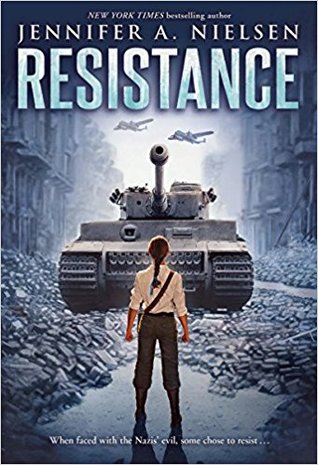
Resistance by Jennifer A. Nielsen, 2018

Click to view
on Goodreads 
Chaya Lindner is a teenager living in Nazi-occupied Poland. Simply being Jewish places her in danger of being killed or sent to the camps. After her little sister is taken away, her younger brother disappears, and her parents all but give up hope, Chaya is determined to make a difference. Using forged papers and her fair features, Chaya becomes a courier and travels between the Jewish ghettos of Poland, smuggling food, papers, and even people.

Soon Chaya joins a resistance cell that runs raids on the Nazis' supplies. But after a mission goes terribly wrong, Chaya's network shatters. She is alone and unsure of where to go, until Esther, a member of her cell, finds her and delivers a message that chills Chaya to her core, and sends her on a journey toward an even larger uprising in the works -- in the Warsaw Ghetto.

Though the Jewish resistance never had much of a chance against the Nazis, they were determined to save as many lives as possible, and to live -- or die -- with honor.

(400 pages)

Wow.

Just, wow. I mean, I've been a fan of Nielsen's for ages, and I adored her East Berlin book A Night Divided, so I knew going in that I was going to love Resistance. But I had no idea how blown away by it I was going to be.

World War II is pretty well-trodden ground by this point, but Nielsen still managed to find an aspect–the Jewish resistance movement–that I didn't know anything about. I never knew that the Jews worked so hard to organize themselves and fight against the Nazis, but they did. They were incredibly brave, risking their lives every day to undermine the war effort, warn the people imprisoned in ghettos about the death camps, and smuggle some out into safe houses.

Chava and her fellow fighters know from day one that they will most likely die for their cause, but they know that they will face death no matter what they do–they want to use their lives to do the most good before they are killed, either for fighting or for being Jewish. It's a horrible situation, the ultimate "rock and a hard place" dilemma, and they are beyond brave for choosing to do what they can to help.

I love how Nielsen doesn't just leave it at that, though. Over the course of Chaya and Esther's journey, they meet lots of different people from all walks of life and religion. They meet some Poles who ignore them, others who attack them for being Jewish, and still others who risk life and limb to help them. They meet some Jews who refuse to fight back out of fear, and some who don't fight out of disbelief, but also some who won't fight because their faith forbids murder–so they fight for the Jewish religion by not taking up arms. Nielsen's focus on these moral nuances, on portraying the various ways people responded to the Nazis without judging them, is a great strength throughout the book.

I realize I haven't really discussed the main characters much yet. It's hard to focus on them when there are so many incredible details about history to pull from Resistance's pages, but Chava is the perfect core to the book. She doesn't see herself as a hero, and she doesn't romanticize anything. She is a very pragmatic person, treating herself almost like an object and calculating how best to use herself for the good of the Jews and downfall of the Nazis. Her initial impatience with/distaste for Esther is completely reasonable, since the younger girl really is pretty useless, but I loved watching them come to understand and respect each other as the story went on. I rooted for both of them, as well as for their cause, though I knew the story couldn't possibly have a picture-perfect happy ending.

I wouldn't recommend Resistance for very young readers, just because the vast majority of the characters in this book either die or expect themselves to die at any moment (and the climax, which is masterfully done by the way, is set in the Warsaw Ghetto during a doomed revolt). There's no bad language or graphic descriptions of the gruesome scenes Chava encounters, though, so as far as books about Polish Jews during WWII goes, this is about as "clean" as it's going to get.

I'm sure it's no surprise when I say that I highly recommend Resistance. I try to always list pros and cons in my reviews, but I literally don't have any cons for this one. It's a wonderfully well-written book, and it gives proper due to the incredible men and women who fought for their people. I hope many children read Resistance and learn the story of these heroes.

Disclaimer: I received a complimentary copy of this novel from the publisher in exchange for an honest review.

27 August 2018

Sons of Blackbird Mountain by Joanne Bischof, 2018

Click to view
on Goodreads 
When Aven Norgaard leaves Norway to serve as housekeeper to her late husband’s cousins in Appalachia, she expects lads in need of care, not three grown men—each in need of a wife and bound by a powerful brotherhood. As the men carve out a living by brewing artisan liquor, young Haakon’s pursuit tempts Aven’s lonely spirit . . . but it is his deaf brother, Thor, whose silent strength shows her the depths of real love.

Unable to speak to any woman, Thor Norgaard never anticipates Aven will befriend him, let alone treat him as her safe harbor. Though hard cider is their livelihood and his greatest talent, he fights his way to sobriety with Haakon’s help, defying the bottle for Aven’s hand—only to face a battle of the heart that tests even the strongest bonds of brotherhood.

(341 pages)

You might think that this is just another cheesy Christian old-timey romance. To a certain extent, you would be right.

But to shove Sons of Blackbird Mountain into the same category as so many of the throw-away novels in that category doesn't really seem fair to it. Because, while I may have been a bit cynical going in, I quickly realized that Bischof has a serious gift for storytelling. Her prose is beautiful and absorbing, and the characters are drawn so well they feel like people you could actually meet in real life.

Perhaps this is because the characters are flawed. And not just the typical "stubborn and quick to righteous anger" flawed, but actually screwed-up people with struggles and challenges. Both Thor and Haakon make big mistakes at different points in the story, and there is no softening or pooh-poohing away the badness of what they do.

Along the same vein, Aven's hard background is laid out for the reader to see: her illegitimate birth in a nobleman's house, her mother's death at a young age, her childhood in a workhouse and her marriage at 17 to a Norwegian stranger who shipped her from Ireland to Norway, her husband's addiction to alcohol, etc. Plus there's an entire storyline about the KKK and their attacks on a black family close to the Norsgaards.

That's not to say that Sons of Blackbird Mountain is a depressing book, though. In fact, if anything, I'd still say it errs on the side of optimism! Thor got away with a lot of bad things when he was an alcoholic, and everyone waved away a lot of things I would have had a very hard time swallowing. I loved that he is deaf, because there are so few books out there with hard-of-hearing characters (and Bischof did an amazing job describing his lifestyle!), but I was a little taken aback by how well he and Aven connected when she literally didn't even understand sign language! Like, seriously.

Overall, though, I really enjoyed reading Sons of Blackbird Mountain even when I had to fight back an eye-roll or two at the most ridiculous plot turns. I loved the characterizations and the way nothing was sugarcoated, and I highly recommend Sons of Blackbird Mountain for those of you who are interested.

I do just have to add a trigger warning for this book, though: there are two scenes where sexual assault is implied (once it is a misunderstanding, the other time it never goes past PG-13).

Disclaimer: I received a complimentary copy of this book in order to participate in a TLC tour.

24 August 2018

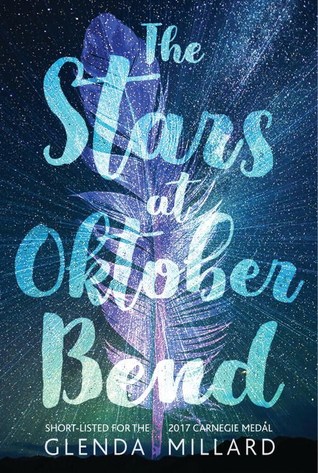
The Stars at Oktober Bend by Glenda Millard, 2018

Click to view
on Goodreads 
i am the girl manny loves. the girl who writes our story in the book of flying. i am alice.

Alice is fifteen, with hair as red as fire and skin as pale as bone. Something inside Alice is broken: she remembers words, but struggles to speak them. Still, Alice knows that words are for sharing, so she pins them to posters in tucked-away places: railway waiting rooms, fish-and-chips shops, quiet corners. Manny is sixteen, with a scar from shoulder to elbow. Something inside Manny is broken, too: he once was a child soldier, forced to do terrible, violent things. But in a new land with people who care for him, Manny explores the small town on foot. And in his pocket, he carries a poem he scooped up, a poem whose words he knows by heart. The relationship between Alice and Manny will be the beginning of love and healing. And for these two young souls, perhaps, that will be good enough.
(288 pages)

I'm struggling to review The Stars at Oktober Bend.

I really don't know what to say. Is it a good book? I think so. Did I personally enjoy it? Not all that much. Can I even remember half of what happens? Nope. Does that make me a bad person? Hopefully not.

Basically, it's the sort of meaningful, lyrical, poignant book that we're all supposed to fall head over heels for. Alice's story is tragic and haunting, and Manny's is equally so.

Or at least, it is once we find out what it is. Unfortunately, so much time is taken up with Alice–her muddled narration, her backstory, her vivid memories and those she blocked out–that there isn't nearly as much focus on Manny. We learn that he was a child soldier, that he is traumatized, and that he quickly falls for Alice. And that's almost all the details we get in the entire book.

Perhaps that is the root of my troubles with the book, my apathy toward their relationship. I cared about Alice, but not so much about Manny because I didn't know him. And besides, I was really just so mad at all the people who did wrong by both of them throughout their lives that I struggled to find much to enjoy.

I genuinely do think this is a good book–it's lyrical and meaningful and poignant, and its exploration of Alice's family dynamics in particular is very well-drawn. But the book and I didn't entirely click. If you're interested (and won't be triggered by mentions of rape), then, by all means, do give it a go. Hopefully you will be able to get more out of it than I did.

Disclaimer: I received a complimentary copy of this novel from the publisher in exchange for an honest review.

20 August 2018

A Defense of Honor by Kristi Ann Hunter, 2018

Click to view
on Goodreads 
When Katherine "Kit" FitzGilbert turned her back on London society more than a decade ago, she determined never to set foot in a ballroom again. But when business takes her to London and she's forced to run for her life, she stumbles upon not only a glamorous ballroom but also Graham, Lord Wharton. What should have been a chance encounter becomes much more as Graham embarks on a search for his friend's missing sister and is convinced Kit knows more about the girl than she's telling.

After meeting Graham, Kit finds herself wishing things could have been different for the first time in her life, but what she wants can't matter. Long ago, she dedicated herself to helping women escape the same scorn that drove her from London and to raising the innocent children caught in the crossfire. But as much as she desperately wishes to tell Graham everything, the risk of revealing the truth may come at too high a price for those she loves.

(376 pages)

This is an odd mix of a book.

For one thing, it's a grim look at the underside of 19th-century highbrow English society, sparing no punches in its depiction of a world where Kit's project–an orphanage and rehab program to help illegitimate mothers impregnated by nobility–is necessary.

From another angle, it's a love story between a woman traumatized by her past and tied down by duty and a man who . . . well, who doesn't have much of a driving force besides a strong friendship for his friend (whose sister has gone missing, most likely into Kit's program) and a penchant for curiosity that brings them together in the first place.

From still another angle, it's a sappy, idealistic book about believing the best in people and about how there are always honorable people out there, even when it seems like everyone is rotten.

I'll be the first to say that I got sucked into the story and enjoyed a few pleasurable hours reading it. But I'll immediately add that that third point quickly began to grate. You can't have a book about abandoned illegitimate children and then try to argue that humans are inherently good. Further, when Kit blackmails these crummy noblemen fathers into paying child support, this is treated like a morally questionable (to downright evil) action. Why?

No, seriously. Why does everyone get so upset about this? These are obviously, by and large, extremely terrible people who will not do what they are obligated to do unless someone holds their feet over the fire. I have absolutely zero issues with Kit threatening to expose their dirt to the world unless they pay paternity (in fact, my only qualm about this arrangement is that this means she is hiding their criminal activity from the world in exchange for child support they should already be providing!).

I was enjoying the book quite a bit until they started bringing this up as a big moral issue, because I just so completely don't agree with the idea that Kit has done anything wrong. The ending is fine enough, though, and the characters are interesting enough (and the children are definitely cute enough!), so I say definitely do give it a try if you'd like.

Disclaimer: I received a complimentary copy of this novel from the publisher in exchange for an honest review. 

17 August 2018

Planet Grief by Monique Polak, 2018

Click to view
on Goodreads 
What a crappy way to spend a weekend. The always-sarcastic Abby would rather be playing soccer, and the cagily quiet Christopher thinks a grief retreat is a waste of time. Neither of them wants to spend two days talking about their feelings. But despite their best efforts to stay aloof, Abby and Christopher are drawn into the lives of the other kids at the retreat. Maybe their stories will make them rethink how they are dealing with their own losses.
(208 pages)

Going in, I was a little nervous that Planet Grief would be too heavy for me. A book about grief counselling doesn't exactly sound like the happiest of summer reads, especially when I already feel antsy thinking about death.

I'm glad I gave in to my curiosity and picked it up, though, because it manages to hit all the right spots. Abby and Christopher are realistic and sympathetic leads, and the other characters in the group are even more interesting and compelling. The various exercises Eugene (the counsellor) has the kids do, and the conversations he supports them through, are fascinating to watch.

Basically, this is a book about kids who have to be strong enough to pull through experiencing something no child should have to face: the death of a close family member. There's no strong plot to pull the book along, though there is a climax, and the story is really driven by the stories of the kids and their struggles. There's no sugar-coating, no skating past the hard emotions of losing a parent or a sibling, and I personally really appreciated "peeking in" on the grief process of these characters.

My only real complaint about the book is that there was one storyline, added just to add drama I think, which I thought was a bit ridiculous and unnecessary. It kind of drew attention away from the core of the book. It wasn't a huge deal, though, and I think Polak handled it in a way that still fit well with the rest of the book. I should also add that there's a family coming to the grief counselling which has two mothers, and there are a few mentions of how unusual it is to have "a maman and a mom." It's not made into a big issue, so I don't think it would bother most readers, but I wanted to mention it just in case.

All in all, I really–well, enjoyed might not be the right word to describe how I felt while reading Planet Grief. I appreciated it, let's say. I liked it. I'm glad that I read it, and I recommend it to anyone who is interested in it.

What other books about children dealing with grief do you recommend? My all-time favorite is Suzanne LaFleur's Love, Aubrey!

Disclaimer: I received a complimentary copy of this book in exchange for an honest review.